Showing posts with label Terrorism. Show all posts

Saturday, January 14, 2012

Panama Ratifies Sentence Against Posada

I first heard this on Radio Mambi during today's noon news program. According to Spanish news agency EFE, the Second Appellate Court in Panama has ratified sentences imposed against Luis Posada Carriles and five other accomplices from 2004. The sentences stem from charges of "threatening public security and falsifying documents" after their arrest in Panama in 2000. This recent ruling paves the way to formally extradite Luis Posada Carriles to Panama. Armando Perez-Roura read the report on Radio Mambi and indicated forthcoming updates on mobilizing the community against the ruling.

Luis Posada was arrested in Panama in 2000 for what looked like another attempt to assassinate Fidel Castro. Posada and five others were found guilty on several charges. In April 2004, Posada was sentenced to eight years in prison for "threatening public security and falsifying documents." But, in August 2004, Posada was pardoned (along with his accomplices) by then-President Mireya Moscoso as she left office. The government of Cuba responded by cutting diplomatic ties with Panama.

The president that followed, Martin Torrijos, sought improved relations with Cuba (he traveled to Havana in 2005 to re-establish diplomatic ties) and his administration also attempted to rectify what it thought were corrupt practices during the Moscoso administration (recent Wikileaks cables described several complaints of bribery to the U.S. embassy).

In 2008, the pardons by Mireya Moscoso were targeted. Those who collaborated with pardoning Luis Posada Carriles were charged for abusing their authority, and in July 2008 Panama's Supreme Court overturned 182 pardons* granted by Moscoso, including Posada's.

This confirmation of Posada's sentence from 2004 opens the door for his possible extradition to Panama. Currently, Venezuela also has an extradition order for Posada related to his alleged involvement in the 1976 bombing of a Cuban civilian airplane, and other investigations related to torture as a Venezuelan intelligence officer. If granted, Panama would become the second country with an extradition order for Posada related to an act of terrorism.

According to the EFE report, Julio Berrios was identified as representing the plaintiffs in this case that confirmed Posada's sentence, and Rogelio Cruz was Posada's lawyer. (In case you didn't know, Berrios is one of Manuel Noriega's lawyers in Panama after Noriega's recent extradition from France.) And, according to Prensa Latina, Berrios will be joined by a grassroots organization called ULIP (Union de Lucha Integral del Pueblo) to file for an extradition order.

*[Wikileaks: Details of Pardon Revocation for Posada and 181 Others]

Monday, December 1, 2008

Freedom for Arocena

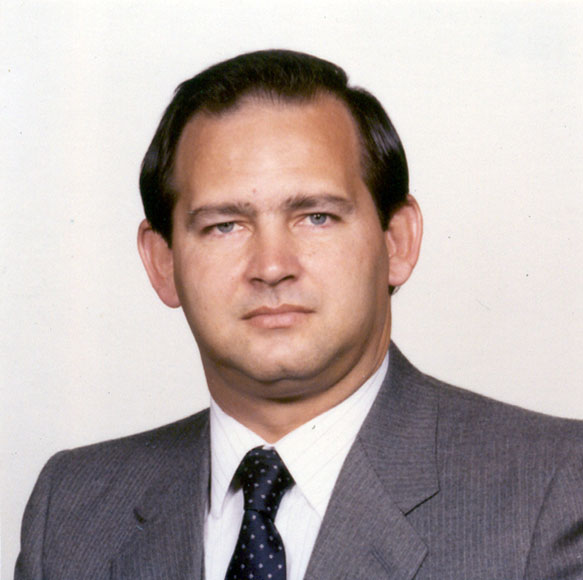
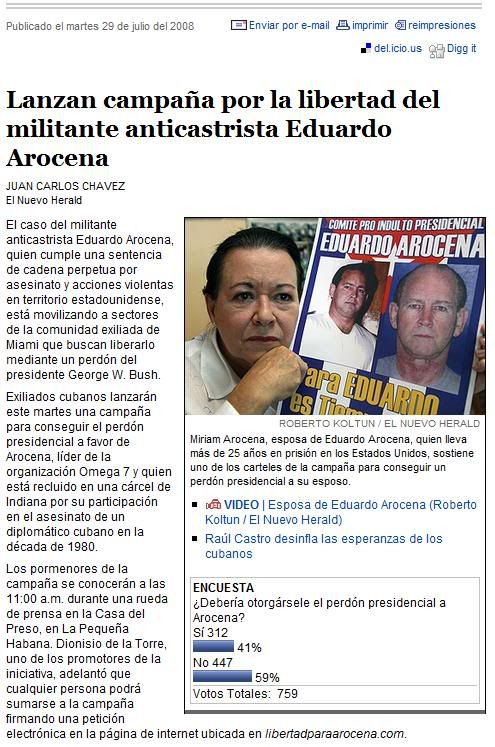
Last week, when Pres. Bush released his list of pardons and commutations, some Cuban exile militants were upset to see that Eduardo Arocena [photo] was not on that list. On Spanish-language radio, some expressed their hope that Arocena would be pardoned by the Thanksgiving holiday, but now some are worried that Arocena might spend the rest of his life behind bars.

It was Friday afternoon, July 22, 1983, when FBI agents arrested Eduardo Arocena on suspicion that he was the leader of a terrorist organization called Omega-7. More than a year later he was found guilty and given a life sentence for several serious charges, including murder. Before being sentenced, Arocena told to the judge:

"[The US government] knows that I am an anti-communist till death and will continue to be until the last days of my existence. More than anything, I shall continue fighting for the liberation of my homeland until the final days of my life. And they won't, nor anyone will, prevent me from continuing to do so...

"[The US government] says I am a terrorist. If fighting for my country, and sacrificing everything the way I have, is to be a terrorist, then I am a terrorist...


"I regret nothing. Your honor, do your duty, for I have done mine
."

This past July marked 25 years since the arrest of Eduardo Arocena, and Cuban militants in Miami believe that he has paid for his crimes and should be released. But, since July, several different arguments have been given to release Arocena from federal prison.

First, it should be noted that the Campaign to Free Eduardo Arocena is NOT seeking a Presidential pardon for Arocena (despite its repeated uses of the word "pardon"), but rather a commutation of his sentence. This is the wording of the official letter that was sent to the Office of the Pardon Attorney.

The use of the word "pardon" (in Spanish "perdon" or "indulto") serves as propaganda for Cuban exile militants to send the message to the public that Arocena's past actions should be officially vindicated by the US government. This is the real motivation behind the campaign, regardless of the hidden fact that Arocena does not qualify for a Presidential pardon.

"Humanitarian reasons" have been argued in asking for a "pardon." But, concerns that Arocena's "health is failing" runs contrary to a 2007 Department of Justice report that says he is in good physical and mental health. Even if his health is truly of concern, it is not mentioned in the official letter to the US Pardon Attorney, nor on the official online petition. And, neither does his wife, Miriam, mention Arocena's failing health in a recent interview with the Miami Herald.

Miriam Arocena has appeared repeatedly on Radio Mambi to speak out for the release of her husband. Her main argument is that Eduardo is imprisoned in the state of Indiana, which is too far from his family in Miami. She has stated that it is very expensive for the family to go visit her husband, and that in the past 25 years she has only seen him 8 times. While this is a reasonable argument to relocate Arocena closer to Miami, I doubt it is sufficient to grant someone a "pardon."

Nevertheless, a commutation of Eduardo Arocena's life sentence is possible in the sole hands of the President. As P.S. Ruckman Jr., expert on executive clemencies, has noted, "[t]here are no rules" when it comes to the power of the President to grant clemency. Arocena can be freed by Christmas if Pres. Bush so decides.

Still, as this administration comes to an end, some militants are growing concerned. Immediately after the release of last week's pardon and commutation list, writers at the militant blog Nuevo Accion wrote:

"Everything indicates that [Pres.] Bush with give one last slap in the face to [us] free Cubans before leaving the White House."

On a more positive note, the Campaign to Free Eduardo Arocena, who is boasting of having sent 60,000 petition letters to the President, also published a response showing confidence that Arocena will receive his "gift" by Christmas:

"We are certain that this will happen, since in his [the President's] hands is the way to reciprocate this community who worked so hard and diligently to make him President on two occasions, and who arduously supported [Senator] McCain until the end. It's time that he reward us with that Christmas gift [for Eduardo Arocena]."

It's shameful to see how some people can easily debase the special powers of the Executive as simple quid pro quo.

Anyway, it should be clear to most readers that Cuban exile militants see Eduardo Arocena as the "patriotic ideal." His "pardon" or release by the President would be exploited by militants in Miami to officially vindicate their belief in violence as a legitimate method in their cause to free Cuba. This would be a harmful message for South Florida, or for any civil society.

While I personally believe that Eduardo Arocena has spent sufficient time in prison, the decision to release him should not come from the sole discretion of the President, but rather from honest "humanitarian reasons." Arocena's release from prison should be part of a larger human rights campaign to address the unfair conditions of the more than 100,000 persons serving life sentences in US jails and prisons, and more than 30,000 of those serving life without parole. [Read 2004 Report, PDF]

This is the humanitarian cause that Arocena's freedom should belong to, and not the militant propaganda that serves to "confront international communism." If Arocena is soon freed, he should be forced to renounce violence publicly. Otherwise, Miami's civil society (whatever remains of it) will suffer an unneccessary setback.

[A recent and excellent article on Eduardo Arocena by Tim Elfrink for the Miami New Times.]

[El Nuevo Herald online poll showing 59% of readers opposed to the release of Eduardo Arocena from prison.]

[Miami Herald editorial from 1985 concerning the imprisonment of Eduardo Arocena.]

Wednesday, November 28, 2007

The Ironies of Miami (Part 3)

In 1992, when Americas Watch released their first report documenting "Attacks on Freedom of Expression in Miami’s Cuban Exile Community" and describing "significant responsibility by the government at all levels, including direct harassment by the government, government support of groups linked to anti-free speech behavior, and a persistent failure to arrest or prosecute those responsible for violent attacks on unpopular speakers," Miami City Mayor Xavier Suarez threatened to sue.

Mayor Suarez found it "defamatory" that Americas Watch reported him calling an FBI-accused terrorist a "freedom fighter."[1] Back in 1983, Eduardo Arocena was a fugitive wanted by the FBI on suspicion of being the leader of the terrorist organization called Omega-7. On July 22, 1983, Arocena was arrested by federal agents and charged with crimes he earlier revealed to FBI agents while cooperating in their investigations the year before. Arocena surrendered peacefully.

On his way to his court hearing, a reporter called out to Arocena: "Why did you do it? Was it for the revolution?" Arocena replied: "Of course... All for the liberation of my country."[2] The FBI adamantly believed Arocena was the leader of Omega-7 and America's most dangerous anti-Castro terrorist. Some in the exile community felt differently. The next day, Miami Herald's Jim McGee quoted Pedro Pablo Rojas, described as head of the Bay of Pigs Veterans Association Brigade 2506, saying: "I feel sorry for him. Anybody who fights Communism has my sympathy... The best Communist is a dead Communist. If that violence is his way to fight, I won't condemn him."[3]

Arocena was eventually charged with several criminal violations and is currently serving a perpetual sentence of about 325 years according to the "Committee to Free Eduardo Arocena," which, as recently as 2004, has been advocating for his transfer to Miami and believes he deserves a Presidential pardon.

Back in 1983, as the Herald came out with several articles revealing the FBI case against Arocena since his arrest in July, Mayor Suarez was still convinced by October that the FBI had arrested a "freedom fighter."

On October 16, 1983, the Herald's Jim McGee wrote an article called "How Terrorism Sways Miami's Politicians." It was a daring piece that showed how some of Miami's political leaders at the time gave legitimacy to suspected terrorists. In the article, Mayor Suarez comes out sounding very similar to Pedro Pablo Rojas:

Suarez said he preferred to describe someone like Eduardo Arocena, the alleged leader of Omega 7, as a "freedom fighter," not a terrorist. "There is a great deal of reluctance to say, 'I condemn your tactics'" Suarez said.

[1] Miami Herald, August 19, 1992, "Prove Report in Error, Rights Group Says" by Alfonso Chardy.
[2]Miami Herald, July 23, 1983, "FBI Agents Arrest Omega 7 'Mastermind'" by Jim McGee and Bob Lowe.
[3]Miami Herald, July 24, 1983, "Arocena 'Armory' Uncovered FBI: Apartment a 'Bomb Factory'" by Jim McGee.

[Photo of Eduardo Arocena, courtesy of Latinamericanstudies.org]

[Conclusion]

Saturday, November 3, 2007

A "Slim Line"

This week's Miami New Times lends support to speculation of Luis Posada Carriles' whereabouts: The Big Five Club in Miami.

Reporter Janine Zeitlin recounts her recent visit to the Big Five Club where Posada Carriles was scheduled to appear as the guest of honor to an art show. Posada Carriles is himself a steady painter of landscapes and portraits related to Cuban history, and had work shown. He appears to be quite good, and obviously very popular among some Cuban exiles.

The Big Five Club itself has a long Cuban history. It's name is a memorial to the old elite social clubs from Havana: the Biltmore Yacht and Country Club, Havana Yacht Club, Miramar Yacht Club, Vedado Tennis Club and Casino Español. According to a 1991 article, "[s]entiment for a touch of pre-Castro Havana and a desire to perpetuate the old social order were the motivating forces and glue behind the creation of the Big Five Club back in the 1960's, when the exile community reluctantly confronted the harsh reality that Castro could not be easily dislodged." An art show featuring Luis Posada Carriles and José Dionisio Suarez Esquivel is but another memorial to Cuban freedom fighters and desires to return to a Cuba free of the Castro regime.

The New Times article also features Enrique Encinosa, who has publicly stated that he supports terrorist methods to bring freedom to Cuba. This week on Radio Mambi, reporting on the recent death of Paul Warfield Tibbets Jr, the pilot who dropped the atomic bomb on Hiroshima, Encinosa described the atrocity as an act of US terrorism. But, gave the impression that it may have been justified. Zeitlin quotes Encinosa describing Posada Carriles:

"[P]eople who think he's a murderer and horrible terrorist are not going to like anything that he does... People who know him know he fights for freedom. He's a talented man with a sensitivity in his heart."

Another attendee to the art show says that Posada "is not a terrorist, but a great patriot... There's a slim line."

This "slim line" may reveal a moral dilemma. Even heroes of the American Revolution have committed acts that we can describe as acts of terrorism. Take George Washington, our first American president, for example.

In 2005, the book Year of the Hangman: George Washington's Campaign Against the Iroquois described another controversial moment in early American history. As the British army began their advance against American rebels around 1777 they also sought the recruitment of American Natives, such as the Iroquois who feared American expansionism. General Washington and his Continental Army was swift in targeting the Iroquois who were increasingly joining the British army. Washington's strategy called for the "total destruction and devastation" of Iroquois villages in the north around New York. According to the historical documents, Gen. Washington sought nothing but terror and violence upon the villages, and in exchange deplete the man power and other important resources the British army depended on. The author of Year of the Hangman argues that this strategic act was a crucial element in America's victory over the British.

Was Washington a freedom fighter, or terrorist? In my personal opinion, there's really no slim line, whether it be Posada Carriles or Washington. I don't see how extreme acts of violence that target civilians can be ever be justified, unless of course our moral principles are already inclined on messianism, or emotional calls for amorphous constructs like "freedom."

Thursday, August 16, 2007

Related News about Luis Posada Carriles

IN MIAMI

Radio Mambi is, of course, reporting the recent release of Osvaldo Mitat, who was arrested in 2005, along with Santiago Alvarez, for possession of illegal weapons. Both also had suspected ties to Luis Posada Carriles.

In November 2005, after a federal raid of a Broward County apartment complex owned by Alvarez, ATF agents found "
a thousand rounds of ammunition," several automatic weapons and explosives. According to the Miami Herald, "Judge Andrea Simonton refused to release the pair because their mere possession of automatic weapons, grenades and rounds of ammunition amounted to a 'crime of violence' and posed a danger to the community."

According to the arrest affidavit: "Following his arrest, Mitat made a spontaneous statement to a uniformed police officer... He told the officer... 'Unfortunately, you guys are doing your jobs and we got caught with a bunch of guns. I love the United States and would never do anything to hurt this country. These guns were not meant to be used against this country."*

Mitat and Alvarez were eventually sentenced to serve 37 and 46 month in prison respectively, but their sentences were then reduced two months ago after more illegal weapons were surrendered to the federal authorities. The June arms surrender included "over 14 pounds of plastic explosives, 200 pounds of dynamite, 4,000 feet of detonator cord, 30 semiautomatic and automatic weapons, one grenade launcher, and two handmade grenades, among other items." According to one report, it was "several grenades."

A related story also revealed that the US Coast Guard found weapons in the Bahamas connected to Alvarez. "Documents say Santiago Alvarez allegedly helped plan and pay for an 'armed incursion' in 2001 against the Cuban government."

Today, Armando Perez-Roura said that all the weapons found were aimed "para combatir ese régimen" (to combat that regime). Ziva from Babalu Blog believes Mitat and Alvarez were "brave patriots" who were furthering the "declared goal of spreading democracy."

Santiago Alvarez is scheduled to be released by the end of this year.


IN PANAMA

Cuban news outlets are reporting that "three officials includ[ing] ex Minister of Government and Justice Arnulfo Escalona, ex National Police Director Carlos Bares and ex assistant director of Migration Javier Tapia" are being charged in Panama "for breaking the law in releasing international terrorist of Cuban origin Luis Posada Carriles [in 2004]." Specifically, charges of "abuse of authority."

Luis Posada Carriles and three other men were pardoned in 2004 by Panamanian President
Mireya Moscoso (who now has a home in Key Biscayne, Florida). She believed that "if they stayed [in Panama], they would be extradited to Cuba and Venezuela, and there they were surely going to kill them there." Posada was serving a sentence in connection to a thwarted assassination plot against Fidel Castro in 2000. The US denies having any influence over President Moscoso's decision. But in Panama, "speculation was rampant that the Bush administration, indirectly or not, had pressured [the] Panamanian President." The current President of Panama, Martin Torrijos, at the time "said he disagrees with the pardons."

Cuban American National Foundation President, Francisco Hernandez, said that the 2004 pardon was "a victory for all those in exile, and a triumph of justice, beyond the strategy adopted to bring democracy to Cuba."

[*]Miami Herald, November 22, 2005, "Posada Allies Denied Release" by Oscar Corral and Jay Weaver.

Tuesday, July 17, 2007

No Defense for Terror (Part 13)

Of course, it would never dawn on Humberto Fontova to re-examine the "overwhelming, authoritative, and conclusive" findings of the Royal Armament Research and Development Establishment (RARDE) done 30 years ago. How can the "most authoritative source on earth for investigations of this kind" be wrong?

What Fontova's blind faith fails to consider is that RARDE at the time had a history of "lies and deceit" documented well in high profile cases that occurred in the 70's, and that the forensic tests used at the time have been found to provide incomplete and inaccurate results.

In a 1993 conference paper [PDF] provided to the
Australian Institute of Criminology ("Australia's pre-eminent national crime and criminal justice research agency"), Beverley Schurr summarized these "miscarriages of justice" by RARDE scientists.

She documents four high profile cases (The Birmingham 6, Guildford 4, Maguire 7, and Judith Ward) from 1973 to 1974, of which all guilty verdicts were eventually annulled by 1992 due to revelations "that the forensic scientists had failed to disclose relevant material favourable to the defence, that they gave evidence which was contradicted by some of their own test results and that their partiality affected all of the evidence that they gave."

Schurr focuses on two of the cases (The Maguire 7 and Judith Ward) that involved RARDE scientists (Mr. Elliott and Mr. Higgs) and how it was "found that they lied and suppressed evidence at the trials" and failed to disclose additional results of their forensic tests looking for traces of nitroglycerine.

Fontova writes that RARDE had "found traces of nitroglycerine, a component of commercial dynamite" in their forensic investigation of the 1976 Cubana flight bombing.

But, Schurr documents how in 1974 it was discovered that "the RARDE test was not exclusive for nitroglycerine" and that negative results were also withheld by the RARDE scientists and possibilities of contamination dismissed. And, this was only for one case.

In another (Judith Ward case), the RARDE scientists "suppressed evidence, wrote a misleading report, told deliberate falsehoods... overstated some test results, lied to a defence expert witness about the test results, went outside test guidelines to record a 'positive' test result" and committed other deceptions.

In the 1981 interview [PDF] with RESUMEN, Carlos Fabbri states that the flotsam examined by RARDE in 1976 was underwater for at least 16 hours and tests showed "strong" indications for nitroglycerine. Its important to note that Fabbri himself did not conduct the chemical tests for nitroglycerine. And, RARDE was found in 1974 of overstating and lying about their nitroglycerine results. But, more importantly to us, the RARDE scientists lied "that there was no other substance which could mimic nitroglycerine results" when in fact they knew that "dyes in shoe polishes and other commodities could produce a positive [Thin Layer Chromatography] test result."

Just like Fabbri, a RARDE scientist (in the Maguire 7 case) boasted of "
a reasonably high level" of nitroglycerine results, when in fact an independent inquiry later found that his confirmatory tests were negative.

In fact, the recovery process for nitroglycerine was still being perfected in the 80's, even by RARDE scientists.

The acquittals and annulments of these high profile cases renewed investigations into the effectiveness of Thin Layer Chromatography in the 70's. It also further deteriorated the public's faith in the criminal justice system, the majority of whom believed the future was still grim.

It serves Humberto Fontova's defense to present RARDE as "
the most authoritative source on earth" in the case of Luis Posada Carriles, and leave readers ignorant of the realities about forensic science and RARDE's questionable history. In my opinion, Fontova is another propagandist, like Enrique Encinosa, at the service of Luis Posada Carriles.

I ask myself why. My best guess is that Luis Posada Carriles still represents the archetypal hero to some Cuban exiles, and thus his noble identity becomes an essential and necessary ingredient to the personal collective identity one wants to present: made of honor and sacrifice. And, thus must be defended at all costs, even at the expense of the facts.

Sure, we all need heroes to look up to and memorialize, to strengthen our cultural values with, but we also need to re-examine where our cultural values stand in this world.

Otherwise, how will we know when new heroes stand up to the world.

[Part 1]

Wednesday, July 11, 2007

No Defense for Terror (Part 11)

Reporter Ann Louise Bardach, who has interviewed Luis Posada Carriles extensively, mentioned the lack of evidence at Posada's first trial in an interview on Democracy Now! (October 10, 2006):

"... almost all the evidence was ruled inadmissible. It was really stunning. All the police reports from Trinidad, the confessions of Ricardo and Lugo, all the reports out of Barbados, every shred of evidence that was extraordinarily compelling was ruled inadmissible on of the grounds of, guess what? They said, 'Well, the interviews were done in an English-speaking country,' even though there were, you know, certified Spanish language translators involved at all times. So they threw out the file -- so there was no evidence. So once you got a judge to declare it inadmissible, what was there to try Bosch [or Posada] on? So, not surprisingly, he did win an acquittal. And I found that one of the more interesting points, because you hear this endlessly in Miami, how he won an acquittal."

But, let's examine the evidence that was left to the judge, and supported by Fontova.

----------

THE ROYAL ARMAMENT RESEARCH AND DEVELOPMENT ESTABLISHMENT

So, some of you might be asking: but didn't Ricardo Morales Navarrete confess to the 1976 bombing? And, thus, Fontova (or Posada) isn't totally wrong to blame Morales, right?

Correct, Fontova is partially right to blame Morales, but the evidence he provides doesn't add up.

The centerpiece to Fontova's defense lies with the examination of the forensic evidence by the Royal Armament Research and Development Establishment (RARDE). RARDE was part of several defense establishments in the UK , which in 1991 together became the Defence Research Agency, and has gone through many changes over the years.

RARDE provided the results of their scientific examination of the Cubana flight wreckage (what was found floating) to the Venezuelan courts. According to Jay Ducassi*, reporting for the Herald, the "controversial 1980 verdict that acquitted Miami Cuban militant Orlando Bosch in one of history's most deadly plane bombings was strongly influenced by a British expert's investigation of the explosion."

The British expert in question was an aeronautics engineer named Erick Newton who was an investigator of aerial accidents for the British Royal Air Force. A man who definitely seems qualified (with 33 years of experience in this department) to investigate the Cubana flight bombing. But, it is not known how many bombing investigations he has done in all his years, unless bombings are frequent in the Royal Air Force.

But, what Fontova forgets to mention (also Ducassi) is the fact that Newton was not alone in his investigations, he had help. And how odd that his help came from a former subordinate of Luis Posada Carriles when Posada worked for the Venezuelan intelligence agency DISIP.

Carlos Fabbri was chief of DISIP's Explosives Department under Posada for two years, and an expert in the field of explosives (with an impressive resume). In a 1980 interview with a publication called ELITE, Fabbri said that he knew Posada was his boss, but only knew him by sight and never met him.

According to a declassified FBI document, a "confidential source who has furnished reliable information in the past" said that "Fabri [sic] and Posada Carriles are good friends and that [both] had actually been arrested a couple of years ago by Venezuelan authorities after it was learned they provided false documentation and explosives to Dr. Orlando Bosch Avila in Venezuela at that time."

*[The Miami Herald, May 15, 1983, "Bosch's Acquittal Hinged on British Expert's Views" by Jay Ducassi.]

[Part 12]

No Defense for Terror (Part 10)

In the first version of Fontova's article he writes:

"The 'Cuban-American crackpot!' (Posada defense lawyers') version has the explosive device planted in the baggage compartment of the plane at the instigation of a Castro double-agent named Ricardo Morales Navarette [sic] while on a previous stop in Guyana."

Fontova then adds that the forensic evidence at Posada's trial supports this theory. He's correct about the support from the forensic evidence, but the theory blaming Ricardo Morales Navarrete comes from only ONE source: Luis Posada Carriles. According to Posada's book, Los Caminos del Guerrero (Paths of the Warrior), in Chapter 13 Posada recalls the day that Ricardo Morales privately confessed to him, with tears in Morales' eyes of course, and a repentant embrace.

According to Luis Posada Carriles, before Ricardo Morales confessed he made sure to scan the room for hidden microphones. How lucky for Morales and Posada. Also, remember that Posada has his secret double-agent from Cuba alleging that Morales planned the bombing with Cuban agents, described by Posada in Chapter 11.

Hardly credible evidence for any honest person to believe, but of course we are talking about everyone's favorite columnist Humberto Fontova who has taken the bait, and its all downhill from here.

----------

"OVERWHELMING, AUTHORITATIVE, AND CONCLUSIVE" EVIDENCE

According to Fontova, Judge
José Moros González obviously had the best evidence at hand to acquit Luis Posada Carriles. Not only did the judge acquit Posada in 1980, but also Freddy Lugo and Hernan Ricardo, both of whom were later charged and found guilty in 1986 after the annulment of this case.

So, why were Freddy Lugo and Hernan Ricardo found guilty later? Easy, the decision in 1980 left out evidence that was later admitted to the decision of 1986. According to Jay Ducassi from the Miami Herald*, the first court had ruled important evidence as inadmissible:

- Statements by [Freddy] Lugo to police in Trinidad that he believed [Hernan] Ricardo had placed the bomb in the airplane bathroom.

- A statement by Lugo to Venezuelan intelligence officials that Ricardo boasted of the bombing during a flight back to Trinidad.

- Statements from Barbados police that [Hernan] Ricardo had called Orlando Bosch after the bombing. Referring to the call, Lugo said Bosch 'was the chief who gave Hernan instructions to place the bomb,' according to the police.

- Ricardo's alleged confession to Trinidad deputy police chief Dennis Ramdwar. 'He said that he was telling me this in the greatest confidence, that Lugo and he had put the bomb in the plane,' Ramdwar testified.

- Ramdwar's statement that Ricardo said he phoned Bosch from Barbados to report on the bombing.

Those confessions and statements can be found at the National Security Archive. From the confession by Freddy Lugo [PDF], and the sworn statement [PDF] by the Chief of Police in Barbados, to the confession [PDF] that implicates Bosch and Posada.

But, of course, this isn't important to Humberto Fontova. He demands hard evidence, unless it comes from Luis Posada Carriles of course.

*[The Miami Herald, May 15, 1983, "Bosch's Acquittal Hinged on British Expert's Views" by Jay Ducassi.]

[Part 11]

Wednesday, July 4, 2007

No Defense for Terror (Part 8)

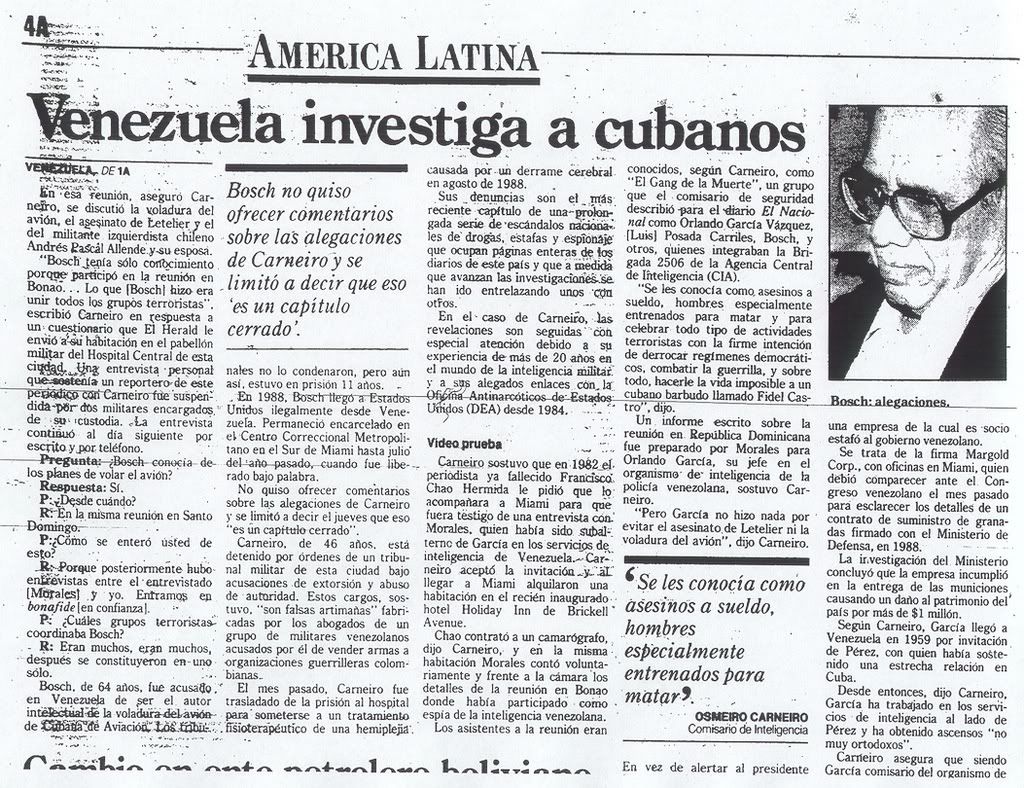
"Carneiro assures that [Orlando] Garcia, being the Commissioner of the police intelligence agency of Venezuela, ordered one of his subordinates to give Cuban-Venezuelan police officer* [Luis] Posada Carriles the C-4 explosives which blew up the [Cubana] plane."[1]

*[Luis Posada Carriles was at the time a private investigator who was a former chief of Venezuela's civilian security police DISIP (Dirección de los Servicios de Inteligencia y Prevención).]

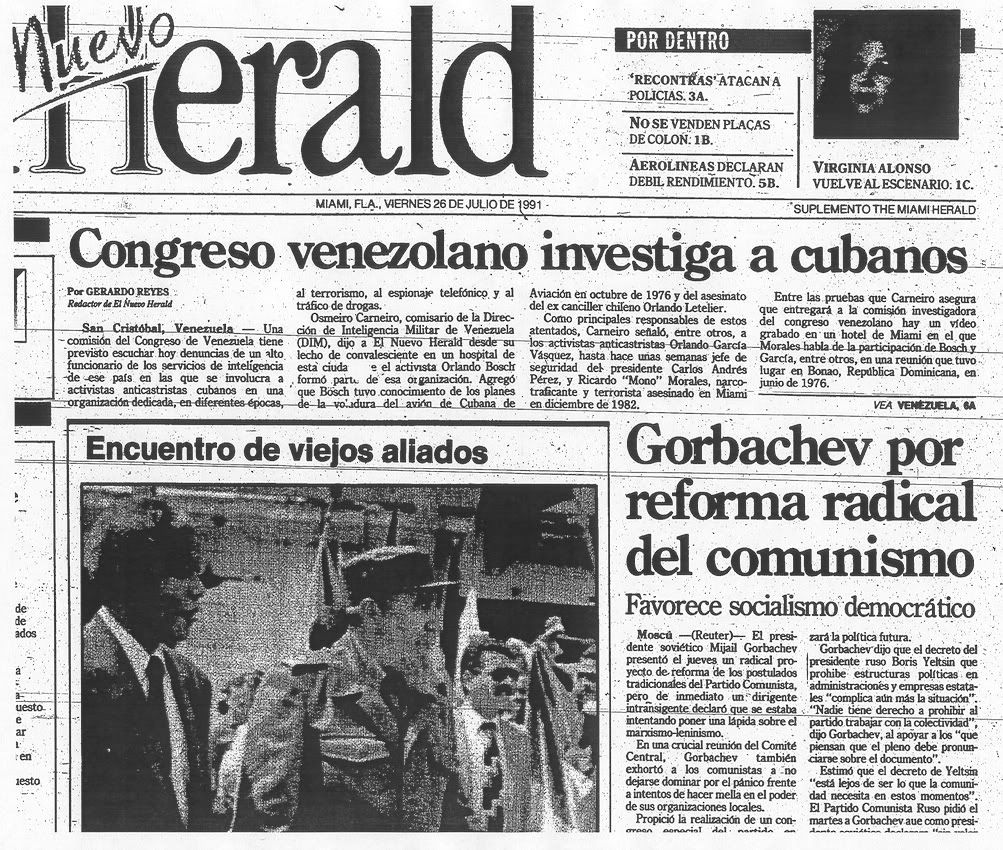
This is what El Nuevo Herald reporter Gerardo Reyes wrote in his July 26, 1991 article about his interview with Osmeiro Carneiro. A story that Enrique Encinosa has erased from memory.

Carneiro's allegations, like Diosdado Diaz's, are based on confessions by Ricardo "El Mono" Morales from another interview which was video-taped by reporter Francisco Chao Hermida.

Carneiro recounts to Gerardo Reyes that "in 1982, the late journalist Francisco Chao Hermida asked [Carneiro] to accompany him to Miami and be a witness to an interview with Morales." According to Carneiro, both men travelled to Miami and stayed in a newly inaugurated Holiday Inn on Brickell Avenue where they interviewed Morales on camera. It was there, according to Carneiro, that Morales confessed about the conspirators of the 1976 bombing, which included Orlando Bosch, Luis Posada Carriles and Orlando Garcia. The three of whom where members of what Carneiro and others knew at the time as the "Gang of Death." But, there is controversy within the confessions to Osmeiro Carneiro and Diosdado Diaz.

According to Luis Posada Carriles, from his book Los Caminos del Guerrero (Chapter 13), Francisco Chao Hermida came back from his Miami interview saying that Ricardo Morales "has recounted interesting things about the bombing of the Cuban airplane and that [Morales] is prepared to tell them to [Posada's] lawyers." One of Posada's lawyers, Raymond Aguiar, immediately flies to Miami and conducts another video interview with Ricardo "El Mono" Morales where he repeats what he supposedly told Francisco Chao Hermida.

According to Luis Posada Carriles, Morales confessed to knowing that the bomb on the Cubana flight was initially placed in Guyana; that the bomb was made of dynamite placed in the baggage compartment of the plane; and that the bomb was originally timed to kill everyone including Hernan Ricardo and Freddy Lugo before they stepped off the plane in Barbados. The motivations for this plan were not revealed.

The contradictions begin here.

- El Nuevo Herald (Alfonso Chardy and Oscar Corral) viewed the 1982 Morales video-taped interview with Francisco Chao Hermida and reported in May 9, 2005 that "El Mono" Morales pointed to Gustavo Castillo, instead of Luis Posada Carriles, as the one who prepared the bomb for the Cubana flight. This contradicts the confessions to Detective Diosdado Diaz and the recollections of Osmeiro Carneiro, both of whom heard that Luis Posada Carriles was involved.

- Morales' confession of the use of dynamite contradicts sworn statements in Operation Tick-Talks of the use of C-4 to blow up the Cubana flight. C-4 being the most popular explosive used for such operations, and involved with prior usage by Luis Posada Carriles and Ricardo Morales.

But, there are ways to make sense of all this.

1) You can believe Detective Diosdado Diaz, who is a more than 20-year veteran officer in Miami, and Osmeiro Carneiro, who was also a more than 20-year veteran of Venezuelan military intelligence, when they say that Luis Posada Carriles was definitely involved in the 1976 bombing (which also supports the declassified evidence and other allegations involving Orlando Garcia), or...

2) You can believe Luis Posada Carriles' secret double-agent who told him that Cuban agents paid Ricardo "El Mono" Morales Navarrete $18,000 to kill 73 innocent people just to continue smearing Miami Cuban exiles and momentarily justify internal Cuban government repression, or...

3) You can dismiss ALL the testimony and alleged confessions by Ricardo "El Mono" Morales, and then realize that ALL the defenders of Luis Posada Carriles (Encinosa, Byrne, Fontova and others) have been deceiving you.

Notice that the final scenario has no defense for the declassified documents on the 1976 bombing (excluding those using Ricardo Morales as a source), and the 1997 bombing campaign against Cuban hotels which is currently being investigated by the FBI, and has Luis Posada Carriles as a prime suspect.

It's up to you to decide.

In my opinion, the defense of Luis Posada Carriles by those mentioned above is nothing more than an exercise in propaganda. Enrique Encinosa, for more than 10 years, has repeated lies about Osmeiro Carneiro and Ricardo Morales. From his 1994 book, Cuba en Guerra (p.280-283), to his 2004 book, Unvanquished (p.124-126), Encinosa has used the July 15, 1991 Osmeiro Carneiro news brief and Luis Posada's book as his only two sources.

Currently, Enrique Encinosa is the news editor at Radio Mambi.

But, there are other important defenders for Luis Posada Carriles.

Humberto Fontova and Robert Alonso.

[1] El Nuevo Herald, July 26, 1991, "Congreso Venezolano Investiga a Cubanos" by Gerardo Reyes.

[Part 9]

No Defense for Terror (Part 7)

So what did Ricardo "El Mono" Morales Navarrete say in a Florida courtroom? Well, it wasn't exactly a courtroom, but instead an office.

Beginning in 1980, Morales had become a state informant for a Miami narcotics investigation called Operation Tick-Talks which eventually led to 53 arrests. Among those arrested were "veteran dealers, respected business people and the politically well-connected."[1]

For three weeks in 1982, Morales testified under oath to "two attempted murders, gangland bombings, political terrorism, narcotics dealing and a role in the destruction of an airliner in which 73 persons died."[2]

"In a ninth-floor office in the Metro Justice Building, Morales was questioned under oath by [Attorneys] Douglas Williams, Ed Carhart and Kirk Munroe for more than three weeks, with Williams asking most of the questions. Lasting more than 75 hours, the sessions produced nearly 1,000 pages of transcripts."[2]

What is important to us is what exactly Ricardo Morales confessed to concerning the 1976 bombing.

"Morales said he helped provide anti-Castro terrorists with the explosive for the bomb."[2]

According to deposition copies found here and here, Morales says he was "part of the conspirators." Specifically, "surveillance of the regular flights of that Cuban Air Force plane*, providing by a third party the explosives."

*[Morales believed that the Cubana airplane was a Cuban Air Force plane in disguise.]

But, there's more that Morales allegedly confessed to.

According to a El Nuevo Herald article from May 9, 2005, the lead detective of Operation Tick-Talks, Diosdado Diaz, said that Morales "stated to him in 1982 that [Morales] supplied the explosives and that [Luis Posada Carriles] prepped them to bring down the plane."

Diosdado Diaz at the time was a veteran to the Special Investigations Section in Miami, the city's anti-terrorism agency. In 1981 he had been selected as December's Officer of the Month.

Before Ricardo Morales was extensively questioned by attorney Douglas Williams, Diosdado Diaz had already questioned Morales. "Douglas Williams recalls that it was the detective [Diosdado Diaz] who confirmed for him in a lengthy deposition that Morales, as chief of counterespionage for Venezuela, had played a role in the Cubana Airlines bombing."[1]

It is in this deposition that Morales claims Luis Posada was involved in the 1976 bombing. Unfortunately, according to the 2005 Herald article, "Diaz says he wrote a report for the Miami police on Morales' confession, but the record could not be found."

How fortunate for Luis Posada Carriles.

But, there is ANOTHER person who also says that Ricardo "El Mono" Morales confessed to Posada's involvement in the '76 bombing.

Osmeiro Carneiro.

[1]The Miami Herald, October 3, 1982, "Errors Lead to Tick-Talks Toss-Out" by Eric Reider.

[2]The Miami Herald, June 1, 1982, "Terrorist Admits Bombings and Two Attempted Murders" by John Katzenbach.

[Part 8]

Tuesday, July 3, 2007

No Defense for Terror (Part 6)

EL MONO

According to Enrique Encinosa's latest book, Unvanquished: Cuba's Resistance to Fidel Castro, "[a] key player in the [1976 Cubana flight bombing] was Ricardo (Monkey) Morales"(p.124). According to Hugo J. Byrne, another defender of Luis Posada Carriles, Ricardo Morales was the "central figure" in the 1976 bombing. Also, everybody's favorite columnist, Humberto Fontova, believes that Ricardo Morales is the confessed terrorist of 1976, which absolves Luis Posada Carriles by default.

ALL the defenses that I have read so far claiming innocence for Luis Posada Carriles have blamed the notorious Ricardo "El Mono" (the Monkey) Morales Navarrete. In my opinion, it is one of the most successful propaganda exercises to vindicate Luis Posada Carriles of the bombing in 1976. But, if one actually READS what Morales Navarrete confessed to, you will see that Orlando Bosch and Luis Posada Carriles are not innocent at all. Let's review the facts.

"According to testimony under oath by Morales Navarrete, the Castro conspiracy originated in Mexico... [where] Morales Navarrete met with Castro agents of the DGI [General Intelligence Directorate] who gave him $18,000 and summarized a plan to blow up a Cuban airplane and destroy Orlando Bosch and Luis Posada Carriles, who would be blamed for the attack."

This is the premise of Enrique Encinosa's theory that places "El Mono" Morales at the center of a Cuban government conspiracy designed to "accuse [Miami] exiles [for the 1976 bombing] and defend itself from accusations of systematic violations of human rights." But, Encinosa is lying again. Ricardo Morales Navarrete never made such statements under oath. These are allegations made by Luis Posada Carriles himself.

In 1994, Luis Posada Carriles wrote a book titled "Los Caminos del Guerrero" (Paths of the Warrior). One of the book's main goals was to let Posada tell HIS side of the story when he was arrested in 1976 for the bombing of the Cubana flight, and recount the events that occured afterward. In Chapter 11, Posada provides HIS theory on who really committed the bombing. Its the same theory that Encinosa provides in La Verdad sobre Posada.

According to Posada, the theory blaming "El Mono" Morales is based on three sources:

- Interviews with Ricardo "El Mono" Morales by Posada's former lawyer, Raymond Aguiar, and by journalist Francisco Chao Hermida, on different occasions.

- Posada's own interview with a secret double-agent inside the Cuban government and allegedly involved in the 1976 bombing.

- Independent investigations of the '76 bombing that where financed by Posada's lawyers.

If you notice, Posada never mentions that his theory is based on the sworn testimony of Ricardo Morales in a Florida court. That's because Morales never said it.

The theory stating that Ricardo "El Mono" Morales received payment from Cuban agents to blow up the Cubana flight originates from Posada's secret double-agent, NOT Morales.

In a Miami Herald interview with Posada, dated May 17, 2005, Luis Posada Carriles specifically tells the Herald that "a spy inside the Cuban Embassy in Caracas told him that Morales had been working for the Cuban government after its agents paid him $18,000 at a Mexico City hotel in early 1976."

Of course, there is no way to verify if this theory is true. How convenient that Posada's double-agent is still undercover.

However, its clear that Luis Posada Carriles never mentions that his theory is based on the sworn testimony of Ricardo Morales in a Florida court as Enrique Encinosa suggests. Yet again, Encinosa is lying.

[Part 7]

Thursday, June 28, 2007

No Defense for Terror (Part 5)

The testimony and allegations by Osmeiro Carneiro are very fascinating (beyond the fallacies Enrique Encinosa presents) because he talks about his involvement in the famous interview between Ricardo "El Mono" Morales Navarrete and Francisco Chao Hermida in 1982, and also names Orlando Garcia Vasquez as a conspirator in the 1976 bombing. At the time, Orlando Garcia was a Venezuelan intelligence director and security adviser for the president, Carlos Andrés Pérez. Those who have read the declassified documents on Luis Posada Carriles will recognize the name Orlando Garcia Vasquez because his name appears on some of the documents, notably on one as the official assigned to "protect and assist" Orlando Bosch while he was in Venezuela in 1976.

The names, Orlando Garcia Vasquez and Osmeiro Carneiro, will reappear in the following posts.

----------

THE 1992 FBI "REPORT"

Before I get to Encinosa's statements on Ricardo Morales Navarrete, I wanted to quickly examine the FBI report that "declares" Luis Posada Carriles as "not involved" in the 1976 bombing.

Enrique Encinosa mentions a February 3, 1992 FBI report declaring "that Posada was not involved in the [1976] Barbados assault." Encinosa accurately mentions the date of the investigation and one of its authors: Special Agent Michael S. Foster. But, this FBI report is not really a report, but instead a deposition investigating Posada's involvement in the resupply operations of Contras in 1985 and '86 . It also had two investigators, Foster and Special Agent George R. Kiszynski. This FBI deposition has been declassified, and is posted on the National Security Archive website. You can read it here.

If you read all 31-pages, you will notice that the overwhelming majority of the topics discussed concern Posada's involvement with the Contras in El Salvador, not his involvement in the bombing of 1976, or other events. Also, this is not an FBI report that investigates or examines facts, or makes suggestions or recommendations. It is a simple FBI interview that does not corroborate or add information, but merely repeats what Posada says.

Its very convenient for Enrique Encinosa to present this FBI document as a "report" because it lends credibility to his defense. But, in this case, the FBI is not declaring anything. The substance of the transcript begins with the statement "Posada then advised as follows:" From that point, until the final page, Posada's statements are mainly referred to in the third person (e.g., "As far as Posada knows" or "As best as Posada can estimate"). Only in the final four pages does the discussion begin to deviate from the involvement with the Contras, and the bombing of 1976 mentioned. On page 30, the investigators write:

"Posada was not responsible for the downing of the Cuban airliner, as he was accused. Posada was involved in the armed struggle against Castro, but he was not responsible for blowing up the Cuban airliner in 1976."

This statement follows comments to the FBI investigators revealing that "Posada would like to come to the United States eventually. He is tired and wants to move on with his life."

These are not declarations by the FBI as Encinosa suggests.

[Part 6]

Wednesday, June 27, 2007

No Defense for Terror (Part 4)

Still, some would say that Luis Posada Carriles was at least acquitted ONCE, and that this must prove his innocence. This is not entirely true. And, there are specific issues about that case that one should examine and consider. I will get into some of the specifics of that case when I analyze the defense of Luis Posada Carriles by everybody's favorite columnist Humberto Fontova. But now let's continue examining the merits of Enrique Encinosa's Truth about Luis Posada.

----------

OSMEIRO CARNEIRO

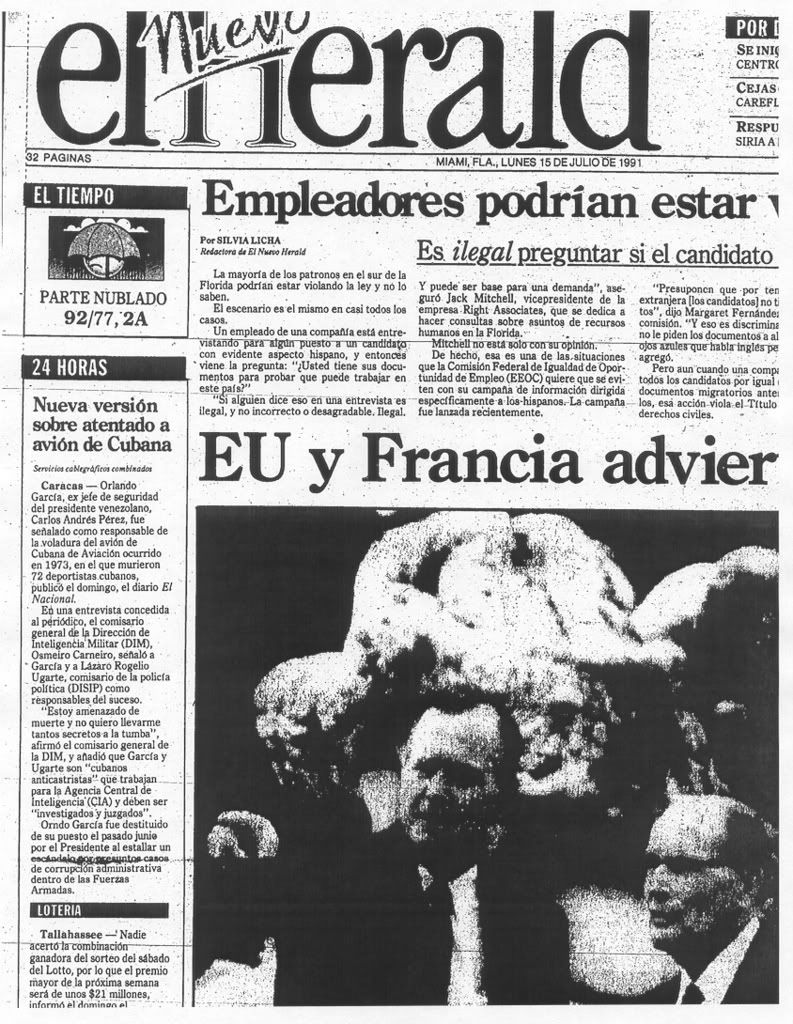
"El testimonio más interesante en las teorías de conspiración proviene de Osmeiro Carneiro."

Encinosa writes that the "most interesting testimony" to support his argument that Luis Posada Carriles is innocent comes from a man named Osmeiro Carneiro. I agree with Encinosa that Carneiro's testimony is very interesting, especially because it reveals the OPPOSITE of what Encinosa argues.

Encinosa writes that "Carneiro declared on July 15, 1991, according to El Nuevo Herald, that Bosch and Posada Carriles were innocent, but were used as 'scapegoats' by [Orlando] Garcia and [Lázaro Rogelio] Ugarte."

This is inaccurate. You can see the article for yourself here.

The article in question, titled "NUEVA VERSION SOBRE ATENTADO A AVION DE CUBANA" (New Version about Assault Against Cubana Plane) is an approximately 200-word news brief that appeared on the left column of the front page of El Nuevo Herald on July 15, 1991. The article never mentions Orlando Bosch or Luis Posada Carriles, and it never says that they were "scapegoats" or "innocent" of the bombing in 1976. In this respect Enrique Encinosa is lying.

I pondered about why Enrique Encinosa would make such a deceptive statement about this article, until I found out that El Nuevo Herald had actually followed up with this story 11 days later with a full interview with Osmeiro Carneiro. On July 26, 1991, El Nuevo Herald published an interview with Carneiro by reporter Gerardo Reyes, who also followed the Carneiro story (about secret wiretaps in Venezuela) on the 27th and 28th. I'm sure that Enrique Encinosa could not have missed these articles, especially since the Carneiro interview made the front page and was a more than 1000-word article.

You can see portions of this 1991 front-page article titled "CONGRESO VENEZOLANO INVESTIGA A CUBANOS" by Gerardo Reyes here: Page1 and Page2.

In this "interesting" interview with Osmeiro Carneiro, a former military intelligence officer in Venezuela for more than 20 years, it is alleged that Orlando Bosch knew about the plan to bomb the Cubana flight in 1976 and helped "unite all the terrorist groups" against the Cuban government in June of that year. The other details that Carneiro mentions also lend support to the US government declassified documents that show Orlando Bosch and Luis Posada Carriles as conspirators to this act of terrorism. Carneiro just adds more names to the fire because he mentions that Bosch and Posada Carriles were part of a group he called "El Gang de la Muerte" (The Gang of Death).

Furthermore, Carneiro NEVER says that Bosch or Posada were "innocent" or "scapegoats." This is a fabrication by Enrique Encinosa, who in my opinion knew about this interview, but decided to ignore it and engage in propaganda to paint Luis Posada Carriles as an innocent victim in the bombing of the Cubana flight in 1976.

[Part 5]

Tuesday, June 26, 2007

No Defense for Terror (Part 3)

I took the time to find out just where this "double acquittal myth" originated from. I did a search using the NewsBank database for all articles that had "Luis Posada" and "twice acquitted" or "acquitted twice." My search lead to many articles that were written in 1997, the majority of which stemmed from one Miami Herald report by Juan O. Tamayo on November 16, 1997.

In 1997, Cuban hotels became the target of a campaign of bomb attacks dating from April to August, eight bombings in total were reported. The first to report on the bombings for the Herald was Juan O. Tamayo with a piece titled "CUBA BOMBS STIR A WILD GUESSING GAME" on August 14, 1997. This piece was also published in El Nuevo Herald. Tamayo followed the story until November 16 when he wrote his report titled "CUBAN HOTELS WERE BOMBED BY MIAMI-PAID SALVADORANS." It was the result of a two-month investigation after which the name Luis Posada Carriles reappeared in all the papers. Tamayo had fingered Posada Carriles as the "key link" between the bombings in Cuba and Cuban exiles in Miami.

But, the most important point here is that Tamayo writes:

"Posada was charged, and twice found innocent, in the 1976 terror bombing of a Cuban jetliner in which 73 people died."

The Associated Press provided the story to the majority of the papers the next day and they all reported that Luis Posada Carriles was "twice acquitted." Most of the leading papers in the US published this AP story and the rest is history.

Before 1997, Orlando Bosch had the distinction of being "twice acquitted" because he in fact was. Once in 1980 by a military court (with Luis Posada, which was later invalidated) and then again in 1986 by a civilian court. This is documented.

But, even so, Bosch was actually reported by some to have been acquitted THREE times! Its a myth that almost caught on.

On July 9, 1990, Luisa Yanez for the Sun Sentinel wrote that "Bosch was imprisoned 11 years even though Venezuelan courts acquitted him three times."[1]

On July 18, 1990, James Lemoyne of the New York Times must have read Yanez's piece and wrote that Bosch "was tried and acquitted three times in Venezuela."[2]

This "Triple Acquittal Myth" came to my attention when a blogger, Manuel A. Tellechea, once commented that Luis Posada Carriles was "thrice tried on these charges by both civil and military courts and found innocent every time."

If you keep repeating a lie, it does force itself on the truth.

[1]The Sun Sentinel (July 9, 1990) - "Judge to Decide If Bosch Will Stay, Attorney: Castro Will Shoot Activist If He Is Deported History of Violence" by Luisa Yanez.

[2]New York Times (July 18, 1990) - "Cuban Linked to Terror Bombings Is Freed by Government in Miami" by James Lemoyne.

[Part 4]

No Defense for Terror (Part 2)

"Examinemos la realidad, más allá de la propaganda y la retórica."

This is the main purpose in Enrique Encinosa's article, La Verdad sobre Luis Posada, telling the reader to "examine the truth, beyond the propaganda and rhetoric." I agree, let's proceed.

Encinosa provides 5 points to proclaim the innocence of Luis Posada Carriles to the bombing of the Cubana Airline flight in 1976.

1) Luis Posada Carriles "voluntarily submitted" to a lie detector test whose results showed he was not involved in the bombing of 1976;

2) Posada Carriles was "acquitted on two occasions" in Venezuelan courts, namely in 1980 by Judge José Moros González;

3) Testimony by Osmeiro Carneiro, made in El Nuevo Herald on July 15, 1991, declaring that Orlando Bosch and Luis Posada Carriles were "innocent" and "scapegoats";

4) Testimony by Ricardo "El Mono" Morales Navarrete confessing to a conspiracy with Cuban intelligence agents to blow up the Cuban airline flight and blame Bosch and Posada;

5) An FBI report "declaring" that Luis Posada Carriles was not involved in the 1976 bombing.

----------

THE LIE DETECTOR

Its important to note that Luis Posada Carriles "voluntarily submitted" to a lie detector test right before he entered the US in 2005 and was accused of illegal entry, and his past history placed under suspicion by the FBI. More likely that the polygraph was the idea of his attorneys and not solely of Posada, already knowing that they would face legal troubles. Not voluntary at all it seems. Nevertheless, polygraph tests have been shown to be very unreliable and its results are not allowed in federal courts as evidence. The website AntiPolygraph.org provides many examples to support the unreliability of such tests. This test alone does not prove the "innocence" of Luis Posada Carriles, but instead is a legal strategy by Posada's lawyers who can use the polygraph examiners testimony to claim innocence for their client, which is allowed in court.

THE ACQUITTALS

According to the judicial record, Luis Posada Carriles has never been acquitted twice. Encinosa is correct in stating that he was acquitted in 1980, but this only counts as ONE. According to what has been officially submitted to the Inter-American Commission on Human Rights (IACHR) of the OAS in 1984, the initial civilian court that brought charges on Posada Carriles never made an acquittal, but instead on "August [25] 1977, [Judge] Dr. Delia Estaba decided that this case was not within her competence, and referred it together with the records, to the Military Courts, specifically to the First Military Court of First Instance."

Only in 1980 was Posada acquitted by José Moros González. Still, this decision was invalidated in 1983. According to the submission to the IACHR:

"On March 24, 1983, the Court Martial declared itself incompetent to handle the case, based on a recent ruling of the Supreme Court of Justice, in deciding in the case of a woman journalist, that persons must be judged by their natural judges; it decided to send the case, consisting of 23 pieces plus the exhibits, to the Superior Judge, XIV Criminal Court, José Erasmo Pérez España, and to submit the conflict of competence to the Criminal Chamber of the Supreme Court of Justice."

According to Jose Pertierra, a Cuban-American lawyer representing Venezuela in its extradition of Luis Posada Carriles, the decision in 1983 means "that the lower Court’s decision is annulled, and that the entire record of the case is void, much akin to the legal effect that an annulment has on an attempt at a marital union."

Rosa Miriam Elizalde, a Cuban journalist, and José Pertierra write about the "Double Acquittal Myth" of Luis Posada Carriles, and explain that in this case "[a] lie, if repeated often enough, turns into truth."

[Part 3]

Wednesday, June 20, 2007

No Defense for Terror (Part 1)

As annoying as the Luis Posada Carriles case is, the defenders of terrorism against Cuba are just as annoying.

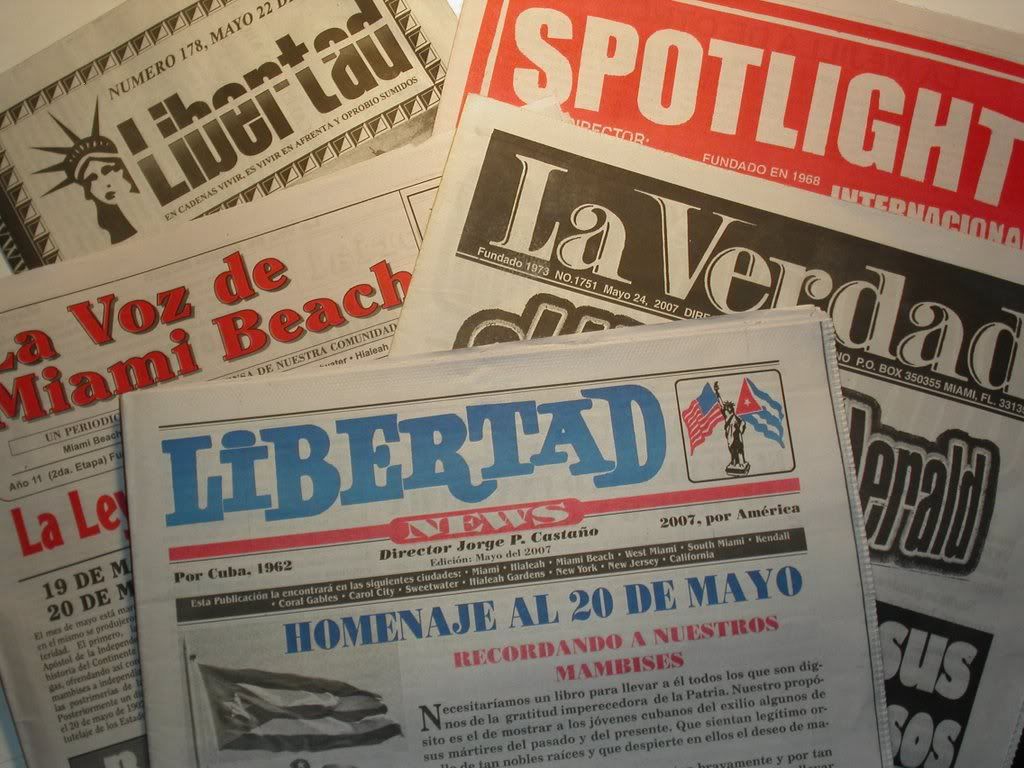
Here in Miami, there are many who are ready to defend Luis Posada Carriles, his acts of terrorism, and have no shame to do so. As the picture on the left shows, many arguments in defense of terrorism against Cuba appear in several small newspaper publications that can be found around Little Havana. Those shown in the picture are merely for the month of May.

These publications can be found in many parts of Little Havana, and have been in existence for very long. Their editiorials regularly speak of the "flagrant violations" by the Cuban government, "the bloody tyrant" Fidel Castro and his "communist aggresion." They're the old-school bloggers. Their pages welcome articles by Carlos Alberto Montaner, Armando Perez-Roura, Ramon L. Bonachea, Luis Conte-Aguero, Agustin Tamargo, and any other who speaks against the "communist agression."

But, as adamant and vocal as some are to justify a war against Cuba, their arguments in defense of Luis Posada Carriles are surprisingly poor. Let's examine one example that argues that Posada Carriles is in fact "innocent" of the bombing of a Cuban airplane in 1976 that killed 73 people on board.

Perhaps one of the most important defenses for Posada Carriles comes from Enrique Encinosa. Encinosa is well known to his listeners on Radio Mambi, and by the fans of his many books on Cuban history. Encinosa also appeared recently on the documentary "638 Ways to Kill Castro" saying that terrorism is an "acceptable method" against Cuba. The documentary also reveals Encinosa's very close relationship with Posada Carriles, whom he called regularly while Posada was in federal prison. Last October, Encinosa released an article titled La Verdad sobre Luis Posada (The Truth about Luis Posada). Its main argument is that Luis Posada Carriles is in fact a "scapegoat" and "innocent" of the 1976 bombing. He presents many theories and testimonies that suggest a connection with the Cuban government and the bombing. This article has found its way into many different websites that I have found:

- La Junta Patriotica Cubana (The Cuban Patriotic Board) website

- La Nueva Cuba (The New Cuba) website

- Cuba Nuestra Digital (Our Cuba Digital) website

- Cuba Democracia y Vida (Cuba, Democracy and Life) website

- The Univision (US Spanish Television Network) website

And blogs:

- El Club de Los Amigos Malos Blog

- Baracutey Cubano Blog

- Blog for Cuba

Encinosa's article DOES NOT presents "La Verdad" about Luis Posada Carriles. On the contrary, I will argue that Encinosa engages in an exercise of propaganda because of his obvious ommissions of important facts in the case of Luis Posada Carriles. Also, I accuse the websites above for supporting false representations of the facts, and perpetuating the false innocence of Luis Posada Carriles.

Let's review the facts of Encinosa's argument.

[Part 2]

Friday, May 11, 2007

A Letter to Alberto Gonzalez

Blogger Leftside from A View to the South has reprinted sections of Massachusetts House Representative(10th District) Bill Delahunt's letter to Attorney General Alberto Gonzalez. In the letter, Delahunt makes a convincing argument on why Luis Posada Carriles should immediately be designated a "terrorist alien" under US laws.

The entire letter can be found here in PDF format. A must-read.

Horizon Towards Indictment

There seems to be some indication that the case of Luis Posada Carriles is not yet over.

Watching the evening Spanish news today, America TeVe's Noticias 41 is reporting that US Attorney General Alberto Gonzalez is "in disagreement" with the latest immigration decision from Judge Cardone in El Paso, Texas. The Noticias 41 website [retrieved May10, 2007] says "La administracion Bush nada contenta con libertad de Posadas Carriles" (The Bush Administration Not at All Happy with release of Posada Carriles). If Gonzalez is actually serious about this (not likely) it may give legitimacy to the serious investigation in progress by the FBI.

Anita Snow, from the Associated Press, also reports today about the federal grand jury in Newark whose "lawyers say there's a good chance that Posada will be tried in New Jersey." Oddly, Snow only quotes ONE lawyer, Gilberto M. Garcia, saying that "[t]he (U.S.) government is working very hard on this [case... and are under tremendous pressure] to get him on something." Garcia is the lawyer of five Cuban-Americans that have been called to testify for the New Jersey investigation, but all of whom claim to be innocent of any wrong-doing.

Snow also quotes Phil Peters, Vice President and "Cuba expert" of the Lexington Institute, from his blog saying "[f]ollow the Newark grand jury... The immigration charges were always a sideshow." Snow precedes this quote with an optimistic opinion that "New Jersey has the most potential to put Posada behind bars." But, Peters' New Jersey quote comes from one of four possible scenarios:

1) Posada Carriles might be deported;
2) he might be indicted in New Jersey;
3) might be extradited to Venezuela [very unlikely];
4) or, be detained under the Patriot Act.

Peters does not mention which one scenario has more potential over the other.

Finally, Anita Snow also mentions the 2005, 10-page, FBI affidavit [PDF] presented by special agent Thomas H. Rice, a 13-year counter-terrorism investigator. Its a collection of evidence that Phil Peters describes as "quite a bit" for a possible indictment. I will comment on this affidavit later, but Snow really offers little to hope for aside from the report by agent Rice.

In the blogoshpere, Leftside has excellent queries about Judge Cardone's decision.

The case of Luis Posada Carriles seems to have some potential for real justice, but only time will tell.

Monday, April 30, 2007

News from Mexico and Geneva...

Gonna be out most of this week, but I do plan to post any updates on the Luis Posada Carriles case. For example, late last week the Mexican Senate agreed UNANIMOUSLY to urge the Foreign Affairs Ministry "to send a diplomatic note to Washington" for Posada Carriles' extradition to Venezuela. This news has been reported so far by Cuban sources and Iranian sources. I haven't seen it in American papers yet.

I found the Senate resolution from their website, you can read it (in Spanish) here. It describes the Cubana airline bombing of 1976 as "perpetrado por" (perpetrated by) Luis Posada Carriles. It also states that according to the US government's own Patriot Act (section 412), Posada Carriles' "liberación amenaza la seguridad nacional de los Estados Unidos" (liberation threatens US national security). I also mentions the incarceration of the Cuban Five, and follows that the temporary release of Posada Carriles is "un insulto para el pueblo cubano y también para el propio pueblo de los Estados Unidos" (an insult to the Cuban people and also to the people of the US). They make proposed three points of agreement:

- Opposition to the temporary release of Luis Posada Carriles.
- To send a diplomatic note to the US urging them to abide by the UN resolutions against terrorism.
- To urge the US Congress to solicit the extradition of Luis Posada Carriles to Venezuela.

In Geneva, one month ago, the UN Human Rights Council convened their 4th Session and reported their findings on human rights in Cuba. You can find all their resolutions here, where they have the Cuban resolution (A/HRC/4/12) in PDF format.

The author of the resolution, Christine Chanet, finds that:

"The restrictions imposed by the embargo help to deprive Cuba of vital access to medicines, new scientific and medical technology, food, chemical water treatment and electricity. The disastrous effects of the embargo in terms of the economic, social and cultural rights of the Cuban people have been denounced by the United Nations Food and Agriculture Organization, the United Nations Children’s Fund, the United Nations Educational, Scientific and Cultural Organization (UNESCO) and the World Health Organization"

And she also makes ten recommendations for the Cuban government, the first three being:

"(a) Halt the prosecution of citizens who are exercising the rights guaranteed under articles 18, 19, 20, 21 and 22 of the Universal Declaration of Human Rights;

(b) Release detained persons who have not committed acts of violence against individuals and property;

(c) Review laws which lead to criminal prosecutions of persons exercising their freedom of expression, demonstration, assembly and association, and in particular Act No. 88 and article 91 of the Criminal Code, in order to bring these provisions of the law into line with the above-mentioned provisions of the Universal Declaration of Human Rights;"

There's plenty to go over: the effects of the US Embargo towards Cuba, the repressive mechanisms of the Cuban government, and also includes a list of the still-imprisoned political prisoners from 2003.

Read at your leisure.

Thursday, April 26, 2007

This isn't another Elian

José Miguel Insulza, Secretary General of the OAS, made news today on Radio Mambi. Radio Mambi read a news brief reporting that Insulza was calling for Luis Posada Carriles' extradition to Venezuela. Radio Mambi even went on to describe Insulza as a Marxist. This irrelevant characterization is most likely false, but no surprise coming from a radio station that defends Posada Carriles' violent history. According to Insulza's biography, he was part of a "moderate coalition of democratic parties" within Chile's Socialist Party. Currently, Chile's President, Michelle Bachelet also has similar political roots with Chile's Socialist Party.

The only news I could find that would explain why Radio Mambi would report this story today comes from China's "People's Daily Online." Otherwise, Insulza's comments are not really surprising. Insulza has made it clear many times that he supports Posada Carriles' extradition to Venezuela. He said it in 2005, and also said it last month.

Recently, Venezuela has petitioned the OAS and the UN to demand that both organizations support the extradition. Its very likely that both international bodies will support Venezuela's claims.

According to the UN's Counter-Terrorism Committee, the Security Council (including the US) unanimously approved a resolution (1373) the very same month of the September 11 attacks outlining specific guidelines to combat terrorism. One of those guidelines states that all nations will:

"Afford one another the greatest measure of assistance in connection with criminal investigations or criminal proceedings relating to the financing or support of terrorist acts, including assistance in obtaining evidence in their possession necessary for the proceedings"

The OAS also has a similar committee and resolutions calling for international cooperation when in comes to investigations of criminal charges related to terrorism. In 2006, the OAS adopted a resolution called "Extradition and Denial of Safe Haven to Terrorists"[PDF]. It clearly states that OAS members will uphold:

"in particular the applicable provisions regarding the provision of mutual legal assistance and the extradition of anyone participating in the planning, preparation, financing, or commission of terrorist acts or, where appropriate, the attempted commission of said offenses."

The case of Luis Posada Carriles is really beginning to heat up. Way beyond the Elian Gonzalez case ever could.