Showing posts with label Luis Posada Carriles. Show all posts

Saturday, January 14, 2012

Panama Ratifies Sentence Against Posada

I first heard this on Radio Mambi during today's noon news program. According to Spanish news agency EFE, the Second Appellate Court in Panama has ratified sentences imposed against Luis Posada Carriles and five other accomplices from 2004. The sentences stem from charges of "threatening public security and falsifying documents" after their arrest in Panama in 2000. This recent ruling paves the way to formally extradite Luis Posada Carriles to Panama. Armando Perez-Roura read the report on Radio Mambi and indicated forthcoming updates on mobilizing the community against the ruling.

Luis Posada was arrested in Panama in 2000 for what looked like another attempt to assassinate Fidel Castro. Posada and five others were found guilty on several charges. In April 2004, Posada was sentenced to eight years in prison for "threatening public security and falsifying documents." But, in August 2004, Posada was pardoned (along with his accomplices) by then-President Mireya Moscoso as she left office. The government of Cuba responded by cutting diplomatic ties with Panama.

The president that followed, Martin Torrijos, sought improved relations with Cuba (he traveled to Havana in 2005 to re-establish diplomatic ties) and his administration also attempted to rectify what it thought were corrupt practices during the Moscoso administration (recent Wikileaks cables described several complaints of bribery to the U.S. embassy).

In 2008, the pardons by Mireya Moscoso were targeted. Those who collaborated with pardoning Luis Posada Carriles were charged for abusing their authority, and in July 2008 Panama's Supreme Court overturned 182 pardons* granted by Moscoso, including Posada's.

This confirmation of Posada's sentence from 2004 opens the door for his possible extradition to Panama. Currently, Venezuela also has an extradition order for Posada related to his alleged involvement in the 1976 bombing of a Cuban civilian airplane, and other investigations related to torture as a Venezuelan intelligence officer. If granted, Panama would become the second country with an extradition order for Posada related to an act of terrorism.

According to the EFE report, Julio Berrios was identified as representing the plaintiffs in this case that confirmed Posada's sentence, and Rogelio Cruz was Posada's lawyer. (In case you didn't know, Berrios is one of Manuel Noriega's lawyers in Panama after Noriega's recent extradition from France.) And, according to Prensa Latina, Berrios will be joined by a grassroots organization called ULIP (Union de Lucha Integral del Pueblo) to file for an extradition order.

*[Wikileaks: Details of Pardon Revocation for Posada and 181 Others]

Friday, June 3, 2011

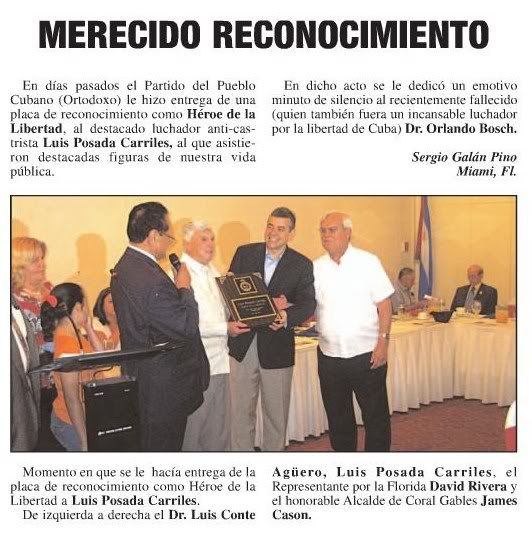
Cason, Rivera and Luis Posada Carriles

Last month, Humbert Fontova found out that Luis Posada Carriles, main suspect in the 1976 bombing of a civilian airliner and reputed terrorist, was publicly honored in Miami by Congressman David Rivera (FL-25) and Coral Gables Mayor James (Jim) Cason. It seems that Fontova (in his usual sarcastic manner) was disappointed that The Miami Herald didn't report on the event. Well, I'm so happy to oblige Mr. Fontova with the details.

Back in April, Luis Conte Agüero was elated to hear that Luis Posada Carriles, whom he considers a "Mambi," was acquitted of several charges of U.S. immigration fraud. So, Conte Agüero, one of Posada's strongest public supporters in Miami, arranged to celebrate the event at the Big Five Club on May 14th where the Cuban Orthodox People's Party was already scheduled to meet. Conte Agüero is the president of that organization.

According to Sergio Galán Pino for Libre Magazine (screenshot of article here), the meeting indeed took place, recognizing Posada as a "Hero of Liberty" and was attended by Rep. David Rivera and Mayor James Cason. Rep. Rivera is a long-time member of the Cuban Orthodox People's Party, and Mayor Cason was an honored guest of the organization in 2009. At that 2009 meeting, Mayor Cason told the Orthodox members that "the enmity of Fidel and Raul [Castro] with us [the United States] is real, it is genuine, they need an enemy to exist, we are that enemy and will always be."

Mayor Cason since 2009 has attended several meetings with other hard-line Cuban exile organizations, and campaigning discreetly among them. Due to this support by Cuban exiles, Cason became Mayor of Coral Gables last April. Mayor Cason was most likely celebrating his Mayoral victory at the May 14th meeting with the Orthodox Party.

[Photo by Libre Magazine - May 24, 2011, left to right: Luis Conte Agüero, Luis Posada Carriles, David Rivera, James Cason.]

Thursday, April 7, 2011

Hialeah Leaders Support Posada


Above shows Hialeah Mayor Julio Robaina and Hialeah Council President Carlos Hernandez expressing their affection for Luis Posada Carriles, a man accused of being a terrorist and a self-admitted unrepentant militant. In South Florida, support for Posada means you either justify his violent tactics in a global war against communism/evil/hate (which the Cuban government represents), or you, as an anti-communist, feel profound respect for someone who has sacrificed his/her life for anti-communism (in this case freedom for Cuba).

But, these are false choices. The violence or cause that Luis Posada Carriles represents is the most extreme form among other methods. Showing public support for Posada, especially as a community leader, serves to advocate these extreme forms of politics while ignoring more moderate ones.

While Robaina and Hernandez have the right to support whatever cause or agent they want in that cause, both Hialeah leaders should be aware that many other Cuban-Americans are not militants, or anti-communists.

As leaders of that community, will they listen to those voices?

-----

- Hialeah Mayor Robaina is currently running for Mayor of Miami-Dade County, while Council Pres. Hernandez is expected to become the interim Hialeah mayor and potential candidate for the seat.

- Recorded from radio program "Esquina de Pepe" hosted by Jose 'Pepe' Yedra on WWFE 670 AM, February 18, 2011. Jose 'Pepe' Yedra is broadcasting live from the Big Five club in West Miami where a fund-raising event is taking place supporting Luis Posada Carriles.

Wednesday, January 19, 2011

The Hand of Fidel


Last week, the trial of Luis Posada Carriles began and I was not surprised to read about how Posada's lawyers wanted to turn the trial around against the Cuban government. I found it typical because one thing I've noticed from my focus on militants and hard-liners in Miami is the constant blaming of the Cuban government for involvement in almost all things that go wrong. It's something that they themselves joke about, but also something that seriously borders on paranoia. In the world of militancy and the hard-line, one is naturally in constant vigilance against the enemy's possible interference in all matters. In the case of Miami, the hand of Fidel Castro and the Cuban government is constantly plotting against Cuban exiles. And, the Posada trial is yet another example of "The Hand of Fidel."

Last week, Arturo Hernandez (above), one of Posada's lawyers, demanded he be allowed to argue in court about "the Cuban government's motive to fabricate" evidence against Posada. (Some evidence collected inside Cuba will be presented in court.) Hernandez argued that this motive originates from the fact that "[i]n a long life of 83 years, [Posada] has made some very powerful enemies. None more powerful than Fidel Castro and his regime." The demand was soon dismissed by the judge as irrelevant. And, prosecutors agreed saying: "This is not the History Channel . . . The regime in Cuba is not the defendant in this case... This is not for The Miami Herald.'' (Ouch.)

[Reality is the FBI alone has gathered enough evidence to criminally charge Posada. Evidence collected from Cuba represents cooperation from two countries that should have better bi-lateral relations.]

No doubt Posada's defense was upset by the decision, but so was Alberto de la Cruz at the Babalu blog. De la Cruz called the trial a "kangaroo court trial" where the judge "has in effect banned the truth from the trial" and the prosecution has "partner[ed] up with a brutal and murderous totalitarian regime." And, no one would have noticed this gross and outrageous blunder of a post from the boys at Babalu if the Miami Herald had not published it this past Sunday.

It seems that the Miami Herald did eventually live up to the expectations of the prosecution at the Posada trial. And there's more, because the Herald managed to squeeze the Babalu commentary (which had the highest word count) in between two other comments by distinguished scholars (Julia Sweig and Peter Kornbluh) and a renowned journalist (Stephen Kinzer). Which means that, despite all the pathetic criticism the Herald gets from Babalu, the Herald has no problems disguising that obscene blog blundering as serious commentary.

That's Miami for you. Some still see Luis Posada Carriles as a hero that fought against modern-day evil, and thus worthy of some kind of defense. But, Posada's violent life and corporal sacrifice also represent something greater: self-confirming evidence proving the existence of the "Hand of Fidel," which is a threat to Cuban exiles and can only be fought with equal intensity.

- Video above of Arturo Hernandez (from local program "A Mano Limpia"), in his own words (@3:35):

"The important thing is that there can be no truthful testimony while those individuals [in Cuba] are in the hands of a dictatorship like that of Fidel Castro and Raul Castro. In other words, its not a question of whether philosophically thinking a person who cooperates is gonna tell the truth or not. No. There is no truth there [in Cuba]. The only thing that exists there is the will of the dictator."

[Related articles]
- Cuban Exile on Trial by Julia Sweig and Peter Kornbluh
- Trial of the Terrorist Who Almost Killed Me by Stephen Kinzer

Tuesday, January 11, 2011

Why Support Posada?

So, maybe some of you might be baffled why Luis Posada Carriles, a person with such a violent history, gets so much support around Miami. Every supporter may have their own personal reason, but the general explanation seems to be that Posada is a symbolic hero of "la causa" (the collective exile mission to defeat the Castro government by any means). But, support for Posada should not be confused with support for violence (despite some Cuban exile leaders who continue to believe in the effective use of violence). Rather, aside from the militant politics he promotes, Posada also represents a politics of force without democracy: this is the hard-line.

I recently posted some reasons why the hard-line is a non-democratic idea, and it is this contempt for the public that it shares with militancy. Those who feel that violence is an effective use of force generally have no regard for public opinion. I'll present some examples. The photo above shows a gathering of Cuban exile groups at the Presidio Politico Historico Cubano, a center in Little Havana that documents past and current abuse of political prisoners inside Cuba. This gathering took place on October 2006 [PDF, Page 14] to protest the detention of Luis Posada Carriles while he awaited criminal immigration charges.

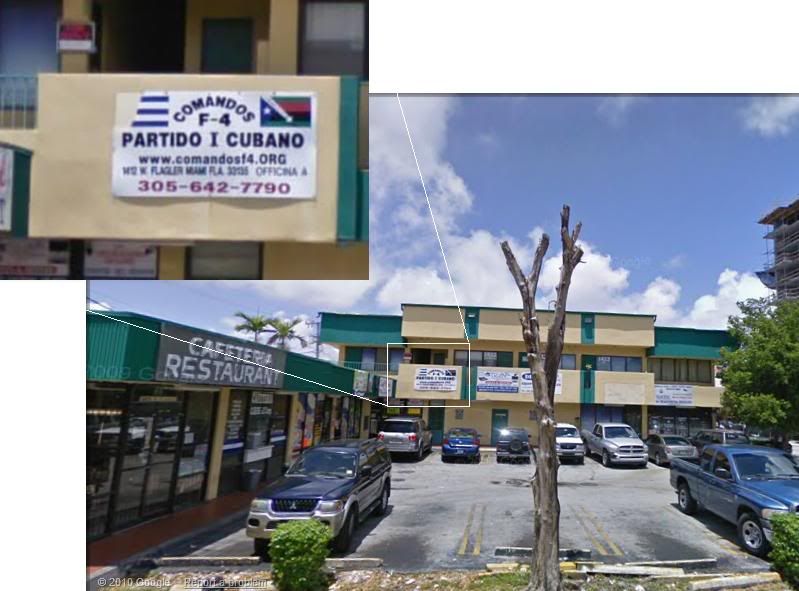
In the photo is Rodolfo Frometa (center, black beard), leader of the recently defunct group F4 Commandos (the website is down and the office has been put for rent). Frometa made it very clear to listeners of Radio Mambi that violence was necessary to bring change to Cuba. Frometa, of course, rarely appeared before any other media outlets in Miami because of the anticipated public rejection. Frometa, without the F4 Commandos, was last seen publicly among the marchers at last year's march supporting the (non-violent) Ladies in White in Little Havana.

Also, in the photo is Miguel Saavedra (center, red tie), leader of Vigilia Mambisa. Back in 2007, Saavedra and other members of Vigilia Mambisa physically attacked a small group of protesters in Little Havana after the small group held up a sign calling Luis Posada Carriles a terrorist. Saavedra is also a member of the militant group Unidad Cubana, and in 2009 was found to be an unpopular figure after a poll found a majority of Cubans (74%) in Miami opposed his protests.

Ernesto Diaz Rodriguez (center, blue shirt), secretary general of Alpha 66, also appears in the photo. Diaz was arrested in 1968 inside Cuba while attempting to "set up a base" and "infiltrate guerrillas." Diaz was released in 1991 after serving 22 years of a 40-year sentence. Alpha 66 long ago gave up its violent campaign, but now advocates the use of "sabotage" inside Cuba by dissidents. (I once heard him suggest on Radio Mambi the burning of Cuban government vehicles.)

Enrique Encinosa (front, dark glasses), also a strong defender of Posada's and news editor at Radio Mambi, was featured in a documentary defending the bombing campaign of Cuban hotels. Encinosa says: "I personally think its an acceptable method. Its a way of damaging the tourist economy. The message that one tries to get across is that Cuba is not a healthy place for tourists. So, if Cuba is not a healthy place for tourist because there's a few windows being blown out of hotels, that's fine."

The individuals and groups above represent a political idea which includes a strong disdain for the public. They don't care if you detest their use of force because for many years they have ignored the public and done as they pleased. Not just because of "la causa," but also because the public (or their representatives) never really tried to stop them. And, neither were any alternatives considered.

Monday, January 10, 2011


Important links:
- Summary of Luis Posada Case by Peter Kornbluh and relevant documents.
- Center for Democracy in the Americas press conference on Posada Case.
- The Posada Files by Ann Louise Bardach

Posada's Supporters in Miami

Luis Posada Carriles' trial over criminal immigration charges started today. Laura Wides-Munoz for the AP provides an interesting report and interview with Posada revealing deep concern at the possibility of being jailed. "If I go to jail, my life ends in jail," says Posada.

Posada was arrested by U.S. immigration officials back in May 2005. It wasn't until January 2007 that Posada was charged with making false statements on his naturalization application and interview. But, in May 2007 Posada was exonerated of these charges because the federal judge believed Posada was the victim of entrapment during the naturalization process. That ruling was later overturned in August of 2008 by a federal appeals court, and after much delay Posada is finally back in court.

[Check a list of important court documents at the Along the Malecon blog.]

Since his release in 2007, Posada has been very active throughout Miami. The main mission of course was to collect funds for his legal expenses, thus public appearances seemed obligatory. Through the years, Posada has met with several important leaders in the Cuba exile community as shown in the collection of photos above.

- Rep. David Rivera (top left) - Newly elected, Rep. Rivera showed his support for Luis Posada Carriles on December 30, 2010 at a public solidarity event [video] in front of the Versailles Restaurant. Rep. Rivera is a member of the hardline/militant organization called the Cuban Orthodox People's Party (Partido del Pueblo Cubano Ortodoxo) which is headed by Cuban exile militant Luis Conte Aguero. Conte Aguero was the main speaker at the Posada solidarity event, and is a fervent Posada supporter. Rep. Rivera showed up at the event, not just to regurgitate platitudes, but to show his solidarity with Cuba exile militancy. Also at the event were Antonio Esquivel, president of the Cuban exile organization Junta Patriotica Cubana, representing the organization's support for Posada and Nelis Rojas Morales, one of the main organizers of Posada's legal fund.

- Mayor Julio Robaina (bottom left) - Hialeah Mayor Julio Robaina allowed the City of Hialeah to present artwork by Luis Posada Carriles at the Walker Community Center on November 15, 2007 (check this schedule). In the photo, Posada stands in front of the Mayor with human rights activist Armando Valladares in the back. The photo was taken during an exhibition of Valladares' artwork on September 14, 2007. (Photos of both events can be found on the City of Hialeah website here.) Mayor Robaina is hoping to become the next Mayor of Miami-Dade County in 2012.

Others in the photo include, Sylvia Iriondo (bottom middle) and Bertha Antúnez Pernet (top right). Both women work prominently with the Cuban Democratic Directorate, a hard-line human rights organization in Miami that has received money from USAID. Both Iriondo and Antúnez travel overseas to promote a hard-line policy towards Cuba while documenting the political repression inside the island. Antunez is also the sister of Jorge Luis Garcia Perez, Cuban dissident whose recorded editorials now appear regularly on Radio Mambi.

Finally, there's Alex Hanna (bottom right), the traffic ticket attorney whose face appears on many billboards and bus benches around Miami. In the photo above he appears next to Posada receiving artwork by Posada during a meeting of the Cuban Orthodox People's Party where Hanna is also a member. Hanna seems to be a very successful attorney who also sponsors many programs on local station America TeVe, which regularly features hard-liners in Miami.

The photos above, mostly collected from the archives of Libre magazine, while only a few, represent the strong support for Posada in Miami. Previous posts related to Luis Posada Carriles also show local support by some Cuban exiles.

[Correction: Radio/TV Marti has reported on the start of the Luis Posada Carriles trial. They include news from EFE news agency reporting that Luis Posada was met with protesters calling him an "assassin" as he left his hotel. The report interviews a supporter of Posada saying that Posada was "verbally attacked" by the ANSWER Coalition. The Nuevo Accion blog reports that the protesters "tried to physically attack" Posada "inside the hotel," but were thwarted by Posada supporters. Nuevo Accion has a consistent record of misinformation.]

[Watch the ANSWER Coalition peacefully demonstrate before the Posada trial.]

Wednesday, March 31, 2010

Among the Marchers

When Luis Posada Carriles attended the Miami demonstration last week in solidarity with the Damas de Blanco many news outlets noticed, such as the Miami Herald, Reuters (photo above), local station WPLG Channel 10, and others.

But, BBC Mundo (Luis Fajardo) was able to interview Luis Posada briefly. In the interview Posada said: "I am strongly supporting freedom, and freedom in the United States, and over in Cuba. Soon we shall be free. Viva Cuba libre!"

In the photo above, it seems that Posada also gave an interview to U.S.-funded Radio and TV Marti. I haven't yet found that audio, but I am curious to hear it.

Thursday, February 18, 2010

Dia del Exilio Cubano [Updated]

This morning Miami-Dade County Commissioner Rebeca Sosa will propose before the board a resolution [PDF] designating February 24th as "International Cuban Exile Day."

The idea for "Dia del Exilio Cubano" (which I translate as "Cuban exile community day") was conceived by the militant organization La Junta Patriotica Cubana (Cuban Patriotic Council) last month. The significance of February 24th is based on the day that the Cuban War of Independence (1895-98) began, which included Jose Marti as one of its leaders.

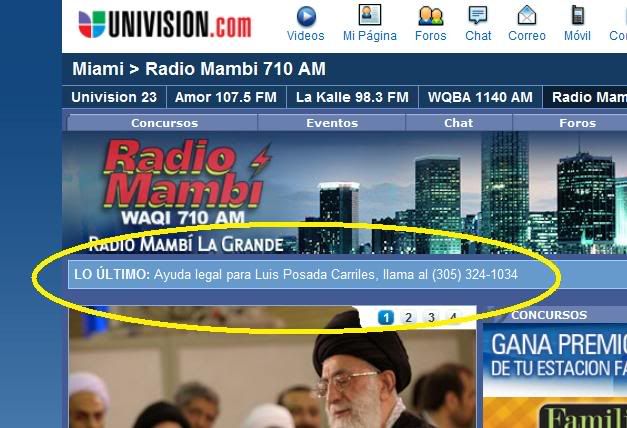
Coincidentally, a radio marathon begins today to collect funds for Luis Posada Carriles' trial beginning in El Paso, Texas next month. (According to Radio Mambi, the fund-raising was organized by Amadeo Lopez Castro, President of Intercontinental Bank in Miami.) Radio Mambi (WAQI 710 AM) and La Poderosa (WWFE 670AM) are providing listeners with a phone number to call (number is posted on the Univision/Radio Mambi website [screenshot]), and locations where listeners can go to leave checks and money orders. Locations include the Versailles Restaurant in Little Havana, the WWFE radio station, and Nuevos Horizontes, the Hialeah lodge of the Federation of Cuban Exile Masons.

This morning on Radio Mambi, Armando Perez-Roura talked about how Luis Posada Carriles is symbolic of the Cuban exile: his character of sacrifice to wage a cosmic battle against communism, only to be betrayed in the end by the rest of the world.

But, aside from praising the exploits of Posada, Perez-Roura also admires the life of being in perpetual conflict. He felt compelled this morning to quote Jose Marti saying:

"A sad thing it is to not have friends, but even sadder must it be not having any enemies; that a man should have no enemies is a sign that he has no talent to outshine others, nor character that inspires, nor valor that is feared, nor honor to be rumored, nor goods to be coveted, nor anything to be envied."

Meaning that if you have critics, then maybe you are doing something right. But, this also sounds like self-deception or making false attributions over one's own character.

[Update: The Miami-Dade Board of County Commissioners voted unanimously approving "Dia del Exilio Cubano" for February 24th, according to a report from Radio Mambi.]

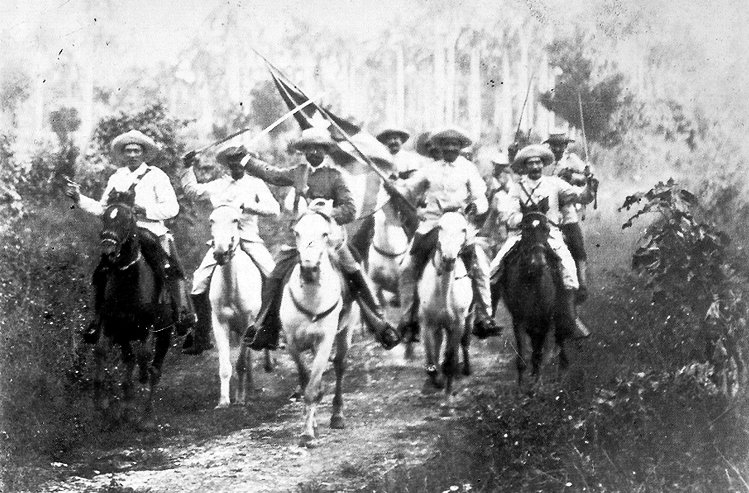
[Photo of Cuban Mambises that fought the Spanish during the Cuban Wars of Independence]

[Along the Malecon has regular updates on the trial of Luis Posada Carriles]

Thursday, October 8, 2009

"Now They Call it Terrorism" [Updated]

Newly declassified CIA documents concerning alleged terrorist Luis Posada Carriles has provoked some interesting reactions.

Blogging for the Miami New Times, Tim Elfrink is finally relieved to say that "[Jorge] Mas Canosa [the late Cuban exile leader] believed in terrorism." Elfrink seems relieved for two reasons: 1) the newly declassified documents prove Mas Canosa funded terrorist operations during the mid-60s; and 2) therefore, Elfrink can't be sued for making such a statement.

But, are the new CIA documents really proof that Mas Canosa "believed in terrorism"? You might have to dig a bit deeper to make such a statement.

These CIA documents only confirm FBI documents declassified in 2005 revealing that Jorge Mas Canosa, working for an organization called RECE (Representacion Cubana en el Exilio/Cuban Representation in Exile), paid Luis Posada Carriles $5000 on June 25, 1965, to complete a "demolition operation in Mexico" involving "100 pounds of C-4 explosives." The new CIA documents shockingly reveal that Luis Posada Carriles was the actual informant that the FBI documents gives credit to. But, the documents, which solely rely on Posada's word, don't say that Posada carried out the operation.

Yet, if we consider other facts that have been revealed over the years, we get a better picture of the Posada/Mas Canosa relationship.

In the early 60s, Posada and Mas Canosa met at Fort Benning, Georgia. Stationed there, Posada "received instruction in demolition, propaganda and intelligence," while Mas Canosa "graduated as a Second Army Lieutenant." The FBI and CIA documents, based on Posada's own admissions, reveal the early partnership of both men in organizing terrorist operations aimed at Cuba.

In interviews published by the New York Times in 1998, Luis Posada Carriles revealed that the CIA trained him along with other Cuban exiles: "The C.I.A. taught us everything... [t]hey taught us explosives, how to kill, bomb, trained us in acts of sabotage. When the Cubans were working for the C.I.A. they were called patriots... Now they call it terrorism."

Concerning Jorge Mas Canosa, Posada also admitted that "leaders of the [Cuban American National Foundation (CANF)] discreetly financed his [bombing] operations. [Jorge Mas Canosa] personally supervised the flow of money and logistical support."

"Jorge controlled everything... Whenever I needed money, he said to give me $5,000, give me $10,000, give me $15,000, and they sent it to me."

Posada estimated that Mas Canosa had over the years provided him a total of $200,000.

Other links between Jorge Mas Canosa and terrorism were alleged by a former CANF board member in 2006. According to Jose Antonio Llama, Mas Canosa helped organize a "paramilitary group" within CANF beginning in 1992 to overthrow Fidel Castro. Francisco J. Hernandez, CANF's current President, was also alleged to have been involved.

Antonio Llama was arrested, among others, in 1997 on charges of conspiracy to assassinate Fidel Castro. Among the weapons found in that criminal investigation were two .50 caliber Barrett assault rifles. One of the rifles was registered to Francisco J. Hernandez.

The AP (Laura Wides-Munoz) recently interviewed Francisco J. Hernandez to respond to these recently declassified CIA documents implicating Jorge Mas Canosa. He said:

"The fact of the matter is that Jorge was never a man who believed in terrorism... Yes, in those years, he believed in taking the war of liberation to Cuba, but not to kill innocent people."

But, Mas Canosa, through RECE in the 60s, did target property, and such attacks are considered acts of terrorism. Also, his relationship with the notorious Luis Posada Carriles, based on Posada's own statements throughout the years, seems to describe a man who couldn't stay away from what they now call terrorism.

--- [Update] ---

The Cuban Colada blog has more about Luis Posada Carriles' activities as an informant for the CIA.

[Photo by Steve Satterwhite/Miami New Times]

Friday, April 10, 2009

"An Act of Justice"


America TeVe, a local Spanish-language station, yesterday took an online poll [available here] asking viewers to complete this sentence: "The accusation towards Luis Posada Carriles for the bombings in Havana is a(n):

a) act of justice
b) concession to Cuba
c) false accusation

The video above shows the results that were broadcast on television where approximately 53% of respondents said the accusations were an "act of justice." About 32% thought it was a "concession to Cuba" and about 16% said it was a "false accusation.

But, when I checked the results in the evening [screenshot] the percentage that thought the accusations were an "act of justice" went up to 65%. "Concession to Cuba" fell to 21% and "false accusation" to 14%.

The video above also has an interview with Cuban exile militant Osvaldo Mitat saying that the charges against Posada in the U.S. are really a "plot made by the Latin American nations, namely Venezuela." In 2006, Mitat was sentenced to 24 months in jail when he pleaded guilty to "conspiracy to possess prohibited firearms." A 2005 federal investigation discovered Mitat had recieved a delivery of "three live grenades, a grenade launcher, four fully automatic machine guns, a silencer and other weapons, some with the serial numbers obliterated."

Mitat later served an additional 8 months after he refused to testify before a Texas grand jury investigating the immigration case of Luis Posada Carriles. Mitat was finally freed last December and now works as a car salesman. Upon his release, Mitat was interviewed by Univision 23 and said that the U.S. government was making an error in the case of Luis Posada Carriles, and that it made no sense to charge someone that the government itself had trained in the past.

In the Univision interview, Mitat also admits that Posada and himself were both trained by the U.S. government, and that the U.S. gave them no problem in the past when they were in Central America, or even when they had been intercepted at sea.

Thursday, April 9, 2009

New Charges Against Posada

It's being reported that a Texas grand jury has entered additional charges against Luis Posada Carriles, including one charge for obstructing an investigation on "international terrorism."

Total charges against Posada are now up to 11, from an original 7-count indictment.

According to the Miami Herald, the obstruction charge is based on Posada lying about his association with Raul Ernesto Cruz Leon, a man found guilty in Cuba for a bombing campaign that targeted Cuban hotels in 1997. Posada told authorities: "I have never seen nor met Raul Cruz, and I have not done any arrangement to send him to another place."

But, in a 1998 interview concerning the bombing campaign, Posada admitted that Raul Ernesto Cruz Leon was among several people that were working for him.

Also, during that period, several others were arrested in relation to the bombings, some who identified Posada as part of the conspiracy.

El Nuevo Herald columnist Alejandro Armengol writes in his blog that these new charges show "great willingness, on the part of federal prosecutors and the grand jury, to resolve this case."

And, the Cuba Journal blog is taking a poll asking readers what they think about these new charges.

Tuesday, April 7, 2009

News and Discussion

ROUND THREE FOR POSADA

The trial of Luis Posada Carriles, charged with several counts of fraud and making false statements during his naturalization process, has been re-scheduled for August 10th after last month's rejection from the U.S. Supreme Court. U.S. federal prosecutors asked Judge Kathleen Cardone today to impose the same conditions of release on Posada Carriles from two years ago: a bond of $350,000, and electronic monitoring with an ankle bracelet. For several months, Posada Carriles has lived freely in Miami, exhibiting his artwork in several locations (fundraising for his legal costs) with (according to this report) certain levels of supervision from U.S. Immigration and Customs Enforcement.

FREE FROM TRINIDAD JIMENEZ

For unknown reasons, Spanish blog Penultimos Dias is happy to see Secretary of State for Ibero-American Affairs, Trinidad Jiménez, leave her post after Spain's recent Cabinet shuffle. Jiménez played an important part in supporting a policy of dialogue between Spain, the EU and Cuba as the best way to bring reforms, rejecting an isolationist policy. Last January, she foresaw a "change of attitude" in the Obama administration with regard to Cuba, and recommended a policy of normalization with Cuba based on "great respect, of not imposing any position and not pressuring publicly." She also supported the eventual end to the U.S. embargo.

Penultimos Dias has simply responded to Jiménez's positions by calling her a "babosa inepta" (like saying "inept moron") and describing her comments as "tonterias" (or "nonsense").

In 2007, Jiménez met with some Cuban exile organizations in Miami where members of the Cuban Liberty Council (CLC) unfairly criticized Spain's support for Cuban dissidents such as Elizardo Sanchez Santa Cruz. Contrary to the CLC's contempt for some dissidents, Jiménez once described all Cuban dissidents as "people for whom we have a profound respect, who we support, and for whom we feel solidarity."

OTTO REICH THE PROPAGANDIST

Otto Reich, from Otto Reich Associates, LLC, was interviewed today with Katrin Hansing, from the Cuban Research Institute, for NPR's Talk of the Nation. Both speakers had starkly opposed viewpoints on U.S. policy towards Cuba, but Reich's memory of history was very interesting. Reich told listeners:

"The embargo was established in the early sixties because of the Cuban government's support for violent revolution in Latin America."

That's not entirely true. The U.S. embargo placed in the sixties was initially in response to Cuban nationalization of U.S. properties, and trade deals made with the Soviet Union, the major U.S. enemy during the Cold War. And, by January 1960, aside from economic sanctions, the U.S. government was already planning a full overthrow of Fidel Castro. Cuba's public support for other revolutions came around the late sixties, and into the seventies.

Reich's convenient use of facts (or what he calls "exploitable information" [PDF]) should come as no surprise.

[Timeline of U.S. aggression against Cuba in the sixties.]
[Timeline of U.S. sanctions against Cuba.]

[Photo above by EFE]

Thursday, March 26, 2009

Supreme Court Rejects Posada Case [Updated]

Today, Alejandro Armengol links to a Granma article that reports that the case of Luis Posada Carriles, the notorious Cuban exile militant, has been rejected by the U.S. Supreme Court. The International Herald Tribune also has the story from the AP.

Posada's lawyers were delivered a devastating reversal last August when the Fifth Circuit Court of Appeals ruled against them, allowing Posada's case on criminal immigration charges to continue. Back in August, it was expected that the Supreme Court would not take the case.

Earlier this month, Luis Posada Carriles attended the Eight National Congress of Alpha 66 at the Big Five Club in West Miami. The event also served as an exhibition of Posada's paintings.

-----

Update: Radio Mambi this morning read El Nuevo Herald on Posada's Supreme Court rejection. Posada's lawyer, Arturo Hernandez, is asking to postpone the trial until next year. Which is very odd because in the article Hernandez says that he was not surprised by the Supreme Court's rejection, but now he needs at least TEN MONTHS to prepare his case for 2010. If he anticipated a rejection, which was the likely decision by the US Supreme Court, what has he been doing for the past SIX MONTHS since the Fifth Circuit Court's decision last August?

There have been sufficient delays in this case.

After the El Nuevo Herald article was read, co-host Enrique Encinosa, who also serves as a news editor for Radio Mambi, commented that this entire judicial process is "offensive" and "shameful" given Posada age and historical background. (Encinosa believes certain acts of terrorism are justified.)

Back in November 15, 2007, Posada's lawyer, Arturo Hernandez, appeared before a US House Subcommittee and explained:

"Mr. Posada Carriles is now almost 80 years old. His is the story of a man’s singular mission to combat Castro’s violent revolutionary communism in all its manifestations and permutations wherever it has reared its ugly head and at whatever personal cost to him. His individual struggle against communism was in a very real sense the often unobserved struggle of our hemisphere to avoid the sovietization of Latin America as part of the great ideological and strategic contest between the United States and the Soviet Union known as the 'Cold War'... and, it is no exaggeration to suggest that more than a few South American and Central American countries owe their democracies to the sacrifices incurred by men and women such as Mr. Posada Carriles."

Hernandez dismisses the accusations of Posada's involvement in the 1976 bombing of a Cuban civilian plane that killed 73 people because the "forensic evidence alone proves that he is innocent." But, I have written before that there's good reason to believe that the forensic evidence in that case is most likely worthless.

[Photo above of Luis Posada Carriles recently at the Big Five, from Alpha 66 website.]

Tuesday, August 26, 2008

Back to Court (Part 2)

I'm very happy to see that the immigration case of Luis Posada Carriles is getting new attention because sometimes in Miami all one hears are the same voices when it comes to Posada: local Spanish-language media outlets, the Miami Herald or long-time anti-Posada activists. The atmosphere tends to create familiar echo chambers around the case. Well, yesterday legal news publication Texas Lawyer gave us a very insightful and objective report.

Senior reporter John Council gives a brief summary of the recent ruling by the Fifth US Circuit Court of Appeals that reversed last year's court decision allowing Luis Posada Carriles to walk free, and includes many important interviews with other experts of immigration law. Among the experts are: David Deitch, a former prosecutor of the Justice Department; Kathleen Walker, past president of the American Immigration Lawyers Association (AILA); and Michael A. Olivas, an immigration law professor at the University of Houston Law Center. Council also includes an interview with a criminal law attorney, Robert Webster, concerning the Posada case which can be viewed on YouTube here.

Not surprisingly, ALL the persons interviewed by Council point out that "Posada is not the average immigrant who applies for naturalization," and thus concerns about government abuse of authority in Posada's immigration case must be held to a different standard. "It's a horse of a different color," explains Michael Olivas to Texas Lawyer.

While some may easily view this as prejudicial or discriminatory, the recent ruling by the US Fifth Circuit makes it very clear that no established rules or procedures were broken in the Posada case, and that Posada was provided all his rights under due process. The ruling further casts serious doubts about last year's opinion (by Judge Kathleen Cardone) which accused the US government of "fraud, deceit and trickery," and using Posada's naturalization process as "a pretext for a criminal investigation."

John Council's report for Texas Lawyer sums up well the Fifth Circuit's ruling, so I encourage people to take the time to read it (if you prefer it over the 35-page court document[PDF]). But, I will point out what I thought were the strongest points in the decision.

- The ruling points out (with precedent) that the US government DOES have the power to conduct both civil and criminal procedures without violating a person's right to due process. Though, this power has its limits, and each case must be reviewed carefully.

- Posada was not "tricked" in his naturalization interview because "[the US] government] did warn Posada (in the presence of Posada’s lawyer) at the beginning of the interview that, among other things, he could exercise his right against self-incrimination if he thought that an answer would incriminate him, lying could subject him to criminal penalties, and any statement he gave could be used in any legal or administrative proceeding."

Furthermore, "Posada, not the government, triggered with his naturalization application a civil adjudicatory process that, by regulation, calls for both an investigation of the applicant and an interview."

- Suspicions that Posada was being setup by the US Justice Department are also unfounded because all evidence indicates Posada was given a fair immigration proceeding. The Fifth Circuit countered the description of Posada's "anomalous" two-day interview:

"More to the point is the undeniable fact that, given his history and notoriety, Posada was a highly unusual applicant. There is simply no reason to expect his naturalization interview to approximate that of a 'typical' applicant."

There are other excellent points in the Fifth Circuit's ruling describing Posada's immigration process as "bona fide" and an appropriate examination of the applicant's "moral character." But, the best part was the opinion showing that the interview transcripts and tapes has no reason to be thrown out from the original trial. According to the Fifth Circuit:

"It was not permissible for the district court [under Judge Kathleen Cardone] to suppress Posada’s statements at the interview unless translation errors affected the crucial questions and answers relevant to the false statements charged in the indictment in such a way that these statements, as a matter of law, may not form the basis for a false statements conviction. Otherwise the matter of Posada’s understanding of the questions should have been left to the jury."

Plain and simple, Judge Cardone basically ignored the basis of the 7-count criminal indictment against Posada which were found in the tapes and transcript, well translated and understood by Posada and the interpreter during the naturalization interview. The basis of those criminal indictments will be discussed here on Mambi Watch soon.

Anyway, John Council for Texas Lawyer gives us an indication that Posada's legal team will have a very tough road ahead as they attempt to take this case to the Supreme Court. But, as noted, most of the legal experts quoted in the article don't believe this particular case has a chance.

But, with Luis Posada Carriles, you never know what's going to happen next. In the meantime, expect Posada and his supporters to continue collecting funds for his legal expenses. But, since the negative reaction from his last public appearance, its seems that Posada may now keep a low profile.

[Photo above by C.M. Guerrero/El Nuevo Herald]

[Part 1]

Wednesday, August 20, 2008

Back to Court (Part 1)

Last week, a federal appeals court in New Orleans ruled against last year's release of Luis Posada Carriles from US custody.

When Posada was released last year, some news reports (including the Miami Herald) included a PDF link to the 38-page decision by the court judge, Kathleen Cardone. But, this recent appeals court ruling did not receive the same treatment, despite it being about the same length: 35 pages. Instead, the recent Herald report (by Alfonso Chardy) used a link to highlight an older Herald article, and not the relevant appeals court ruling. Well, I took the time to find the unpublished opinion at the Fifth Circuit Court of Appeals website, and found the ruling to be very informative. Read it here [PDF] at your leisure.

I also discovered that this ruling got less coverage in general than last year's ruling by Judge Cardone. Perhaps because it wasn't so surprising and sudden as Judge Cardone made it out to be. But, be assured that this recent appeals court ruling is incredibly informative and a sobering opinion that counters every argument that allowed Luis Posada Carriles to be released in the first place.

But before reviewing the Fifth Circuit Court's opinion, I want to quickly go over some of last year's reactions to the release of Luis Posada Carriles.

Posada was released on May 8th, 2007 by Judge Kathleen Cardone in El Paso, Texas. By May 11th, some opinions in the mainstream media surfaced. Columnist Eugene Robinson expressed his surprise, highlighting the inconsistency of waging a "War on Terror":

"I'll wager that the evidence against Posada, which I find compelling, is more solid than the secret evidence against most of the detainees at Guantanamo. But Posada's alleged crimes were against the Castro regime."

Columnist Rosa Brooks for the LA Times (also a law professor) had similar thoughts:

"So for now, Posada's a free man — even though the administration has sufficient evidence to arrest him for his role in either the 1976 airliner bombing or the 1997 Havana bombings. For that matter, Posada easily could be detained under Section 412 of the Patriot Act, which calls for the mandatory detention of aliens suspected of terrorism."

But, the editorial staff at the Miami Herald took a more nuanced position, mostly supportive of the decision by Judge Cardone, whom they described as a "courageous judge":

"The reason this case has attracted so much attention is that Mr. Posada is not just another Cuban immigrant. To his supporters, he is a genuine hero of the anti-Castro cause. To his detractors, he is a vicious terrorist. To Judge Cardone, he was like any other defendant who is entitled to certain rights under the U.S. Constitution."

The Herald editorial ends with: "The alternative [for the US prosecution] is to come up with evidence that Mr. Posada is a terrorist and present it before an impartial judicial forum. If it can't do this, the government should leave him alone."

This position by the Herald is quite odd, especially now that Judge Cardone's decision has been reversed. I would understand this bold position by the Herald if it had come AFTER the appeals court had sided with Judge Cardone, but instead it seems that the Herald was easily swayed by their "courageous judge." This is clearly a sign of bias by the editorial staff at the Miami Herald.

The Herald's editorial basically stands with every important argument made by Judge Cardone, leaving no room for doubt. But, there were people with doubts about the decision.

A very objective and informed opinion was expressed by Kevin Jon Heller, a professor of law in New Zealand, expert on international criminal law, and writer for the Opinio Juris blog. Jon Heller expressed his thoughts about the Posada case the day after Posada's release, and raised FOUR good points about Judge Cardone's decision. Those four points coincided (almost identically) with the opinion of the Fifth Circuit Court of Appeals in New Orleans. It was certainly prophetic.

So the doubts were there at the time, and they were good ones. How unfortunate that the Herald editorial staff didn't take a more cautious position.

Let's review the opinion of the Fifth Circuit.

[Part 2]

Wednesday, February 27, 2008

Rohrabacher the Militant

Yesterday, Jay Weaver of the Miami Herald and Wilfredo Cancio Isla of El Nuevo Herald updated readers on developments of the Luis Posada Case. As you may know by now, Luis Posada Carriles is a militant Cuban exile who has been accused of terrorism. Writing and documentation about his violent history is extensive, and sufficient enough to raise the suspicions of any honest person.

But, Luis Posada Carriles has his defenders (dare I say "apologists"). I myself have found that most of Posada's defenders provide elaborate exonerations for him, but which are filled with many distortions and omissions. And, then there's Rep. Dana Rohrabacher from California.

This past November, the House Subcommittee on International Organizations, Human Rights, and Oversight reviewed the case of Luis Posada Carriles. I recently finished viewing the almost 4-hour video of the meeting and it was very informative, and I highly recommend its viewing for those interested in the case. [Video and full transcript (PDF) available in the archives section for November 15, 2007.]

The Subcommittee is chaired by Rep. Bill Delahunt of Massachusetts (long-time opponent of the US embargo towards Cuba), and includes ranking member Rep. Rohrabacher (long-time opponent of Communism). What a couple.

Rep. Rohrabacher is a complex man. He calls himself a defender of human rights, but supports the death penalty; a practice opposed by most human rights organizations. During the November meeting, Rep. Rohrabacher kept reiterating that "[a]nybody who is involved directly in killing innocent civilians in order to obtain a political end... that person is a murderer and should be executed." Rep. Rohrabacher also defends practices like extraordinary rendition, again in direct contradiction with human rights organizations who believe this practice is illegal.

Last April, Rep. Rohrabacher made some controversial comments in defense of extraordinary rendition during a subcommittee hearing (includes video):

"[W]e are at war, and we’ve got to make sure that we do not let go 50 terrorists who will go out and plant a bomb in London and kill 20,000 people in order to protect that one person who we arrested accidentally because his name was the same. That’s the type of unfortunate consequence.

[Audience groans.]

"Well, I hope it’s your families, I hope it’s your families that suffer the consequences."

But, this would all make sense if you understand that Rep. Rohrabacher is at war. Last June, Rep. Rohrabacher made a speech at the Dedication of the Victims of Communism Memorial. In his speech, he made it clear that communism was an "evil ideology that was a monstrous threat to the people of this planet for seven decades." But, since we defeated that monstrous threat, it's "fitting" that Americans now have a special duty: "Americans represent every race, religion and ethic group found on this planet, so it comes to us to take the stand, to lead the way in those battles that determine the fate of mankind." According to Rep. Rohrabacher, "there is a new scourge threatening the free people of the world in the form of radical Islam."

Just like Cuban exiles militants (who are still at war with communism), Rep. Rohrabacher is prepared to overlook (or deny) the violent sins of some in order to keep all eyes on the enemy. In doing so, it is more likely to be accepted that innocent people, in the margins, be sacrificed ("unfortunate consequence") in the name of a greater cause. Those who accept this doctrine are, thus, more likely to view men like Luis Posada Carriles as heroes who made great sacrifices for this great cause. As Rep. Rohrabacher put it:

"
We remember them and we are grateful to those who put themselves in harm’s way and often gave their lives to protect the free people of the world , to prevent us from becoming victims of communism."

Needless to say, Posada's attorney, Arturo Hernandez, had expressed similar views about the "monstrous threat" in front of the Subcommittee last November:

"In the final analysis, the historical record is clear, Cuba has stood for years as a poisonous dagger aimed at the side of the United States. Mr. Posada Carriles, as an ally of the United States, does not deny that he confronted Cuban-trained and rebel insurgencies in Venezuela and in other countries in defense of their democracies."

Posada's alleged sins are then forgotten.

The two articles in the Herald and Nuevo Herald are incomplete summaries of the November Subcommittee hearing. I encourage readers to read the full transcript or view the video. The testimony by Ann Louise Bardach and Peter Kornbluh are together a convincing reason to further investigate this case, and seek answers for the victims of terrorist actions.

[Addendum: El Nuevo Herald includes a response letter (in English) by Rep. Rohrabacher about the November Subcommittee hearing. In the letter, Rep. Rohrabacher ignores the ample evidence presented by Ann Louise Bardach (testimony) and Peter Kornbluh (testimony), and makes his final judgment based on one single piece of evidence. In an apparent case of denial Rep. Rohrabacher concludes: "
With due admiration and respect for Chairman Delahunt, the hearing of own our subcommittee was not definitive enough to convince me that Luis Posada Carriles is a murderous terrorist instead of a Cuban exile trying to bring democracy to his country and prevent Communist dictatorships from taking hold in other Latin America countries."]

Friday, February 15, 2008

Miami Madness

What a week. Plenty to write about and so little time.

ON THE FRONTLINE

Carlos Miller, photo and video journalists, finally uploaded footage from last Saturday's Code Pink demonstration at the Versailles Restaurant. According to Miller, he was assaulted by a Versailles Restaurant "bodyguard" after he stepped over into the pro-Luis Posada Carriles side of Calle Ocho, where militant Cuban exiles have little tolerance for dissenting views, and was being forced to leave by a shouting crowd. Miami police intervened in the altercation and asked if Miller wished to press charges on the "bodyguard" who assaulted him. Miller declined to press charges citing that he nor his equipment were harmed in the quarrel.

Nevertheless, in his blog, Miller describes his anger over the treatment he received by some at the protest in front of the Versailles Restaurant. He also adds some expletives aimed at Aldo Rosado-Tuero, director of the Nuevo Accion blog, who is accused by Miller for lying about the incident on Saturday. Nuevo Accion is a Spanish-language blog not too different from the Babalu Blog, but far more motivated by tabloid tendencies, intimidation tactics, public defamation and manipulation. (Or is that the same as Babalu Blog?)

[Check out the other videos by Carlos Miller and Magic City Media]


GUEVARAGATE?

In another attempt to obviate from the important issues, Henry Gomez from the Babalu Blog has led a misinformation campaign against Presidential candidate Barack Obama and his supporters by focusing on the controversial figure of Ernesto "Che" Guevara.

For decades, the Guevara image (and rhetoric) has been generally understood as a force of benevolent revolution, but recent publications, some of which have gained national attention, have strengthened the debate over the "Che" image, and the real man. But, this new debate has yet to take hold over every person in America, and it is unreasonable (and unrealistic) for Henry Gomez to think that this issue of "Guevaragate" should be forced among the most pressing national issues.

But, important national issues don't seem to matter to Mr. Gomez. He's more concerned about creating conflict among Americans who are still ignorant of the new debate over Guevara. At the very least, Mr. Gomez has the opportunity to expand an important and serious debate over the controversial life of Ernesto "Che" Guevara. (Notice that debate is virtually banned from the Babalu Blog.) Instead, Mr. Gomez's plan is to now stereotype American citizens supporting Barack Obama as being "Che admirers."

According to Mr. Gomez, "the percentage of people who support [Barack Obama] who have subscribed to those Che myths is substantial" and "there are a significant number of Che admirers supporting [Barack Obama]."

What's the proof, you say? According to Mr. Gomez: "14 user generated web pages at BarackObama.com [feature] quotes or pictures from Che Guevara." Case closed.

Here's what Mr. Gomez leaves out: 1) most of those 14 profiles have legitimate concerns about top national issues such as healthcare, the Iraq War and energy independence; and 2) there are over 100,000 profiles at BarackObama.com.

But, those facts do not matter to Mr. Gomez. He's more concerned about something else: the ideological battle against the Cuban government.

Saturday, February 9, 2008

Code Pink in Little Havana (Round 2)

According to the local news reports by 6pm, today's Code Pink demonstration across the street from the Versailles Restaurant in Little Havana was a success [video]. It seems that the barricades assembled along Calle Ocho helped the police keep both Code Pink and counter-demonstrators away from each other.

It is among the most important duties for the police to keep the streets clear of people gathered for public assemblies, and last month's failed Code Pink demonstration showed how necessary barricades are to keep the peace.

Most local news coverage was very brief, Telemundo51 was the only station to provide brief interviews with opposing sides, but most reports were just short summaries of today's event.

Thanks to the power of blogging we have some details emerging so far of today's event. Last month, there was a blogger who provided his first-hand account of the counter-protest from Versailles Restaurant. Magdaleno Rose-Avila reported on his experience from "the middle of an active hornets nest" which he also described was "not a safe place for a liberal." It's a very interesting report.

Today, Carlos Miller, blogger and video/photo journalist, provides his thoughts on today's demonstration and describes an altercation he had with some individuals in front of the Versailles Restaurant. The description of the quarrel sounds familiar to incidents reported in the past when hard-line Cuban exiles gather in large numbers, but Carlos Miller reminds everyone of an important point :

"I know many of you will have a field day with this. I know many of you will say this just proves that I am a troublemaker with a camera. And others will say that this just proves that the entire Cuban exile community has no regards for the First Amendment. So I do want to stress that most of the Cuban exiles were extremely respectful of what I was doing."

Those who gathered today in Little Havana , from which ever side of the street they were on, do not represent by their actions any larger population to which they affiliate themselves with. The Code Pink demonstration today does not represent the actions of a larger national progressive movement, just as the hostile actions of Vigilia Mambisa do not represent the larger Cuban exile democracy movement.

Friday, January 25, 2008

Code Pink in Little Havana (Epilogue)

An article published in this week's Miami New Times about Code Pink's demonstration two weeks ago provides another perspective of the events, of which I'd also like to share mine.

According to Chuck Strouse, the Code Pink clash with counter-protesters at the Versailles Restaurant "showed not only titanic ugliness on both sides," but also "astounding insensitivity" by Code Pink in targeting Luis Posada Carriles. Strouse spent some time with members of Code Pink in recalling events prior to the demonstration, even recalling some other Code Pink activities (described by Strouse as having a "yippy-dippy style") around Capitol Hill, such as the time when one member of Code Pink directly confronted Sec. of State Condoleeza Rice causing a ruckus.

During his interviews with Code Pink members, in three separate occasions Strouse asks if Code Pink had any thoughts to stop their planned demonstrations in Little Havana (even a future demonstration for February). The answers were no surprise if one is aware of the several past arrests of some of the Code Pink members.

But, there seems to be a reason why Strouse kept asking the same question. At one point in the article, Strouse reveals: "[t]his is where I get angry." Strouse's indignation seems to arise from the fact that on the same day of the Little Havana demonstration (Jan. 12th) a City of Miami police officer was being buried. Detective James Walker, 30, was killed off duty on Jan. 8th by gunfire (which coincidentally, according to Strouse, was also the day Code Pink "began their Miami odyssey"). The funeral for Detective Walker was attended by hundreds of officers and city officials (except the Mayor). Understandably, while Code Pink was complaining of the low police protection for their demonstration, "[t]he cops protecting [Code Pink] could have been paying their respects to a fallen comrade."

Strouse then concludes: "Yet [Code Pink] seems unashamed of its behavior."

Strouse's comments are very confusing. It's not clear if he believes that Code Pink was "insensitive" for targeting Posada, which Strouse first describes as a "rare South Florida hero," and then later an "80-year-old Cuban wacko." Or, if Code Pink was "insensitive" for demonstrating "at the most Cuban of local sites" (Versailles Restaurant), despite repeated warnings and threats of possible violence. Or, if Code Pink was "insensitive" for complaining about police protection when hundreds of Miami police officers ("in this crime-ridden metropolis") were burying one of their comrades that same day.

Well, the first example collapses because Strouse contradicts himself in describing Luis Posada Carriles as both a hero and wacko for his readers. The following example I agree with, since demonstrating in Little Havana against one of the Cuban hard-line's militant heroes is very confrontational (not to mention the long hostile history of Miami hard-line militants). But, getting angry because Code Pink's complaints coincided with a fallen officer's funeral makes no sense. All planned demonstrations in Miami are approved by the Police Department and coordinated with city officials. The Police Department (specifically the Chief of Police) has the power to deny an assembly application if there is a good reason to do so (maybe to allow officers to pay their respects to a fallen comrade), and set a different date for the demonstration. Obviously, Code Pink was given the permission by the Police Department to demonstrate, and the Department thus has the duty to fulfill any obligation to that assembly application. Additionally, describing Miami as a "crime-ridden metropolis" doesn't mean that Police should cut back from their general services to the community, or sacrifice their commitments to it.

Also, according to Code Pink's personal account of events, "[Code Pink] called Detective Jorge Gonzalez who had committed to being at Versailles and ensuring us police protection. He intimated that everything was under control and set up for our press conference across the street from the Versailles restaurant."

Code Pink had the right to complain to the police for having not completed their demonstration at the Versailles Restaurant, and for having been threatened by counter-protesters with long flagpoles (which are most likely prohibited during demonstrations in other cities).

While I agree with Strouse that some of Code Pink's activities are very radical and confrontational, this fact does not justify that groups in opposition react the same way, or go further with threats and aggression. Even if violence was anticipated if Code Pink showed up at the Versailles Restaurant, this still does not justify violence or having Code Pink be chased away and saying Code Pink deserved it.

While I agree with Val Prieto from the Babalu Blog that Code Pink could've picked a better location to demonstrate against Posada, I disagree with their comparisons of Code Pink's action being similar to "provocateurs like a KKK group burning a cross in a mostly black town." Facts alone should render that comparison as pure ignorance. But, one comment (by Ray) on the Babalu Blog described what could've been the best response to Code Pink that day on Jan. 12th.

"Anyway, perhaps a good way to deal with Code Pink could have been to have a silent group of Cuban Americans standing in front of El Versailles Restaurant holding up posters with pictures of political prisoners who are currently serving time [in] Castro's jails."

Another commenter later agreed with such an action. I agree too, and these comments provide hope for the future. This would've been the best way to confront Code Pink.

I had responded earlier to Robert that Code Pink, aside from its general opposition to US policy, has a campaign on the dire situation in Darfur, so why not on Cuba? Since, both Code Pink and some Cuban exiles won't see eye-to-eye on Luis Posada Carriles, maybe they will agree on the human rights situation of Cuba's political prisoners. But, that requires that Code Pink and exile organizations cooperate. That might take a lot of effort on both sides, but the results could be extremely beneficial for everyone.

Back to our central issue, Luis Posada Carriles will continue to be a figure that shall divide sections of this South Florida community, and larger populations in the Western Hemisphere. It's important that people inform themselves and each other about their views of this militant and his controversial past. The silence of the City of Miami, and Spanish-language media outlets about the divisions created by this man's actions will surely one day hurt this community.

Just like they were silent a year ago when a similar incident occurred.