Showing posts with label El Nuevo Herald. Show all posts

Monday, February 11, 2008

Great Article by Armengol [Updated]

In today's El Nuevo Herald, columnist Alejandro Armengol writes about those who resist changing social dynamics in his article titled "Radio of the Losers." Armengol highlights how conservative radio hosts (including those on Radio Mambi) have been left without a Republican candidate to call their own, and this highlights an inevitable socio-political change.

Noting that Radio Mambi has now lost a preferred Presidential candidate like Mitt Romney, Armengol believes that the "the 'Mambises' [militant exiles] from Calle Ocho" have to face a certain reality this year and advises them to "step out onto the sidewalk and look at the world... because it's changing."

Armengol also noticed how Radio Mambi last week totally disregarded the recent news of Joe Garcia's candidacy to run against Rep. Mario Diaz-Balart. I noticed this too last week, and today Radio Mambi did not report on the candidacy of Annette Taddeo against Rep. Ileana Ros-Lehtinen. It is likely that Radio Mambi will make all efforts to avoid reporting on the three new Democrat challengers in South Florida this year.

But, Armegol replies:

"The time has come to hear new voices and to elect to Washington politicians who represent an alternative against lies, complacency and the accomplishments of the war politician disguised as public service."

"For many years, radio stations that hijacked the duty of representing the Cuban community carried out a hypertrophic [abnormally overgrown] task, in the manner of emotional complacency for an exiled audience in a country with a different language and culture. They stood out more for their supposed militant character of political struggle, than their progress and informative capacities."

According to Armengol, stations like Radio Mambi have resisted the socio-political changes that surrounds them due to the policies of the Bush administration. As a result, those stations have anchored themselves to "their traditional image of nostalgia, false hopes, and radio combativeness." And, also their favored Cuban-American politicians.

Armengol has no problem with Radio Mambi providing an exclusive soapbox for Ileana, Lincoln and Mario, but they should pay for the airtime, just like everyone else. Otherwise, it is immoral.

[Update]

The Cuba Journal Blog yesterday links to reported rumors being spread that Radio Mambi's programming director, Armando Perez Roura, has been adamantly opposed to airing any mention of the new South Florida Democrat candidates. According to El Duende (Max Lesnick) on Radio Miami, Radio Mambi's programming director "has given instructions" to deny airtime to the new Democrat challengers in South Florida. Lesnick bases this rumor on "a report that arrived at the Univision headquarters."

Ever since I have been carefully listening to Radio Mambi, NEVER have I heard an interview, report or serious discussion with or about a Democrat, or the Democrat party. Radio Mambi exclusively caters to and gives generous airtime to Republicans and Republican issues. Given that this year marks the first time South Florida Congressional Republicans are being seriously challenged, it is going to be very interesting to hear how Radio Mambi confronts the important issue of the public airwaves for the public interest.

Thursday, January 17, 2008

Covering Code Pink in Little Havana (Part 1)

What troubles me most about the interrupted Code Pink demonstration from this past Saturday is how some people have acquiesced to or explicitly approved of the hostile actions by counter-demonstrators.

Some comments on websites and blogs have been quite repulsive in support of the aggression, such as this comment from the Gateway Pundit: "Don't you just LOVE the Cuban-American community." The Gateway Pundit is not being sarcastic. At the end of his/her post is a link to the Babalu blog that continues the fulminations against the members of Code Pink.

One revealing post comes from Mark Falcoff, a resident scholar at the American Enterprise Institute (AEI), and who has written extensively on Cuba. Despite his romantic description of Luis Posada Carriles as "one of those soldiers of fortune who worked with the CIA cowboys in Central America during the Cold War," Falcoff believes that Code Pink got what they deserved:

"...so [Code Pink] decided to make a big fuss in Miami knowing perfectly well the kind of hot reception they would get."

This is no surprise to me coming from someone who works with AEI, but very disappointing coming from a man with a Ph.D in political science from Princeton University. And, to top it off, "Doctor" Falcoff comes to the same conclusions as Henry Gomez, a blogger.

According to Gomez and Falcoff, the Code Pink demonstration was "to make sure the 'Posada Carriles/plane bomb/terrorist/US complicity' meme landed once again on the front pages of our papers"(Falcoff), or simply a "stunt created solely for media consumption"(Gomez). That's right, all Code Pink wanted was to see their faces in the paper, or TV. If we follow such logic, maybe all people who protest and demonstrate publicly (in the face of potential opposition and media coverage) could be labeled compulsive narcissists. Like Martin Luther King Jr., or perhaps Darsi Ferrer from this past December. Yeah, maybe Ferrer is doing it just to appear on Marti TV.

OR, perhaps these demonstrations are about honest grievances. But, that is a conclusion we must each make individually. In the case of Code Pink, one need only look at their many political campaigns, read the official goal of last Saturday's demonstration, and read the various news reports that followed. After doing that, it should be clear what Code Pink sought to bring to the public's attention: "to highlight the need to stop the U.S.’s selective enforcement of terrorism."

Now, there's plenty to read on the debate over Luis Posada Carriles, and his label as "terrorist" or "hero. But, this post is about how the local news reported on Saturday's events and the mission of Code Pink. Let's review.

There's a methodology I chose in reviewing the media coverage following the Code Pink demonstration. It's fairly simple. The most informative and accurate report would fulfill these basic journalistic duties: 1) Mention the mission of Code Pink; 2) accurately describe the actions directed at Code Pink in Little Havana; and 3) mention the background of and debate over Luis Posada Carriles. These requirements I think are easy to achieve (in varying degrees), but there were some reports that failed to do so.

THE MIAMI HERALD

The Herald published a 440 word article (by David Quinones) that was pretty good, but very brief. The article mentioned that Code Pink "came to Miami for the week to get signatures on postcards advocating Posada's imprisonment." (It was actually less than a week that included other activities.) Quinones described the hostile actions by writing that "[t]he pro-Posada group... tried to rip down [Code Pink's] two-sided billboard. That prompted the CodePink protesters to abandon their demonstration." (There were several other hostile actions directed at Code Pink that day.) And, Quinones briefly described the controversial background of Posada, mentioning the CIA, the 1976 bombing, and his escape from prison. Also included for balance were quotes from Posada's lawyer, Arturo Hernandez. But, today the Herald published some corrections to this article, such as the fact that the US is still pursuing an appeal to Posada's recently dismissed immigration case, and Posada's initial acquittal in a Venezuelan military court. The Herald ignores the fact that Posada's military trial blocked crucial evidence in the case, lacked jurisdiction, and was eventually annulled. Quinones also reports that the crowd of counter-protesters numbered "more than 500," instead of the 200-300 count observed by most reports. Finally, the Herald also included an AP piece that was also very brief and similar, but numbered the counter-protest crowd at around 200, mentioned that "the Posada supporters charged at the [Code Pink] truck," and mentioned that Posada "is wanted by the Cuban and Venezuelan government on charges that he plotted the deadly 1976 bombing."


EL NUEVO HERALD

Nuevo Herald actually published two articles BEFORE the Saturday demonstration and one afterwards. Wilfredo Cancio Isla wrote two article before the demonstration, one of which was very informative and the other which was very brief. The first one (Jan. 10) accurately describes the mission of Code Pink (and their many scheduled activities) and included a very good quote by Medea Benjamin articulating the inconsistency of terrorism enforcement by the US. But, the article very briefly mentions Posada's controversial background, and interestingly mentions that Code Pink made an effort to visit Luis Posada Carriles' wife, Nieves González. The following article (Jan. 12) briefly reports on how some exile organizations had planned to meet one hour before the Code Pink demonstration, and that these groups belong to the "Committee in Support of Luis Posada Carriles." The article briefly describes the mission of the Code Pink campaign, and provides several quotes by exile supporters calling Posada a "great patriot" and promising to act "without violating peaceful conduct." And, I found this article to be the ONLY ONE that mentions last year's attack on the Bolivarian Youth. Wilfredo Cancio Isla writes: "January of last year, a demonstration of exile groups supporting freedom for Posada provoked a violent incident in the middle of Calle Ocho."

AFTER the Code Pink demonstration, El Nuevo Herald published a very brief article of events (a little less than 400 words). Juan Carlos Chavez, in a few words, quickly describes the Code Pink mission, Posada's controversial background and mentions that counter-protesters "prevented" and "blocked" Code Pink from accomplishing their campaign. The article includes a decent quote from Medea Benjamin, and from Miguel Saavedra of Vigilia Mambisa (the same man caught attacking members of the Bolivarian Youth last year).

[Part 2]

Wednesday, November 21, 2007

The Ironies of Miami (Part 1)

On April 5th, 2007, El Nuevo Herald again published an article by Juan M. Juara Silverio, veteran of the Bay of Pigs invasion and former Cuban prisoner after the invasion. Juara Silverio wrote about the "irony of history" pointing out that 3 of the 6 pilots who fought and survived against the US-backed Cuban exiles, now themselves live as exiles in Miami. Juara Silverio continued:

"Alvaro Prendes, Douglas Rudd and Rafael del Pino, abandoned their higher military responsibilities, honors and medals and became exiles to fight against the communist dictatorship, providing an example of political unselfishness and integrity."

"Del Pino, Rudd y Prendes, with their honest deeds, today unite themselves with those who fought, in unity with the ideals of liberty and justice that led Brigade 2506 to battle at Playa Girón (Bay of Pigs)."

That was perhaps the last time Rafael Del Pino was praised in the local Spanish media.

Back in 1987, Rafael Del Pino made headlines when he defected from Cuba, becoming the highest ranking military official to be exiled in the US. One Reagan administration official at the time described it as "the biggest intelligence catch we've ever had from Cuba." Upon his arrival, Del Pino was "questioned by American intelligence officers for two or three weeks" and provided plentiful amounts of new information concerning possible Cuban retaliatory attacks against the US, "Cuba's expeditionary force in Angola, about growing discontent in Cuba as the economy worsens, about the nearly 10,000 Soviet civilian and military advisers in Cuba, and about his life in the United States and his hopes for the future." Del Pino gave several interviews to US-funded Radio Marti, providing interesting transcript excerpts which were soon published by the Cuban American National Foundation in a small book titled "General Del Pino Speaks." By the early 90's, as the Cuban economy began collapsing, Del Pino's defection was used by some Cuba experts to argue of the fractured Cuban military and to predict the coming end of the Cuban regime. The predictions eventually faded, and so did Del Pino. Until this year.

Earlier this month, Wilfredo Cancio Isla from the Miami Herald reported on a lawsuit initiated by Rafael Del Pino against some Bay of Pigs veterans, Radio Mambi and other Spanish-language media outlets. According to the complaint [PDF], Del Pino alleges that his First Amendment rights were violated due to "a series of violent threats and intimidation" by hard-liners in Miami in retaliation for two published articles in El Nuevo Herald advocating negotiations between the US and the Cuban government.

Two months after Juara Silverio commended Del Pino, El Nuevo Herald published the first article in a series by Del Pino titled "La Hora de las Negociaciones" (The Hour of Negotiations) on June 25th. Phil Peters from the Cuban Triangle Blog gave a good summary of Del Pino's proposal that day. Two other articles followed, in anticipation of Cuba's July 26th Revolution Day celebration and speeches, one of them (Aug. 1) titled "Carta Abierta a Raúl Castro" (Open Letter to Raul Castro), in which Del Pino follows up his initial US-Cuba negotiations proposal, this time urging Raul Castro to lift the internal "blockade against Cubans on the island" (i.e. prohibition on property rights) and recognize that "the system does not work and... will never work."

Each article gained wider criticism against Del Pino from Miami hard-liners, each easily dismissing his calls for calibrated negotiations as "silliness" and instead reiterating the hard-line position that "the international community has the moral obligation to intervene in Cuba in favor of the defenseless and oppressed Cuban people and against the powerful and oppressive dictatorship."

By September, I also began noticing how Radio Mambi and other Spanish media outlets had unfairly criticized Rafael Del Pino for his articles, some even insulting and vilifying his character to obviate from the important political alternative he presented. Some would make the argument that this new criticism is about Rafael Del Pino's military history with the Cuban government or actions at the Bay of Pigs (where he supposedly shot at Cuban exiles on the beach from his plane), but that is a mistake.

The new condemnation and retaliation against Rafael Del Pino is purely the result of his recently published articles in the El Nuevo Herald (beginning on June 25th) advocating negotiations between the US and Cuba. Before these dates, Del Pino was hardly, if ever, mentioned by the defendants identified in his lawsuit. If this case goes to trial, I think the proceedings will reveal some truths about the Spanish media in Miami, about it's hostility and blind allegiance to a hard-line position on US/Cuba policy.

[Part 2]

Wednesday, June 27, 2007

No Defense for Terror (Part 4)

Still, some would say that Luis Posada Carriles was at least acquitted ONCE, and that this must prove his innocence. This is not entirely true. And, there are specific issues about that case that one should examine and consider. I will get into some of the specifics of that case when I analyze the defense of Luis Posada Carriles by everybody's favorite columnist Humberto Fontova. But now let's continue examining the merits of Enrique Encinosa's Truth about Luis Posada.

----------

OSMEIRO CARNEIRO

"El testimonio más interesante en las teorías de conspiración proviene de Osmeiro Carneiro."

Encinosa writes that the "most interesting testimony" to support his argument that Luis Posada Carriles is innocent comes from a man named Osmeiro Carneiro. I agree with Encinosa that Carneiro's testimony is very interesting, especially because it reveals the OPPOSITE of what Encinosa argues.

Encinosa writes that "Carneiro declared on July 15, 1991, according to El Nuevo Herald, that Bosch and Posada Carriles were innocent, but were used as 'scapegoats' by [Orlando] Garcia and [Lázaro Rogelio] Ugarte."

This is inaccurate. You can see the article for yourself here.

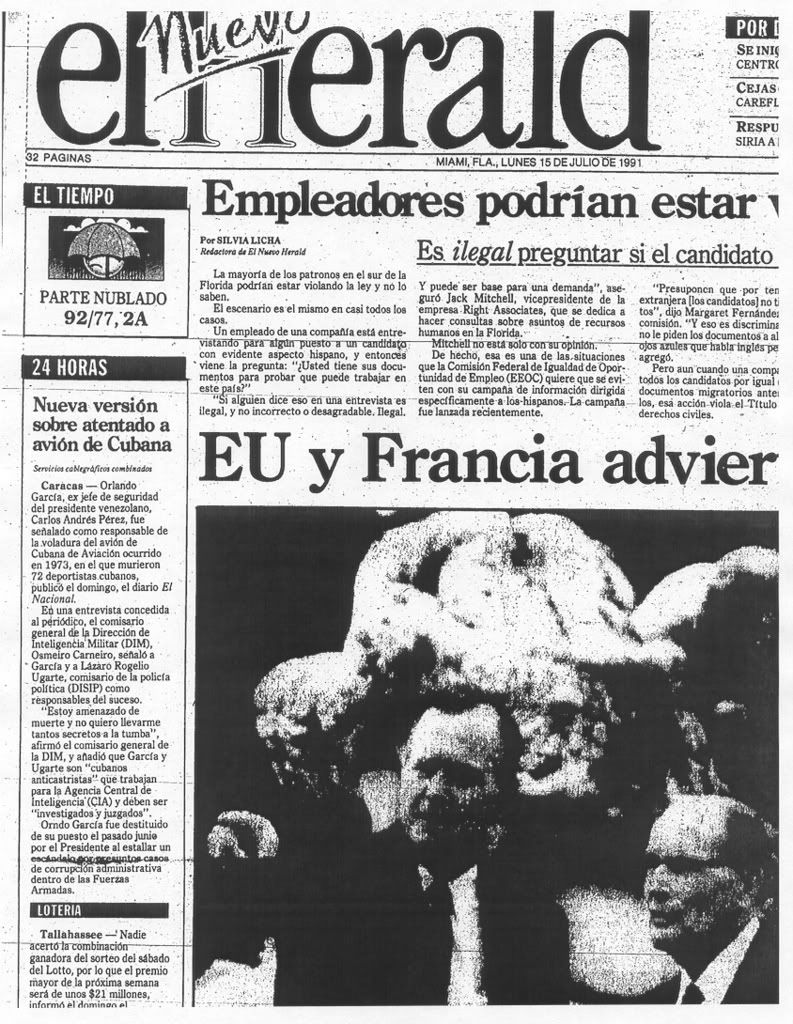
The article in question, titled "NUEVA VERSION SOBRE ATENTADO A AVION DE CUBANA" (New Version about Assault Against Cubana Plane) is an approximately 200-word news brief that appeared on the left column of the front page of El Nuevo Herald on July 15, 1991. The article never mentions Orlando Bosch or Luis Posada Carriles, and it never says that they were "scapegoats" or "innocent" of the bombing in 1976. In this respect Enrique Encinosa is lying.

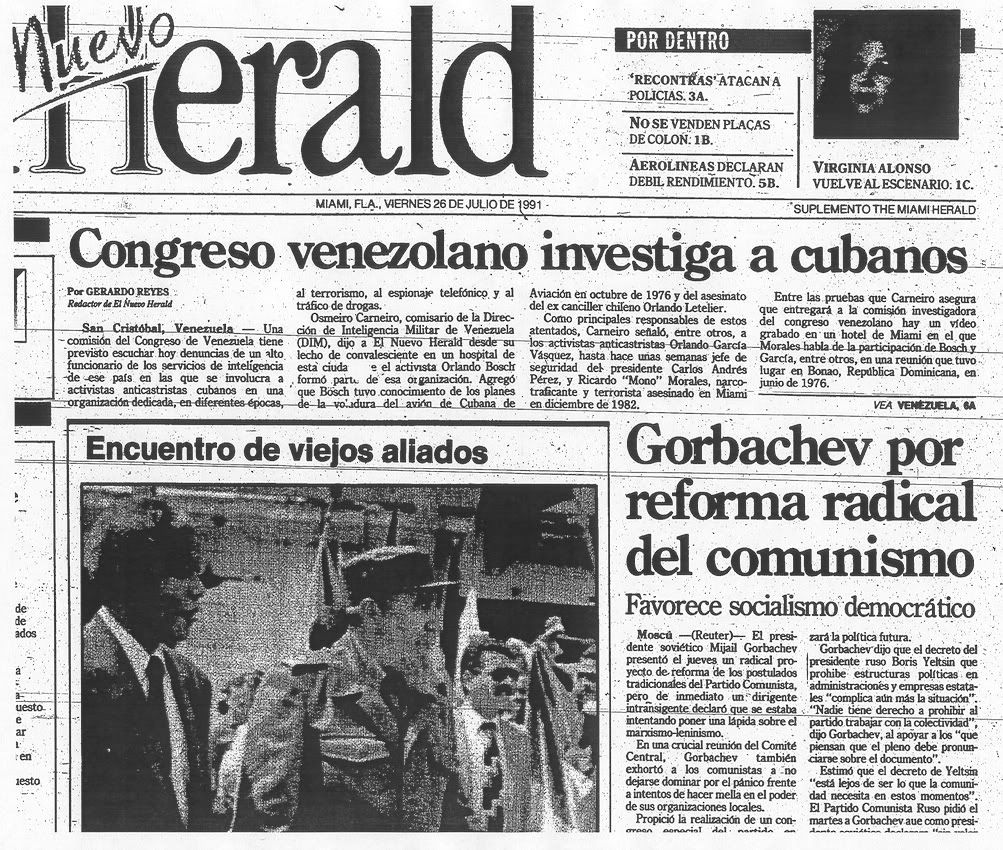
I pondered about why Enrique Encinosa would make such a deceptive statement about this article, until I found out that El Nuevo Herald had actually followed up with this story 11 days later with a full interview with Osmeiro Carneiro. On July 26, 1991, El Nuevo Herald published an interview with Carneiro by reporter Gerardo Reyes, who also followed the Carneiro story (about secret wiretaps in Venezuela) on the 27th and 28th. I'm sure that Enrique Encinosa could not have missed these articles, especially since the Carneiro interview made the front page and was a more than 1000-word article.

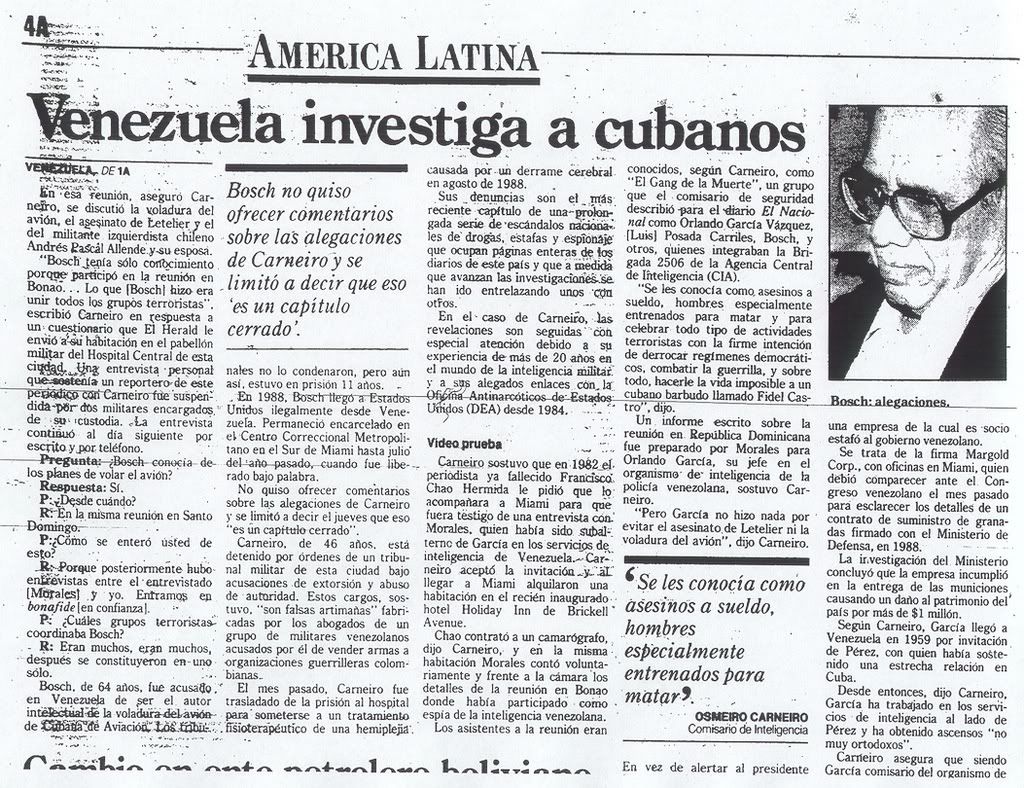
You can see portions of this 1991 front-page article titled "CONGRESO VENEZOLANO INVESTIGA A CUBANOS" by Gerardo Reyes here: Page1 and Page2.

In this "interesting" interview with Osmeiro Carneiro, a former military intelligence officer in Venezuela for more than 20 years, it is alleged that Orlando Bosch knew about the plan to bomb the Cubana flight in 1976 and helped "unite all the terrorist groups" against the Cuban government in June of that year. The other details that Carneiro mentions also lend support to the US government declassified documents that show Orlando Bosch and Luis Posada Carriles as conspirators to this act of terrorism. Carneiro just adds more names to the fire because he mentions that Bosch and Posada Carriles were part of a group he called "El Gang de la Muerte" (The Gang of Death).

Furthermore, Carneiro NEVER says that Bosch or Posada were "innocent" or "scapegoats." This is a fabrication by Enrique Encinosa, who in my opinion knew about this interview, but decided to ignore it and engage in propaganda to paint Luis Posada Carriles as an innocent victim in the bombing of the Cubana flight in 1976.

[Part 5]

Tuesday, February 27, 2007

The Last Protest (Part 2)

Last night, Marta Flores on Radio Mambi commented that she had hoped to see more people at the demonstration, especially younger ones. I was perhaps one of the very few under fifty. I looked around to see anyone near my age, but I was a needle in a haystack of middle-agers and retirees.

Among her remarks, Flores mentioned her disgust with a particular incident, of which I can also confirm. She mentioned that aerial banners that day had flown over the park which called on the release of the Cuban Five. I had an instant flashback once she said that because those two planes were unmistakable that afternoon. One after the other, those brightly colored planes flew over Miami's downtown highways, plainly visible to those underneath. I noticed them on my way to the demonstration, but was too far to read what they said.

According to El Nuevo Herald, the two banners read: "Posada-Terrorista-Libertad a los 5" (Posada-Terrorist-Free the 5) and "Posada-Terrorista-Enemigo de América" (Posada-Terrorist-Enemy of America). The exiles saw this as another provocation, but their demonstration saw no other distraction.

Once the final speaker finished and put the megaphone down, the sunburnt crowd began to disperse. Members of Vigilia Mambisa began to fold up their extra-large flag with care and precision, revealing the many times they had unfurled their national colors. Many walked home a short familiar route heading back to Little Havana, still wearing their miniature flags on their guayaberas. But, will it be the same ones the next time around I wondered, concerned with their progressing age.

Flores, reminisced about the old days where large crowds of Cuban-Americans would easily block Calle Ocho in protest, boasting of that old power. She was revealing her concerns about the future of the struggle. What has happened since then she asked herself. She blames communist/socialist propaganda that has poisoned their youth. What else could it be?

Far from Miami, on September 23, 2006, a protest of about 600 people gathered in Washington DC to condemn the incarceration of the Cuban Five, the largest gathering ever for that cause. Just like a bizarro reality, this group called for the extradition of Luis Posada Carriles to Venezuela, and condemned terrorism towards Cuba. These calls are also similar to the ones made in 2005 at the Ibero-American Summit in Spain where all the nations of Latin America signed a resolution calling for the extradition of Luis Posada Carriles to Venezuela, and condemning US policy towards Cuba.

Flores' concern is real. There is a shift occurring. And, that shift may have to do with the younger generation. But, I am not concerned about them like Flores, I have faith in them.

[Part1]

The Last Protest (Part 1)

The news of the turn out on February 24, 2007, was somewhat disappointing to Marta Flores. Flores, the nicknamed "Queen of the Night" on Radio Mambi, described last Saturday's protest with some disappointment, especially the lack of attendance of young Cuban-Americans. I agree with her description, I was there.

Several Cuban exile organizations gathered at the Jose Marti Park this past Saturday to call for the release of Cuban patriots in US prisons, such as Luis Posada Carriles. This protest is a repetition of the demonstration that occurred on January 19, 2007, at the Bay of Pigs Memorial on Calle Ocho. That event made headlines when counter-protesters where attacked by members of Vigilia Mambisa and their president Miguel Saavedra, all of whom were captured on video and photographed initiating the fight.

This time, some of the same exile groups came out on what turned out to be a beautiful Saturday afternoon, and the bright blue, cloudless sky presented no premonitions of hostilities. As I drove to Jose Marti Park, I had my radio tuned to Radio Mambi and listened to the 12 o'clock news program. By that time, Radio Mambi was already reporting a high turn out for the demonstration. According to El Nuevo Herald, about 500 protesters made the time to come out that day.

Once there, I noticed many other people, couples and families simply enjoying the weather, playing at the park, taking their pictures with the famous Miami River. I also happened to notice a boy scout troop had assembled nearby and were visiting the river front. Nevertheless, this wasn't any other Saturday for the gathered Cuban exiles.

Protesters calling for the release of their Cuban patriots shouted into a megaphone, making their demands to the crowd and the US government. Some, from as far away as Los Angeles, called for their immediate release, while others called for continued struggle. One made it clear to all who listened that the struggle is already underway to liberate Cuba. Never mind the obstacles that they have encountered all these years, one shouted out, they have plans ready for the eventual overthrow of the Cuban government. He assured everyone that many exile groups have their plans ready, and that they are waiting for the right moment.

[Photo by Ariel Remos of Diario Las Americas]

[Part 2]