Showing posts with label ricardo morales navarrete. Show all posts

Saturday, October 13, 2007

"Nack for Storytelling"

This week's Miami New Times features an article about Robert Alonso, a man who believes he is at war with the government of Venezuela. The article by Janine Zeitlin is a summary of Alonso's life as a Cuban exile and anti-Chavez activist, now living in Miami. Alonso left Cuba at the age of 11, on an old Spanish ship, an event where Alonso believes he committed himself to fighting dictatorships.

Today, Alonso is director of Venezuela Sin Mordaza, a magazine that is very critical of the Venezuelan government, which also includes articles by Carlos Alberto Montaner, Antonio Esquivel, just to name a few that are also very critical of the Cuban government.

I ran into the name Robert Alonso earlier this year when I wrote the 13-part post called "No Defense for Terror." You see, Alonso is another, like Humberto Fontova and Enrique Encinosa, who came to the aid of Luis Posada Carriles after he was arrested in 2005, trying to exculpate him in the eyes of the public. In "No Defense for Terror" I confronted some of these arguments that were in favor of Posada Carriles and found out they were either false or exaggerated. I focused mainly on Fontova and Encinosa after I realized that Alonso was just repeating what the other two were saying, and also because I was getting tired of writing.

But, Robert Alonso did add a new twist in the defense of Luis Posada Carriles and his involvement (or non-involvement) in the case of the Cubana flight bombing of 1976. You see, Zeitlin of the Miami New Times leaves out the part when Alonso was a so-called "independent" journalist in Venezuela during the 70's and 80's. Working in Venezuela at the time, Alonso began investigating the case of the Cubana flight bombing and the arrest of Luis Posada Carriles, a case he later called "The Trial of the Century" for a 1985, 50-minute documentary, which can be viewed on Google Video in five parts (in Spanish). The video (which is very informative) is essentially a soapbox for Posada Carriles, Orlando Bosch and their defense team. The documentary ends happily with the news of Luis Posada Carriles having escaped from prison in 1985.

Twenty years later, Robert Alonso, now exiled in Miami, appears on Miami Spanish TV with Maria Elvira Salazar (you can watch the edited version of the interview (in Spanish) on Google Video, courtesy of Guarimba TV). Alonso comes on the show (August 2005) for one important purpose: to defend Luis Posada Carriles who was arrested a few months ago (May 2005). Maria Elvira Salazar gives Alonso an entire show to dust off his 1985 book titled "Los Generales de Castro" (Castro's Generals) and present his version of events that absolve Posada Carriles from the bombing of Cubana flight 455, and instead accuse the Cuban government of the sinister plot. (Alonso also admits that he is "very friendly" with Posada Carriles, especially since they both come from the same city in Cuba.)

There are four important arguments in Alonso's defense: 1) the suspicious involvement of Ricardo Morales Navarrete as a possible double-agent and confessed involvement; 2) the forensic results of the Royal Armament Research and Development Establishment (RARDE) lab led by Erick Newton; 3) suspicious refusal of the Cuban government to recover the Cuban flight wreckage from the bottom of the sea; and 4) the identification of seven mysterious "generals" from the Cuban military who were supposedly on the doomed flight, but never included within the official list of 73 victims on board.

The first two arguments I have dealt with already because they were repeated by Fontova and Encinosa. Alonso, like the others, fails to mention that Morales Navarrete confessed to being one of many involved in the bombing, or at least knowing those who conspired in it. According to two persons who interviewed him (Diosdado Diaz and Osmeiro Carneiro), Morales Navarrete is as guilty as Luis Posada Carriles for the bombing of Cubana flight 455.

The results of RARDE should also be seriously doubted since the poor lab techniques used and the political influence of a Venezuelan official in the "independent" forensic investigation most likely favored Posada Carriles' defense.

The refusal of the Cuban government to recover the Cubana flight wreckage from the deep water is suspicious, especially since it could have provided important evidence in the case, but to create a grand conspiracy around this fact alone is irrational. There's plenty of other important evidence to inquire about in this case.

Finally, Alonso presents a very unique theory. In his interview with Maria Elvira Salazar, Alonso tells us that the Cuban government very likely blew up the plane because of seven Cuban military officials on board who would threaten Fidel Castro's leadership upon their return to Cuba. According to Alonso's personal investigation of the Cubana flight bombing, he discovered that there were seven unidentified men on board after examining the photo's taken by Hernan Ricardo inside the doomed plane. (Hernan Ricardo was eventually sentenced to 20 years in 1986 for his involvement in the bombing.) Supposedly, Ricardo took enough photos of all the ill-fated passengers for Alonso to conclude that there were seven men left off the "official" death count of 73 passengers. We are to assume further that these seven men secretly boarded the flight and that Ricardo's film has now been concealed by the Venezuelan government, or Cuban government, in a vast conspiracy to completely erase the whereabouts of these seven men (who were supposedly gaining great respect among their men after battles in Angola), and any other person or memory of those who knew them, because Fidel Castro alone feared their possible influence upon their return.

I've tried to get a hold of a copy of "Los Generales of Castro," but the book is out of print. And, unfortunately, the theory of the seven generals has not been reported elsewhere, or on the internet. But, how fortunate for Alonso to have his theory presented to a wide audience with Maria Elvira Salazar, who was delighted in accepting everything Alonso said.

If one reads the Miami New Times article on Alonso carefully one will see that the life of Robert Alonso, told to Janine Zeitlin, is very mysterious itself. Not only does he get "murky" when asked about specifics of his secret life (which he also long withheld from his own wife), Zeitlin notices some embellishments too. I think Zeitlin's instincts may have been accurate when she wrote that Robert Alonso "
has knack for storytelling." This may also extend to his supposed activism.

---------

Just discovered this. There's an article about Robert Alonso from 2002 published online from El Nacional, a Venezuelan newspaper. The article by Eric Colon, titled "Robert Alonso: The History Behind the Venezuelan Ed Wood" further supports the characterization of Alonso having a "nack for storytelling."

In the early eighties, according to the article, Alonso produced a very popular and controversial Venezuelan television show called "Lo Increíble" (The Incredible). It was shaped by the popularity of such American shows like "That's Incredible" where guests would perform "daring human feats with extraordinary precision." This means things like catching bullets with your mouth, or performing "psychic" stunts.

But, in Venezuela, Robert Alonso pushed the boundaries with his show. According to Colon, Alonso's show "adapted the format of investigative journalism to amazing fiction and the paranormal." Colon recalls shows "that demonstrated three-headed frogs and paralytic bullfighters." Robert Alonso also admits to making things up for the show, especially after his bosses asked for an additional half-hour of programming.

The Colon article covers additional history not found in the Miami New Times by Zeitlin, such as Alonso's run in with the corrupt media, and a stint in jail where he organized a concert for inmates, starring his famous sister, Maria Conchita Alonso.

But, what I found most fascinating about the article was this brief exchange with the reporter:

Colon: What's your opinion on the practice of journalism [in Venezuela]?
Alonso: That every good journalist should lie.
Colon: Are you sure? And they never accused you of being a swindler? Of being a fraud?
Alonso: No. On the contrary, they gave me awards and provided tributes... completely satisfied as long as your voice is lost within the frenetic song of the macaws and the dusk.

A "nack for storytelling" indeed.

Monday, July 9, 2007

No Defense for Terror (Part 9)

Everybody's favorite columnist, Humberto Fontova (left), asks the question that's on everybody's mind: Is Luis Posada Carriles a "Terrorist or Freedom Fighter?" This is the title to Fontova's May 21, 2007 column from FrontPageMag website, a version of an earlier piece released on May 15 on the NewsMax website. The second version presenting a less sarcastic and hysterical Fontova.

According to Fontova, the "Castroite propaganda apparatus (and its ever-faithful media and think-tank auxiliaries from London to Madrid to New York to Washington D.C.)" have presented a negative picture of a man who has dedicated himself for many years to noble American causes. One example Fontova mentions is the Reagan administration's mission to "crush communism in Nicaragua by arming and training Nicaraguan Contras." This noble cause that Luis Posada Carriles helped with was found by the International Court of Justice to have violated several international laws. The judges sided with the nation of Nicaragua and accused the US of "unlawful use of force." Nicaragua calls it terrorism.

Anyway, Fontova says that we should "cut Mr. Posada some slack."

But, what's important here is the defense that Fontova presents for us. Not surprisingly, Humberto Fontova doesn't mention the FBI investigations currently underway involving Posada Carriles and the bombing campaign against Cuban hotels in 1997. But, instead we are reminded that "
the accusations against Posada Carriles regarding the [1976] plane bombing have already had their day in court."

Fontova makes three arguments for Posada's "innocence" based on the findings that led to the acquittal of Luis Posada Carriles in 1980:

1) "
The evidence examined by Venezuelan judge José Moros González in 1980 to declare Posada totally innocent was so overwhelming, authoritative, and conclusive...";

2) "
Among this evidence was a 200-page report from the Forensic Explosives Laboratory of Britain's Royal Armament Research & Development Establishment, (ARDE) considered the most authoritative source on earth for investigations of this kind";

3) "Finally, there is already a confession to the plane bombing of which Carriles is accused. It comes in the form of deposition in Dade County’s 11th Judicial court dated April, 5 1982—and it’s from a Castro double-agent named Ricardo Morales Navarette."

No, I'm not gonna criticize Fontova for misspelling Navarrete, but rather examine a principle that Fontova describes in his article. He states that:

"
The intervening half-century witnessed many events [from Cuba] that might have prompted mainstream journalists and commentators to be a tad careful when accepting [the Cuban] regime's press releases at face value, right?"

Mr. Fontova is correct. All journalists and commentators should question their sources (no matter their origin), but its unfortunate that Humberto Fontova himself does not follow his own advice. Instead, Fontova has easily accepted the allegations which come directly from Luis Posada Carriles himself. Let's review.

[Part 10]

Wednesday, July 4, 2007

No Defense for Terror (Part 8)

"Carneiro assures that [Orlando] Garcia, being the Commissioner of the police intelligence agency of Venezuela, ordered one of his subordinates to give Cuban-Venezuelan police officer* [Luis] Posada Carriles the C-4 explosives which blew up the [Cubana] plane."[1]

*[Luis Posada Carriles was at the time a private investigator who was a former chief of Venezuela's civilian security police DISIP (Dirección de los Servicios de Inteligencia y Prevención).]

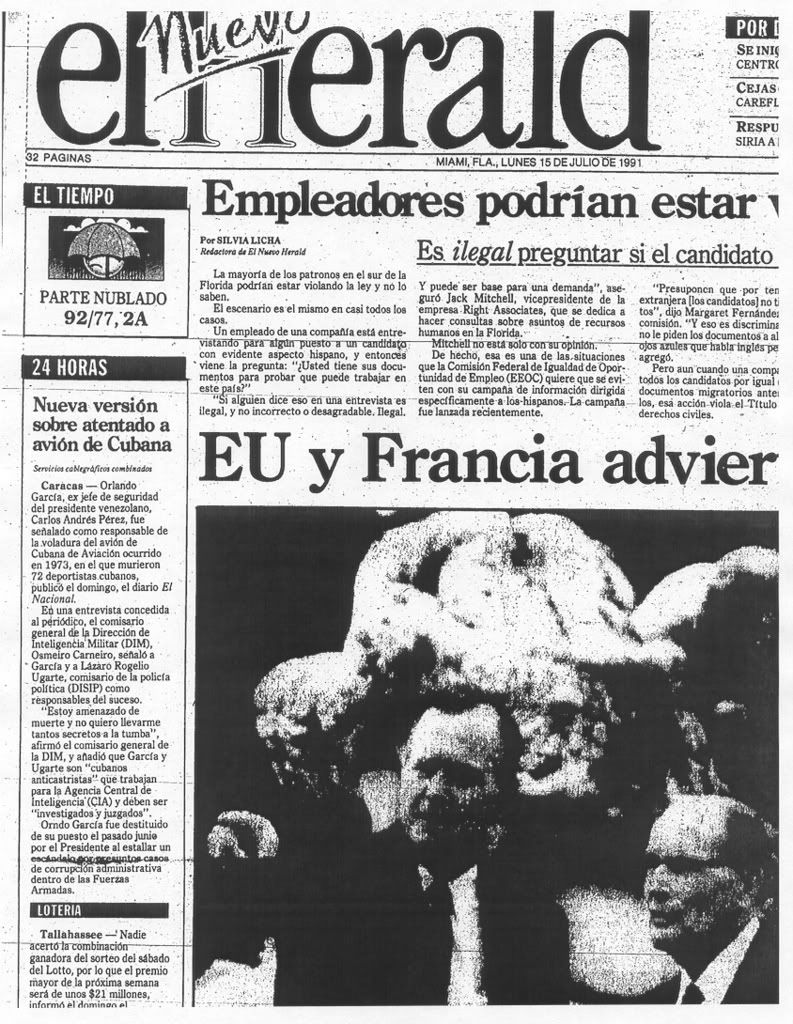
This is what El Nuevo Herald reporter Gerardo Reyes wrote in his July 26, 1991 article about his interview with Osmeiro Carneiro. A story that Enrique Encinosa has erased from memory.

Carneiro's allegations, like Diosdado Diaz's, are based on confessions by Ricardo "El Mono" Morales from another interview which was video-taped by reporter Francisco Chao Hermida.

Carneiro recounts to Gerardo Reyes that "in 1982, the late journalist Francisco Chao Hermida asked [Carneiro] to accompany him to Miami and be a witness to an interview with Morales." According to Carneiro, both men travelled to Miami and stayed in a newly inaugurated Holiday Inn on Brickell Avenue where they interviewed Morales on camera. It was there, according to Carneiro, that Morales confessed about the conspirators of the 1976 bombing, which included Orlando Bosch, Luis Posada Carriles and Orlando Garcia. The three of whom where members of what Carneiro and others knew at the time as the "Gang of Death." But, there is controversy within the confessions to Osmeiro Carneiro and Diosdado Diaz.

According to Luis Posada Carriles, from his book Los Caminos del Guerrero (Chapter 13), Francisco Chao Hermida came back from his Miami interview saying that Ricardo Morales "has recounted interesting things about the bombing of the Cuban airplane and that [Morales] is prepared to tell them to [Posada's] lawyers." One of Posada's lawyers, Raymond Aguiar, immediately flies to Miami and conducts another video interview with Ricardo "El Mono" Morales where he repeats what he supposedly told Francisco Chao Hermida.

According to Luis Posada Carriles, Morales confessed to knowing that the bomb on the Cubana flight was initially placed in Guyana; that the bomb was made of dynamite placed in the baggage compartment of the plane; and that the bomb was originally timed to kill everyone including Hernan Ricardo and Freddy Lugo before they stepped off the plane in Barbados. The motivations for this plan were not revealed.

The contradictions begin here.

- El Nuevo Herald (Alfonso Chardy and Oscar Corral) viewed the 1982 Morales video-taped interview with Francisco Chao Hermida and reported in May 9, 2005 that "El Mono" Morales pointed to Gustavo Castillo, instead of Luis Posada Carriles, as the one who prepared the bomb for the Cubana flight. This contradicts the confessions to Detective Diosdado Diaz and the recollections of Osmeiro Carneiro, both of whom heard that Luis Posada Carriles was involved.

- Morales' confession of the use of dynamite contradicts sworn statements in Operation Tick-Talks of the use of C-4 to blow up the Cubana flight. C-4 being the most popular explosive used for such operations, and involved with prior usage by Luis Posada Carriles and Ricardo Morales.

But, there are ways to make sense of all this.

1) You can believe Detective Diosdado Diaz, who is a more than 20-year veteran officer in Miami, and Osmeiro Carneiro, who was also a more than 20-year veteran of Venezuelan military intelligence, when they say that Luis Posada Carriles was definitely involved in the 1976 bombing (which also supports the declassified evidence and other allegations involving Orlando Garcia), or...

2) You can believe Luis Posada Carriles' secret double-agent who told him that Cuban agents paid Ricardo "El Mono" Morales Navarrete $18,000 to kill 73 innocent people just to continue smearing Miami Cuban exiles and momentarily justify internal Cuban government repression, or...

3) You can dismiss ALL the testimony and alleged confessions by Ricardo "El Mono" Morales, and then realize that ALL the defenders of Luis Posada Carriles (Encinosa, Byrne, Fontova and others) have been deceiving you.

Notice that the final scenario has no defense for the declassified documents on the 1976 bombing (excluding those using Ricardo Morales as a source), and the 1997 bombing campaign against Cuban hotels which is currently being investigated by the FBI, and has Luis Posada Carriles as a prime suspect.

It's up to you to decide.

In my opinion, the defense of Luis Posada Carriles by those mentioned above is nothing more than an exercise in propaganda. Enrique Encinosa, for more than 10 years, has repeated lies about Osmeiro Carneiro and Ricardo Morales. From his 1994 book, Cuba en Guerra (p.280-283), to his 2004 book, Unvanquished (p.124-126), Encinosa has used the July 15, 1991 Osmeiro Carneiro news brief and Luis Posada's book as his only two sources.

Currently, Enrique Encinosa is the news editor at Radio Mambi.

But, there are other important defenders for Luis Posada Carriles.

Humberto Fontova and Robert Alonso.

[1] El Nuevo Herald, July 26, 1991, "Congreso Venezolano Investiga a Cubanos" by Gerardo Reyes.

[Part 9]

No Defense for Terror (Part 7)

So what did Ricardo "El Mono" Morales Navarrete say in a Florida courtroom? Well, it wasn't exactly a courtroom, but instead an office.

Beginning in 1980, Morales had become a state informant for a Miami narcotics investigation called Operation Tick-Talks which eventually led to 53 arrests. Among those arrested were "veteran dealers, respected business people and the politically well-connected."[1]

For three weeks in 1982, Morales testified under oath to "two attempted murders, gangland bombings, political terrorism, narcotics dealing and a role in the destruction of an airliner in which 73 persons died."[2]

"In a ninth-floor office in the Metro Justice Building, Morales was questioned under oath by [Attorneys] Douglas Williams, Ed Carhart and Kirk Munroe for more than three weeks, with Williams asking most of the questions. Lasting more than 75 hours, the sessions produced nearly 1,000 pages of transcripts."[2]

What is important to us is what exactly Ricardo Morales confessed to concerning the 1976 bombing.

"Morales said he helped provide anti-Castro terrorists with the explosive for the bomb."[2]

According to deposition copies found here and here, Morales says he was "part of the conspirators." Specifically, "surveillance of the regular flights of that Cuban Air Force plane*, providing by a third party the explosives."

*[Morales believed that the Cubana airplane was a Cuban Air Force plane in disguise.]

But, there's more that Morales allegedly confessed to.

According to a El Nuevo Herald article from May 9, 2005, the lead detective of Operation Tick-Talks, Diosdado Diaz, said that Morales "stated to him in 1982 that [Morales] supplied the explosives and that [Luis Posada Carriles] prepped them to bring down the plane."

Diosdado Diaz at the time was a veteran to the Special Investigations Section in Miami, the city's anti-terrorism agency. In 1981 he had been selected as December's Officer of the Month.

Before Ricardo Morales was extensively questioned by attorney Douglas Williams, Diosdado Diaz had already questioned Morales. "Douglas Williams recalls that it was the detective [Diosdado Diaz] who confirmed for him in a lengthy deposition that Morales, as chief of counterespionage for Venezuela, had played a role in the Cubana Airlines bombing."[1]

It is in this deposition that Morales claims Luis Posada was involved in the 1976 bombing. Unfortunately, according to the 2005 Herald article, "Diaz says he wrote a report for the Miami police on Morales' confession, but the record could not be found."

How fortunate for Luis Posada Carriles.

But, there is ANOTHER person who also says that Ricardo "El Mono" Morales confessed to Posada's involvement in the '76 bombing.

Osmeiro Carneiro.

[1]The Miami Herald, October 3, 1982, "Errors Lead to Tick-Talks Toss-Out" by Eric Reider.

[2]The Miami Herald, June 1, 1982, "Terrorist Admits Bombings and Two Attempted Murders" by John Katzenbach.

[Part 8]

Tuesday, July 3, 2007

No Defense for Terror (Part 6)

EL MONO

According to Enrique Encinosa's latest book, Unvanquished: Cuba's Resistance to Fidel Castro, "[a] key player in the [1976 Cubana flight bombing] was Ricardo (Monkey) Morales"(p.124). According to Hugo J. Byrne, another defender of Luis Posada Carriles, Ricardo Morales was the "central figure" in the 1976 bombing. Also, everybody's favorite columnist, Humberto Fontova, believes that Ricardo Morales is the confessed terrorist of 1976, which absolves Luis Posada Carriles by default.

ALL the defenses that I have read so far claiming innocence for Luis Posada Carriles have blamed the notorious Ricardo "El Mono" (the Monkey) Morales Navarrete. In my opinion, it is one of the most successful propaganda exercises to vindicate Luis Posada Carriles of the bombing in 1976. But, if one actually READS what Morales Navarrete confessed to, you will see that Orlando Bosch and Luis Posada Carriles are not innocent at all. Let's review the facts.

"According to testimony under oath by Morales Navarrete, the Castro conspiracy originated in Mexico... [where] Morales Navarrete met with Castro agents of the DGI [General Intelligence Directorate] who gave him $18,000 and summarized a plan to blow up a Cuban airplane and destroy Orlando Bosch and Luis Posada Carriles, who would be blamed for the attack."

This is the premise of Enrique Encinosa's theory that places "El Mono" Morales at the center of a Cuban government conspiracy designed to "accuse [Miami] exiles [for the 1976 bombing] and defend itself from accusations of systematic violations of human rights." But, Encinosa is lying again. Ricardo Morales Navarrete never made such statements under oath. These are allegations made by Luis Posada Carriles himself.

In 1994, Luis Posada Carriles wrote a book titled "Los Caminos del Guerrero" (Paths of the Warrior). One of the book's main goals was to let Posada tell HIS side of the story when he was arrested in 1976 for the bombing of the Cubana flight, and recount the events that occured afterward. In Chapter 11, Posada provides HIS theory on who really committed the bombing. Its the same theory that Encinosa provides in La Verdad sobre Posada.

According to Posada, the theory blaming "El Mono" Morales is based on three sources:

- Interviews with Ricardo "El Mono" Morales by Posada's former lawyer, Raymond Aguiar, and by journalist Francisco Chao Hermida, on different occasions.

- Posada's own interview with a secret double-agent inside the Cuban government and allegedly involved in the 1976 bombing.

- Independent investigations of the '76 bombing that where financed by Posada's lawyers.

If you notice, Posada never mentions that his theory is based on the sworn testimony of Ricardo Morales in a Florida court. That's because Morales never said it.

The theory stating that Ricardo "El Mono" Morales received payment from Cuban agents to blow up the Cubana flight originates from Posada's secret double-agent, NOT Morales.

In a Miami Herald interview with Posada, dated May 17, 2005, Luis Posada Carriles specifically tells the Herald that "a spy inside the Cuban Embassy in Caracas told him that Morales had been working for the Cuban government after its agents paid him $18,000 at a Mexico City hotel in early 1976."

Of course, there is no way to verify if this theory is true. How convenient that Posada's double-agent is still undercover.

However, its clear that Luis Posada Carriles never mentions that his theory is based on the sworn testimony of Ricardo Morales in a Florida court as Enrique Encinosa suggests. Yet again, Encinosa is lying.

[Part 7]