Showing posts with label Killing Fidel Castro. Show all posts

Wednesday, February 27, 2008

What Will They Say? (Part 2)

Last week I focused on an article published by the Miami Herald which raised some questions for its editors: "Will [Fidel Castro] still be the dictator? The former dictator? The half dictator? Or if he dies, what should his obituary say?"

This prescient article, written a few days before Fidel Castro publicly resigned as Cuba's immovable President, I found to be quite unoriginal and incomplete. The author, Edward Schumacher-Matos (the Herald's Ombudsman), ignores the very questions he himself raises and provides no direction or guidance to readers (or editors) so they can decide for themselves how to answer those questions. Instead, the article becomes a soapbox for Schumacher-Matos' views in which he criticizes reporters for being "squeamish" when describing Fidel Castro as a "leader" or "president" instead of "dictator." And, finally ends all debate and discussion because "calling [Fidel] Castro a dictator is a fact, as much as it is that most contentious of things, a truth."

In my opinion, Edward Schumacher-Matos never wanted to have a serious discussion about how people describe their political leaders, or to enlighten anyone with a discussion on how the general population reflects on abuses of power by leaders of the world. By avoiding "that most contentious of things," Schumacher-Matos misses a very important point about the word "dictator," leaving readers very misinformed, and journalists in danger of risking their obligations to the public.

"Dictator" is an emotionally-loaded word. It has various uses throughout society describing all kinds of people who abuse their authority or position within a social hierarchy against the wishes of subordinates. Of course, the label is most used when its comes to heads of state: note the recent list of Parade Magazine's "World's Worst Dictators." Obviously, since these are political agents capable of exerting maximum power over a population, they become the targets of the most passioned denouncements, mainly by their victims. Therefore, using the word "dictator" is not merely an act of reporting "fact" as Schumacher-Matos conveniently describes it, it is also an act of outrage, which is not the role of a journalist.

One of the most important tenets of journalism is independence. If a journalist begins to express certain outrage (real or perceived) in favor of one side, then his or her public credibility can be harmed. By settling for neutral labels like "leader" or "president," the journalist prevents any perceived conflicts of interest, and can concentrate on the ultimate journalistic duty of "providing a fair and comprehensive account of events and issues." I believe the honest journalist will see that this position is justified, unless one is willing to sacrifice the public's right-to-know for one moment's personal outrage.

Yet, sometimes we cannot help it. Emotions have a way of influencing most of our behavior, and sometimes without our control. In addition, those expressions are mostly subjective and sometimes may not adhere to the general attitudes of the population. Therefore, it seems reasonable for the journalist to avoid using emotionally-loaded writing, and instead place priorities towards the science of testing accurate information, and the responsibility of providing relevant context.

But, we are still human, and the word "dictator" still belongs to our arsenal of personal judgments. When the recent "World's Worst Dictators" list came out, several readers' comments nominated President George W. Bush. Even the author of the list, David Wallechinsky, in 2006 stated that "Bush does use many of the same tactics that real dictators use, committing the same human rights abuses that the U.S. State Department condemns when they occur in other countries, declaring himself not bound by laws passed by Congress, and using the old, classic dictator line, 'Our nation is threatened by an evil outside force; only I can save the country and if you oppose me you are unpatriotic and support the enemy.'" (But personally, Wallechinsky does not believe Bush is a "dictator.")

So, what will they say when Fidel Castro dies? For whom shall he be "president," and for whom "dictator?" Let's find out.

[Part 3]

Wednesday, June 20, 2007

No Defense for Terror (Part 1)

As annoying as the Luis Posada Carriles case is, the defenders of terrorism against Cuba are just as annoying.

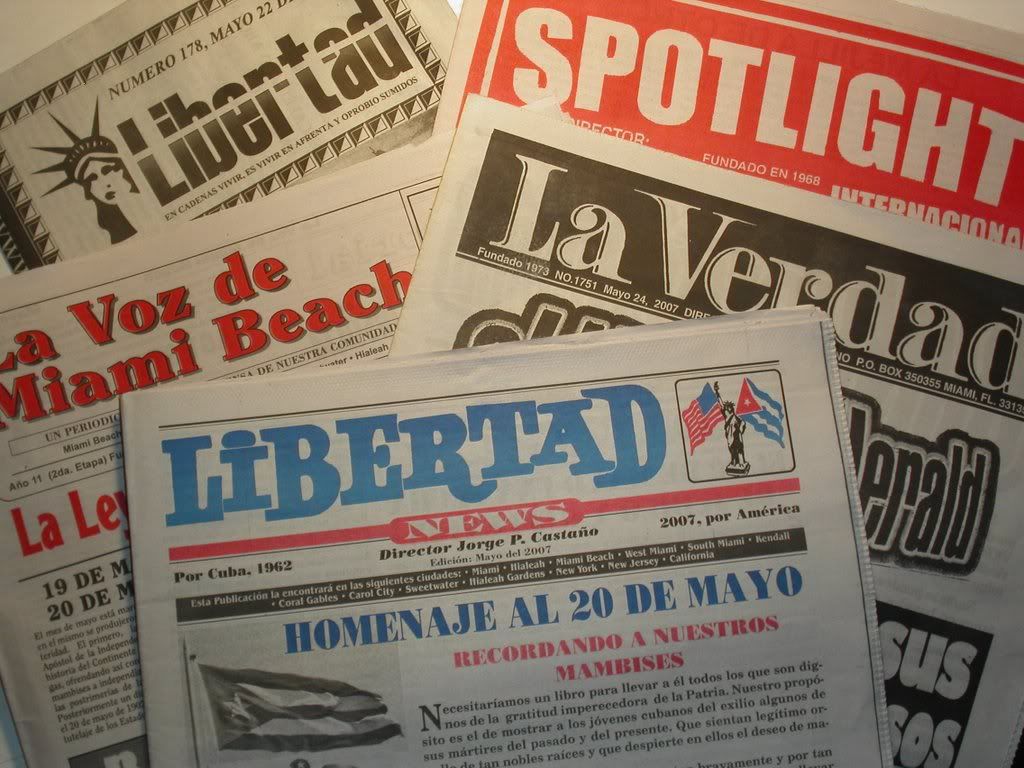
Here in Miami, there are many who are ready to defend Luis Posada Carriles, his acts of terrorism, and have no shame to do so. As the picture on the left shows, many arguments in defense of terrorism against Cuba appear in several small newspaper publications that can be found around Little Havana. Those shown in the picture are merely for the month of May.

These publications can be found in many parts of Little Havana, and have been in existence for very long. Their editiorials regularly speak of the "flagrant violations" by the Cuban government, "the bloody tyrant" Fidel Castro and his "communist aggresion." They're the old-school bloggers. Their pages welcome articles by Carlos Alberto Montaner, Armando Perez-Roura, Ramon L. Bonachea, Luis Conte-Aguero, Agustin Tamargo, and any other who speaks against the "communist agression."

But, as adamant and vocal as some are to justify a war against Cuba, their arguments in defense of Luis Posada Carriles are surprisingly poor. Let's examine one example that argues that Posada Carriles is in fact "innocent" of the bombing of a Cuban airplane in 1976 that killed 73 people on board.

Perhaps one of the most important defenses for Posada Carriles comes from Enrique Encinosa. Encinosa is well known to his listeners on Radio Mambi, and by the fans of his many books on Cuban history. Encinosa also appeared recently on the documentary "638 Ways to Kill Castro" saying that terrorism is an "acceptable method" against Cuba. The documentary also reveals Encinosa's very close relationship with Posada Carriles, whom he called regularly while Posada was in federal prison. Last October, Encinosa released an article titled La Verdad sobre Luis Posada (The Truth about Luis Posada). Its main argument is that Luis Posada Carriles is in fact a "scapegoat" and "innocent" of the 1976 bombing. He presents many theories and testimonies that suggest a connection with the Cuban government and the bombing. This article has found its way into many different websites that I have found:

- La Junta Patriotica Cubana (The Cuban Patriotic Board) website

- La Nueva Cuba (The New Cuba) website

- Cuba Nuestra Digital (Our Cuba Digital) website

- Cuba Democracia y Vida (Cuba, Democracy and Life) website

- The Univision (US Spanish Television Network) website

And blogs:

- El Club de Los Amigos Malos Blog

- Baracutey Cubano Blog

- Blog for Cuba

Encinosa's article DOES NOT presents "La Verdad" about Luis Posada Carriles. On the contrary, I will argue that Encinosa engages in an exercise of propaganda because of his obvious ommissions of important facts in the case of Luis Posada Carriles. Also, I accuse the websites above for supporting false representations of the facts, and perpetuating the false innocence of Luis Posada Carriles.

Let's review the facts of Encinosa's argument.

[Part 2]

Friday, March 2, 2007

This Week's Documentary

I've been extremely busy and will be for the next two weeks. My posts therefore will be shorter than usual. So, I've decided to list some documentaries about Cuba that I think are excellent, and contribute to the current debate about US policy. Today I will highlight one film, followed by another next week.

Some of you may have heard of this documentary when its outtake of Ileana Ros-Lehtinen supporting an assassination attempt on Fidel Castro made the news. She denied her remarks first, then (two weeks later) admitted them. You can also check out how some of our favorite Cuban-American bloggers (Mr. Gomez from Cuban American Pundits, and Robert from 26th Parallel) displayed similar, astonishing attempts at denial when the news first broke. While Mr. Gomez and Robert don't seem to care about the ethical responsibilities of US Representatives, most likely they still believe the video outtake to be a manipulation.

But, aside from Ileana's controversial comment, the film "638 Ways to Kill Castro" by Dollan Cannell is excellent. The final cut does not include our favorite Republican from district 18, but it does include Radio Mambi's own Enrique Encinosa, who alone makes his own controversial comment in the film in support of terrorism. In general, the film is a historical outline of the hostile relations of the US towards Cuba (not just towards Fidel) since the Revolution. Perhaps the most important part of the film, in my opinion, is its focus on our local "patriots," like Rodolfo Frometa (leader of the F4 Commandos and who seems to have successfully indoctrinated his son in the film) and Luis Posada Carriles (some of whose paintings are sold through Enrique Encinosa at exorbitant prices).

Thanks to the magic of the internet (and Google Video) the entire documentary by Dollan Cannell is available to us. It is viewable in two parts (in mp4 format for download), with commercials due to its premiere on UK Channel 4.

[Part One]

[Part Two]

Best to all.

Wednesday, February 7, 2007

Enrique Encinosa in the Spotlight


Aside from Ileana's supporting role in the documentary "638 Ways to Kill Castro," Univision's own Enrique Encinosa plays a small role as "man who justifies terrorism."(my title)

Just yesterday, I posted Encinosa's comment about what he thinks Cubans should do with a thousand boxes of matches. Well, now its pretty clear that Radio Mambi's Enrique Encinosa, who works as their news editor, favors terrorist methods. In this part of the documentary, when he's asked about the hotel bombings in Cuba in 1997, Encinosa replies:

"I personally think its an acceptable method. Its a way of damaging the tourist economy. The message that [almost says YOU, as if he's done it before]... one tries to get across is that Cuba is not a healthy place for tourists. So, if Cuba is not a healthy place for tourist, because there's a few windows being blown out of hotels, that's fine."

There's an interesting psychology involved here. It seems that acceptance for this form of terrorism, which seems to target property only and not civilians, totally denies the fact that there are financial victims nonetheless. And, furthermore, does not account for use of explosives, which can cause accidental bodily harm, or death. Incidentally, the bombing campaign in '97 led to the death of an Italian tourist, of which suspected terrorist mastermind Luis Posada Carriles responded: "It is sad that someone is dead, but we can't stop... That Italian was sitting in the wrong place at the wrong time.''

According to the US Department of Defense, terrorism is defined as:

"... the unlawful use or threatened use of force or violence against individuals or property to coerce or intimidate governments or societies, often to achieve political, religious, or ideological objectives."

There's no question that Posada Carriles' aims are political, and not alone economically focused. In his 1998 interview with Ann Louise Bardach, Posada Carriles passed her a three-page manifesto that read at one point:

"The absence of freedom of expression, of freedom of movement for a hungry people oppressed and terrorized by communist repression... This gives all free Cubans a right to take up arms against the tyrant, using violence or whatever means at our disposal to derail this terrible system and bring freedom to our country."

Enrique Encinosa has mentioned many times on radio that he keeps in touch with Posada Carriles, who is now in prison for federal charges, and how he's a patriot above all. Just last week, Encinosa said that if things get worse, Posada Carriles was prepared to hunger strike to his death!

I can't say I would admire such an act.

Thursday, February 1, 2007

Miami Herald's Misplaced Priorities

While recently doing research for tomorrow's BIG blog post, I ran into another example of how our local media gives uneven and biased coverage to Cuba-related issues. Now, I'm sure many would say that since we live in Miami, where the Cuban-American population outnumbers other ethnic groups, that the public is entitled to a larger coverage of Cuba-related news. Well, I agree on that point. Where I disagree is on the biased coverage of Cuba-related stories, and unfair coverage in comparison to much more important national news.

This seems like a personal grievance, but allow me to present a clear example.

I was recently shocked to see that on December 6, 2006, the Miami Herald devoted only 433 words to the latest report on health in the US, while on January 17, 2007, the Herald devoted 1120 words to continued speculation on Fidel Castro's health.

This is an astonishing example of how priorities at the Miami Herald are gravely misplaced.

John Dorschner, health reporter for the Herald, essentially wrote a very brief summary of the annual report titled "America's Health Ranking's." This report, compiled by the United Health Foundation, the American Public Health Association, Partnership for Prevention and other collaborations, is perhaps the most detailed report on the nation's health. Dorschner's piece titled "Florida drops a spot to No. 41 for healthcare", which appeared nicely on top of page 6A, but dominated by the presence of New York's ban on trans fat, saved only the last few paragraphs to describe the real impact of the report: that the nation's health has "stagnated" since 2000, obesity levels are "alarming", and that the US has fallen behind international health standards among the industrialized nations.

Yet, on January 17, 2007, John Dorschner and Nancy San Martin devoted 1120 words to a story on Fidel Castro's intestines, based on anonymous sources from Spain of course. This is tragic. Why couldn't it have been the other way around, with the nation's health receiving 1120 words instead of 433?

Why hadn't the nation's health appear on the front page that day, while a piece on how Hugo Chavez uses Jesus Christ as a socialist inspiration does? Actually, what should have happened was that the Chavez piece, which was 336 words, should have been scrapped, and the nation's health should have been given its appropriate space on the front, and with 769 words total to better summarize the health report.

There's no excuse for such unfair coverage.