Showing posts with label Dictators. Show all posts

Saturday, March 1, 2008

What Will They Say? (Part 3)

As argued in Part Two, using the word "dictator" to describe world leaders is not just technical, but also emotionally personal and subjective, and sufficient enough to harm a journalist's independence and responsibility to the public if perceived this way. Nevertheless, reporters are human too, and our personal judgments always seem to find their way into our work and behavior.

With this in mind, what will the public say about Fidel Castro when he finally kicks the bucket? Will they call him President? Dictator? Will descriptions be objective, or subjective? Curious myself, I decided to so a small study and make a prediction.

As some may or may not know, Haji Muhammad Suharto of Indonesia died last month after being gravely ill for weeks. Suharto ruled Indonesia for 32 consecutive years before his forced resignation in 1998. His legacy is a controversial one; some accusing him of vast human rights violations (including genocide), others overlooking his mistakes for other social gains. (Sound familiar?) Reviewing how American newspapers described Suharto (as "president" or "dictator") during events of his official resignation and after his death, I believe, may provide a glimpse into how the media will eventually describe Fidel Castro near the end of his life.

I also took the time to review how American newspapers have described Fidel Castro during two past events: his transfer of power to his brother in July 31, 2006 and his recent resignation on February 19th. I used the NewsBank database for this small study, whose results were very interesting and, given the different historical and political backgrounds, open to interpretation.


SUHARTO

The news of Indonesian President Suharto's resignation in May 1998 reached the headlines of many American newspapers. This was mainly due to the fact that Indonesia was hit with "its worst economic crisis in decades" and a student-led movement to oust Suharto soon erupted into looting and massive riots. The origins of the immediate outrage were reported: "... sharp increases in the prices of basic goods and services last week have further impoverished ordinary Indonesians. Anger spilled over into the streets Tuesday after police shot and killed six anti-government protesters at a student rally." As the riots spread, and the death toll continued to rise, US Secretary of State Madeleine Albright intervened to demand Suharto's resignation. He did the next day. Months later it was estimated that over a 1000 people died in the riots in Jakarta and other cities.

I found 335 American newspaper articles reporting Suharto's resignation, including reports of the following two days. Of those reports, only 6% included the word "dictator," while 96% used "president." A closer look showed that some reports referred to Suharto's "autocratic rule" or "ironclad rule."

All of this changed this year when Suharto became gravely ill and died in January. American newspapers paid very little attention this time with only 58 articles found on the day of his death and the following two days. But, somehow reporters felt far more inclined to describe Suharto as a "dictator" and less a "president." Of those 58 articles, 79% used "president" (drop from 96% in 1998) and 59% used "dictator" (rise from 6% in 1998). I also found that more articles used both "president" AND "dictator" during this time (40%, a rise from 6% in 1998).

I believe this change in attitude in the newspapers was due to the revelations that immediately occurred after President Suharto resigned, and the growing public awareness (and extensive documentation) concerning his abuse of power before his final days. After his death, it seems that the media expressed their well-developed outrage over the 32-year governance of President Suharto, as reflected in the increased use of "dictator."


SUHARTO INC. and BEYOND

It was just one year after his resignation that Time magazine published a special 4-month investigative report ("Suharto Inc.") revealing the vast corruption behind Suharto's presidency. According to the report:

"Suharto laid the foundation for the family fortune by establishing the intricate nationwide system of patronage that kept him in power for 32 years. His children, in turn, parlayed their ties to the President into the role of middlemen for government purchases and sales of oil products, plastics, arms, airplane parts and petrochemicals. They held monopolies on the distribution and import of major commodities. They obtained low-interest loans by colluding with or even strong-arming bankers, who were often afraid to ask for repayment."

Time magazine was sued by Suharto afterwards. Despite two lower courts ruling in favor of Time, a final Supreme Court decision in Indonesia sided with Suharto. Time has appealed and stands by their story. But, the Time report was just the beginning. Charges of corruption haunted Suharto while on his deathbed and now haunt his legacy, and family.

The day after Suharto's death, William Pesek of Bloomberg News pointed out how international organizations had already pointed to the culture of corruption left behind by President Suharto, and how that vast corruption revealed itself in the collapse of 1998.

"It's the great Suharto paradox. During his tenure, per- capita income in the fourth-most-populous nation quadrupled and the ratio of those living in absolute poverty declined from more than three people in five to about one in 10 by 1998. Yet Indonesia's development model proved to be a house of cards that crumbled in a matter of months. Perhaps the bigger question is how a nation as resource-rich as Indonesia [with oil, gas, timber] could do so little. This is among Suharto's biggest failings."

Yet, Pesek noticed how Suharto still had strong support among those who felt he helped Indonesia in the economic long-run.

"The nostalgia some feel for the Suharto days is among the most baffling [and maddening] elements of the post-Suharto era. It's all about the 'cult of GDP' that dominates much of Asia. 'Indonesia's political and intellectual poverty, the repressive security apparatus... these were accepted because, economically, Suharto was a hero,' Richard Lloyd Parry wrote in his 2005 book 'In the Time of Madness.' 'However unhappy Indonesians were with their leader, there was no doubt that, under him, most of them had become better off.'"

"It's a phenomenon that political scientists refer to as 'performance legitimacy.' Suharto knew that if Indonesians felt better off, they would tolerate a stunted society."


CROOK AND TYRANT

Unlike Pesek at Bloomberg, the Economist magazine had very tough words for Suharto after his death. They called him "a despot, a cold-war monster cosseted by the West because his most plausible opponents were communists. Behind his pudgily smooth, benign-looking face lay ruthless cruelty. The slaughter as he consolidated his power in the mid-1960s cost hundreds of thousands of lives. Tens of thousands were locked up for years without charge. After the invasion of East Timor in 1975, the Indonesian occupation led to the deaths of perhaps one-third of its people. Meanwhile, he was robbing his own country blind. Perhaps no leader's family anywhere has ever amassed so much ill-gotten loot. When he was forced to quit at last, the economy was in a tailspin and the stability he had boasted of creating proved an illusion."

And, this seems to be the prevailing attitude about the legacy of President Suharto in the US. Even the US-funded Voice of America reported about how the many victims of Suharto's presidency are trying to reclaim their lives from memories of horrific violence and death. Ever since his resignation, the corrupt and bloody history of Suharto's presidency has been well-documented and implanted into the public consciousness. But, for Americans there might be an additional sense of outrage, as it all occurred with approval by the Western powers, especially the US government.


MASS MURDERER

The National Security Archives has been leading the way in providing declassified material concerning US support of the genocide against East Timor. Their Indonesia/East Timor Documentation Project is extensive, and include materials that have served in Truth and Reconciliation programs, resulting in calls for US reparations. The documents reveal a long strategic US relationship of confidence and support with President Suharto, even overlooking a massacre of almost one million alleged communists once Suharto took power.

Concerning the East Timor genocide, a final Truth and Reconciliation commission report found that U.S. "political and military support were fundamental to the Indonesian invasion and occupation" of East Timor from 1975 to 1999. In addition to that, Suharto had a long list of other atrocities and countless victims, whose families, some of which extend into the West, now demand justice. Human Rights Watch believes it is still an opportune time. Thus, it is understandable that some may designate Suharto a "dictator" or a "mass murderer." As Chris Kline, a Western relative of one of Suharto's victims, states:

"I have visited many countries as a foreign correspondent for CNN and Fox, but all my life I have been excluded from Indonesia, because of Suharto. Now that he is gone, I will be able to embrace my own heritage at last. And the man who overthrew my grandfather will take his place beside Pol Pot, Pinochet, Milosevic, Stalin, Idi Amin, Mao and all the other great murderers of their own people."


FIDEL

So what will they say about Fidel? There are very interesting similarities between the two autocrats and one wonders if American newspapers will have the same reaction of outrage upon Fidel Castro's passing. Reviewing how Fidel Castro was described in the papers during two important past events (his transfer of power in 2006, and resignation last month), I found that American newspapers were pretty consistent in using "dictator." In both two events (from over 400 articles), around 30% used "dictator." The use of both "dictator AND president" was between 21% (in 2006) and 26% (in 2008). But, "president" was most used at 50% (in 2006) and 73% (in 2008). In this case, the increased use of "president" in 2008 may indicate the formality of Fidel resigning from a political position, which was also seen in Suharto's case.

Obviously, the political context surrounding Cuba and Indonesia clouds any confidence in making a prediction based on this small study, but I will have a crack at it. I think that unless serious allegations and revelations arise against Fidel Castro between now and his eventual passing there is no indication that news reports will describe him any different than they have so far. The controversial history of Fidel Castro and his government has been covered and examined extensively already, and distributed widely. But, I also believe that media reports may react with some additional outrage at another leader who's legacy and abuse of power may be a very controversial one. Yet, if international political matters remain no different than today, then that outrage may be tempered.

In the end, it may all depend on how informed and consciously aware we are of Cuba's history.

[Photo above of Indonesians celebrating in the news of Suharto's resignation in 1998.]

[Part 1]

Wednesday, February 27, 2008

What Will They Say? (Part 2)

Last week I focused on an article published by the Miami Herald which raised some questions for its editors: "Will [Fidel Castro] still be the dictator? The former dictator? The half dictator? Or if he dies, what should his obituary say?"

This prescient article, written a few days before Fidel Castro publicly resigned as Cuba's immovable President, I found to be quite unoriginal and incomplete. The author, Edward Schumacher-Matos (the Herald's Ombudsman), ignores the very questions he himself raises and provides no direction or guidance to readers (or editors) so they can decide for themselves how to answer those questions. Instead, the article becomes a soapbox for Schumacher-Matos' views in which he criticizes reporters for being "squeamish" when describing Fidel Castro as a "leader" or "president" instead of "dictator." And, finally ends all debate and discussion because "calling [Fidel] Castro a dictator is a fact, as much as it is that most contentious of things, a truth."

In my opinion, Edward Schumacher-Matos never wanted to have a serious discussion about how people describe their political leaders, or to enlighten anyone with a discussion on how the general population reflects on abuses of power by leaders of the world. By avoiding "that most contentious of things," Schumacher-Matos misses a very important point about the word "dictator," leaving readers very misinformed, and journalists in danger of risking their obligations to the public.

"Dictator" is an emotionally-loaded word. It has various uses throughout society describing all kinds of people who abuse their authority or position within a social hierarchy against the wishes of subordinates. Of course, the label is most used when its comes to heads of state: note the recent list of Parade Magazine's "World's Worst Dictators." Obviously, since these are political agents capable of exerting maximum power over a population, they become the targets of the most passioned denouncements, mainly by their victims. Therefore, using the word "dictator" is not merely an act of reporting "fact" as Schumacher-Matos conveniently describes it, it is also an act of outrage, which is not the role of a journalist.

One of the most important tenets of journalism is independence. If a journalist begins to express certain outrage (real or perceived) in favor of one side, then his or her public credibility can be harmed. By settling for neutral labels like "leader" or "president," the journalist prevents any perceived conflicts of interest, and can concentrate on the ultimate journalistic duty of "providing a fair and comprehensive account of events and issues." I believe the honest journalist will see that this position is justified, unless one is willing to sacrifice the public's right-to-know for one moment's personal outrage.

Yet, sometimes we cannot help it. Emotions have a way of influencing most of our behavior, and sometimes without our control. In addition, those expressions are mostly subjective and sometimes may not adhere to the general attitudes of the population. Therefore, it seems reasonable for the journalist to avoid using emotionally-loaded writing, and instead place priorities towards the science of testing accurate information, and the responsibility of providing relevant context.

But, we are still human, and the word "dictator" still belongs to our arsenal of personal judgments. When the recent "World's Worst Dictators" list came out, several readers' comments nominated President George W. Bush. Even the author of the list, David Wallechinsky, in 2006 stated that "Bush does use many of the same tactics that real dictators use, committing the same human rights abuses that the U.S. State Department condemns when they occur in other countries, declaring himself not bound by laws passed by Congress, and using the old, classic dictator line, 'Our nation is threatened by an evil outside force; only I can save the country and if you oppose me you are unpatriotic and support the enemy.'" (But personally, Wallechinsky does not believe Bush is a "dictator.")

So, what will they say when Fidel Castro dies? For whom shall he be "president," and for whom "dictator?" Let's find out.

[Part 3]

Wednesday, February 20, 2008

What Will They Say? (Part 1)

Fidel Castro's exit from his long-held position in power was expected by some, but the timing surprised them nonetheless when it came yesterday morning. Many were expecting an announcement near the weekend before Sunday's election by the Cuban National Assembly for a new Council President. In preparation for a possible resignation, the Miami Herald published an article by its Ombudsman, Edward Schumacher-Matos, on Sunday acknowledging that once Fidel Castro steps down "Herald editors will be faced with the conundrum of deciding what his real powers are. Will he still be the dictator? The former dictator? The half dictator? Or if he dies, what should his obituary say?"

But, despite those very intriguing questions about names we assign to people in power, or names for those who operate within systems of concentrated power at different degrees, Schumacher-Matos is not interested in a long discussion or debate about the topic. His mind is pretty much made up: "A dictator is a dictator for good or ill." And, he thinks Herald reporters are being too "squeamish" when they use other descriptors for Fidel Castro, such as "leader" or "president." He explains:

"Journalists, however, are [squeamish], and usually for good reasons. They avoid tendentious characterizations. A formal title is objective and safe. But calling Castro a dictator is a fact, as much as it is that most contentious of things, a truth. Indeed, he is the world's longest-ruling dictator."

Certainly, Fidel Castro for many decades has been the designated and unyielding leader of Cuba's military oligarchy, a system of power that has extended its control over virtually all of Cuban society. But, would it have made a difference if I had said "dictator" in the last sentence? Not really. Heads of government from across the globe inhabit a space that wields great power and influence. To say whether they commit genocide or bring peace to a region requires that we understand how systems of power operate, not whether we can differentiate between "leader" or "dictator." But, Schumacher-Matos gives a reason why Fidel Castro is a "dictator."

"But whatever [Fidel Castro's] intentions, and some good accomplishments, they do not justify the murder and jailing of political opponents, the massive security state and a brainwashing propaganda machine."

I agree, but Schumacher-Matos does not say who is justifying such acts. And, thus, one is left to assume that perhaps, according to Schumacher-Matos' article, anyone who refuses (or is squeamish) to call Fidel Castro a "dictator" is justifying such acts. Certainly, Schumacher-Matos does not mean this, but his insistence that "a dictator is a dictator" leaves readers with little room to wonder.

Of course, when it comes to Fidel Castro, the label "dictator" seems appropriate. But, one should wonder if the descriptor should be exclusively tied to abuses of power, especially those that create suffering and death. Are "leaders" or "presidents" incapable of committing great abuses of power that lead to suffering and death? Certainly not. (For example, President Musharraf of Pakistan.) Are "leaders" or "presidents" incapable of stretching the reach of their designated powers, or justifying such abuse for the good of a nation? Certainly not.

I think it would have been better stated if Schumacher-Matos had said: "A head of government who abuses his/her powers is a head of government who abuses his/her powers for good or ill."

This better explains how the exercise of power operates. But, of course, the debate now extends to what we define as abuses of power, and providing examples. One good measure examines the degree to which people become affected by the actions of those in power. And, also by how citizens who benefited from or were victimized by such power can look back and justify that system of power.

I think such inquiries will be beneficial as we draw closer to the end of Fidel Castro's life. We can examine and compare similar examples of dictatorial regimes with Fidel's. And, fortunately, we have one example that would be enlightening to compare with: The recent death of "President" Haji Muhammad Suharto.

[Part 2]

Tuesday, February 19, 2008

An Exit "Devoid of All Drama" [Updated]

Well, the local Spanish-language news networks (Univision and Telemundo) are in overdrive, most likely going non-stop till noon. They're talking to experts and Cubans, especially the exiles at La Carreta and Versailles Restaurant, some of which are celebrating.

There are some Cuban exiles that see Fidel Castro's renouncement of power as a positive step for economic or political change. Some are focused on how best to bring war crime charges on the former totalitarian leader.

Noticias23 (Univision) had video of Cubans on the island reacting to the recent news. All of them understood that Fidel Castro is too old to be in power and that he needed to retire. Most explained that Fidel struggled and gave everything that he could for Cuba. One Cuban woman almost came to tears.

Video of Cuban dissidents was also made available by Noticias23. Eloy Gutierrez Menoyo was hopeful and said that economic changes are inevitable (whether the political elites want it or not), and that positive developments await Cuba once everyone realizes that Democracy depends on pluralism. Oswaldo Paya is also seen hopeful, but more cautious. He says that he does not look towards the "palace," but rather to the people who want their freedom, and want peace.

[The Cuban Triangle has more, the Cuba Journal gives thanks and says farewell to Fidel, and the Babalu Blog is, well, intransigent.]

[Excerpts from Fidel Castro's farewell letter from the BBC.]

[Update: Great interviews with Cuba experts Julia Sweig (from the Council on Foreign Relations, and Peter Kornbluh (from the National Security Archive).]

Wednesday, December 19, 2007

What I Missed

Boy, have I missed out. Here's some Cuba-related news I missed from the last two weeks.

CUBA: AMONG TOP 5 JAILER OF JOURNALISTS

The Committee to Protect Journalists (CPJ) released several special reports concerned about the growing incarceration and murder of journalist around the world. One CPJ report shows a dramatic and continuing increase in death of journalists since 2002, making this year "the deadliest year for the press in more than a decade." According to CPJ, "[f]or the fifth straight year, Iraq was the deadliest country in the world for the press." The second-deadliest place for journalists was Somalia, followed by countries such as Nepal, the Occupied Palestinian Territory, Haiti, Honduras, Russia and Mexico. No mention of Cuba. (Aside from Iraq, the US currently conducts military operations in Somalia, which is a growing conflict considered "the worst on the [African] continent." Also check Human Rights Watch report: "Shell-Shocked".)

But, Cuba was included in the recent CPJ report on journalists around the world jailed without charge. According to CPJ, "[n]early 17 percent of journalists jailed worldwide in 2007 were held without any publicly disclosed charge, many for months or years at a time and some in secret locations." The world's leading jailer remains China (for the past NINE years), followed by Cuba, Eritrea, Iran, and Azerbaijan. "Twenty-four Cuban journalists are imprisoned, CPJ found, most of them swept up in a March 2003 crackdown on the independent press."

Of the top five jailers mentioned above, the US has diplomatic relations with three of them: China, Eritrea and Azerbaijan. Both China and Azerbaijan, despite their human rights record (China and Azerbaijan), have strong diplomatic and economic relations (both with MFN status) with the US. On the other hand, US-Eritrean relations have been getting worse, especially with Eritrean involvement in the Ethiopian/Somali conflict, and an abandoned border dispute between Ethiopia, a US ally.


INTERNATIONAL HUMAN RIGHTS DAY

Last week (December 10th) marked Human Rights Day around the world, but was followed in Cuba by two paradoxical news reports: repeated assault and intimidation against Cuban dissidents and the announcement that the Cuban government is prepared to sign two important Human Rights agreements (check the Cuban Triangle blog).

The new repression of dissidents in Cuba was captured on video (unedited video at US-funded Marti Noticias website) and highlighted in Miami by local Spanish programming (such as "A Mano Limpia" hosted by Oscar Haza). Yet, despite the news from Cuba, thoughts on Human Rights Day was focused on other grave issues.

Irene Khan, Secretary General from Amnesty International (AI), sent a public message from the website explaining that "we have cause for both celebration and challenge." Khan mentions that "[f]rom Afghanistan to Zimbabwe, human rights are being violated, neglected and eroded with audacity and impunity by governments, big business and armed groups." In her message, Khan specifically focuses on seven regions for "renewed commitment": Darfur, Zimbabwe, the Middle East, China, Myanmar (Burma), Pakistan and "the world’s most powerful government" (the United States).

A few days before December 10th, Human Rights Watch (HRW) released a new 140-page report on the massive political crackdown in Burma from September. "[HRW] research determined that that the security forces shot into crowds using live ammunition and rubber bullets, beat marchers and monks before dragging them onto trucks, and arbitrarily detained thousands of people in official and unofficial places of detention. In addition to monks, many students and other civilians were killed, although without full and independent access to the country it is impossible to determine exact casualty figures." The US has trade sanctions on the Burmese government, but the American-owned Chevron Corp. still operates there, and has received increased pressure from human rights groups and Congress to either pull out or push for human rights.

A few days after December 10th, a coalition of human rights groups from Zimbabwe reported that since January "there have been 549 cases of torture, 3,086 of unlawful arrest and detention and 2,719 violations of the right to freedom of expression, association and movement." The high numbers include the violent March crackdown earlier this year against the growing pro-democratic movement in Zimbabwe. Nevertheless, President Mugabe , who believed the March crackdown was "deserved", will most likely run for re-election next year, especially with the continued backing of the ruling party and the increased rhetoric against western "sabotage" by the US and the EU. Both the EU and the US have sanctions policies against Zimbabwe that do not seem to be working at all.


ANOTHER GAO REPORT

Last year's report by the Government Accountability Office (GAO) that found waste and fraud on aid going to Cuba (with reports dismissed by Babalu blog as "pointless" and "hardly news") now has a sequel that again focuses on US policy towards Cuba.

According to the new GAO report (reported by Marc Lacey for the New York Times), US Customs and Border Protection (CBP) "conducts secondary inspections on 20 percent of charter passengers arriving from Cuba at Miami International Airport, more than six times the inspection rate for other international arrivals, even from countries considered shipment points for narcotics." This concentration on Cuba, according to the GAO, has "strained CBP's capacity to carry out its primary mission of keeping terrorists, criminals and inadmissible aliens from entering the country at Miami International Airport."

The news has already allowed opponents of the US embargo to state that "[i]t’s vindictive. It’s stupid. It’s costly. And now we find out it’s a threat to our national security." Time will tell how this news will be received by the American public.


FAREWELL TO SOTP

Also, I wanted to say good-bye and thank you to the bloggers formerly from Stuck on the Palmetto. I enjoyed that blog, as I'm sure many did, and will miss it. Best wishes to both bloggers.

Tuesday, September 11, 2007

Good or Bad? (Part 2)

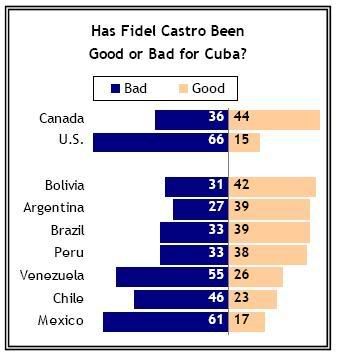
According to the poll [PDF, page 80] by the Pew Global Attitudes Project, Fidel Castro is viewed in South America (including Mexico) as having been BAD for Cuba with an average of 41%, and GOOD for Cuba with an average of 32% (margin of error 3%). But, looking closer, there's a very interesting picture.

Bolivia, Argentina, Brazil and Peru have very similar and mixed attitudes about Fidel Castro's Cuba (with an average GOOD of 40%, and BAD of 31%), in comparison to Mexico and Venezuela's very negative view of Fidel Castro's affect on Cuba (with an average GOOD of 22%, and BAD of 58%).

Also very interesting is the mixed view from Canada (44% Good) in comparison to the United States (66% Bad). There's definitely much to interpret into these results, but the obvious difference in foreign policy between Canada and the US clearly weighs into how public perceptions of Cuba have been influenced (positively or negatively). It should also be noted that the survey samples from Bolivia, Brazil and Venezuela are more skewed to urban centers. The most skewed is Bolivia, where the poll reflects a 92% urban population, instead of the accurate 64% currently living in urban centers. Another point to consider is the fact that many respondents chose not to give an answer.

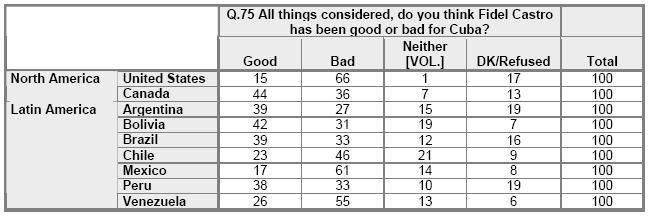
The poll shows [data table] that in some countries almost 20% of respondents "didn't know" or "refused" to give an answer. Argentina and Peru had 19% who gave no response, and the US and Brazil had the next highest with 17% and 16% respectively. Again, we can make many interpretations about this particular data, but, according to other previous responses, many people surveyed may be refusing to answer just because they feel uninformed about the particular issue.

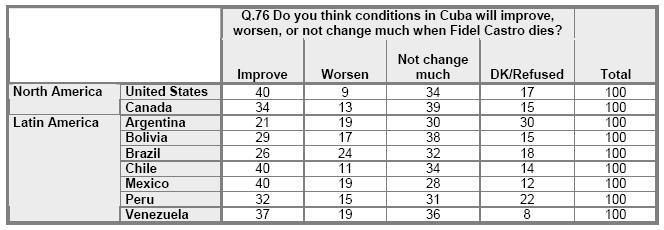
The other question asked was: "Do you think conditions will improve, worsen, or not change much, when Fidel Castro dies?"

The average responses from the South American countries surveyed (including Mexico) showed 32% improve, 18% worsen, and 33% not change much. The four nations (Bolivia, Argentina, Brazil, Peru) that had mixed views about Fidel Castro's Cuba showed similar averages, while Mexico and Venezuela, who saw Fidel as mostly BAD for Cuba, showed 39% improve, 19% worsen, and 32% not change much. The US, also with a very negative view of Fidel Castro, showed 40% believing that improvements lay ahead after Fidel kicks the bucket, with 39% of Canadians believing things in Cuba won't change much.

There are so many other interesting and important findings in the Pew Global Attitudes Project poll, that I encourage readers to take the time to read the full report [PDF]. In my opinion, other important (and sometimes contradictory) findings were related to the rising positive outlook in South America, despite the many detailed concerns about living conditions, crime and economic dissatisfactions, and the alarming negative view of the US as a regional threat.

FIVE out of the SEVEN surveyed nations south of the US saw the United States as the greatest threat in the region. Bachelet's Chile doesn't view the US as a threat at all, but Garcia's Peru sees the US as the SECOND greatest threat (20%) after Chile (53%).

[Part 1]

Good or Bad? (Part 1)

Back in February, I wrote about an article that appeared in Foreign Policy Magazine. The article [PDF] was a debate about Cuba and Fidel Castro, matching Carlos Alberto Montaner versus Ignacio Ramonet.

Ignacio Ramonet writes for Le Monde diplomatique, a monthly news magazine that covers international affairs, and Carlos Alberto Montaner is a world-syndicated columnist that covers international issues, with a focus on the Latin region.

In my February post, I wrote how this debate was "a stalemate between opposing views, reflecting how in general there are little attempts to bridge the political gap." I also mentioned how the opposing sides provided "no convincing argument" in my opinion. (Babalu blog obviously saw it very differently.) Looking at the article again, I see Ramonet's argument MORE convincing than Montaner's.

One main disagreement I have with Montaner (among others) is his description of how "[n]o one is more anxious to abandon egalitarian collectivism than the legion of engineers, doctors, technicians, and teachers forced to live without the slightest hope of betterment." Egalitarian collectivism? According to past polls and other sources about the attitudes of Cubans, there are many indications that the majority of Cubans still favor revolutionary principles (such as equality over freedom), especially the universal educational and health institutions that are highly criticized in Miami, especially by hard-liners. Montaner's confident belief that educated Cubans are "anxious to abandon" a construct that is viewed very favorably in Cuba, seems to be based more on desire than fact. On the other hand, Ramonet presents a more realistic view of what past research indicates.

Anyway, the big question that Foreign Policy Magazine asked in February (Was Fidel Castro Good for Cuba?) was a question incorporated in an international poll conducted by the Pew Global Attitudes Project.

In their report, released last July (full PDF report), concerning various attitudes in the developing world, the Pew Global Attitudes Project found time to incorporate two questions concerning Cuba and Fidel Castro while doing surveys in South America. The results come from surveys of about 800, over-18-year old adults each from Argentina, Brazil, Bolivia, Chile, Mexico, Peru, and Venezuela.

[Part 2]

Thursday, August 30, 2007

He Said What?! (Part 1)

I was reading La Contra Revolución blog (as I usually do because he actually tolerates comments in opposition, unlike Babalu blog where my comments are reviewed and never posted) and blogger Gusano writes about his thoughts on the recent rumors that spread about Fidel Castro being dead and all. A recent article by Miguel Cossio, news editor at channel 41, America TeVe, prompted Gusano to respond to some very important points about the ethics of reporting news.

Journalistic ethics, of course, do not apply to blogs, but nevertheless provide sound arguments about the responsibility bloggers have to their readers (and bloggers who report news should assume they have a readership).

The website of the Society of Professional Journalists provides their Code of Ethics which summarizes very well what the goals of critical bloggers should be. That is of course if bloggers wish to be the "critical eye" for their readers.

Those ethics do not rule out the use of rumors, or "unofficial sources of information [that] can be equally valid." But, ethical standards do compel reporters to "[i]dentify sources whenever feasible. The public is entitled to as much information as possible on sources' reliability." And, that is a responsibility (if a blogger chooses to accept it) that readers are entitled to.

Miguel Cossio also makes excellent points about the responsibility reporters (or bloggers) have to their readers:

"When the media substitute news for rumor they violate the premise that makes them the critical eyes of society and could lose the confidence entrusted in them by its citizens."

But, that only refers to those who write blogs based on that opportune premise. In my opinion, I suspect some blogs do not care much for their readers, but instead prioritize their self-interests.

Cossio also criticizes blogs for the recent rumors of Fidel's "death", but points out two. He writes: "Babalublog.com and perezhilton.com were perhaps the ones who most fueled the collective hysteria." He describes PerezHilton.Com as a "factory of rumors", but doesn't extend that descriptor to the people of Babalu blog, who have repeatedly posted rumors of Fidel Castro being near death or dead already since August of last year (with many more rumors to come I'm sure).

According to a May 29th poll, 61% of Babalu blog readers (from 318 voters) believe Fidel Castro is already dead.

[Part 2]

Friday, August 17, 2007

The Work of Robin Eley

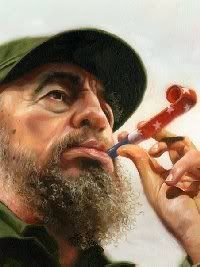
This funny painting of Fidel Castro appeared on the cover of this week's Miami New Times. The artist is Robin Eley, an artist from Australia, who has several other funny portraits and illustrations on his website: RobinEley.com.

According to his blog, this is his first commissioned work using oil-based paints, instead of his regular acrylics. The difference really shows, if you happen to be familiar with the medium.

Inside, the Miami New Times has a very funny article comparing the personal histories of Fidel Castro and Hugh Hefner. The subtitle is: El Jefe and Hef turn 81. (Both men were born in August and April 1926, respectively.)

Tuesday, July 31, 2007

A Year Later...

I can still remember my surprise as I, and the rest of Miami, was caught unaware by the news of Fidel Castro's transfer of power to Raul one year ago. How could anyone have imagined it, especially when that very day President Bush was having breakfast at Versailles Restaurant in Little Havana?

Looking back, this transfer of power was just procedural because President Bush himself transferred his powers to Vice-President Cheney this month when he went under general anesthesia for a colonoscopy. Its a right given to the President under the 25th Amendment.

Fidel Castro seems to be getting better now, but you couldn't have convince anyone of this a year ago.

Looking back at the local news coverage a year ago, many were convinced of something very dire. Sure, Fidel is old, but most of the news afterward painted a very grim picture. Remember the Negroponte quote from last December: "Everything we see indicates it will not be much longer... months, not years."

On July 31, one local news station had US Representative Lincoln Diaz-Balart describing what some in Miami were thinking: "It's evident that Castro is either dead or dying."

Many were convinced that Fidel Castro was in fact dead. A Telemundo51 poll from August 2nd showed that 43% of viewers though Castro was dead, while 33% thought he was really ill.

On August 1, Maria Elvira Salazar hosted a special television program about the recent events. She surveyed her audience with an online poll and the results showed that 91% thought Fidel was dead. That's was based on viewers of MegaTV channel 22.

Many had made it clear: how could an ego-driven dictator relinquish power unless he is already dead? Any other alternative logic was suspended.

In my opinion, the phenomena that occurred in Miami that evening on July 31, 2006, only revealed the negative bias that still permeates this city on the Cuban issue. A simple transfer of power was immediately met with signs of death. Why would our thoughts expect anything else?

That's why I have great distrust in a lot of information that comes from Miami, especially when it is about Cuba. In Miami it is difficult to find a view that doesn't attribute the worst from a government that has no other face than that of a "perverse circus" as Lincoln Diaz-Balart once described it.

But, a year later, what have we learned?

- Phil Peters at the Cuban Triangle Blog has more thoughts.
- More Pics here at ViewImages.Com

[Photo by Roberto Schmidt/AFP/Getty Images]

Monday, July 30, 2007

Guess What Tomorrow Will Be...


Yep, it's gonna be a whole year since the celebrations in Miami that were sparked by Fidel Castro's "temporary" transfer of power to Raul. It was quite an exciting day, in the historical sense.

Here's some flashback posts from July 31/Aug. 1:

- USA Today Blog
-Babalu Blog
-Miami's Cuban Connection

Will post more tomorrow.

[Photo by Al Diaz/Miami Herald]

Thursday, July 26, 2007

"Airs of Permanence"

Fidel didn't show up for today's Revolution Day festivities in Camaguey this morning. It's definitely a sign that some will see as confirming Fidel's actual death, that is until he appears in the media again.

Fox News/AP reports today that Raul Castro's "provisional government took on further airs of permanence" with the absence of Fidel. Univision/AFP says that this is the "first time in 48 years" that Fidel has missed the Revolution Day festivities.

One source reported that "without Fidel Castro present, the mood [at the festivities] appeared somewhat subdued." But, another source said that "it was hard to find much disappointment that the elder Castro failed to show up." It has been estimated that 100,000 Cubans were in attendance for Raul Castro's speech.

Last month (June 4, 2007) I wrote about how Fidel Castro appeared in new photos and video, and how these events pointed out that Fidel Castro was in fact alive and getting better. I also mentioned Andy Gomez, a Senior Fellow at UM's Instiute for Cuban and Cuban-American Studies, and called him a "selfish academic." I actually regret that description because "selfish" is not the appropriate word to describe Andy Gomez's confidence in his work. The better word would be arrogant.

On June 4th, Andy Gomez appeared on the local station Telemundo51 for the 11pm news. Given that Fidel Castro had recently appeared with visiting Vietnamese officials and was scheduled to appear in a television interview, Andy Gomez made it very clear that Fidel would appear for today's Revolution Day festivities. To my recollection, he was very confident in his prediction.

This afternoon, Andy Gomez appeared again on Telemundo51 for the 11:30 local news program. His video segment did not mention the embarrassing prediction he made on June 4th, but instead Gomez went back to his old position that the post-Fidel era is "clearly marked" and that Raul Castro must win the hearts of all Cubans on the island or face a collapse.

It seems that many in Miami feel that Fidel Castro will not return to power. A recent Telemundo51 web poll (of more than 600 votes) showed that 87% of viewers thought Fidel Castro would not improve physically to return to power.

This is a sentiment that also seems to be taking hold in Cuba. "[Fidel's] getting older, and in poor health, he should let others continue with the Revolution," says one Cuban. "I am certain Fidel is recovering but there's no problem because we have Raul," says another in Camaguey.

Raul Castro today has (for the third time since last July) suggested that a dialogue begin with the US in a "civilized manner." He also proposed an "olive branch" deal to the future 2008 administration, or face another 50 years of Cuban opposition to US policy towards Cuba.

[Photo by Javier Galeano/AP]

Wednesday, July 25, 2007

Will Fidel Be a No-Show?

According to Mark Frank from Reuters, "Cuban leader Fidel Castro has bowed out of Thursday's Revolution Day festivities, with his stand-in and brother, Raul Castro, to speak in his place."

Frank quotes a Cuban saying: "We'll be waiting for him. If Fidel can't make it, who better than Raul to be here."

Looks like the prediction by UM's Andy Gomez is not going to happen. I will post more tomorrow.

Monday, June 4, 2007

I Bet That's Gotta Hurt

Boy, its gonna be a tough pill to swallow for some, but it looks like Fidel Castro might be making his comeback. I was watching the 11pm news on Telemund51 this evening, and they had Andy Gomez from the University of Miami saying that it is very likely that Fidel might make his official comeback appearance on July 26, to mark that significant day. Mark your calendars boys and girls! This is an embarrassing reversal for Andy Gomez (Senior Fellow at ICCAS) because just last December he wrote that it was "clearly marked" that the post-Fidel Castro era had begun. Well, these errors happens when you are a selfish academic who wants his named splashed all over the news. But, it only adds to the other unreliable work done at UM's Institute for Cuban and Cuban American Studies.

Anyway, this news comes at the heels of a recent Babalu Blog poll done on May 29, 2007. Blogger Val Prieto simply asked: Is Fidel Castro Dead? 61.3% of 310 voter said yes. Also, that same day Mr. Prieto confidently wrote: "What I don't get is how anyone could believe the guy is alive." Mr. Prieto is betting a lot of money with his readers that he's right. Since last July, he's already posted one, two, three posts with certainty that Fidel Castro is actually dead.

Telemundo51 has their own online poll asking their Spanish-speaking viewers if they believe the newest video footage of Fidel Castro means he will return to power. So far the results are split 50-50.

The newest signs of life for Fidel Castro come from his recent meeting with a Vietnamese Communist Party official (lovebirds above), and video clips of an upcoming television interview(with Cuba's Mesa Redonda) which will be aired on Tuesday (June 5) in Cuba.

I heard this news briefly mentioned on Radio Mambi by a caller (and then ignored immediately by Armando Perez Roura), but they will most likely comment fully very soon. They have a lot of 'splaining to do.

Ever since Fidel became sick last July, the suspicions by RadioMambi commentators on his health have reached enormous proportions of exaggeration. From repeated appearances by doctor Enrique Huertas on Radio Mambi's Mesa Redonda saying that Fidel is "un muerto que camina" ("the walking dead": a claim which Huertas has been making since 1998), to claims of terminal illness (repeating a John Negroponte fallacy, and also an Argentinian story of its CIA origins), to discrediting a Spanish doctor who said that Fidel had no signs of cancer, to newer claims that Fidel Castro is most likely suffering from a neurological disease and unable to make any sense at all, RadioMambi commentators have launched all possible negative scenarios of Fidel Castro's health that I cannot imagine they will ever accept any positive signs, even if they read it on Babalu Blog.

But, the next few days will be real interesting to hear and read how the newest Fidel Castro video is really fake. I wouldn't expect anything less from the most intransigent.

Monday, April 9, 2007

About Intelligence...

Today's Miami Herald publishes an article by Pablo Bachelet which describes that "Washington... is now largely ignorant of what is happening within the inner circles in Havana." You don't say!

Bachelet's article seems to be supported by interviews with about a dozen people who are closely familiar with US intelligence gathering on Cuba. While these anonymous persons state that US intelligence on Cuba is ''pretty good'' in general, they also believe the US has "little credible information on events at the top levels" of the Cuban government.

The article basically mentions three US reports that were "off the mark." One was the 2002 allegation by the ever-belligerent John Bolton of a biological weapons "program" in Cuba. These "serious" allegations have since been dismissed by people who are well aware of Cuba's biological capabilities, and the current administration. The Center for Defense Information believes that this allegation was politically driven and lacked strong evidence.

The second "off the mark" intelligence report mentioned is Fidel's diagnosis of Parkinson's disease by the CIA. But, I don't think this is really "intelligence" since it is based on public (not secret) information. The CIA basically examined Fidel's public speeches. Otherwise, there's no strong evidence to consider.

And, the final "intelligence" report mentioned by Bachelet is last year's allegation by John D. Negroponte, director of US National Intelligence (term used loosely), stating that "[e]verything we see indicates it will not be much longer . . . months, not years [for Fidel]." Its been months John.

One of the definitions of "intelligence" is the capacity to APPLY knowledge. Those who are aware of the long diplomatic history between Cuba and the US know well that this definition of knowledge is not being applied. There is ample evidence to show that US policy will not succeed, but that knowledge is ignored. There is sufficient findings that indicate that Americans disagree with US policy towards Cuba, but that is also ignored. There is also good reason to believe that the majority of Cuban dissidents are opposed to current US policy towards Cuba, but they too are ignored.

It seems Washington is largely ignorant of many important things that are related to Cuba.

Thursday, March 22, 2007

The Other Black Spring (Part 6)

The abuse of power by Robert Mugabe and his government has been atrocious and extremely cruel towards his own people. And, for decades, this abusive pattern has always been justified under the rhetoric of domination by the West. While there is a level of paranoia involved, reasons for hostility exist.

Jerrold Post, one of the leading political psychologists in the US, admits that current dictators have reasons to be fearful of Western aggression, and that paranoia alone is not an adequate explanation. Just like US policy towards Cuba, Britain and the EU will have to review its aggressive policy towards Zimbabwe, or face possible escalations of violence in a country facing an economic downward spiral.

Just as we closely observe the events in Cuba and the health of Fidel Castro, we should also focus on events in Zimbabwe and the 83 year-old Mugabe. Britain is currently looking to toughen sanctions on Mugabe's government, and planning a post-Mugabe agenda for next year's troubled elections.

The following months will provide real lessons on how developed nations honestly react to explicit human rights abuses, and their general behavior towards developing nations and dictatorial regimes. No doubt, a possible future scenario for Cuba.

The Other Black Spring (Part 5)

Fidel Castro and Robert Mugabe share an intense displeasure with Western countries. They both accuse the West of being antagonistic and at fault for worldwide poverty. Yet, their accusations of the West are not unfounded, they have good reasons to be angered.

This month's latest report from the anti-poverty organization Oxfam has clearly shown that "trade and investment agreements between rich and poor countries threatens to deny developing countries a favorable foothold in the global economy." The report targets the US and EU for unfair trading practices where "[t]he worst of the agreements strip developing countries of the capacity to effectively govern their economies and to protect their poorest people. "

Like Castro and the US, Zimbabwe shares a hostile relationship with Britain and the EU. Relations intensely deteriorated in 2002 when Britain pushed for targeted sanctions on Mugabe and his cronies after EU election observers where evicted from the southern African nation. Mugabe fired back at the 2002 Earth Summit declaring: "We don't mind having sanctions banning us from Europe. We are not Europeans... Blair, keep your England. Let us keep our Zimbabwe."

The acts by Britain against Zimbabwe, similar to the acts of the US against Cuba, send the same message: threats from the industrialized Western society (and former colonial masters).

But, this shared unstable relationship between developing countries and the West does not justify any abuse of power and violation of human rights from either side.

The Other Black Spring (Part 4)

This crackdown has set in motion what some are describing as Zimbabwe's political and societal breakdown. Many place the blame on Zimbabwe's president Robert Mugabe, who has governed this nation since 1980, and considered one of the 10 worst dictators alive.

Consequently, there are many similarities with Cuba and Fidel Castro. Robert Mugabe, like Fidel Castro, is widely described as a tyrant and oppressor of human rights. Yet, the reports of Mugabe's tyranny is far more cruel and horrendous than what has been attributed to Castro. The economy of Zimbabwe, like Cuba's, is collapsed. Yet, the level of Zimbabwe's economic performance is far more bleak and desperate than Cuba's economy could ever be. Also, the health indicators in Zimbabwe are far more drastic and dire than Cuba's.

The recent crackdown in Zimbabwe also operates in similar fashion to Cuba's Black Spring. In this case, Mugabe has for many years systematically repressed a pro-democratic movement because he feels they were mercenaries and "shameless stooges of the West" threatening the nation's sovereignty. And, like Castro, Mugabe is fiercely anti-imperialist and accuses the West for many of his country's troubles.

It may appear obvious to some that these dictators are clearly paranoid and addicted to power. But, this conclusion ignores several facts. Its very convenient to blame the dictator for an entire country's woes, but history presents another picture. Just like Cuba's history with the US, Zimbabwe has a very violent history with South Africa (and its colonial rulers) under apartheid, and like many other African nations, a strong nationalism originating from its colonial past.

Wednesday, March 21, 2007

The Other Black Spring (Part 3)

Many international organizations have settled with the position that amelioration of Cuba's human rights abuses is dependent on US policy. That may be a reason why there is little to say over the four-year mark of Cuba's Black Spring: everyone is waiting for the US to change its policy.

So, while some ask (dare I say whine) about why there is little coverage of Cuba's Black Spring, there has been substantial coverage of another Black Spring. Despite the claim that many support solidarity with other oppressed people in the world, there has been a virtual silence in Miami about the recent Black Spring in Zimbabwe.

One week exactly before the mourning of Cuba's Black Spring, police in the capitol of Zimbabwe violently interrupted a demonstration of pro-democracy activists with a massive crackdown of about 100 arrests. The event made headlines after it was discovered that one of the leading pro-democracy activists, Morgan Tsvangirai, was among the arrested and severly beaten, suffering a fractured skull among other injuries.

Friday, March 2, 2007

This Week's Documentary

I've been extremely busy and will be for the next two weeks. My posts therefore will be shorter than usual. So, I've decided to list some documentaries about Cuba that I think are excellent, and contribute to the current debate about US policy. Today I will highlight one film, followed by another next week.

Some of you may have heard of this documentary when its outtake of Ileana Ros-Lehtinen supporting an assassination attempt on Fidel Castro made the news. She denied her remarks first, then (two weeks later) admitted them. You can also check out how some of our favorite Cuban-American bloggers (Mr. Gomez from Cuban American Pundits, and Robert from 26th Parallel) displayed similar, astonishing attempts at denial when the news first broke. While Mr. Gomez and Robert don't seem to care about the ethical responsibilities of US Representatives, most likely they still believe the video outtake to be a manipulation.

But, aside from Ileana's controversial comment, the film "638 Ways to Kill Castro" by Dollan Cannell is excellent. The final cut does not include our favorite Republican from district 18, but it does include Radio Mambi's own Enrique Encinosa, who alone makes his own controversial comment in the film in support of terrorism. In general, the film is a historical outline of the hostile relations of the US towards Cuba (not just towards Fidel) since the Revolution. Perhaps the most important part of the film, in my opinion, is its focus on our local "patriots," like Rodolfo Frometa (leader of the F4 Commandos and who seems to have successfully indoctrinated his son in the film) and Luis Posada Carriles (some of whose paintings are sold through Enrique Encinosa at exorbitant prices).

Thanks to the magic of the internet (and Google Video) the entire documentary by Dollan Cannell is available to us. It is viewable in two parts (in mp4 format for download), with commercials due to its premiere on UK Channel 4.

[Part One]

[Part Two]

Best to all.