Showing posts with label US embargo. Show all posts

Thursday, December 18, 2014

Local Polls Support New U.S.-Cuba Policy


Above is a sample of polls conducted by South Florida news websites in response to Wednesday's announcement of a new U.S. policy towards Cuba. The majority of the polls show strong support (above 60 percent) for the new policy.

Despite the local media's false presentation of a divided Miami, and constantly refocusing the debate around the opinion of the minority hard-line, the poll results above reflect the more accurate view of a rational Miami. Unfortunately, for as long as I've been monitoring the local media, the news stations have yet to center their reporting (and analysis) on this accurate widespread belief. 

Polls Results shown above (clockwise):

Americateve.com: Do you agree with the U.S. and Cuba re-establishing diplomatic relations? (Yes, 54%)
Elnuevoherald.com: Do you believe re-establishing relations between the U.S. and Cuba will benefit Cubans on the island? (Yes, 68%)
WFLA.com: Do you think vacation travel should be permitted to Cuba? (Yes, 66%)
Local10.com: Do you agree with the U.S. trying to normalize diplomatic relations with Cuba (Yes, 68%)

[The poll results also support the findings of the more recent Atlantic Council poll on U.S.-Cuba policy, and the FIU Cuba Poll.]

Wednesday, December 17, 2014

Alan Gross is Free


Alan Gross: "I also feel compelled to share with you my utmost respect for and fondness for the people of Cuba... It pains me to see them treated so unjustly as a consequence of two governments' mutually belligerent policies. Five and a half decades of history shows us that such belligerence inhibits better judgement. Two wrongs never make a right."

- Video and transcript available at C-Span website.

Tuesday, February 19, 2013

Yoani Sanchez in Brazil [Updated]


Above is a short video of famous Cuban blogger Yoani Sanchez making her first public appearance yesterday in Brazil. She was at the Museu Parque do Saber in the city of Feira de Santana where a screening of a documentary was planned. Sanchez was welcomed by Brazilian Senator Eduardo Suplicy and also met by a crowd of protesters calling her a "mercenary" and "traitor." The group of protesters seemed to be made up of local members from the Union of Young Socialists and the Jose Marti Cultural Association.

In the video, Yoani Sanchez explains her position on the U.S. embargo against Cuba:

"I don't fear problems. I'm not afraid of problems. I'm not afraid of oppressors. OK? And so, I am against the embargo for various reasons which I want to share with you.

"One, it appears to me 'inherencista' [meaning a policy seen as interventionist and/or hegemonic].

"Two, it appears to me a fossil of the Cold War that makes no sense in the modern world in which we live in.

"And three, it seems to be the best argument the Cuban government has to explain its economic inefficiency. On my plate there's no tomatoes! There's no potatoes!"

Other video of Sanchez in Brazil has her stating that the current economic reforms in Cuba are "on the right path," but still lack "velocity and depth" in their implementation. And, a much longer version of her appearance yesterday in Feira de Santana can be found here and here (in Spanish). In those videos Sanchez attempts to explain her purpose of blogging about everyday life in Cuba, and her dreams about a future Cuba. According to Sanchez, among the Cuban people there is diversity of opinion and political thought which is curtailed by the oppressive institutions of the Cuban government.  "Where's the Cuba they promised me as a small girl?" asked Sanchez out loud.

In her most recent blog post at Generation Y, Sanchez described the protest at this event as "unprecedented" in her life.

"They wanted to lynch me, I talked. They were responding to orders, I am a free soul. At the end of the night I had the same feelings as after a battle against the demons of the same extremism that fueled those acts of repudiation in 1980 in Cuba. The difference is that this time I understood the mechanism that foments these attitudes, I could see the long arm that controls them from the Plaza of the Revolution in Havana."

Yoani Sanchez will be traveling South America, the U.S. and other countries for the next 3 months. The quotes above against the embargo have been censored out by Carlos Santana in his report today for Radio Mambi.

--- [Update] ---

During an appearance with Brazilian legislators on Wednesday, Yoani Sanchez made more headlines with her comments about the U.S. embargo against Cuba, the U.S. military base at Guantanamo, and the Cuban Five.

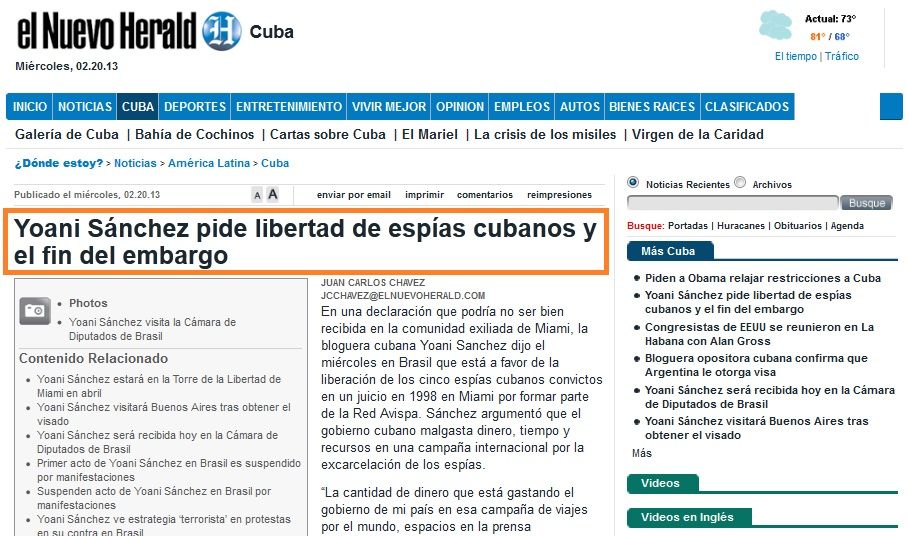
Juan Carlos Chavez of El Nuevo Herald on Wednesday wrote an article titled "Yoani Sanchez calls for release of Cuban spies and the end to the embargo." (The Herald article follows the reporting of a Spanish journalist who blogs about Cuba at Punt de Vista.) Interestingly, the original Herald article begins with a forwarning:

"In a statement that might not be well-received in the exile community of Miami, the Cuban blogger Yoani Sanchez said on Wednesday in Brazil that she is in favor of the liberation of the [Cuban Five]."

Unfortunately, Yoani Sanchez didn't say this. If one views video of her full comments, Sanchez states that she would "prefer" the liberation of the Cuban Five IF their freedom would lead to revenue and attention re-directed back to important educational priorities in Cuba.

The Herald has now attempted to correct their error with a new article titled "Blogger Yoani Sanchez says comment on ‘Cuban Five’ was ironic, misunderstood." This comes after Sanchez posted a response to the Herald article through her facebook account. But, if anyone knows the hard-liners in the exile community (as Juan Carlos Chavez knows), a correction or clarification sometimes isn't good enough. With Yoani Sanchez now scheduled to be at the Miami Freedom Tower in April, many Cuban exiles (especially the hard-liners who never trusted her, and might never trust her now) will most likely protest the event.

Way to go Miami Herald.

Tuesday, August 14, 2012

Paul Ryan's Anti-Embargo Record

You've probably heard already. The Republican pick for vice-president, Rep. Paul Ryan (WI-1), has an anti-embargo voting record, and has been very clear about it. So, it's no wonder some hard-liners are trying to hide this fact.

A post on the (pro-embargo) Capitol Hill Cubans blog first raised my curiosity. It was apparent that the author was trying to hide Rep. Paul Ryan's voting record before 2007, and giving him an excuse by describing Rep. Ryan as an "unconditional free trader." (For hard-liners on Cuba, there is no room for other principles except unconditional sanctions.)

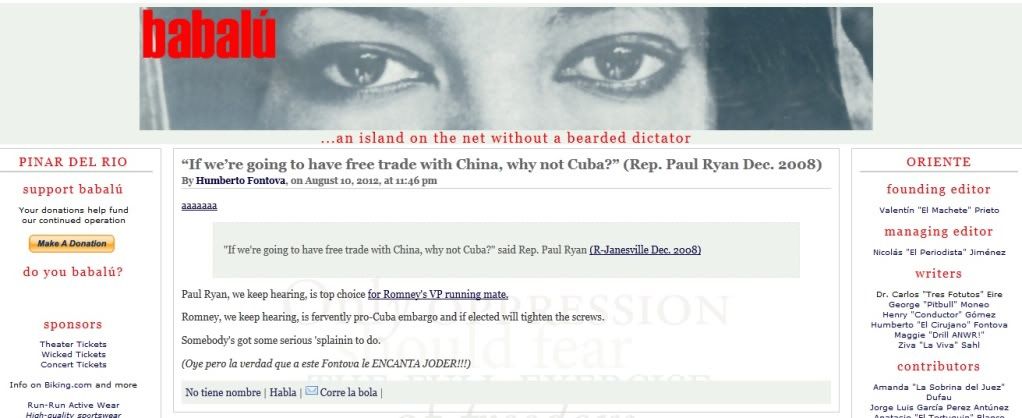
Even the boys at the Babalu blog did some quick work to hide Rep. Ryan's anti-embargo stance. Following the rumors that circulated on Friday, Humberto Fontova was the first to warn readers of Rep. Ryan's anti-embargo feelings. Fontova titled his post after a 2008 Ryan quote: "If we're going to have free trade with China, why not Cuba?"[cached link/screenshot] The post was soon removed. It was later responded with a post by Babalu economic super-genius Henry Louis Gomez who was an "economics major in college." According to Gomez, "99.9% of people" (including renowned libertarians like Milton Friedman and William F. Buckley who opposed the U.S. embargo towards Cuba) don't understand Cuba like he does.

In reality, national polling shows about 50% of Americans are opposed to the embargo (39% in favor, 10% undecided), so Gomez is being a little paranoid. But, it seems that Rep. Paul Ryan in 2002 was with the majority: 
"The embargo doesn't work. It is a failed policy. It was probably justified when the Soviet Union existed and posed a threat through Cuba. I think it's become more of a crutch for Castro to use to repress his people. All the problems he has, he blames the American embargo... [Cuban-Americans] have their reasons [for supporting the embargo] and they're very passionate about their reasons, I just don't agree with them and never have."
So, the question now is why did Rep. Ryan change his position on the embargo? Did a grown-man with strong free market convictions get "educated" on the embargo as Mauricio Claver-Carone told the Miami Herald?

I seriously doubt it.

--- [Below are Rep. Paul Ryan's House votes in opposition to the U.S. embargo on Cuba] ---
  • July 25, 2001: Amendment to prohibit funding to administer the Cuban Assets Control Regulations with respect to any travel or travel related transaction. Rep. Ryan (WI) voted Aye, [Roll Call 270, HR 2590].
  •  July 25, 2001: Amendment sought to prohibit the use of funds in the bill to implement, administer, or enforce the economic embargo of Cuba. Rep. Ryan (WI) voted Aye [Roll Call 271, HR 2590].
  • September 21, 2004: Amendment prohibits funds in the bill from being used to enforce certain regulations restricting family travel to Cuba. Rep. Ryan (WI) voted Aye [Roll Call 460, HR 5025].
  • September 22, 2004: An amendment to insert the following new section on page 166 after line 3: Sec. 647. None of the funds made available in this Act may be used to implement, administer, or enforce the economic embargo of Cuba, as defined in section 4(7) of the Cuban Liberty and Democratic Solidarity (LIBERTAD) Act of 1996 (Public Law 104-114), except that the foregoing limitation does not apply to the administration of a tax tariff. Rep. Ryan (WI) voted Aye [Roll Call 461, HR 5025].
  • June 15, 2005: An amendment to prohibit use of funds in the bill to implement, administer, or enforce regulations relating to amendments made to the Code of Federal Regulations relating to license exemptions for gift parcels and humanitarian donations for Cuba. Rep. Ryan (WI) voted Aye [Roll Call 254, HR 2862].

Friday, February 17, 2012

What Embargo? [Part 2]

Over the decades, countless arguments have been made for keeping the US embargo (e.g. Soviet threat, property nationalization, approaching success, violation of human rights). In Miami, no two defenders will have the same defense. And, asking "What embargo?" is not only an effective excuse from again defending a half-century of sanctions, but it also expresses widespread exhaustion and disappointment with the effectiveness of current policy. But, despite its accepted failure, embargo defenders still view the embargo as the fine line that protects the Cuban exile identity, the necessary line that divides friend and enemy.

EXILE NEWS BUBBLE

I was listening to Nancy Perez Crespo on WWFE (670 AM) last week. She appeared shocked to see that Diario Las Americas, whose editors are hard-liners on Cuba policy, published an EFE article on the 50th Anniversary of the embargo which she thought was intolerable. She barely got halfway through reading the article on-air because she refused to accept the article's contention that economic reforms have been implemented in Cuba. "What reforms?," she asked. Maybe not the reforms that Perez Crespo had in mind. But, it seems, even to suggest any change in the cruelty of your enemy is unacceptable. God forbid the enemy does change and produces the need for a new strategy.

Upon the 50th anniversary, embargo defenders in Miami had to remind themselves why they should remain committed. One example came from Jesus Marzo Fernandez, former Cuban official who defected in 1996, and now a local "expert" on the Cuban economy (appearing countless times on Spanish-language TV and radio). Last week, Fernandez outlined chronologically why the US embargo was justified. Fernandez begins: "1960 - During this year 473 citizens were executed by firing squad, unprecedented in Cuban history." Interestingly, his chronology ends on October 24, 1960 when supposedly all American companies in Cuba have been nationalized. In fact, most of the dates in the timeline have to do with Cuban intervention and nationalization of foreign companies during the 60s, and therefore we can assume that Fernandez, like others in Miami, believe the embargo is justified because of these nationalizations (without fair compensation).

But, as usual, the timeline is incorrect and misleading.

There's no mention that both Washington and Havana did attempt to negotiate for fair compensation of future nationalized properties during 1959. But, the U.S. eventually rejected the compensation offer of 20-year bonds. (Of course, there were huge disagreements over what was "fair" compensation, such as the case of United Fruit properties which Cuba estimated at around $6 million, but the company wanted around $38 million!) By the time 1960 came around, negotiation attempts were replaced with escalating threats. And, as mentioned in the previous post, throughout the 60s the Eisenhower administration already had plans to overthrow the Cuban government with a covert war.

This is the context missing from Marzo Fernandez's chronology defending the embargo. In addition, his timeline has errors. According to Fernandez, on Jan. 3, 1960 "all phosphorous plants are confiscated." I assume he means sulphur plants, which the biggest one (Moa Bay Mining Co.) was intervened upon (not confiscated) in March 1960.

Also, Fernandez doesn't mention the accurate date the U.S. embargo began on (Oct. 19, 1960), and instead makes the chronology look like the embargo followed a long series of Cuban nationalizations. On the contrary, the Cuban government confiscated over 100 American companies in reaction to the Eisenhower embargo. (Interestingly, Moa Bay Mining Co. was not yet confiscated.)

WHO'S SIDE ARE YOU ON?

Over the years, I've heard countless excuses on why the U.S. embargo towards Cuba should be kept. None make much sense to me, but that's because the embargo means something deeper than rational thinking. It's more about exile identity and its corresponding narrative of combating an eternal enemy. Recently, Jaime Suchlicki made it very clear (and revealing his militant side) in a recent op-ed for El Nuevo Herald, arguing that "[a]ll forms of struggle for liberty are legitimate. The last recourse of a defenseless and oppressed people is violence. Cuba is on that road. Let us hope the last sacrifice is coming soon."

Preserving the line between friend and enemy is something that draws hard-liners and militants together. And those voices are also our political leaders. As Rep. Ileana Ros-Lehtinen once said on Radio Mambi: "[it's] not very difficult Ninoska. The intellectuals want to make it like - Oh, this is so difficult, you have to look at this as very complex. No, no, no. There are friends and there are enemies. Who's side are you on?"

In this world of eternal battle, who knows when intolerance, ignorance or violence may fall on either side.

Friday, February 10, 2012

What Embargo? [Part 1]

That's an often repeated line from callers and guests on Radio Mambi. The denial seems to be premised on the US being one of Cuba's top trading partners since 2000 when Congress allowed exceptions for agricultural exports (with several restrictions which you can look up here). In 2007, the US became Cuba's fifth-largest trading partner with approx. $582 million in agricultural sales (and approx. $710 million in 2008). In 2010, sales in food products dropped to approx. $410 million (seventh-largest trade partner with Cuba).

Of course the embargo exists (just ask the US-Cuba Democracy PAC), but, in Miami, hard-liners towards Cuba have grown incredibly frustrated defending the policy. The easiest way out of an argument is to say: "What embargo?" And, even the most adamant defenders of the policy know they don't have much to stand on. Let's take a look.

THE EMBARGO BEGAN IN 1960

Lot of articles were written this week about the US embargo towards Cuba, and its 50th year in operation. But, the embargo actually began in 1960 under the Eisenhower administration when US exports were cut. You can see from the picture above (courtesy of The Miami News on Google Archives), the top headline is from 1960, and the bottom one is the Kennedy administration's ban on imports from Cuba in 1962 (good chronology of US sanctions on Cuba here [PDF]). This is an important distinction because the Eisenhower administration made the goals of economic sanctions against Cuba very clear. Last year, historian Robert S. McElvaine wrote this in his op-ed to the L.A. Times:
"Noting in a 1960 memorandum that 'the majority of Cubans support Castro,' Lester D. Mallory, deputy assistant secretary of State for inter-American affairs, argued that 'the only foreseeable means of alienating internal support is through disenchantment and disaffection based on economic dissatisfaction and hardship.' The objective, he wrote, was 'to decrease monetary and real wages, to bring about hunger, desperation and overthrow of government.'"
And, it was throughout the 60s that the US was secretly planning a covert war against Cuba. You can check this great chronology from the National Security Archive to get an idea of how extensive American plans were to overthrow the Cuban government (also good is "The Castro Obsession" by Don Bohning).

EMBARGO DEFENDERS

The above context is important, especially when you hear today about how "moral" it is to keep the US embargo. While it certainly won't topple the Cuban government today, the embargo is perceived in Cuba as a policy of aggression, as it was in 1960 and 1962.

So, last Tuesday our four Cuban-American representatives in Congress came out with their defense of the US embargo. According to Rep. Ros-Lehtinen, "the embargo is a moral stance against the brutal dictatorship. Over the last 50 years, the embargo has served as a constant form of solidarity with the Cuban people."

What Rep. Ros-Lehtinen really means when she says "moral stance" is to say that the embargo is a symbol of our confrontation against Cuba. A message that should be interpreted by the Cuban government as "we are enemies, not friends." (Nevermind the preamble of the Universal Declaration of Human Rights suggesting " it is essential to promote the development of friendly relations between nations.") Also, the embargo is not a "form of solidarity" with the people of Cuba. The majority of Cubans oppose the embargo (a 1994 poll inside Cuba found widespread opposition, and a 2006 poll showed Cubans highly favoring the US as an ideal trading partner.) Anyway, our foreign policy should not ignore the majority voice of Americans that oppose the US embargo.

Reps. Mario Diaz-Balart and Albio Sires make similar comments defending the embargo, but Rep. David Rivera seems to describe the need for expanding sanctions on Cuba because of their "Chavista and Mullah" allies. If we follow this logic, the US should expand their embargo to the rest of the western hemisphere.

Speaking of irrationality, let's not forget the other intransigents in Miami.

Tuesday, December 27, 2011

"Cuba's Economic Revival"


So, will Cuba's economic reforms have the desired effect? And will it have any effect on US policies towards Cuba?

Inside Story Americas
discusses with guests: Peter Kornbluh, the director of the Cuba Documentation Project at the National Security Archive; Philip Brenner, a professor of US foreign policy at American University; and Philip Peters, the vice president of the Lexington Institute think tank.

Friday, January 7, 2011

Do You Favor Democracy?

So, as a new Congress convenes I'm getting ready to keep a good eye on our South Florida representatives, and the ambitious Senator Marco Rubio. And, boy! I thought the hard-line could not get any tougher. Now, here comes David Rivera and Marco Rubio, two known hard-liners on U.S. policy towards Cuba, and Rep. Ros-Lehtinen heading the House Foreign Affairs Committee and appointing other hard-liners as Subcommittee Chairmen. Yikes!

And, maybe some of you are wondering why being a hard-liner* is a cause of concern. Well, the answer is simple: hard-liners tend to ignore the opinion of others, namely their own constituents. Put more bluntly, they don't believe in democracy. Why am I so convinced? A quick review of public opinion concerning U.S. policy towards Cuba is a good start.

Over several years, Gallup polling has documented a strong and consistent American opinion that differs greatly with hard-liners' policy for Cuba. For several years, surveyed Americans have strongly favored (with an average of 59% since 2000) re-establishing diplomatic relations with Cuba if it was a key issue up for a referendum.

Ending the U.S. embargo towards Cuba has also seen strong approval in some polling. A recent online survey by Widmeyer Communications showed a majority of Americans supporting the end of the embargo by 47%, with 22% in opposition and 31% unsure. These results are similar to those reached by Gallup, and several other surveys.

So what about South Florida's opinion on the embargo? A 2008 survey from Florida International University's Institute for Public Opinion Research (IPOR) found a slight majority of Cuban-Americans favoring the end of the embargo, but a 2000 survey (also by IPOR) had already shown that 60% of Miami non-Cubans opposed continuing the embargo.

Of course, the local media continues to present the issue of public opinion concerning Cuba as divided. Last March, the Miami Herald (Juan O. Tamayo) reported on a BBC World News/Harris Interactive online poll showing "no clamor for change in U.S. Cuba policy." The online poll seemed to show support for the embargo (40% in favor, 36% opposed), but the questionnaire used Likert scaling (agree-disagree) on the statement "The embargo towards Cuba should remain in effect." The measurement was clearly vulnerable to bias because it implied one policy option.

Interestingly, after the Herald published this report (the only ones who reported on this poll according to a NewsBank search), another survey was conducted as a direct response. That survey was from the National Association of Evangelicals (NAE). The NAE conducts a monthly survey of its Board of Directors, and last March they found that 63% of evangelical leaders opposed the U.S. embargo towards Cuba. According to the NAE:

"The embargo’s impact on the poor, its failure to influence the leadership in Cuba toward greater openness and respect for human rights, and the potential benefit the lift would have on the spread of the gospel are the primary reasons evangelical leaders support the embargo’s end."

This survey by the NAE, who represent "40,000 local churches" was not reported by the Herald. In fact, according to NewsBank, it got no coverage at all.

So, when I read about South Florida hard-liners being proud over their tough stance on Cuba by supporting the embargo, all I can conclude is that they don't believe in democracy. And, all their talk about the "civilized world" seems like a joke.

And, I haven't even gotten to the part about Cuban dissident opposition to the embargo and travel restrictions!

[*A good definition of "hard-line" comes from George Mason University professor Colin Dueck.]

Thursday, June 10, 2010

Cuban Dissidents Support H.R. 4645 [Updated]

Haven't seen this reported on Radio Marti yet.

Seventy-four Cuban dissidents have signed a letter in support of H.R. 4646, the Travel Restriction Reform and Export Enhancement Act. This bill was also supported by the Conference of Catholic Bishops [PDF of letter] and Human Rights Watch back in March.

The Havana Note and El Yuma blog have all the details. Ted Henken of El Yuma blog describes some of the names that stand out:

"The bloggers associated with DesdeCuba/VocesCubanas.com Juan Juan Almeida, Claudia Cadelo, Dimas Castellanos, Miriam Celaya, Martha Cortizas, Reinaldo Escobar, Eugenio Leal, Pablo Pacheco, and Yoani Sánchez; the well-known government critics and opposition figures Elizardo Sánchez Santa Cruz, Manuel Cuesta Morúa, Héctor Palacios, Oscar Espinosa Chepe, Miriam Leiva, Guillermo Fariñas, and Félix Bonne Carcassés; leaders of Convivencia (the new on-line project of the original Vitral group) Karina Gálvez, Virgilio Toledo, and Dagoberto Valdés; and the Santiago priest José Conrado."

---[Update]---

Radio Marti has provided not one but TWO reports concerning this letter of support by Cuban dissidents. The first one mentions the letter and some of its more popular signatories, and includes an interview with signatory Dagoberto Valdez, the director of the wonderful online magazine Convivencia (Co-Existence).

The second report is about the Center for Democracy in the Americas (CDA) and their support of the letter. The report includes an interview with Sarah Stephens, executive director of the CDA.

Hooray for Radio Marti! Though they should report more often about how Cubans in general oppose US policy towards Cuba.

Friday, March 19, 2010

Black Spring 2010

The Ladies in White have been marching this entire week protesting the arrest of 75 Cuban dissidents in 2003. The massive political repression seven years ago, now known as the "Black Spring," was (and continues to be) widely condemned across the world, but has left its direct victims and families without recourse, and desperate.

Amnesty International again has called for the release of all Cuban political prisoners, many of whom were arrested in 2003, and to revoke its laws that authorize political repression. But, it should be clear to readers that Amnesty International (AI) and Human Rights Watch (HRW) have long ago presented their recommendations on improving the plight of Cuba's political dissidents.

I have addressed them before and will repeat them:

- AI believes "the US embargo has helped to undermine the enjoyment of key civil and political rights in Cuba by fueling a climate in which such fundamental rights as freedom of association, expression and assembly are routinely denied" and that "any tightening of the existing sanctions would only heighten the negative human rights impact of the embargo." Thus, US policy creates "a situation in which perceived external aggression is met with increased internal repression of dissent." [AI 2003 report that recommends the end of the U.S. embargo.]

- HRW believes "the US must end its failed embargo policy. It should shift the goal of its Cuba strategy away from regime change and toward promoting human rights. In particular, it should replace its sweeping bans on travel and trade with Cuba with more effective forms of pressure." [HRW 2009 report that recommends a multilateral policy of smart sanctions.]

It should come to no surprise then that the Committee to Protect Journalists (CPJ) has recently written a letter to the European Union, and not the White House, urging the European countries to pressure Cuba to release political prisoners and enact reforms.

With our current policy the U.S. has no influence over Cuba, and has virtually abandoned the Ladies in White.

[CPJ 2008 Report on "Cuba's Long Black Spring"]
[BBC report on Wednesday's protest (video)]
[Photo of Reina Luisa Tamayo, mother of Orlando Zapata, by Javier Galeano/AP]

Sunday, March 14, 2010

Human Rights Watch on H.R. 4645

From José Miguel Vivanco, Executive Director of Human Rights Watch, Americas Division to the House Committee on Agriculture:


[Excerpts below]

Human Rights Watch fully supports the Travel Restriction Reform and Export Enhancement Act (H.R. 4645), which would remove obstacles to legal sales of US agricultural commodities to Cuba and abolish restrictions on travel to the island. We believe the proposed legislation, as well as similar legislation in the United States Senate (S. 1089), represents a necessary step towards ending a US policy that has failed for decades to have any impact whatsoever on improving human rights in Cuba.

[...]

The death in custody on February 23, 2010, of political prisoner Orlando Zapata Tamayo after an 85-day hunger strike served as a tragic reminder of the abuse suffered by those who dare to criticize the Castro government, and the lack of recourse for victims of repression. In the aftermath of Zapata's tragic death, some have argued that the US embargo policy should not be changed, or that restrictions on trade and travel should be tightened further. Human Rights Watch disagrees.

[...]

There is no question: the Cuban government bears full and exclusive responsibility for the abuses it commits. However, so long as the embargo remains in place, the Castro government will continue to manipulate US policy to cast itself as a Latin American David standing up to a US Goliath, a role it exploits skillfully. Ending the travel ban and removing obstacles to agricultural trade are steps in the right direction toward reforming this failed policy, and Congress should act swiftly to pass the Travel Restriction Reform and Export Enhancement Act.

[Full letter here]
[Human Rights Watch Report (November, 2009): "New Castro, Same Cuba"]

Wednesday, November 25, 2009

A Prize for Yoani's Bruises

Alex, from A Grand Illusion blog, has a great post about how Cuban exile hard-liners may be "deadly scared" about the moderate political views of Yoani Sanchez, the famous Cuban blogger. In his post, Alex highlights Yoani's past moderate viewpoints and mainly responds to Mauricio Claver-Carone, from Capitol Hill Cubans, who earlier this week tried to convince Yoani that those 178 U.S. Representatives who support the lifting of travel restrictions to Cuba are really trying "to take advantage of our [Cuban] family's diversity, in the hopes of hindering our united purpose."

This desperate attempt to deceive Yoani with a tale of Congressional conspiracy absolutely reveals that hard-liners, like Claver-Carone, ARE afraid of Yoani's moderate views, and the global attention they may generate.

So how are hard-liners going to deal with Yoani? Very carefully. This means they will emphasize Yoani's criticism against the Cuban government, acts of repression against her, but when it comes to her views on U.S. policy towards Cuba, she will have no voice. This has been the pattern with all other dissidents, many of whom do not support many aspects of U.S. policy.

If you don't believe me, here's a good example. The Cuban Liberty Council (CLC), one of Miami's most powerful Cuban exile organization, awarded Yoani Sanchez their "Heroes of Freedom" prize last Saturday. The award comes after Yoani has been blogging for about two years, has already gained worldwide attention, and her blog recognized with several international awards.

Why did it take so long for the CLC to award Yoani?

Simple, she's not hard-line enough. Like Alex showed in his post, in the past Yoani has not shown to be a hard-liner or militant. At least not as hard-lined as previous winners of the "Heroes of Freedom" prize, such as Roger Noriega, Mel Martinez or Carlos Gutierrez [full list of previous winners, PDF]. So, the CLC, like other organizations, kept their distance, suspicious of her authenticity.

So what made the CLC change it's mind? Answer: Yoani got beat up by Cuban state agents on November 6th.

After being violently attacked by Cuba's repressive machinery, Yoani recieved her bona fides for the CLC. You see, Yoani's writings were not enough, it took bruises and trauma for the hard-line to embrace Yoani because she now shared their pain. But, most of all, now the CLC had good propaganda: Yoani's traumatic experience would be used as proof of the evil Cuban government.

So why do I think this is what ultimately convinced the CLC?

After the violent incident on Nov. 6th, hard-liners on Radio Mambi (and other media outlets) seemed vindicated. Armando Perez-Roura, programming director of Radio Mambi, gave increased attention to Yoani Sanchez, reading her account of the incident on Radio Mambi, even quoting her entire blog post about the incident in his weekly column for Libre magazine. A rare move.

It was finally reported on November 17th that the CLC would award Yoani Sanchez the "Heroes of Freedom" prize for "her valor, her defense for the civil liberties of the Cuban people, and for the violent attacks she fell victim to, she deserves [the prize], but mostly for knowing how to get the attention of the world with her novel cybernetic struggle." The day of the award ceremony would fall on November 21st, the same day CLC would hold their annual fundraising dinner originally titled "A Cuban Evening with Albita" (Note that this post of the event from Nov. 11th had no mention yet of the award to Yoani, possibly meaning that CLC had not yet reached a consensus to award her).

On November 19th, CLC President Diego Suarez explained to Diario Las Americas (Ena Curnow) that they contacted Yoani "close to about 15 days" ago regarding giving her the prize. That estimate falls very close to the day Yoani was violently assaulted. According to Suarez, Yoani responded by saying it would be "a great honor."

On November 21st, the CLC fundraiser and award ceremony was attended by Diego Suarez, Ninoska Perez-Castellon, Luis Zuniga, Manuel Alzugaray, the new Mayor of the City of Miami, Tomas Regalado, and (of course) Reps. Lincoln and Mario Diaz-Balart.

All names above support U.S. travel restrictions to Cuba.


Yoani Sanchez does not support U.S. travel restrictions to Cuba.

But the CLC does not care.

[Photo by Sergio Alsina. (Left to right) Ninoska Perez-Castellon, Alberto Hernandez, Diego Suarez]

Wednesday, November 18, 2009

... And Still the Same U.S. Policy [Updated]

Human Rights Watch (HRW) has just released an new 123-page report on Cuba focused on its systematic (and often violent) repression of dissent inside the island. In sum, the report calls for a multilateral policy towards Cuba, rejecting the U.S. embargo, and placing maximum pressure on the Cuban government for the release of political prisoners and a change to its repressive laws.

This new report is based on "more than 60 in-depth interviews [from June and July 2009] with human rights defenders, journalists, former political prisoners, family members of current political prisoners, members of the clergy, trade unionists, and other Cuban citizens." It is an impressive report [summary and full report], here's a sample:

"Raúl Castro’s government has relied in particular on a provision of the Cuban Criminal Code that allows the state to imprison individuals before they have committed a crime, on the suspicion that they might commit an offense in the future. This “dangerousness” provision is overtly political, defining as “dangerous” any behavior that contradicts socialist norms. The most Orwellian of Cuba’s laws, it captures the essence of the Cuban government’s repressive mindset, which views anyone who acts out of step with the government as a potential threat and thus worthy of punishment."

"Imprisonment is only one of the many tactics the Cuban government uses to repress fundamental freedoms. Dissidents who try to express their views are often beaten, arbitrarily arrested, and subjected to public acts of repudiation. The government monitors, intimidates, and threatens those it perceives as its enemies. It isolates them from their friends and neighbors and discriminates against their families."

I also noticed that some bloggers have already mentioned some points like the above, but have not yet gotten to the other important part of the report: the recommendations.

It should be first noted that a multilateral policy towards Cuba has been dismissed for years by hard-liners and militants who instead desire an overthrow of the Cuban government through unilateral pressure (or intervention) from the U.S. government. So, some are going to ignore or reject the recommendations by HRW.

According to HRW: "The embargo imposes indiscriminate hardship on the Cuban population as a whole, and has done nothing to improve the situation of human rights in Cuba. Rather than isolating Cuba, the policy has isolated the United States, enabling the Castro government to garner sympathy abroad while simultaneously alienating Washington’s potential allies."

Therefore: "To remedy this continuing failure, the US must end its failed embargo policy. It should shift the goal of its Cuba strategy away from regime change and toward promoting human rights. In particular, it should replace its sweeping bans on travel and trade with Cuba with more effective forms of pressure."

HRW recommends a multilateral policy that includes 1) a firm committment from "[the European Union], Canada and Latin American allies" to demand the "immediate and unconditional release of all political prisoners" inside Cuba; 2) the commitment must include an agreement on the definition of "political prisoner"; 3) provide a six-month deadline that includes punitive measures (such as targeted sanctions) if the Cuban government does not comply; and 4) once this committment is secured, the U.S. must end its embargo towards Cuba

If the Cuban government does not release its political prisoners, the multilateral coalition must impose its targeted sanctions policy. If all political prisoners are released then the coalition should continue with a strategy to pressure Cuba to change its repressive laws on dissent.

The recommendations are bold and its application a moral imperative. I see no reason to ignore or dismiss the recommendations, given the facts of the report.

--- [Update] ---

The Cuban Interest Section in Washington D.C. has already responded to the HRW report saying:

"HRW is an organization that analyzes this issue from a discriminatory, selective and above all politicized perspective. Its evaluation of human rights in Cuba is illegitimate and illegal."

"The presentation of this report in a news conference precisely today has no other intention than to divert the public's attention from the hearing by the international relations committee of Congress on the elimination of restrictions on Americans' travel to Cuba. That audience will be tomorrow. No doubt, a strange coincidence!"

It should be reiterated that HRW, along with Amnesty International and other human rights organizations, has called for the end of the U.S. embargo repeatedly and consistently, including U.S. restrictions on travel to Cuba.

Tuesday, August 18, 2009

The Flawed Embargo

It was a decent debate on the U.S. embargo towards Cuba. Last week, Phil Peters and Mauricio Claver-Carone, two experts on Cuba, debated the issue and made several interesting points. [Audio of debate available here.]

Opposed to the embargo was Phil Peters who, in my opinion, made two important points about the embargo: the U.S. government DOES NOT have an embargo on other dictatorships and human rights violators such as China or Saudi Arabia; and the embargo towards Cuba sends a hostile message to the Cuban government AND the Cuban people that it is an "enemy."

Peters believes that once the embargo is gone, the Cuban people will finally view the Cuban government as fully responsible for all faults concerning the economy, and eventually hold it responsible for those policies enacted.

Supporting the embargo, Mauricio Claver-Carone expressed SEVERAL reasons why it should remain. Let's begin with the first one.

According to Claver-Carone, the U.S. embargo "was codified into law in 1996" and, therefore, discussing the end of the embargo depends on what this law says. Claver-Carone is obviously talking about the Cuban Liberty and Democratic Solidarity Act of 1996 [PDF] (also known as Helms-Burton), which in fact outlines EIGHT specific "requirements" before the embargo can be terminated (found in Section 205). But, Claver-Carone does not talk about these specific requirements. Instead, Claver-Carone strangely mentions "three essential conditions" before the U.S. can normalize its relations with Cuba.

Claver-Carone's "three essential conditions" hardly touch on all the specific and elaborate requirements that are expressed in Helms-Burton, and one should wonder if Claver-Carone is deliberately misleading the public, or has been terribly misinformed. In either case, Claver-Carone's statements supporting the embargo are flawed.

Claver-Carone's other arguments are mainly moral positions stating that normal economic relations with a dictatorial regime supports the brutal repression of those citizens and is therefore immoral. It would also be immoral to end the embargo because the embargo represents solidarity with all Cubans who desire democracy and human rights.

These are strong arguments, but the facts do not support a hard-line position. I've already mentioned before that it is very likely that the majority of dissidents inside Cuba oppose the embargo, and this also applies to the majority of Cubans who oppose the embargo and a significant number who view the U.S. as an "ideal partner" for trade.

Yet, Claver-Carone was adamant and insisted that tourists (or "spring-breakers" as he called them) to Cuba would not address political freedoms, or bring about the release of Cuba's many political prisoners. Instead, American tourism to Cuba would finance the brutal government to "beat the hell out of the Cuban people."

The political repression that occurs in Cuba is more complex than Claver-Carone describes because it is more a local government reaction, rather than one solely directed by its leadership, such as the military. While Claver-Carone insists (citing a 2004 article from the Economist) that tourism dollars will go directly to Gaviota, the military-run hotel company in Cuba (created for reasons reported here), there is no evidence that the military has been directing recent political repression. Instead, several cases have pointed to the local police or neighborhood committees committing acts of intimidation or repression.

Also, hard currency (American dollars) earned from tourism keeps many Cubans away from low standards of living. It is only natural for Cuba to become a tourist destination given its unique culture and environment, so why should Cubans (as employed or licensed, self-employed workers) be denied making a living from its visitors? In fact, the Cuban economy thrives from tourism as much as the economy of the Dominican Republic does, and Cuban tourism continues to show growth despite the global recession. Despite all this, the standards of living in Cuba are better than those in the Dominican Republic, according to the Human Development Index [Cuba's HDI; DR's HDI], and added American tourism would most certainly improve those conditions.

Increased numbers of visitors to Cuba may not lead to improved human rights and increased freedom for all Cubans, but neither has the embargo achieved this ultimate goal. Instead, travel restrictions deny Cubans and Americans from making beneficial reciprocal interactions (monetary or otherwise) and from forming long-lasting relationships, from which freedoms can eventually arise.

The challenges of democracy and human rights in Cuba (or in any other nation) shall not be solved with foreign policies, or pressures from foreign governments. They shall always be the problems of its direct citizens, and solved by their own organized efforts. Only people, not governments, can demonstrate their honest support and solidarity with such efforts.

The U.S. embargo towards Cuba has always been an obstacle in creating honest solidarity amongst the people of these two nations.

Thursday, August 13, 2009

Who Wants a Debate?

If you're looking for what will be an exciting and informative debate over U.S. policy towards Cuba, then this might be it.

Today at 11am EST, the people at Wide Angle will host a debate between Phil Peters (of the Cuban Triangle blog) and Mauricio Claver-Clarone (of the Capitol Hill Cubans blog) titled: Should the Cuban Trade Embargo be Lifted? You can listen live at Wide Angle's Blog Talk Radio webpage, and participate if you wish by phone or leaving a question here. The debate will be moderated by Wide Angle correspondent and journalism professor Aaron Brown.

My position on the U.S. embargo has been posted about on several occasions, such as these two. Furthermore, there is wide public support (from the majority of Americans, significant numbers of Cuban-Americans, and prominent dissidents inside Cuba) to end the U.S. embargo (and other related policy measures) towards Cuba. Why should the U.S. remain adamant on maintaining such a policy?

If you missed the debate, I will post the highlights soon.

[The Wide Angle event is also related to the re-broadcast of the documentary "Victory is Your Duty" (aka "Sons of Cuba") which I posted about in 2007.]

Thursday, June 4, 2009

"The Cold War has Ended" at the OAS

That's how the President of Honduras, Manuel Zelaya, summed it up. Yesterday, members at the OAS took a good step forward towards a new era of dialogue. All members of the General Assembly, including the U.S., were able to agree on a resolution that rescinded an old 1962 decision that suspended Cuba's membership from the organization. (Three months ago, Secretary General of the OAS, Jose Miguel Insulza, originated the idea of annulling this resolution by calling it "obsolete.")

[Original 1962 resolution available in PDF, bottom of page 12.]

While U.S. Secretary of State Clinton was not present yesterday, she had worked with other OAS members on the draft resolution before she left, and approved of the final vote. According to the New York Times (which provides a PDF link to the draft resolution), OAS members and the U.S. had agreed on a "list of conditions" that would follow annulment of the '62 resolution. But, oddly, the NYT does not describe the contents of the "list of conditions."

Instead, the conditions that were agreed upon seem to be general guidelines for the OAS and Cuba, if Cuba decides at some point to initiate its return into the OAS. The guidelines operate as a three-part voluntary process: Cuba must initiate interest in joining the OAS, must agree to a "process of dialogue" with members of the OAS, and adhere to the "practices, proposals and principles" of the OAS. Political analysts believe that pressure from other OAS members made the U.S. drop the explicit preconditions of improving human rights, and releasing political prisoners in Cuba. Also, it is expected that there will be political conflict when members attempt to redefine the "practices, proposals and principles" of the OAS in order to allow Cuba's possible return.

President of the OAS General Assembly, Patricia Rodas, called yesterday's vote "historic" and something that "would not have been possible during the Bush administration." [Video of Rodas' remarks.]

President Zelaya of Honduras called the vote a "wise and honorable rectification," and stressed that the consensus reached by all members provided "an example, that in order to make changes and transformation in the world you don't need weapons, you need the help of conscience and dignity." Zelaya also said that the OAS was "starting a new era of fraternity and tolerance." A more controversial comment followed as Pres. Zelaya claimed the new era at the OAS has shown the people of Cuba that "history has absolved [Fidel Castro]."[Video of Zelaya's full speech.]

Representing the U.S. yesterday was Thomas A. Shannon Jr., Assistant Secretary to the Bureau of Western Hemisphere Affairs. He told the OAS General Assembly:

"Today’s resolution was an act of statesmanship. Today we addressed and bridged an historic divide in the Americas, while reaffirming our profound commitment to democracy and the fundamental human rights of our peoples. Today we removed an historical impediment to Cuba’s participation in the OAS, but we also established a process of engagement with Cuba based on the core practices, principles, and purposes of the OAS and the Inter-American system.

"It will also be understood as an action that affirms our commitment to build relationships in the Americas based on dialogue and collaboration, and as an agreement that strengthens the OAS as an institution.

"We are not interested in fighting old battles or living in the past. We are committed to building a better future for all of the Americas, by listening, learning, and forging partnerships based on mutual respect. At the same time, we will always defend the timeless principles of democracy, human rights, and the rule of law that animate our societies and serve as a beacon for those around the world who are oppressed, silenced, and subjugated." [Video of full speech, copy of prepared speech.]

These are hopeful words from Sec. Shannon, but only the future will prove if these intentions are honest. Yesterday's vote at the OAS will only motivate members to confront another obstacle from the Cold War, namely the U.S. embargo towards Cuba, and this effort will certainly test the merit of America's new attitude towards its neighbors. It should be noted that the majority of countries in the Latin Region are totally opposed to the U.S. embargo, and that this policy will be the next logical target for the OAS concerning Cuba.

According to a Bloomberg report, "Brazilian President Luiz Inacio Lula da Silva said the lifting of the embargo is inevitable." "There’s no explanation today, nowhere in the world, for the embargo to Cuba," said the Brazilian President.

You might call it "obsolete."

[Full video speeches by members of the OAS General Assembly concerning the vote on Cuba.]

[Additional commentary by Phil Peters at the Cuban Triangle blog.]

[Getty Images Photo: U.S. Sec. Hillary Clinton with Pres. Manuel Zelaya of Honduras.]

Tuesday, June 2, 2009

Clinton at the OAS

U.S. Secretary of State Hillary R. Clinton arrived in Honduras yesterday to attended this week's meeting of the Organization of American States (OAS) General Assembly.

This year's meeting is significant because the majority of OAS members seem determined on repealing the 1962 resolution which effectively suspended Cuba's membership. Many countries in Latin America now favor Cuba's possible re-entry into the OAS, and U.S. policy towards Cuba seems to be an obstacle in exercising this effort.

While some analysts agree that the 1962 OAS resolution should be rescinded, others, like Sec. Clinton, feel that conditions should be attached beforehand. There is also the possibility that an agreement will not be reached by the OAS this week, but a dialogue (with the help of Brazil) might extend over into next year.

I personally agree wholeheartedly with the position of John McAuliff of the Fund for Reconciliation and Development. His recent post at the Havana Note makes perfect sense:

"Placing special conditions on Cuba’s membership or ducking the issue brands the organization as still too compliant with US domestic political agendas and sustains Fidel Castro’s anti-OAS argument. An extended dialogue about reentry is likely given Cuba’s oft repeated denunciation of the OAS, but such a very useful process can only begin if the 1962 suspension is repealed and it is only up to Cuba to decide if and when it retakes its seat.

"As with the rest of [U.S.-Cuba] policy to date, trying to maintain leverage by incremental change is living in denial and counterproductive. Secretary Clinton should simply abstain if the OAS votes on ending Cuba's suspension without conditions. In that way she demonstrates we are listening and serious about a new collaborative role, even if the Administration is not able politically to join the affirmative vote."

[Additional analysis at the Cuban Triangle blog.]

[Reuters photo: Sec. Clinton with U.S. Ambassador to Honduras Hugo Llorens.]

Thursday, April 16, 2009

Diego Suarez: Mass Cuban Exodus Coming

I was watching the show "Ultima Palabra" (Last Word) last night. Ultima Palabra is an hour-long political talk show on local Spanish-language station GentTV. The show is hosted by Ninoska Perez-Castellon, radio host of Radio Mambi and member of the Cuban Liberty Council.

In the last few days, Perez-Castellon and her guests have talked about the recent lifting of the Cuban-American travel and remittance restrictions. Yesterday, she had Diego Suarez (photo above) and Jose Azel on her show. All guests agreed that Obama had made an error in his recent Cuba policy decision, which amounted to nothing more than a "unilateral concession."

Jose Azel is a senior research associate at the University of Miami's Institute for Cuban and Cuban-American Studies (ICCAS). Azel has recently appeared prominently on the local Spanish news outlets as a Cuba expert. He's actually more of a business man, and heads ICCAS's "Cuba Business Roundtable" (CBR) along with former-US Secretary of Commerce Carlos Gutierrez (also a long-time business man, and opposed to lifting of travel and remittance restrictions). The goal of the CBR is to provide "businesses [with] a comprehensive menu of services and professional advice on how to prepare for conducting business in a future Cuba." The future Cuba they envision of course is post-Castro, and most likely a democratic Cuba. Why ICCAS has created a CBR is beyond me. Except that it does make sense when one recalls that ICCAS was (and may continue to be) funded by the US government to "undertake [US] preparations for a free and democratic Cuba" as outlined similarly by the Commission for Assistance to a Free Cuba of 2004.

(By the way, is CAFC still in effect with this administration?)

Anyway, Diego Suarez is another business man (and one of the founders of the Cuban Liberty Council). Last time I checked he was a successful CEO of several companies, two of which were Reynolds International and Vanguard Technologies, both of which manufacture the kind of large machinery one would need to reconstruct a future "free Cuba." So, Suarez was on Ultima Palabra and said that the Obama administration made a big error with the lifting of travel and remittance restrictions, and added that because of this decision a large Cuban exodus will happen within months. I missed the exact reasons he stated this, but they may be premised on the fact that Cubans on the island may now be more motivated to migrate north and take advantage of the economic benefits of unlimited travel and sending of remittances back home.

He may have a point. But, further normalization of US-Cuba relations could prevent that. But, that's a solution that Diego Suarez would never consider. In fact, Suarez is a militant on par with Armando Perez-Roura of Radio Mambi. His solution would be something like a naval blockade on Cuba, like Perez-Roura once mentioned.

[Photo of Diego Suarez from Libre Magazine. Suarez is also a big campaign contributor to Reps. Mario and Lincoln Diaz-Balart.]

Tuesday, April 14, 2009

The Policy that "Jumped the Shark"


The last two days has been total information overload with the lifting of the Cuban-American travel and remittance restrictions. I've been reading as many reports and articles as I can, and I'm beat. Which I'm sure you are too. So, I've decided to let David Rothkopf, visiting scholar at the Carnegie Endowment for International Peace and writer for Foreign Policy, to sum up my thoughts.

In the video excerpt above, from a New America Foundation conference on Latin America held on Tuesday, Rothkopf uses the proper (and honest) context in which to view US-Cuba relations, namely the US embargo towards Cuba:

"When there is economic downturn, we have immigration problems, crime problems, security problems, border problems. It is self-interested of the United States to engage in the big issues of the region, just like it is self-interested for the United States to disengage from this absurd anachronism, and to take it and to move it to where it exactly belongs: next to the Fonzi's jacket in the Smithsonian Institute as an example of bad American foreign policy of the late twentieth century."

I personally believe that the policy decision by the Obama administration to lift Cuban-American travel and remittance restrictions will become the catalyst for the eventual normalization of US-Cuba relations.

So, mark April 13th, 2009 as an important date in the long (long) history of US-Cuba relations, and remember that it was the Obama administration which was brave enough to promise such a move (despite it being politically risky), and it being a small step in the right direction.

[Also, I've allowed comments for now. So, speak your mind.]