The Cuban Memorial began on Friday and continues until Sunday in Miami. According to their website, "this symbolic cemetery will give testament to the world of the thousands of victims of the Castro dictatorship." There are over 10,000 crosses. The Miami Herald has more, which also includes video.
Many of the documented victims have been verified through the Cuba Archive, "an initiative of the Free Society Project, Inc., a non-profit, tax-exempt organization incorporated in 2001 in Washington, D.C., to promote the understanding, recognition, and observance of human rights."
Funny that their Board of Advisors don't necessarily reflect "understanding" and "human rights." Enrique Encinosa and Ernesto Diaz Rodriguez are moral supporters of Luis Posada Carriles and Encinosa has been on record to justify forms of terrorism. And, Carlos Alberto Montaner and Dennis Hays are adamant supporters of the US embargo towards Cuba, a policy virtually condemned by the rest of the world.
Anyway, memorials are very important parts of all societies. They help us remember history, atrocities and important lessons. But, memorials may also serve different purposes for some people. It all depends on the lessons we draw from particular events of the past, and how we look towards the future.
"There's an old Russion proverb: 'Dwell on the past and you will lose an eye. Forget the past and you will lose both eyes.' Dwelling on the past, for victims of hatred and abuse, can lead to depression, disassociation, hopelessness; or the tendency to blame entire groups and the fantasy, or reality, of revenge."*
*[Minow, Martha. (2002). Breaking the cycles of hatred. In Nancy Rosenblum (ed.), Breaking the cycles of hatred: memory, law, and repair. Princeton, NJ: Princeton University Press.]

Showing posts with label Enrique Encinosa. Show all posts
Showing posts with label Enrique Encinosa. Show all posts
Saturday, February 16, 2008

Saturday, November 3, 2007
A "Slim Line"
 This week's Miami New Times lends support to speculation of Luis Posada Carriles' whereabouts: The Big Five Club in Miami.
Reporter Janine Zeitlin recounts her recent visit to the Big Five Club where Posada Carriles was scheduled to appear as the guest of honor to an art show. Posada Carriles is himself a steady painter of landscapes and portraits related to Cuban history, and had work shown. He appears to be quite good, and obviously very popular among some Cuban exiles.
The Big Five Club itself has a long Cuban history. It's name is a memorial to the old elite social clubs from Havana: the Biltmore Yacht and Country Club, Havana Yacht Club, Miramar Yacht Club, Vedado Tennis Club and Casino Español. According to a 1991 article, "[s]entiment for a touch of pre-Castro Havana and a desire to perpetuate the old social order were the motivating forces and glue behind the creation of the Big Five Club back in the 1960's, when the exile community reluctantly confronted the harsh reality that Castro could not be easily dislodged." An art show featuring Luis Posada Carriles and José Dionisio Suarez Esquivel is but another memorial to Cuban freedom fighters and desires to return to a Cuba free of the Castro regime.
The New Times article also features Enrique Encinosa, who has publicly stated that he supports terrorist methods to bring freedom to Cuba. This week on Radio Mambi, reporting on the recent death of Paul Warfield Tibbets Jr, the pilot who dropped the atomic bomb on Hiroshima, Encinosa described the atrocity as an act of US terrorism. But, gave the impression that it may have been justified. Zeitlin quotes Encinosa describing Posada Carriles:
"[P]eople who think he's a murderer and horrible terrorist are not going to like anything that he does... People who know him know he fights for freedom. He's a talented man with a sensitivity in his heart."
Another attendee to the art show says that Posada "is not a terrorist, but a great patriot... There's a slim line."
This "slim line" may reveal a moral dilemma. Even heroes of the American Revolution have committed acts that we can describe as acts of terrorism. Take George Washington, our first American president, for example.
In 2005, the book Year of the Hangman: George Washington's Campaign Against the Iroquois described another controversial moment in early American history. As the British army began their advance against American rebels around 1777 they also sought the recruitment of American Natives, such as the Iroquois who feared American expansionism. General Washington and his Continental Army was swift in targeting the Iroquois who were increasingly joining the British army. Washington's strategy called for the "total destruction and devastation" of Iroquois villages in the north around New York. According to the historical documents, Gen. Washington sought nothing but terror and violence upon the villages, and in exchange deplete the man power and other important resources the British army depended on. The author of Year of the Hangman argues that this strategic act was a crucial element in America's victory over the British.
Was Washington a freedom fighter, or terrorist? In my personal opinion, there's really no slim line, whether it be Posada Carriles or Washington. I don't see how extreme acts of violence that target civilians can be ever be justified, unless of course our moral principles are already inclined on messianism, or emotional calls for amorphous constructs like "freedom."
Monday, July 9, 2007
No Defense for Terror (Part 9)
 Everybody's favorite columnist, Humberto Fontova (left), asks the question that's on everybody's mind: Is Luis Posada Carriles a "Terrorist or Freedom Fighter?" This is the title to Fontova's May 21, 2007 column from FrontPageMag website, a version of an earlier piece released on May 15 on the NewsMax website. The second version presenting a less sarcastic and hysterical Fontova.
According to Fontova, the "Castroite propaganda apparatus (and its ever-faithful media and think-tank auxiliaries from London to Madrid to New York to Washington D.C.)" have presented a negative picture of a man who has dedicated himself for many years to noble American causes. One example Fontova mentions is the Reagan administration's mission to "crush communism in Nicaragua by arming and training Nicaraguan Contras." This noble cause that Luis Posada Carriles helped with was found by the International Court of Justice to have violated several international laws. The judges sided with the nation of Nicaragua and accused the US of "unlawful use of force." Nicaragua calls it terrorism.
Anyway, Fontova says that we should "cut Mr. Posada some slack."
But, what's important here is the defense that Fontova presents for us. Not surprisingly, Humberto Fontova doesn't mention the FBI investigations currently underway involving Posada Carriles and the bombing campaign against Cuban hotels in 1997. But, instead we are reminded that "the accusations against Posada Carriles regarding the [1976] plane bombing have already had their day in court."
Fontova makes three arguments for Posada's "innocence" based on the findings that led to the acquittal of Luis Posada Carriles in 1980:
1) "The evidence examined by Venezuelan judge José Moros González in 1980 to declare Posada totally innocent was so overwhelming, authoritative, and conclusive...";
2) "Among this evidence was a 200-page report from the Forensic Explosives Laboratory of Britain's Royal Armament Research & Development Establishment, (ARDE) considered the most authoritative source on earth for investigations of this kind";
3) "Finally, there is already a confession to the plane bombing of which Carriles is accused. It comes in the form of deposition in Dade County’s 11th Judicial court dated April, 5 1982—and it’s from a Castro double-agent named Ricardo Morales Navarette."
No, I'm not gonna criticize Fontova for misspelling Navarrete, but rather examine a principle that Fontova describes in his article. He states that:
"The intervening half-century witnessed many events [from Cuba] that might have prompted mainstream journalists and commentators to be a tad careful when accepting [the Cuban] regime's press releases at face value, right?"
Mr. Fontova is correct. All journalists and commentators should question their sources (no matter their origin), but its unfortunate that Humberto Fontova himself does not follow his own advice. Instead, Fontova has easily accepted the allegations which come directly from Luis Posada Carriles himself. Let's review.
[Part 10]
Wednesday, July 4, 2007
No Defense for Terror (Part 8)
"Carneiro assures that [Orlando] Garcia, being the Commissioner of the police intelligence agency of Venezuela, ordered one of his subordinates to give Cuban-Venezuelan police officer* [Luis] Posada Carriles the C-4 explosives which blew up the [Cubana] plane."[1]
*[Luis Posada Carriles was at the time a private investigator who was a former chief of Venezuela's civilian security police DISIP (Dirección de los Servicios de Inteligencia y Prevención).]
This is what El Nuevo Herald reporter Gerardo Reyes wrote in his July 26, 1991 article about his interview with Osmeiro Carneiro. A story that Enrique Encinosa has erased from memory.
Carneiro's allegations, like Diosdado Diaz's, are based on confessions by Ricardo "El Mono" Morales from another interview which was video-taped by reporter Francisco Chao Hermida.
Carneiro recounts to Gerardo Reyes that "in 1982, the late journalist Francisco Chao Hermida asked [Carneiro] to accompany him to Miami and be a witness to an interview with Morales." According to Carneiro, both men travelled to Miami and stayed in a newly inaugurated Holiday Inn on Brickell Avenue where they interviewed Morales on camera. It was there, according to Carneiro, that Morales confessed about the conspirators of the 1976 bombing, which included Orlando Bosch, Luis Posada Carriles and Orlando Garcia. The three of whom where members of what Carneiro and others knew at the time as the "Gang of Death." But, there is controversy within the confessions to Osmeiro Carneiro and Diosdado Diaz.
According to Luis Posada Carriles, from his book Los Caminos del Guerrero (Chapter 13), Francisco Chao Hermida came back from his Miami interview saying that Ricardo Morales "has recounted interesting things about the bombing of the Cuban airplane and that [Morales] is prepared to tell them to [Posada's] lawyers." One of Posada's lawyers, Raymond Aguiar, immediately flies to Miami and conducts another video interview with Ricardo "El Mono" Morales where he repeats what he supposedly told Francisco Chao Hermida.
According to Luis Posada Carriles, Morales confessed to knowing that the bomb on the Cubana flight was initially placed in Guyana; that the bomb was made of dynamite placed in the baggage compartment of the plane; and that the bomb was originally timed to kill everyone including Hernan Ricardo and Freddy Lugo before they stepped off the plane in Barbados. The motivations for this plan were not revealed.
The contradictions begin here.
- El Nuevo Herald (Alfonso Chardy and Oscar Corral) viewed the 1982 Morales video-taped interview with Francisco Chao Hermida and reported in May 9, 2005 that "El Mono" Morales pointed to Gustavo Castillo, instead of Luis Posada Carriles, as the one who prepared the bomb for the Cubana flight. This contradicts the confessions to Detective Diosdado Diaz and the recollections of Osmeiro Carneiro, both of whom heard that Luis Posada Carriles was involved.
- Morales' confession of the use of dynamite contradicts sworn statements in Operation Tick-Talks of the use of C-4 to blow up the Cubana flight. C-4 being the most popular explosive used for such operations, and involved with prior usage by Luis Posada Carriles and Ricardo Morales.
But, there are ways to make sense of all this.
1) You can believe Detective Diosdado Diaz, who is a more than 20-year veteran officer in Miami, and Osmeiro Carneiro, who was also a more than 20-year veteran of Venezuelan military intelligence, when they say that Luis Posada Carriles was definitely involved in the 1976 bombing (which also supports the declassified evidence and other allegations involving Orlando Garcia), or...
2) You can believe Luis Posada Carriles' secret double-agent who told him that Cuban agents paid Ricardo "El Mono" Morales Navarrete $18,000 to kill 73 innocent people just to continue smearing Miami Cuban exiles and momentarily justify internal Cuban government repression, or...
3) You can dismiss ALL the testimony and alleged confessions by Ricardo "El Mono" Morales, and then realize that ALL the defenders of Luis Posada Carriles (Encinosa, Byrne, Fontova and others) have been deceiving you.
Notice that the final scenario has no defense for the declassified documents on the 1976 bombing (excluding those using Ricardo Morales as a source), and the 1997 bombing campaign against Cuban hotels which is currently being investigated by the FBI, and has Luis Posada Carriles as a prime suspect.
It's up to you to decide.
In my opinion, the defense of Luis Posada Carriles by those mentioned above is nothing more than an exercise in propaganda. Enrique Encinosa, for more than 10 years, has repeated lies about Osmeiro Carneiro and Ricardo Morales. From his 1994 book, Cuba en Guerra (p.280-283), to his 2004 book, Unvanquished (p.124-126), Encinosa has used the July 15, 1991 Osmeiro Carneiro news brief and Luis Posada's book as his only two sources.
Currently, Enrique Encinosa is the news editor at Radio Mambi.
But, there are other important defenders for Luis Posada Carriles.
Humberto Fontova and Robert Alonso.
[1] El Nuevo Herald, July 26, 1991, "Congreso Venezolano Investiga a Cubanos" by Gerardo Reyes.
[Part 9]
*[Luis Posada Carriles was at the time a private investigator who was a former chief of Venezuela's civilian security police DISIP (Dirección de los Servicios de Inteligencia y Prevención).]
This is what El Nuevo Herald reporter Gerardo Reyes wrote in his July 26, 1991 article about his interview with Osmeiro Carneiro. A story that Enrique Encinosa has erased from memory.
Carneiro's allegations, like Diosdado Diaz's, are based on confessions by Ricardo "El Mono" Morales from another interview which was video-taped by reporter Francisco Chao Hermida.
Carneiro recounts to Gerardo Reyes that "in 1982, the late journalist Francisco Chao Hermida asked [Carneiro] to accompany him to Miami and be a witness to an interview with Morales." According to Carneiro, both men travelled to Miami and stayed in a newly inaugurated Holiday Inn on Brickell Avenue where they interviewed Morales on camera. It was there, according to Carneiro, that Morales confessed about the conspirators of the 1976 bombing, which included Orlando Bosch, Luis Posada Carriles and Orlando Garcia. The three of whom where members of what Carneiro and others knew at the time as the "Gang of Death." But, there is controversy within the confessions to Osmeiro Carneiro and Diosdado Diaz.
According to Luis Posada Carriles, from his book Los Caminos del Guerrero (Chapter 13), Francisco Chao Hermida came back from his Miami interview saying that Ricardo Morales "has recounted interesting things about the bombing of the Cuban airplane and that [Morales] is prepared to tell them to [Posada's] lawyers." One of Posada's lawyers, Raymond Aguiar, immediately flies to Miami and conducts another video interview with Ricardo "El Mono" Morales where he repeats what he supposedly told Francisco Chao Hermida.
According to Luis Posada Carriles, Morales confessed to knowing that the bomb on the Cubana flight was initially placed in Guyana; that the bomb was made of dynamite placed in the baggage compartment of the plane; and that the bomb was originally timed to kill everyone including Hernan Ricardo and Freddy Lugo before they stepped off the plane in Barbados. The motivations for this plan were not revealed.
The contradictions begin here.
- El Nuevo Herald (Alfonso Chardy and Oscar Corral) viewed the 1982 Morales video-taped interview with Francisco Chao Hermida and reported in May 9, 2005 that "El Mono" Morales pointed to Gustavo Castillo, instead of Luis Posada Carriles, as the one who prepared the bomb for the Cubana flight. This contradicts the confessions to Detective Diosdado Diaz and the recollections of Osmeiro Carneiro, both of whom heard that Luis Posada Carriles was involved.
- Morales' confession of the use of dynamite contradicts sworn statements in Operation Tick-Talks of the use of C-4 to blow up the Cubana flight. C-4 being the most popular explosive used for such operations, and involved with prior usage by Luis Posada Carriles and Ricardo Morales.
But, there are ways to make sense of all this.
1) You can believe Detective Diosdado Diaz, who is a more than 20-year veteran officer in Miami, and Osmeiro Carneiro, who was also a more than 20-year veteran of Venezuelan military intelligence, when they say that Luis Posada Carriles was definitely involved in the 1976 bombing (which also supports the declassified evidence and other allegations involving Orlando Garcia), or...
2) You can believe Luis Posada Carriles' secret double-agent who told him that Cuban agents paid Ricardo "El Mono" Morales Navarrete $18,000 to kill 73 innocent people just to continue smearing Miami Cuban exiles and momentarily justify internal Cuban government repression, or...
3) You can dismiss ALL the testimony and alleged confessions by Ricardo "El Mono" Morales, and then realize that ALL the defenders of Luis Posada Carriles (Encinosa, Byrne, Fontova and others) have been deceiving you.
Notice that the final scenario has no defense for the declassified documents on the 1976 bombing (excluding those using Ricardo Morales as a source), and the 1997 bombing campaign against Cuban hotels which is currently being investigated by the FBI, and has Luis Posada Carriles as a prime suspect.
It's up to you to decide.
In my opinion, the defense of Luis Posada Carriles by those mentioned above is nothing more than an exercise in propaganda. Enrique Encinosa, for more than 10 years, has repeated lies about Osmeiro Carneiro and Ricardo Morales. From his 1994 book, Cuba en Guerra (p.280-283), to his 2004 book, Unvanquished (p.124-126), Encinosa has used the July 15, 1991 Osmeiro Carneiro news brief and Luis Posada's book as his only two sources.
Currently, Enrique Encinosa is the news editor at Radio Mambi.
But, there are other important defenders for Luis Posada Carriles.
Humberto Fontova and Robert Alonso.
[1] El Nuevo Herald, July 26, 1991, "Congreso Venezolano Investiga a Cubanos" by Gerardo Reyes.
[Part 9]
Tuesday, July 3, 2007
No Defense for Terror (Part 6)
 EL MONO
According to Enrique Encinosa's latest book, Unvanquished: Cuba's Resistance to Fidel Castro, "[a] key player in the [1976 Cubana flight bombing] was Ricardo (Monkey) Morales"(p.124). According to Hugo J. Byrne, another defender of Luis Posada Carriles, Ricardo Morales was the "central figure" in the 1976 bombing. Also, everybody's favorite columnist, Humberto Fontova, believes that Ricardo Morales is the confessed terrorist of 1976, which absolves Luis Posada Carriles by default.
ALL the defenses that I have read so far claiming innocence for Luis Posada Carriles have blamed the notorious Ricardo "El Mono" (the Monkey) Morales Navarrete. In my opinion, it is one of the most successful propaganda exercises to vindicate Luis Posada Carriles of the bombing in 1976. But, if one actually READS what Morales Navarrete confessed to, you will see that Orlando Bosch and Luis Posada Carriles are not innocent at all. Let's review the facts.
"According to testimony under oath by Morales Navarrete, the Castro conspiracy originated in Mexico... [where] Morales Navarrete met with Castro agents of the DGI [General Intelligence Directorate] who gave him $18,000 and summarized a plan to blow up a Cuban airplane and destroy Orlando Bosch and Luis Posada Carriles, who would be blamed for the attack."
This is the premise of Enrique Encinosa's theory that places "El Mono" Morales at the center of a Cuban government conspiracy designed to "accuse [Miami] exiles [for the 1976 bombing] and defend itself from accusations of systematic violations of human rights." But, Encinosa is lying again. Ricardo Morales Navarrete never made such statements under oath. These are allegations made by Luis Posada Carriles himself.
In 1994, Luis Posada Carriles wrote a book titled "Los Caminos del Guerrero" (Paths of the Warrior). One of the book's main goals was to let Posada tell HIS side of the story when he was arrested in 1976 for the bombing of the Cubana flight, and recount the events that occured afterward. In Chapter 11, Posada provides HIS theory on who really committed the bombing. Its the same theory that Encinosa provides in La Verdad sobre Posada.
According to Posada, the theory blaming "El Mono" Morales is based on three sources:
- Interviews with Ricardo "El Mono" Morales by Posada's former lawyer, Raymond Aguiar, and by journalist Francisco Chao Hermida, on different occasions.
- Posada's own interview with a secret double-agent inside the Cuban government and allegedly involved in the 1976 bombing.
- Independent investigations of the '76 bombing that where financed by Posada's lawyers.
If you notice, Posada never mentions that his theory is based on the sworn testimony of Ricardo Morales in a Florida court. That's because Morales never said it.
The theory stating that Ricardo "El Mono" Morales received payment from Cuban agents to blow up the Cubana flight originates from Posada's secret double-agent, NOT Morales.
In a Miami Herald interview with Posada, dated May 17, 2005, Luis Posada Carriles specifically tells the Herald that "a spy inside the Cuban Embassy in Caracas told him that Morales had been working for the Cuban government after its agents paid him $18,000 at a Mexico City hotel in early 1976."
Of course, there is no way to verify if this theory is true. How convenient that Posada's double-agent is still undercover.
However, its clear that Luis Posada Carriles never mentions that his theory is based on the sworn testimony of Ricardo Morales in a Florida court as Enrique Encinosa suggests. Yet again, Encinosa is lying.
[Part 7]
Thursday, June 28, 2007
No Defense for Terror (Part 5)
The testimony and allegations by Osmeiro Carneiro are very fascinating (beyond the fallacies Enrique Encinosa presents) because he talks about his involvement in the famous interview between Ricardo "El Mono" Morales Navarrete and Francisco Chao Hermida in 1982, and also names Orlando Garcia Vasquez as a conspirator in the 1976 bombing. At the time, Orlando Garcia was a Venezuelan intelligence director and security adviser for the president, Carlos Andrés Pérez. Those who have read the declassified documents on Luis Posada Carriles will recognize the name Orlando Garcia Vasquez because his name appears on some of the documents, notably on one as the official assigned to "protect and assist" Orlando Bosch while he was in Venezuela in 1976.
The names, Orlando Garcia Vasquez and Osmeiro Carneiro, will reappear in the following posts.
----------
THE 1992 FBI "REPORT"
Before I get to Encinosa's statements on Ricardo Morales Navarrete, I wanted to quickly examine the FBI report that "declares" Luis Posada Carriles as "not involved" in the 1976 bombing.
Enrique Encinosa mentions a February 3, 1992 FBI report declaring "that Posada was not involved in the [1976] Barbados assault." Encinosa accurately mentions the date of the investigation and one of its authors: Special Agent Michael S. Foster. But, this FBI report is not really a report, but instead a deposition investigating Posada's involvement in the resupply operations of Contras in 1985 and '86 . It also had two investigators, Foster and Special Agent George R. Kiszynski. This FBI deposition has been declassified, and is posted on the National Security Archive website. You can read it here.
If you read all 31-pages, you will notice that the overwhelming majority of the topics discussed concern Posada's involvement with the Contras in El Salvador, not his involvement in the bombing of 1976, or other events. Also, this is not an FBI report that investigates or examines facts, or makes suggestions or recommendations. It is a simple FBI interview that does not corroborate or add information, but merely repeats what Posada says.
Its very convenient for Enrique Encinosa to present this FBI document as a "report" because it lends credibility to his defense. But, in this case, the FBI is not declaring anything. The substance of the transcript begins with the statement "Posada then advised as follows:" From that point, until the final page, Posada's statements are mainly referred to in the third person (e.g., "As far as Posada knows" or "As best as Posada can estimate"). Only in the final four pages does the discussion begin to deviate from the involvement with the Contras, and the bombing of 1976 mentioned. On page 30, the investigators write:
"Posada was not responsible for the downing of the Cuban airliner, as he was accused. Posada was involved in the armed struggle against Castro, but he was not responsible for blowing up the Cuban airliner in 1976."
This statement follows comments to the FBI investigators revealing that "Posada would like to come to the United States eventually. He is tired and wants to move on with his life."
These are not declarations by the FBI as Encinosa suggests.
[Part 6]
The names, Orlando Garcia Vasquez and Osmeiro Carneiro, will reappear in the following posts.
----------
THE 1992 FBI "REPORT"
Before I get to Encinosa's statements on Ricardo Morales Navarrete, I wanted to quickly examine the FBI report that "declares" Luis Posada Carriles as "not involved" in the 1976 bombing.
Enrique Encinosa mentions a February 3, 1992 FBI report declaring "that Posada was not involved in the [1976] Barbados assault." Encinosa accurately mentions the date of the investigation and one of its authors: Special Agent Michael S. Foster. But, this FBI report is not really a report, but instead a deposition investigating Posada's involvement in the resupply operations of Contras in 1985 and '86 . It also had two investigators, Foster and Special Agent George R. Kiszynski. This FBI deposition has been declassified, and is posted on the National Security Archive website. You can read it here.
If you read all 31-pages, you will notice that the overwhelming majority of the topics discussed concern Posada's involvement with the Contras in El Salvador, not his involvement in the bombing of 1976, or other events. Also, this is not an FBI report that investigates or examines facts, or makes suggestions or recommendations. It is a simple FBI interview that does not corroborate or add information, but merely repeats what Posada says.
Its very convenient for Enrique Encinosa to present this FBI document as a "report" because it lends credibility to his defense. But, in this case, the FBI is not declaring anything. The substance of the transcript begins with the statement "Posada then advised as follows:" From that point, until the final page, Posada's statements are mainly referred to in the third person (e.g., "As far as Posada knows" or "As best as Posada can estimate"). Only in the final four pages does the discussion begin to deviate from the involvement with the Contras, and the bombing of 1976 mentioned. On page 30, the investigators write:
"Posada was not responsible for the downing of the Cuban airliner, as he was accused. Posada was involved in the armed struggle against Castro, but he was not responsible for blowing up the Cuban airliner in 1976."
This statement follows comments to the FBI investigators revealing that "Posada would like to come to the United States eventually. He is tired and wants to move on with his life."
These are not declarations by the FBI as Encinosa suggests.
[Part 6]
Wednesday, June 27, 2007
No Defense for Terror (Part 4)
 Still, some would say that Luis Posada Carriles was at least acquitted ONCE, and that this must prove his innocence. This is not entirely true. And, there are specific issues about that case that one should examine and consider. I will get into some of the specifics of that case when I analyze the defense of Luis Posada Carriles by everybody's favorite columnist Humberto Fontova. But now let's continue examining the merits of Enrique Encinosa's Truth about Luis Posada.
----------
OSMEIRO CARNEIRO
"El testimonio más interesante en las teorías de conspiración proviene de Osmeiro Carneiro."
Encinosa writes that the "most interesting testimony" to support his argument that Luis Posada Carriles is innocent comes from a man named Osmeiro Carneiro. I agree with Encinosa that Carneiro's testimony is very interesting, especially because it reveals the OPPOSITE of what Encinosa argues.
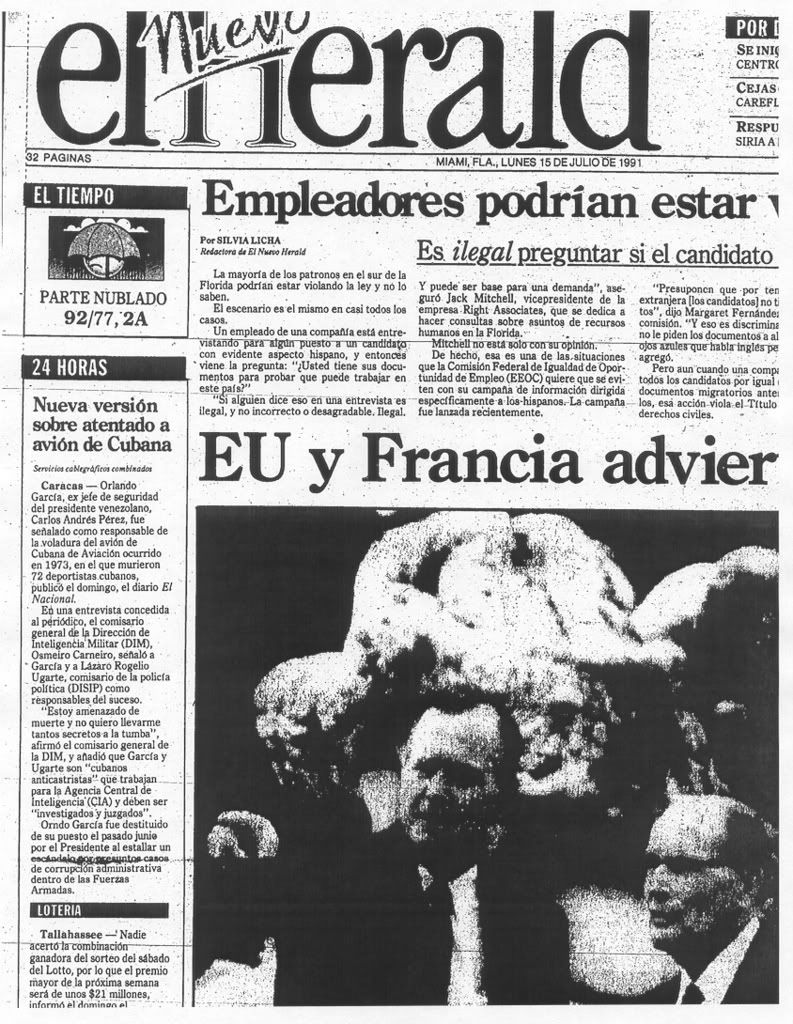
Encinosa writes that "Carneiro declared on July 15, 1991, according to El Nuevo Herald, that Bosch and Posada Carriles were innocent, but were used as 'scapegoats' by [Orlando] Garcia and [Lázaro Rogelio] Ugarte."
This is inaccurate. You can see the article for yourself here.
The article in question, titled "NUEVA VERSION SOBRE ATENTADO A AVION DE CUBANA" (New Version about Assault Against Cubana Plane) is an approximately 200-word news brief that appeared on the left column of the front page of El Nuevo Herald on July 15, 1991. The article never mentions Orlando Bosch or Luis Posada Carriles, and it never says that they were "scapegoats" or "innocent" of the bombing in 1976. In this respect Enrique Encinosa is lying.
I pondered about why Enrique Encinosa would make such a deceptive statement about this article, until I found out that El Nuevo Herald had actually followed up with this story 11 days later with a full interview with Osmeiro Carneiro. On July 26, 1991, El Nuevo Herald published an interview with Carneiro by reporter Gerardo Reyes, who also followed the Carneiro story (about secret wiretaps in Venezuela) on the 27th and 28th. I'm sure that Enrique Encinosa could not have missed these articles, especially since the Carneiro interview made the front page and was a more than 1000-word article.
You can see portions of this 1991 front-page article titled "CONGRESO VENEZOLANO INVESTIGA A CUBANOS" by Gerardo Reyes here: Page1 and Page2.
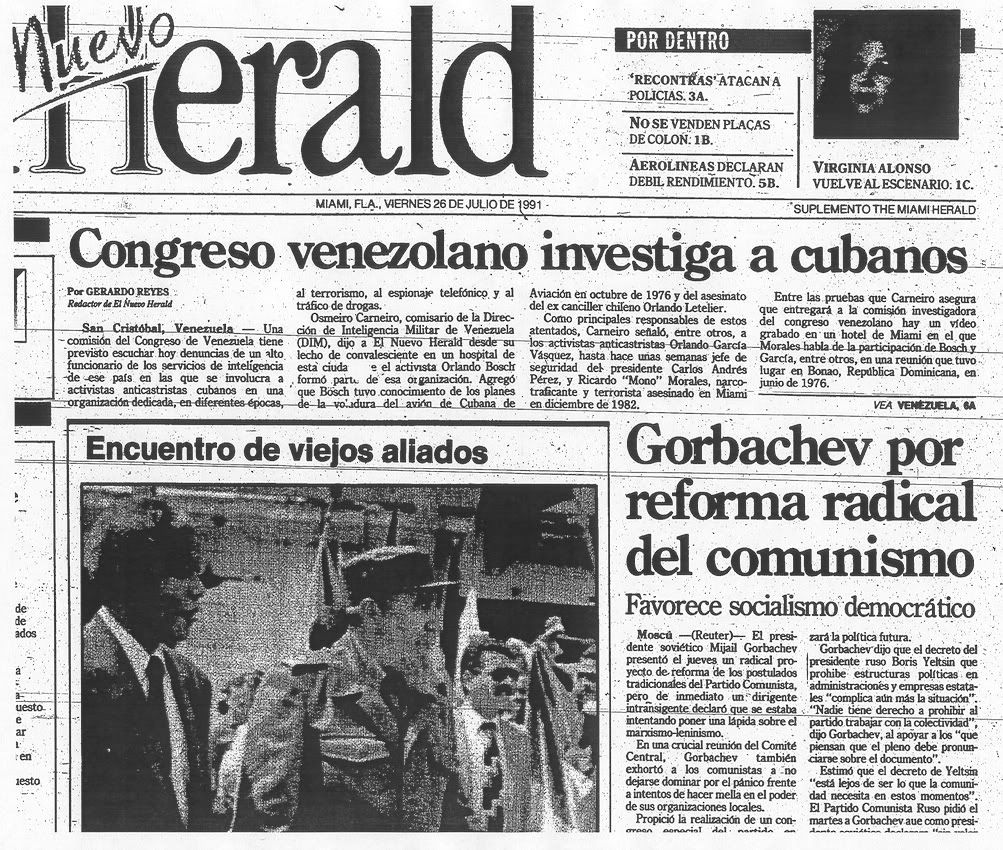
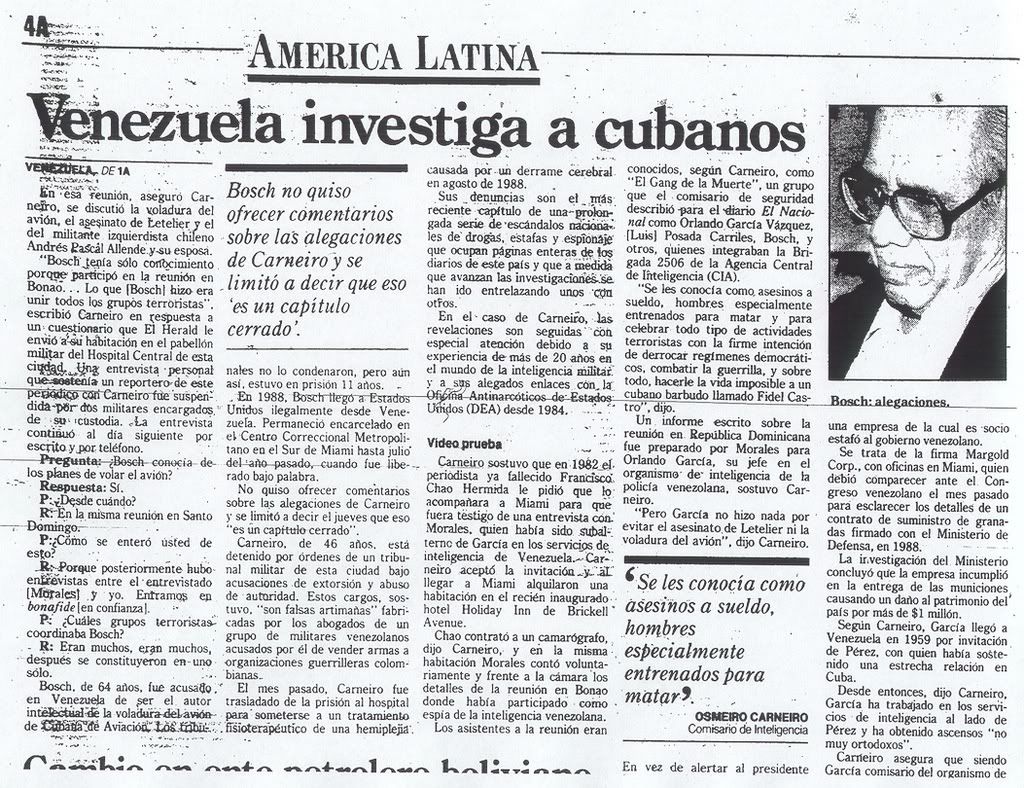
In this "interesting" interview with Osmeiro Carneiro, a former military intelligence officer in Venezuela for more than 20 years, it is alleged that Orlando Bosch knew about the plan to bomb the Cubana flight in 1976 and helped "unite all the terrorist groups" against the Cuban government in June of that year. The other details that Carneiro mentions also lend support to the US government declassified documents that show Orlando Bosch and Luis Posada Carriles as conspirators to this act of terrorism. Carneiro just adds more names to the fire because he mentions that Bosch and Posada Carriles were part of a group he called "El Gang de la Muerte" (The Gang of Death).
Furthermore, Carneiro NEVER says that Bosch or Posada were "innocent" or "scapegoats." This is a fabrication by Enrique Encinosa, who in my opinion knew about this interview, but decided to ignore it and engage in propaganda to paint Luis Posada Carriles as an innocent victim in the bombing of the Cubana flight in 1976.
[Part 5]
Tuesday, June 26, 2007
No Defense for Terror (Part 2)
"Examinemos la realidad, más allá de la propaganda y la retórica."
This is the main purpose in Enrique Encinosa's article, La Verdad sobre Luis Posada, telling the reader to "examine the truth, beyond the propaganda and rhetoric." I agree, let's proceed.
Encinosa provides 5 points to proclaim the innocence of Luis Posada Carriles to the bombing of the Cubana Airline flight in 1976.
1) Luis Posada Carriles "voluntarily submitted" to a lie detector test whose results showed he was not involved in the bombing of 1976;
2) Posada Carriles was "acquitted on two occasions" in Venezuelan courts, namely in 1980 by Judge José Moros González;
3) Testimony by Osmeiro Carneiro, made in El Nuevo Herald on July 15, 1991, declaring that Orlando Bosch and Luis Posada Carriles were "innocent" and "scapegoats";
4) Testimony by Ricardo "El Mono" Morales Navarrete confessing to a conspiracy with Cuban intelligence agents to blow up the Cuban airline flight and blame Bosch and Posada;
5) An FBI report "declaring" that Luis Posada Carriles was not involved in the 1976 bombing.
----------
THE LIE DETECTOR
Its important to note that Luis Posada Carriles "voluntarily submitted" to a lie detector test right before he entered the US in 2005 and was accused of illegal entry, and his past history placed under suspicion by the FBI. More likely that the polygraph was the idea of his attorneys and not solely of Posada, already knowing that they would face legal troubles. Not voluntary at all it seems. Nevertheless, polygraph tests have been shown to be very unreliable and its results are not allowed in federal courts as evidence. The website AntiPolygraph.org provides many examples to support the unreliability of such tests. This test alone does not prove the "innocence" of Luis Posada Carriles, but instead is a legal strategy by Posada's lawyers who can use the polygraph examiners testimony to claim innocence for their client, which is allowed in court.
THE ACQUITTALS
According to the judicial record, Luis Posada Carriles has never been acquitted twice. Encinosa is correct in stating that he was acquitted in 1980, but this only counts as ONE. According to what has been officially submitted to the Inter-American Commission on Human Rights (IACHR) of the OAS in 1984, the initial civilian court that brought charges on Posada Carriles never made an acquittal, but instead on "August [25] 1977, [Judge] Dr. Delia Estaba decided that this case was not within her competence, and referred it together with the records, to the Military Courts, specifically to the First Military Court of First Instance."
Only in 1980 was Posada acquitted by José Moros González. Still, this decision was invalidated in 1983. According to the submission to the IACHR:
"On March 24, 1983, the Court Martial declared itself incompetent to handle the case, based on a recent ruling of the Supreme Court of Justice, in deciding in the case of a woman journalist, that persons must be judged by their natural judges; it decided to send the case, consisting of 23 pieces plus the exhibits, to the Superior Judge, XIV Criminal Court, José Erasmo Pérez España, and to submit the conflict of competence to the Criminal Chamber of the Supreme Court of Justice."
According to Jose Pertierra, a Cuban-American lawyer representing Venezuela in its extradition of Luis Posada Carriles, the decision in 1983 means "that the lower Court’s decision is annulled, and that the entire record of the case is void, much akin to the legal effect that an annulment has on an attempt at a marital union."
Rosa Miriam Elizalde, a Cuban journalist, and José Pertierra write about the "Double Acquittal Myth" of Luis Posada Carriles, and explain that in this case "[a] lie, if repeated often enough, turns into truth."
[Part 3]
This is the main purpose in Enrique Encinosa's article, La Verdad sobre Luis Posada, telling the reader to "examine the truth, beyond the propaganda and rhetoric." I agree, let's proceed.
Encinosa provides 5 points to proclaim the innocence of Luis Posada Carriles to the bombing of the Cubana Airline flight in 1976.
1) Luis Posada Carriles "voluntarily submitted" to a lie detector test whose results showed he was not involved in the bombing of 1976;
2) Posada Carriles was "acquitted on two occasions" in Venezuelan courts, namely in 1980 by Judge José Moros González;
3) Testimony by Osmeiro Carneiro, made in El Nuevo Herald on July 15, 1991, declaring that Orlando Bosch and Luis Posada Carriles were "innocent" and "scapegoats";
4) Testimony by Ricardo "El Mono" Morales Navarrete confessing to a conspiracy with Cuban intelligence agents to blow up the Cuban airline flight and blame Bosch and Posada;
5) An FBI report "declaring" that Luis Posada Carriles was not involved in the 1976 bombing.
----------
THE LIE DETECTOR
Its important to note that Luis Posada Carriles "voluntarily submitted" to a lie detector test right before he entered the US in 2005 and was accused of illegal entry, and his past history placed under suspicion by the FBI. More likely that the polygraph was the idea of his attorneys and not solely of Posada, already knowing that they would face legal troubles. Not voluntary at all it seems. Nevertheless, polygraph tests have been shown to be very unreliable and its results are not allowed in federal courts as evidence. The website AntiPolygraph.org provides many examples to support the unreliability of such tests. This test alone does not prove the "innocence" of Luis Posada Carriles, but instead is a legal strategy by Posada's lawyers who can use the polygraph examiners testimony to claim innocence for their client, which is allowed in court.
THE ACQUITTALS
According to the judicial record, Luis Posada Carriles has never been acquitted twice. Encinosa is correct in stating that he was acquitted in 1980, but this only counts as ONE. According to what has been officially submitted to the Inter-American Commission on Human Rights (IACHR) of the OAS in 1984, the initial civilian court that brought charges on Posada Carriles never made an acquittal, but instead on "August [25] 1977, [Judge] Dr. Delia Estaba decided that this case was not within her competence, and referred it together with the records, to the Military Courts, specifically to the First Military Court of First Instance."
Only in 1980 was Posada acquitted by José Moros González. Still, this decision was invalidated in 1983. According to the submission to the IACHR:
"On March 24, 1983, the Court Martial declared itself incompetent to handle the case, based on a recent ruling of the Supreme Court of Justice, in deciding in the case of a woman journalist, that persons must be judged by their natural judges; it decided to send the case, consisting of 23 pieces plus the exhibits, to the Superior Judge, XIV Criminal Court, José Erasmo Pérez España, and to submit the conflict of competence to the Criminal Chamber of the Supreme Court of Justice."
According to Jose Pertierra, a Cuban-American lawyer representing Venezuela in its extradition of Luis Posada Carriles, the decision in 1983 means "that the lower Court’s decision is annulled, and that the entire record of the case is void, much akin to the legal effect that an annulment has on an attempt at a marital union."
Rosa Miriam Elizalde, a Cuban journalist, and José Pertierra write about the "Double Acquittal Myth" of Luis Posada Carriles, and explain that in this case "[a] lie, if repeated often enough, turns into truth."
[Part 3]
Wednesday, June 20, 2007
No Defense for Terror (Part 1)
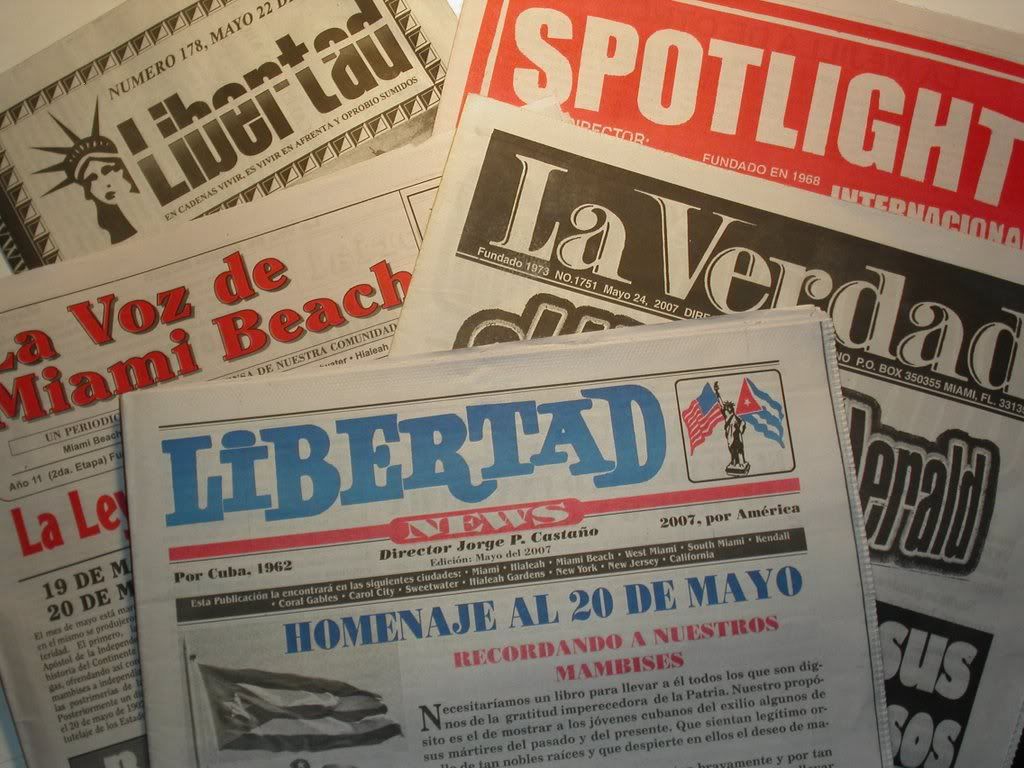 As annoying as the Luis Posada Carriles case is, the defenders of terrorism against Cuba are just as annoying.
Here in Miami, there are many who are ready to defend Luis Posada Carriles, his acts of terrorism, and have no shame to do so. As the picture on the left shows, many arguments in defense of terrorism against Cuba appear in several small newspaper publications that can be found around Little Havana. Those shown in the picture are merely for the month of May.
These publications can be found in many parts of Little Havana, and have been in existence for very long. Their editiorials regularly speak of the "flagrant violations" by the Cuban government, "the bloody tyrant" Fidel Castro and his "communist aggresion." They're the old-school bloggers. Their pages welcome articles by Carlos Alberto Montaner, Armando Perez-Roura, Ramon L. Bonachea, Luis Conte-Aguero, Agustin Tamargo, and any other who speaks against the "communist agression."
But, as adamant and vocal as some are to justify a war against Cuba, their arguments in defense of Luis Posada Carriles are surprisingly poor. Let's examine one example that argues that Posada Carriles is in fact "innocent" of the bombing of a Cuban airplane in 1976 that killed 73 people on board.
Perhaps one of the most important defenses for Posada Carriles comes from Enrique Encinosa. Encinosa is well known to his listeners on Radio Mambi, and by the fans of his many books on Cuban history. Encinosa also appeared recently on the documentary "638 Ways to Kill Castro" saying that terrorism is an "acceptable method" against Cuba. The documentary also reveals Encinosa's very close relationship with Posada Carriles, whom he called regularly while Posada was in federal prison. Last October, Encinosa released an article titled La Verdad sobre Luis Posada (The Truth about Luis Posada). Its main argument is that Luis Posada Carriles is in fact a "scapegoat" and "innocent" of the 1976 bombing. He presents many theories and testimonies that suggest a connection with the Cuban government and the bombing. This article has found its way into many different websites that I have found:
- La Junta Patriotica Cubana (The Cuban Patriotic Board) website
- La Nueva Cuba (The New Cuba) website
- Cuba Nuestra Digital (Our Cuba Digital) website
- Cuba Democracia y Vida (Cuba, Democracy and Life) website
- The Univision (US Spanish Television Network) website
And blogs:
- El Club de Los Amigos Malos Blog
- Baracutey Cubano Blog
- Blog for Cuba
Encinosa's article DOES NOT presents "La Verdad" about Luis Posada Carriles. On the contrary, I will argue that Encinosa engages in an exercise of propaganda because of his obvious ommissions of important facts in the case of Luis Posada Carriles. Also, I accuse the websites above for supporting false representations of the facts, and perpetuating the false innocence of Luis Posada Carriles.
Let's review the facts of Encinosa's argument.
[Part 2]
Wednesday, June 13, 2007
Looking for the Truth
 Been busy, but plan to post big soon on the ongoing case of Luis Posada Carriles (he's not off the hook YET). Some time back I was carefully looking at one of Enrique Encinosa's arguments defending Luis Posada Carriles. The article, titled La Verdad sobre Luis Posada (The Truth about Luis Posada), is in fact very far from the "Truth." Doing some simple research on his allegations shows that Encinosa conveniently leaves out a lot of information that contradicts his side of the story. It's embarassing.
Anyway, my next post will definitely target most of the popular "defenses" and defenders of Luis Posada Carriles. I will try to show that there really is no defense for people who have long and undeniable histories of violence. Those who attempt to, end up sacrificing any form of logic and rationale, contradicting their very own principles.
This may explain why some prefer not to directly comment on Posada's or Orlando Bosch's past violent history, and prefer to obviate by describing them as heroes, thus automatically justifying all their prior actions as noble. This method has its limits, especially in the face of facts.
Late last month, Nick Welsh for the Santa Barbara Independent wrote about Ann Louise Bardach, the journalist who extensively interviewed Posada Carriles in 1998. Welsh reminds us that the FBI has been very active in its investigation on Luis Posada Carriles, in an attempt to be "consistent with our global-war-on-terror rhetoric," but also suggests that the Justice Department may have something else up their sleeve, which may be good news for Posada Carriles, and bad for Ann Louise Bardach.
Welsh recounts how the FBI has repeatedly subpoenaed Bardach for important information on Posada Carriles (ever since they mysteriously destroyed their Posada files in 2003), and how they may be deliberately targeting Bardach "precisely because they know she’ll put up a fight" (Bardach has refused to hand over her notes on Posada Carriles to the government).
The rationale by the FBI may be the based on the fact that "the feds can’t afford to go after Carriles because of what he knows and what he might say. But because of the administration’s so-called war on terror, the feds can’t afford to give him a pass either. The best solution... is to orchestrate an impasse."
Provided that the FBI has been to Cuba to collect facts, and shown others positive signs, there seems to be a strong case to charge Luis Posada Carriles in the US. Welsh also writes that Bardach "contends the government already has more than enough information to nail Carriles to the wall." But, there also seems to be a growing motivation to allow the federal investigation to stall, and maybe even collapse with a simple order by the executive branch.
It seems that only time will tell.
Friday, March 2, 2007
This Week's Documentary
 I've been extremely busy and will be for the next two weeks. My posts therefore will be shorter than usual. So, I've decided to list some documentaries about Cuba that I think are excellent, and contribute to the current debate about US policy. Today I will highlight one film, followed by another next week.
Some of you may have heard of this documentary when its outtake of Ileana Ros-Lehtinen supporting an assassination attempt on Fidel Castro made the news. She denied her remarks first, then (two weeks later) admitted them. You can also check out how some of our favorite Cuban-American bloggers (Mr. Gomez from Cuban American Pundits, and Robert from 26th Parallel) displayed similar, astonishing attempts at denial when the news first broke. While Mr. Gomez and Robert don't seem to care about the ethical responsibilities of US Representatives, most likely they still believe the video outtake to be a manipulation.
But, aside from Ileana's controversial comment, the film "638 Ways to Kill Castro" by Dollan Cannell is excellent. The final cut does not include our favorite Republican from district 18, but it does include Radio Mambi's own Enrique Encinosa, who alone makes his own controversial comment in the film in support of terrorism. In general, the film is a historical outline of the hostile relations of the US towards Cuba (not just towards Fidel) since the Revolution. Perhaps the most important part of the film, in my opinion, is its focus on our local "patriots," like Rodolfo Frometa (leader of the F4 Commandos and who seems to have successfully indoctrinated his son in the film) and Luis Posada Carriles (some of whose paintings are sold through Enrique Encinosa at exorbitant prices).
Thanks to the magic of the internet (and Google Video) the entire documentary by Dollan Cannell is available to us. It is viewable in two parts (in mp4 format for download), with commercials due to its premiere on UK Channel 4.
[Part One]
[Part Two]
Best to all.
Wednesday, February 7, 2007
Enrique Encinosa in the Spotlight
Aside from Ileana's supporting role in the documentary "638 Ways to Kill Castro," Univision's own Enrique Encinosa plays a small role as "man who justifies terrorism."(my title)
Just yesterday, I posted Encinosa's comment about what he thinks Cubans should do with a thousand boxes of matches. Well, now its pretty clear that Radio Mambi's Enrique Encinosa, who works as their news editor, favors terrorist methods. In this part of the documentary, when he's asked about the hotel bombings in Cuba in 1997, Encinosa replies:
"I personally think its an acceptable method. Its a way of damaging the tourist economy. The message that [almost says YOU, as if he's done it before]... one tries to get across is that Cuba is not a healthy place for tourists. So, if Cuba is not a healthy place for tourist, because there's a few windows being blown out of hotels, that's fine."
There's an interesting psychology involved here. It seems that acceptance for this form of terrorism, which seems to target property only and not civilians, totally denies the fact that there are financial victims nonetheless. And, furthermore, does not account for use of explosives, which can cause accidental bodily harm, or death. Incidentally, the bombing campaign in '97 led to the death of an Italian tourist, of which suspected terrorist mastermind Luis Posada Carriles responded: "It is sad that someone is dead, but we can't stop... That Italian was sitting in the wrong place at the wrong time.''
According to the US Department of Defense, terrorism is defined as:
"... the unlawful use or threatened use of force or violence against individuals or property to coerce or intimidate governments or societies, often to achieve political, religious, or ideological objectives."
There's no question that Posada Carriles' aims are political, and not alone economically focused. In his 1998 interview with Ann Louise Bardach, Posada Carriles passed her a three-page manifesto that read at one point:
"The absence of freedom of expression, of freedom of movement for a hungry people oppressed and terrorized by communist repression... This gives all free Cubans a right to take up arms against the tyrant, using violence or whatever means at our disposal to derail this terrible system and bring freedom to our country."
Enrique Encinosa has mentioned many times on radio that he keeps in touch with Posada Carriles, who is now in prison for federal charges, and how he's a patriot above all. Just last week, Encinosa said that if things get worse, Posada Carriles was prepared to hunger strike to his death!
I can't say I would admire such an act.
Tuesday, February 6, 2007
Radio Mambi and Ten Thousand Boxes of Matches
Still, those who listen and call to Radio Mambi are older generation Cubans who believe militarism is justified.
On January 5, 2007, another caller to "La Mesa Redonda" (The Round Table) urged Perez-Roura and his listeners that the US must do MORE to help the Cubans on the island, specifically suggesting a naval blockade. Perez-Roura replied that "ojala con tiempo"(hopefully with time) the US would approve such an option.
On January 12, 2007, Perez-Roura invited Ernesto Diaz Rodriguez, member of Alpha 66, to denounce the US indictments on Luis Posada Carriles. He basically reiterated an important point on how far some Cubans are willing to go. He mentioned that it was a "sacred pledge... to fight (or struggle) to free Cuba without counting on anybody, nor asking permission from anyone, whatever the price may be."
On January 23, 2007, in another "Tome Nota" radio commentary, Perez-Roura made it very clear that he would not consider any other alternatives to the US/Cuba conflict. He said that their struggle "would not permit, at the last minute, for an agreement to be reached... In Cuba there must be change. There cannot be a succession. There cannot be a transition, where everything definitely stays the same, because we know well how Communists are."
According to Perez-Roura's praise of Luis Posada Carriles and Santiago Alvarez, I'm sure he and others at Radio Mambi would be very happy with a violent coup to settle their anger.
On December 22, 2006 ("En Caliente" morning show), a caller made it very clear what kind of "struggle" Radio Mambi really wants.
Caller: ... because [in Cuba] what we must do is fight, and throw rocks, do anything, and from here [in Miami] guide it. Often we are afraid of others' criticisms because we want everything [in Cuba] to be by the law. With the Communist government, there can be NOTHING by the law. It has to be based on FORCE! Otherwise, they will never be liberated!
Enrique Encinosa (co-host with Perez-Roura): "I'm very much in agreement. If the ten thousand who signed the Varela Project, instead of signing, had instead taken to the streets with ten thousand boxes of matches, it would be over in a day."
Thursday, February 1, 2007
A Terrorist's Veil of Innocence (Part 1)
 One false notion that is constantly heard and repeated is that Luis Posada Carriles is innocent because he has been "twice acquitted" for his crimes. These so-called "acquittals" relate to charges against Carriles, in which he was a primary suspect, for the bombing of a civilian aircraft in 1976.
Currently, Luis Posada Carriles is being held in a US federal prison for charges of fraud connected to his illegal entrance and false immigrant application into the US. And, just this morning in Miami, cries of injustice continue to be called out on the radio. Callers to Radio Mambi, one of Carriles' main supporters for his release, ask Armando Perez-Roura on his morning show: where's justice for this freedom fighter who was already aquitted for his crimes? And, there's a silence. It's a silence that belongs to those baffled with simple logic, based on a false premise. One of the hosts on Radio Mambi's morning show, Enrique Encinosa, responds that there is a lot international pressure in the case of Carriles, but mainly that "para los communistas no importa"[*](it doesn't matter to the Communists) if Carriles has been aquitted.
The truth is that Luis Posada Carriles has NOT been aquitted. Yet, it seems that THIS doesn't matter to Enrique Encinosa, and others who believe that Carriles is an innocent man.
The best clarification of Carriles' false "veil of innocence" has come from the Council on Hemispheric Affairs. They write that:
"Posada was first tried before a military tribunal, which acquitted him of the crime of treason. However, a higher military court found that the lower one lacked jurisdiction and annulled the entire case, which was then handed off to the civil courts. They would have prima facie jurisdiction over Posada, as he was at the time a citizen of Venezuela. Initially, the prosecutors in the civil case declined to try him; their replacements, however, saw fit to bring homicide charges against Posada, and it was during this period that he escaped from prison.
"To Posada’s potential benefit, many have interpreted this lack of a verdict to mean that two Venezuelan courts have found him innocent of terrorism. However, neither of the legal actions against him carried any precedential effect. The military tribunal annulment effectively wiped the slate clean, resetting the entire judicial process and leaving all parties situated as if no legal action had ever occurred.
"In the final analysis, Posada was in the process of facing prosecution for a major crime at the time when he escaped from Venezuela."
This description is supported by the official statements of the Venezuelan Embassy in the US. They say:
"The history of the litigation in Venezuela that shows that after litigation in the military tribunals, the case was annulled on March 24, 1983, because it was conducted in the wrong forum. Subsequently, it was sent to the penal courts where, prior to a verdict by the court, Posada escaped from prison in San Juan de los Morros in Guárico state on August 18, 1985... The statutory period for trying the case has not lapsed, because according to Article 110 of the Penal Code, the statute of limitation is tolled for a fugitive until a new legal action is taken."
This is why the Venezuelan government continues to demand for the extradition of Luis Posada Carriles from the US, who together have extradition obligations to fulfill. This demand for extradition was also supported by virtually all the countries in Latin America at the 2005 Ibero-American Summit where they agreed on such a resolution.
The case of Luis Posada Carriles is pretty clear in Latin America: he's a terrorist that should be extradited and tried for his charges in Venezuela. But, here in Miami, its a totally different story.
[*]Enrique Encinosa - Radio Mambi: "En Caliente" Morning Show (February 1, 2007)
Friday, January 12, 2007
The Pride of Perez Roura
Today's Miami Herald reports that the patriot/terrorist, Luis Posada Carriles, was indicted by a federal grand jury in Texas (finally). Anyway, Radio Mambi's general director Armando Perez Roura found this decision as an "abuso"(abuse) and quoted Carriles' lawyer, Eduardo Soto, saying that the charges are "absurdo"(absurd). Furthermore, Radio Mambi's morning show, "La Noticia y Usted/En Caliente," had a spokesperson from the "formerly" militant Cuban-American exile group Alpha 66, stating their full condemnation of the recent indictment.
In the Mambi morning show, Enrique Encinosa, one of the three hosts of the political talk program, said that the decision of the grand jury, and its absurdity, lies in an earlier US statement pointing out that releasing Carriles from prison would pose a problem with foreign relations. Afterwards, Encinosa equated this decision with the likes of being coerced by Libya or some other unfavorable nation. But this is not the case.
International pressure DID and continues to play a part in this case, but it does not originate from ONE country, like Encinosa's inaccurate example.
In October of 2005, at the 15th Ibero-American Summit, virtually ALL the countries from the Latin region condemned US policy towards Cuba, specifically asking that Luis Posada Carriles be tried and extradited to Venezuela. That's 19 nations, not one.
I will produce in the future the statements made by Alpha 66 this morning.
For now, I will leave you with what Armando Perez Roura had to say about Luis Posada Carriles, and another defendant (Santiago Alvarez) who was indicted yesterday.
[From December 22, 2006 - La Noticia y Usted/En Caliente (Morning Show)]
Armando Perez Roura:
"...we have compatriots whom we love and admire much, in the prisons of the United States. I want to tell you what I told Santiago [Alvarez] and Luis [Posada Carriles] yesterday, so the message can be heard by all, absolutely all of those who are suffering in prison for trying to and using their courage to, in all senses, liberate Cuba:
"We are proud of you, we are proud of you. [Or: We have pride because of you.]
"You are the reserve [military or reservoir of good will] that we have, so that one day not far, we can return without bowed heads before a regime that has destroyed our motherland."
In the Mambi morning show, Enrique Encinosa, one of the three hosts of the political talk program, said that the decision of the grand jury, and its absurdity, lies in an earlier US statement pointing out that releasing Carriles from prison would pose a problem with foreign relations. Afterwards, Encinosa equated this decision with the likes of being coerced by Libya or some other unfavorable nation. But this is not the case.
International pressure DID and continues to play a part in this case, but it does not originate from ONE country, like Encinosa's inaccurate example.
In October of 2005, at the 15th Ibero-American Summit, virtually ALL the countries from the Latin region condemned US policy towards Cuba, specifically asking that Luis Posada Carriles be tried and extradited to Venezuela. That's 19 nations, not one.
I will produce in the future the statements made by Alpha 66 this morning.
For now, I will leave you with what Armando Perez Roura had to say about Luis Posada Carriles, and another defendant (Santiago Alvarez) who was indicted yesterday.
[From December 22, 2006 - La Noticia y Usted/En Caliente (Morning Show)]
Armando Perez Roura:
"...we have compatriots whom we love and admire much, in the prisons of the United States. I want to tell you what I told Santiago [Alvarez] and Luis [Posada Carriles] yesterday, so the message can be heard by all, absolutely all of those who are suffering in prison for trying to and using their courage to, in all senses, liberate Cuba:
"We are proud of you, we are proud of you. [Or: We have pride because of you.]
"You are the reserve [military or reservoir of good will] that we have, so that one day not far, we can return without bowed heads before a regime that has destroyed our motherland."
Subscribe to:
Posts (Atom)