
Showing posts with label Radio Mambi. Show all posts
Showing posts with label Radio Mambi. Show all posts
Thursday, March 21, 2013
Radio Mambi Attacks Yoani Sanchez, Unknowingly Puts Foot in Mouth
As famed Cuban blogger Yoani Sanchez gets closer and closer to her Miami visit, militant and hard-line Cuban exiles are going through an interesting phase of introspection: How much respect or support should they show Sanchez during her internationally publicized trip around the world, while withholding their deep displeasure by her public opposition to the U.S. embargo towards Cuba and the presence of the U.S. Naval Base in Guantanamo. This is how Radio Mambi responded.
DIVISION
On Monday, the day before Yoani Sanchez's historic visit to Washington D.C., Radio Mambi's Armando Perez-Roura (founder and programming director) decided to make his position clear on the famous Cuban blogger. Some weeks ago, Perez-Roura admitted he thought about it carefully, especially after Sanchez's public comments in Brazil. He debated the issue with his group Unidad Cubana one Saturday, where he described the discussion as very divisive. I recall years ago Perez-Roura showing much admiration for Yoani Sanchez.
But, given her recent comments against U.S. policy, it seems that Perez-Roura can no longer give Yoani Sanchez his full support. Instead, on Monday Perez-Roura invited Tito Rodriguez Oltmans to his two-hour show "Tome Nota" to reflect their displeasure with Sanchez, and cast doubt on her motives.
PARANOIA
Tito Rodriguez Oltmans, former exile militant of the group Salva a Cuba (Save Cuba) and Unidad Revolucionaria (Revolutionary Unity), is the long-time host of Radio Mambi's show "Puntos de Vista" (Points of View) which airs every Saturday at 8pm. In his two-hour show, Rodriguez talks about all sorts of conspiracies related to international communism, the infiltration of communists in the U.S., and his deep distrust of some dissidents inside Cuba. According to Rodriguez, Cuba's Ministry of the Interior has such complete control of communications inside the island that any regular mention of dissident activities in the international media is actually being permitted by the Cuban government. In other words, behind Yoani Sanchez lurks a communist plot in the shadows.
Armando Perez-Roura said he invited Rodriguez to his show because he had heard Rodriguez's previous show on Yoani Sanchez. Clearly, Perez-Roura had approved of those comments, as he approves of most guests who appear on his show, and continues to ban others he disapproves of, namely Democrats.
But, Tito Rodriguez Oltmans unknowingly made a huge error on Monday. As Rodriguez raised several questions about Yoani Sanchez and her blog, calling into question her motives for visiting Miami, and making absurd allegations, he was actually relying on questions being raised by Cuban government supporters who also oppose the famous dissident blogger. In other words, Tito Rodriguez Oltmans on Monday did a huge favor for his long-time enemy, the Cuban government.
If you listen carefully to the audio excerpts above, you'll notice that Rodriguez raised some of the same questions mentioned in Salim Lamrani's recent article titled "40 Questions for Yoani Sanchez" (If you were lucky to hear the entire show, Rodriguez relied heavily on this document). Lamrani is a journalist who writes frequently on several topics related to Cuba. To get an idea where he stands on U.S. policy towards Cuba, then check out his edited volume titled "Superpower Principles: U.S. Terrorism Against Cuba." He's written several other books about U.S. policy towards Cuba, which have been published in Spanish by Editorial Jose Marti, a publisher based in Havana. Lamrani has also been a long-time critic of Yoani Sanchez.]
I find it hard to believe that Tito Rodriguez Oltmans would use this material if he knew the author, especially given Lamrani's political stance on U.S. policy and support of the Cuban government. Most likely, Rodriguez was unconcerned about who wrote these questions, and more interested in his own agenda to defame Yoani Sanchez.
SELF-DESTRUCTION
In their paranoid world, Rodriguez and Perez-Roura believe that Sanchez's message being transmitted throughout the world is another attack against their militant cause. They don't like the division and introspection that Sanchez's messages provoke. They prefer the unity of mind that exile militants are used to, where friend and enemy are easily recognized, and where the right solution for Cuba is clear: a political transition through righteous violence.
For those militants, Yoani Sanchez doesn't fit.
Saturday, January 14, 2012
Newt Gingrich Interview on Radio Mambi [Updated]
 Republican Presidential candidate Newt Gingrich arrived in South Florida last Thursday just in time for an evening fundraiser in Coral Gables. The following day, Gingrich visited Little Havana where he pledged a hard-line policy towards Cuba in a written letter to Miami's most intransigent Cuban exile organization, Unidad Cubana. While Unidad Cubana seemed very pleased by Gingrich's promise, they were probably even more pleased that a Presidential candidate had actually endorsed such an extremist policy. The letter, undoubtedly written in Miami and not by Gingrich, has now raised policy expectations by the most hard-line in Little Havana.
ENTER DAVID RIVERA
Thursday's fundraiser was held at the luxurious Biltmore Hotel where Gingrich met up with Rep. David Rivera (FL-25) who, surprising some, is strongly endorsing and accompanied Gingrich while in Miami. Rep. Rivera was recently named one of the "most wanted corrupt politicians in Washington," and, according to Politico's Alex Isenstadt, accepting Rivera's endorsement shows Gingrich in a "scramble to put an organization in place" before the Florida primary. But, in Miami, Rivera is untouchable.
For years, David Rivera has been consistent with his hard-line policy towards Cuba (e.g. supporting 2006's Florida academic travel ban to terror-sponsoring nations like Cuba [now heading to the Supreme Court], proposing legislation to reform the Cuban adjustment act in order to punish Cubans in Miami who dare return to their homeland, and welcoming alleged criminals to Miami like Luis Posada Carriles). And, this is why Rivera still has many strong supporters in Miami, namely Cuban exile political leaders and other supporters of a "free Cuba."
ENTER LITTLE HAVANA
Perhaps knowing that Newt Gingrich was "scrambling" for support in South Florida, hard-liners in Miami most likely saw an opportunity to raise the political stakes and asked Gingrich to accept their extremist positions on Cuba in exchange for the coveted Cuban-American vote.
Disguised as a letter written by Gingrich himself, the four points outlined describe traditional and recent frustrations from hard-line exiles in Miami. Keeping the U.S. embargo towards Cuba is standard, while full implementation of Helms-Burton has been a long-time grievance in Miami, but frustrated due to international pressure on Washington. Seeking criminal indictments of Fidel and Raul Castro was proposed by Rivera earlier this year, but has been part of the Cuban American National Foundation's policy recommendations for years, and a local project headed by Cuban exile militant Santiago Alvarez at least since 2010. And, reversing the Obama administration's relaxed travel restrictions for Cubans would be a tremendous relief for hard-liners who find it outrageously immoral to see Cubans traveling back and/or sending remittances to Cuba. (In reality, the new Obama travel policies are very popular in Miami, but hard-liners don't care.)
ENTER RADIO MAMBI
Before the interview on Friday morning, Newt Gingrich and David Rivera held a press conference inside the Univision Radio offices (Univision 23 report). Surrounded by the press, and various members of the hard-line Cuban exile community, Gingrich officially presented his so-called Cuba policy letter to Unidad Cubana, Miami's most intransigent Cuban exile organization. At the table, Gingrich sat next to Armando Perez-Roura, chairman of Unidad Cubana and programming director of Radio Mambi. Also nearby were members of Vigilia Mambisa, such as Laura Vianello and Miguel Saavedra.
Once ready inside the studio of Radio Mambi, Perez-Roura began by expressing his pleasure with the Gingrich pledge to fulfill the initiatives outlined in the letter. But, besides the outlined policy, Gingrich hardly had any other original ideas. Following his answer regarding Cuba travel restrictions, Gingrich added his idea of a "very aggressive public relations policy" which would include a "daily report" about human rights abuses and other violations by the Cuban government. The purpose of course would be to convince the world about the evil nature of the Cuban regime. But, I seriously doubt any country would use these reports to change their long-established relationships with Cuba.
When asked what he would do about the Alan P. Gross case, Gingrich gave no practical solution and instead suggested something similar to his "public relations policy" from before. Then, as if related in some way, Gingrich proposed implementing a "much more effective program" of intelligence and counter-intelligence "against pro-castro infiltrators." Of course, this is a nod to espionage cases like Ana Belen Montes and the Myers. But, with the U.S spending about $80 billion (!) on intelligence services, I'm confident that those agencies are doing just fine without Gingrich proposing a "more effective program" for them.
EXIT MIAMI
After leaving Miami, Gingrich's Cuba policy certainly lifted spirits and expectations, like that of Manuel Malgor. Besides being a member of AMCVA, Malgor is also active in other local political organizations that focus on Cuba, and he "couldn't find a single defect in what [Gingrich] said" concerning Cuba.
Armando Perez-Roura has told listeners that he now expects to receive a similar pledge from Mitt Romney upon his next visit to Little Havana. It will be very interesting to see how Romney's advisors can top the letter to Unidad Cubana. As a reminder, Perez-Roura has translated Gingrich's letter for the recent publication of Libre Magazine. (It is the only Spanish version since the Gingrich campaign forgot to translate it for their Spanish-language website.)
Little Havana is certainly looking forward to seeing Mitt Romney's Cuba policy.
[Newt Gingrich Interview on Radio Mambi]
Newt Gingrich Interview on Radio Mambi by Mambi Watch
Saturday, February 6, 2010
The Cuban Five Must Suffer
 I've been listening regularly to Ninoska Perez-Castellon (photo) on Radio Mambi for years now. And, I've noticed that she has an ongoing peculiar interest in the suffering of the Cuban Five.
Before some of the Cuban Five had their life sentences reduced, Ninoska Perez-Castellon would boast on her radio show about how well-deserved their life-sentences were. One could almost sense her satisfaction that these men would spend the rest of their lives in prison. According to Perez-Castellon, the Cuban Five were part of the larger Cuban government conspiracy to destroy the Cuban exile community, and were justly sentenced for their involvement in the shootdown of the Brothers to the Rescue planes.
But, even their imprisonment was not enough. When the wives of the Cuban Five were denied visas to visit their husbands in federal prison, Perez-Castellon showed no sympathy saying that the denials were well deserved.
Yesterday, Ninoska Perez-Castellon's peculiar interest in the Cuban Five found its way to Louisville, Kentucky, where the paintings of one of the Cuban Five (Antonio Guerrero) are scheduled for an exhibition. The location of the exhibition is at a library on the campus of the University of Louisville, and sponsored partly by the Kentucky Interfaith Taskforce on Latin America and the Caribbean, and the Henry Wallace Brigade.
Perez-Castellon comments (as indicated from Friday's radio show) on the internet article from the Courier-Journal: "How pathetic that a university sponsors the so-called art work of a federal prisoner serving time for spying the United States." In the end, Perez-Castellon goes on to describe Antonio Guerrero as a "terrorist," which is clearly manipulative since Guerrero was not charged with such a crime, nor convicted of such actions.
Perez-Castellon, after expressing her indignation, shared on the radio the contact information to the President of the University of Louisville, James R. Ramsey. Radio listeners we're told to send a fax, if they wanted to.
Antonio Guerrero was originally sentenced to 10 years, plus life inside a Supermax prison in Colorado, but was re-sentenced last year producing the possibility of being released by 2016. Along the Malecon has examples of Guerrero's work posted, including information from a previous exhibition in Colorado Springs.
So, it seems that imprisonment until at least 2016 (Guerrero has already served about 11 years) is not enough according to Ninoska Perez-Castellon. Guerrero's right to "take part in cultural life" as described in Article 15 of the International Covenant on Economic, Social and Cultural Rights should be ignored. That is certainly strange for someone who regularly talks about defending human rights. Unless, of course, human rights apply only to some, while the others must suffer.
[More information on the Cuban Five]
[Cuba and Terrorism, research from the Center for International Policy]
Friday, December 4, 2009
"A Dangerous President"
 Those were the exact words that Rep. Ileana Ros-Lehtinen used to describe President Barack Obama when she appear on Radio Mambi last month.
Rep. Ros-Lehtinen occasionally appears on Radio Mambi to provide updates for listeners on her activities. She represents Florida's 18th Congressional District, which includes parts that most people recognize as "Miami," such as Coral Gables, Downtown Miami, Key Biscayne, Brickell and Miami Beach.
On November 13th, Rep. Ileana Ros-Lehtinen appeared on "La Mesa Redonda" (The Roundtable) with Armando Perez-Roura, programming director of Radio Mambi. I believe other issues were discussed, but the main issue seemed to be the decision that day by the U.S. Justice Department to federally prosecute five men accused of conspiring in the attacks of September 11. Rep. Ros-Lehtinen was outraged, as were many in the Republican party that day.
But, near the end of the radio show, Rep. Ileana Ros-Lehtinen summed it up for listeners. She not only felt that the decision from the Obama administration was misguided, and that the decision put U.S. security at risk (as other Republicans asserted), but she also felt that we had "a dangerous President" in the White House.
So I wonder what kind of decision a Radio Mambi listener might come to after that interview.
Here's an indication. Yesterday it was reported by El Nuevo Herald (Wilfredo Cancio Isla) that the U.S. Secret Service is investigating a call to Radio Mambi of someone who made an on-air threat to Pres. Obama saying someone should "shoot him in the head."
Now, some of you might think that maybe this was just some crazy person who called in one day, and said something stupid. Not likely. The Herald reports that the voice was from a regular caller to Radio Mambi (which is the case with most callers to Radio Mambi), and quotes an anonymous employee at the radio station saying that "what is heard there [on Radio Mambi] everyday against Obama and against any other is outrageous."
There is also a larger context here. Ever since Barack Obama became President, Radio Mambi has reached a new level of radicalism that I had never heard before. I will try to post about that soon, and with some audio samples.
[Another thing. The Herald article by Wilfredo Cancio Isla is not easily accessible to regular users of The Miami Herald and El Nuevo Herald websites. Doing a search for the article is useless. It doesn't even appear on Google News. Wierd.]
[Background on the recent decision by the U.S. Justice Department to prosecute 9-11 conspirators.]
[Photo by Getty Images]
Monday, May 4, 2009
The Intolerance of Ileana (Part 3)
 So, last Tuesday, Rep. Ileana Ros-Lehtinen called in to Radio Mambi (WAQI 710 AM) and spoke with host Ninoska Perez Castellon. Rep. Ros-Lehtinen called not only to inform listeners that she has sent out a "protest letter" to State Sec. Clinton, but also to encourage listeners of Radio Mambi to write their own letters of protest to the State Department because of what occurred at the U.S. Embassy booth of the Buenos Aires International Book Fair. Furthermore, Rep. Ros-Lehtinen also mentioned another letter that is being signed by "dozens and dozens" of her colleagues telling Sec. Clinton that "she should be informed about (or alerted to)" what is happening at our Embassies.
[Audio of Interview]
While the exact words of the "protest letter" to Sec. Clinton are not known, the comments from the press release are incredibly misinformed. Rep. Ros-Lehtinen believes that the book presentation of "Che's Afterlife" was an event "venerating" Ernesto Guevara. And, thus "the U.S. Embassy in Argentina is using American tax dollars to advance the radical agenda of those working feverishly to threaten regional stability and undermine critical U.S. foreign policy priorities in the region."
These comments make no sense at all.
The book by Michael Casey, just like the other investigations into Korda's "Che," does not "venerate" anyone, and does not "advance" any political ideology. Rather, it seems that Rep. Ileana Ros-Lehtinen is completely misinformed about the content of Michael Casey's book. As a matter of fact, Rep. Ros-Lehtinen mentions that she wrote her "protest letter" immediately after reading the Miami Herald's article describing the book presentation as "provocative" and part of a "charm offensive." Way to go Herald.
But, even if Rep. Ros-Lehtinen did have some knowledge of the book's content, she would probably still protest because as she told Radio Mambi: "I don't care about the image of 'Che' Guevara. What I care about is what 'Che' Guevara has done, and the hundreds of Cubans that died because of this tyrant."
It's clear that some people only see a "Killing Machine" when they see or think of Ernesto "Che" Guevara. Ileana Ros-Lehtinen's father, Cuban historian Enrique Ros, is author of one of the first books to confront the "Che Myth" before Humberto Fontova or Alvaro Vargas Llosa did. To these authors, based on their thorough research, Guevara embodied all the worst human elements anyone can think of. Therefore, they believe that the people who continue to idolize "Che" the assassin are either "idiots," victims or members of the "worldwide media/academia axis," or tyrants themselves.
But, it's incredibly ironic that these authors, who write to counter the appeal of "Che," are revealing historical material that is irrelevant to the worldwide appeal, distribution and proliferation of Korda's "Che." Remember what Michael Casey wrote, those who idolize "Che" are engaging in a "personal act" where they re-interpret and incorporate "Che" into their "idealized self." It has little, or nothing, to do with the documented facts of Ernesto Guevara.
Interestingly, the conclusions drawn by Casey, and others, concerning the worldwide appeal of the "Che" image, may inform why some Cuban exile militants venerate alleged terrorists like Orlando Bosch, or Luis Posada Carriles.
For example, Orlando Bosch, who was arrested as a suspect of the 1976 bombing of a civilian Cuban airliner which killed 73 people and and act which he publicly justified (in print and video@4:30) as an act of war, has never denounced acts of terrorism attributed to him. Despite his long-time, open support for terrorism against the Cuban government, then-State Sen. Ileana Ros-Lehtinen signed a letter in 1988 which described Bosch as a "valiant freedom fighter."*
In a 2006 interview, Bosch told a reporter: "I would have liked to kill [Fidel Castro] to set an example for future generations." That same year, Rep. Ileana Ros-Lehtinen appeared in a video saying: "I welcome the opportunity of having anyone assassinate Fidel Castro and any leader who is oppressing the people." She dismissed the video as a fraud once it gained media attention, but then admitted it's authenticity days later, never apologizing for her comments.
I guess her admiration for Orlando Bosch is a personal thing, like those that admire "Che." One wonders if it has anything to do with the historical facts. But, just like her protest against a book which she hasn't read, and has no interest in reading anyway, why should the facts get in the way?
[*] Harrison, Carlos. (1988, February 23). Politicians plead for Bosch's release. The Miami Herald.
----- [Extras]-----
- Michael Casey responds to Roger Noriega's book review on "Che's Afterlife."
- Another reaction from a blogger in Buenos Aires.
- And, despite being charged repeatedly with torturing, kidnapping, and homicide, and having U.S. support throughout his brutal repression, Humberto Fontova would have no problem wearing an Augusto Pinochet t-shirt. Welcome to the Twilight Zone.
[Part 1]
Tuesday, April 28, 2009
R.I.P. Sarvelio del Valle
 One of my earliest memories of Radio Mambi is hearing the musical introduction to their sports program which was hosted by Sarvelio del Valle. I doubt anyone could miss it, living in Miami among the biggest fans of Baseball, surely all Cubans would anticipate the scores read out by del Valle during lunch.
Sarvelio del Valle was perhaps the happiest man on Radio Mambi. Over the years, listening to del Valle report on the Miami Heat, the Marlins, or boxing history from Cuba, you could aways sense the smile on his face, and the joy provided over the airwaves. Never would his daily program go without a good laugh.
How did he maintain this merriment working inside Radio Mambi, perhaps the most confrontational and controversial radio station in Miami?
He didn't talk about politics.
Whenever a caller to his show would inject some politics into their comments, de Valle would either avoid making a direct response to the subject, or cut the call immediately. But, over the years most callers already knew that his half-hour sports program was not the forum for politics. Therefore, del Valle's sports program was a peaceful island in the sea of Radio Mambi.
Nevertheless, Sarvelio del Valle had great admiration for Armando Perez Roura, the programming director for Radio Mambi, and the leading voice of Cuban exile militancy. In a short Univision profile (which is no longer available) del Valle names Perez Roura as one of his biggest influences. And, in a recent article by Diario las Americas, Perez Roura is named as Sarvelio's guide and someone to whom he owed his life to.
Yesterday, Perez Roura dedicated his daily radio commentary to memories of Sarvelio del Valle. He described de Valle as more than just a brother, but someone who was "quiet, simple and when he had to prove himself, he did." According to Perez Roura, del Valle exhibited a "quiet and effective patriotism."
Rest in Peace, Sarvelio del Valle.
[More from El Nuevo Herald and Diario las Americas. Photo by Univision.]

Thursday, March 26, 2009
Supreme Court Rejects Posada Case [Updated]
 Today, Alejandro Armengol links to a Granma article that reports that the case of Luis Posada Carriles, the notorious Cuban exile militant, has been rejected by the U.S. Supreme Court. The International Herald Tribune also has the story from the AP.
Posada's lawyers were delivered a devastating reversal last August when the Fifth Circuit Court of Appeals ruled against them, allowing Posada's case on criminal immigration charges to continue. Back in August, it was expected that the Supreme Court would not take the case.
Earlier this month, Luis Posada Carriles attended the Eight National Congress of Alpha 66 at the Big Five Club in West Miami. The event also served as an exhibition of Posada's paintings.
-----
Update: Radio Mambi this morning read El Nuevo Herald on Posada's Supreme Court rejection. Posada's lawyer, Arturo Hernandez, is asking to postpone the trial until next year. Which is very odd because in the article Hernandez says that he was not surprised by the Supreme Court's rejection, but now he needs at least TEN MONTHS to prepare his case for 2010. If he anticipated a rejection, which was the likely decision by the US Supreme Court, what has he been doing for the past SIX MONTHS since the Fifth Circuit Court's decision last August?
There have been sufficient delays in this case.
After the El Nuevo Herald article was read, co-host Enrique Encinosa, who also serves as a news editor for Radio Mambi, commented that this entire judicial process is "offensive" and "shameful" given Posada age and historical background. (Encinosa believes certain acts of terrorism are justified.)
Back in November 15, 2007, Posada's lawyer, Arturo Hernandez, appeared before a US House Subcommittee and explained:
"Mr. Posada Carriles is now almost 80 years old. His is the story of a man’s singular mission to combat Castro’s violent revolutionary communism in all its manifestations and permutations wherever it has reared its ugly head and at whatever personal cost to him. His individual struggle against communism was in a very real sense the often unobserved struggle of our hemisphere to avoid the sovietization of Latin America as part of the great ideological and strategic contest between the United States and the Soviet Union known as the 'Cold War'... and, it is no exaggeration to suggest that more than a few South American and Central American countries owe their democracies to the sacrifices incurred by men and women such as Mr. Posada Carriles."
Hernandez dismisses the accusations of Posada's involvement in the 1976 bombing of a Cuban civilian plane that killed 73 people because the "forensic evidence alone proves that he is innocent." But, I have written before that there's good reason to believe that the forensic evidence in that case is most likely worthless.
[Photo above of Luis Posada Carriles recently at the Big Five, from Alpha 66 website.]

Friday, March 20, 2009
What Happened This Week
 Plenty of news to cover for the week, and so little time. Let's start.
PEREZ ROURA GLOATS OVER CUBA TEAM LOSS
Armando Perez Roura, programming director of Radio Mambi, has a daily radio editorial called "Tome Nota" (like saying "pay attention"). In yesterday's editorial, Perez-Roura relishes in Wednesday's loss of the Cuban baseball team to Japan in the World Baseball Classic. Perez Roura describes the defeat as "a kick delivered to the liver of the 'evil one' who clings to life and does not want to let go." [Listen here at 4:51]
Perez Roura also states that Wednesday's loss "will be a headache for sports in Cuba," and that this loss somehow represents how "in Cuba everything has failed."
That last quote makes no sense at all. In the last World Baseball Classic, of 2006, Cuba and Japan faced each other for the championship. Japan won 10-6. But, Cuba had already proven itself an incredibly strong team and was expected to do very well this year. The Cuban baseball team had won a gold medal in the 2004 Olympics, and recently a silver in 2008. And that doesn't mention the several other baseball tournaments where Cuba has reached the finals.
The defeat to Japan most likely upset many Cubans, but there are many more tournaments to play, and its very likely that Cuba will win many of them. [Full coverage the Cuban baseball team in the 2009 World Baseball Classic at the Cuba Journal blog.]
SIX YEARS SINCE THE BLACK SPRING
Back in 2007, I had written thoroughly about Cuba's "Black Spring." At the time I contrasted the event with another much more brutal act of violent political repression. That other act of repression had occurred in Zimbabwe targeting members of the Movement for Democratic Change (MDC). It's amazing how things have changed in Zimbabwe because now the MDC has grown into a much more influential political party that may finally bring an end to the dictatorship of Robert Mugabe.
Meanwhile in Cuba, things don't change much when it comes to political repression. Wednesday marked six years since the "Black Spring." Some would say that the Cuban government is to blame, and others might say that the political climate between the US and Cuba is to blame. And, I believe it is the latter.
In 2003, a few months after the massive arrests of Cuban dissidents, Amnesty International (AI) released a very detailed report on the incident. It is highly recommended since it provides the necessary context in which to view this incident. In 2007, I summarized some of AI's findings.
According to AI: "the US embargo has helped to undermine the enjoyment of key civil and political rights in Cuba by fueling a climate in which such fundamental rights as freedom of association, expression and assembly are routinely denied" and that "any tightening of the existing sanctions would only heighten the negative human rights impact of the embargo." Thus, US policy creates "a situation in which perceived external aggression is met with increased internal repression of dissent."
In the end of its report, AI made several recommendations to the Cuban government, and some to the US government, such as:
· to immediately suspend decisions on any measures that could toughen the embargo.
· to review its foreign and economic policy towards Cuba, with an aim towards ending this damaging practice.
· to place enjoyment of the full range of human rights at the forefront of its concerns in developing new policy towards Cuba.
The Bush administration obviously didn't listen, and just toughened it's old position.
Anyway, six years later, the wives and family of those arrested in 2003, known as the Ladies in White, continue to demonstrate regularly for the release of the 54 who remain in jail since 2003. AI (who counts 57 "prisoners of conscience") and Freedom House are repeating their calls for their unconditional release.
AI has also reported on the recent ongoing repression of the Ladies in White in their planned demonstrations for this week. And, today in El Nuevo Herald, which reported earlier this month of heightened surveillance of the Ladies in White, reports on an incident that occurred yesterday where the Ladies in White met a counter-protest of about 40 Cuban women. The women yelled out epithets such as "gusanas" (which means "counter-revolutionaries") and "vendepatrias" (which means "one who betrays their nation for money").
The confrontation ended after the Ladies in White, which numbered around 30, were boarded on a bus by the police and delivered back to one of their homes. No violent incidents occurred and no arrests were made.
[The Uncommon Sense blog has pictures of those still imprisoned since 2003, Along the Malecon has a good post with pics and plenty of links, and check out an excellent Special Report from 2008 by the Committee to Protect Journalists.]
AND FINALLY...
"The only two Central American countries that don't recognize Cuba's government say they plan to re-establish diplomatic ties with the communist nation."
That's the biggest news I think. A significant shift in international politics has occurred in the Western Hemisphere, and the US is going to have to review its policy towards Cuba. Hopefully, it will consider the wishes of its own people, the Cuban people and the voices of its neighbor's elected leaders.
I hope Pres. Obama will have the courage to do what is best for all, and not just for some.
Wednesday, February 11, 2009
Polls Schmolls
 Yesterday on Radio Mambi, Ninoska Perez Castellon responded to an article in El Nuevo Herald reporting on the introduction of the Freedom to Travel to Cuba Act. The bill was introduced last week by Rep. William Delhunt [D-MA] and co-sponsored by Democrats and Republicans. In sum, the bill "prohibits the U.S. president from regulating or prohibiting travel to or from Cuba by U.S. residents, except in times of war between the two countries or of imminent danger to public health or the safety of U.S. travelers."
Phil Peters, Cuba expert from the Lexington Insitute, has hopes for the bill: "I think the conditions are good for it... The veto threat is gone and Obama has signaled that he is interested in revamping policy. I am not making any predictions, but is it a bill that gets introduced every year and has no chance? No."
Perez Castellon was outraged and described Rep. Delahunt as "anti-American" and "an apologist for the [Cuban] dictatorship." But, it seems that Perez Castellon was even more outraged with the local polling data showing support for Rep. Delahunt's bill. Perez-Castellon cannot accept that fact and has gone into denial.
The El Nuevo Herald article that Perez Castellon was referring to yesterday had an online poll attached to it. Perez Castellon could not believe the results. "Obviously they are not even scientific and lord knows who or how they are being manipulated," said Perez Castellon about the poll. She then began to insinuate a larger conspiracy:
"... in this poll that mysteriously is 75 percent in favor [for American travel]. That if you told me this happened in Arkansas, well OK it was in Arkansas, or in New York or in Boston, who are very liberal... no, no in Miami, right in the heart of the exile community. These are the results because this is consistent with the thesis that the exile community has changed. If the exile community has changed then the three [Cuban-American] members of congress would not have been re-elected." [MP3]
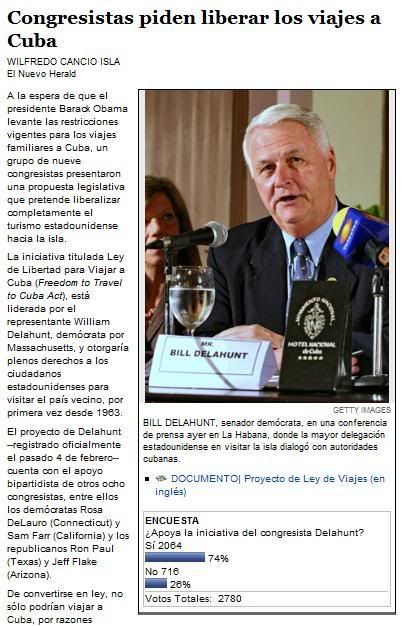
Later in the evening, Telemundo51 covered the same story on the Freedom to Travel to Cuba Act. They also asked their viewer to participate in an online poll. They asked: Are you in favor of easing travel to Cuba for Americans? From approximately 1500 votes, 82 percent(!) were in favor. The El Nuevo Herald poll had over 2800 votes.
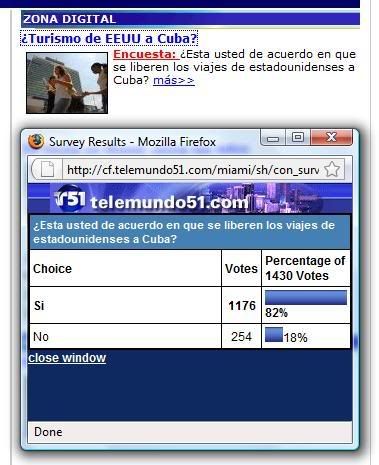
These online results in fact support the scientific polling data presented by the 2008 Cuba/US Transition Poll, conducted by the Institute of Public Opinion Research at Florida International University and supported by the Brookings Institution and the Cuba Study Group. The poll questioned 800 Cuban-Americans in Miami-Dade County, with a 3.6% margin of error.
In that Transition Poll, concerning the question of unrestricted travel to Cuba by Americans, respondents age 18 to 44 favored unrestricted American travel by 75 percent. Respondents who left Cuba from 1980 to 1998 favored the idea by 67 percent, while those who left Cuba after 1998 were in favor by 80 percent.
People who favor unrestricted travel to Cuba sometimes call Radio Mambi. Of course, their comments are immediately denounced and their person insulted. Perez Castellon calls them "stupid" on the air, while loyal callers are allowed to call them "ratas" or rats. [MP3]
Ninoska Perez Castellon does not accept any reliable polling data such as the Transition Poll, which she called "bogus" when it first came out. Nor did she believe a more extensive version when it came out in 2007. But, of course, she supported the results of a recent poll that contradicted the Transition Poll. This one headed by a loyal Republican firm, and called a "joke" by Phil Peters.
I doubt anything would convince Ninoska Perez Castellon, or any Cuban exile militant, that opinions on US policy towards Cuba are drastically changing in Miami. It's called denial.
[Photo by Jeff Chiu/AP, McCain supporters from 2008]
Wednesday, January 14, 2009
Radio Mambi: Thank God for Bush
 On Monday, after giving his last appearance before the press, Pres. George W. Bush called in to Radio Mambi to say goodbye. He was received by Ninoska Perez-Castellon on her 3pm program.
You can hear the interview here, courtesy of Univision.
Near the end [7:04], Perez-Castellon (self-appointed spokesperson for the Cuban-American community, and Cubans in general) reveals her feelings of high adoration for Pres. Bush:
"Mr. President, during the G8 summit in 2007, when you spoke at the Czech Republic, you said that an individual with moral clarity and courage can change the course of history, and I believe that you are that man. And I know that when freedom finally comes [to Cuba], the Cuban-Americans, as well as the Cubans on the island, will know that you stood by us in your darkest hour. So, I think you have a lot of gratitude in this community."
In that 2007 speech, at the Czech Republic, Bush stated: "Freedom is the design of our Maker, and the longing of every soul."
Bush also mentioned that after his Presidency he plans to create his "Freedom Institute" in Dallas, at the Southern Methodist University. He has told the press that it will be "cool-looking."
Anyway, contrary to what Perez-Castellon states, I don't believe the Bush administration ever stood with the Cuban-American community or Cubans on the island.
During his administration, prominent Cuban dissidents on the island have expressed their disagreements with US funding and Cuban family travel restrictions. And the Cuban-American community has increasingly shown their disagreement with the US embargo and travel restrictions.
In addition, Telemundo 51 recently asked their viewers to respond to an online poll asking if they agree with the Obama administration to eliminate travel restrictions to Cuba. From more than 1000 votes, an overwhelming 88% (!) voted in favor.
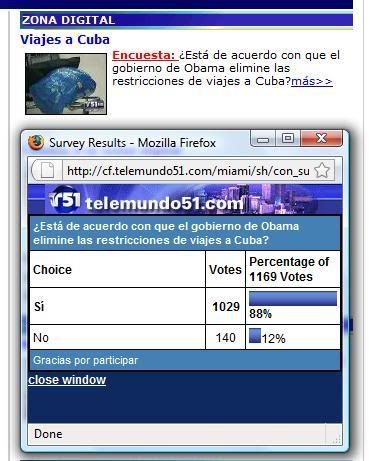
So who's standing with the Cuban and Cuban-American community?
Thursday, December 4, 2008
Radio Mambi Says Poll is Bogus
 Early this morning on Radio Mambi ("La Noticia y Usted" show), hosts Armando Perez Roura and Ninoska Perez Castellon charged that a recent poll on Cuban-Americans is "bogus."
The poll conducted by the Brookings Insititution, the Cuba Study Group, and the Insititute for Public Opinon Research found that a majority of Cuban-American in Miami are opposed to current US policy towards Cuba. [Full report here.]
Radio Mambi believes the results are fake because they do not represent the recent electoral victory of Reps. Ileana Ros-Lehtinen, Mario and Lincoln Diaz-Balart of South Florida. All three are adamant supporters of current US policy towards Cuba.
Ninsoka Perez Castellon, host of Radio Mambi, recently told the Miami Herald:
"I am tired of these polls that mean nothing... The point is that three Congress members who support the embargo were elected by an overwhelming majority of the people. The reelection of these Congress members tells me that this sample is not a majority. I don't believe this poll."
Today, she accused the poll of producing fake results. Armando Perez Roura, programming director of Radio Mambi, also made the same allegation.
These are serious charges being directed at the three organizations that helped conduct this poll, and the first time that I know of such charges being made by the hosts of Radio Mambi.
Last year a similar poll was conducted by the same organizations, but such charges were not made.
Monday, October 27, 2008
Losing His Touch
 As usual, I was listening to Radio Mambi (the highest rated AM station in South Florida) yesterday and waiting to hear what Armando Perez Roura had to say in his daily radio commentary, Tome Nota. (The title translates more or less to "pay close attention," but literally means "take notes." Perez Roura is Radio Mambi's programming director, and perhaps the most popular voice in Miami of the militant Cuban exile.)
Lately, hosts on Radio Mambi have been warning their listeners of the potential danger of electing Sen. Barack Obama this November. Callers have been calling in to repeat those concerns, and in a nutshell they all seem to share a common conclusion about Sen. Obama: he's part of a worldwide communist conspiracy to destroy the United States. This assertion would undoubtedly have strong resonance within the mostly Republican Cuban exile community, but I don't think that propaganda works anymore.
Years of polling data about the Cuban community in Miami show that attitudes have changed, including their policy options against the Cuban government. Recent polling of three important congressional districts in South Florida [18th, 21st, and 25th], which are composed of mostly Cuban residents, show that younger Cubans may be distancing themselves from the traditional militant position. The results show that the 18 to 44 age group in each district is far more likely to vote (by an average margin of 27%) for the Democratic candidate, Barack Obama, who has voiced a new diplomatic strategy towards the Cuban government.
Nevertheless, Radio Mambi seems to remain unchanged with their military strategy to free Cuba from the evil clutches of "communism." There should be no doubt that self-proclaimed "intransigents" like Armando Perez Roura only see a military solution for Cuba. But, seeing that attitudes are changing in Miami, militant exiles, like Perez Roura, sound more and more removed from reality with every passing day.
Take yesterday's Tome Nota for example.
Armando Perez Roura begins by praising Colombian President Alvaro Uribe for the recent news of a freed FARC hostage, Oscar Lizcano. Ever since the Colombian army successfully killed a top FARC leader last March in a controversial military operation inside Ecuador, Cuban exile militants have been cheering for the Uribe administration. Perez Roura repeated his mantra yesterday that "these elements [of the FARC] can only be stripped of power by force."
But, if you are familiar with his speeches, when Perez Roura says "these elements" he really means terrorists, communists, socialists, democrats, etc. They're all somewhat the same to him, like Hugo Chavez, or Barack Obama.
Recently in Miami, former Venezuelan President Carlos Andres Perez was honored by some former Cuban political prisoners. Telemundo51 was there for an interview and recorded him calling for the violent overthrow of current Venezuelan President Hugo Chavez. Telemundo51 probably already knew what Carlos Andres Perez was gonna say, since he said it before publicly in 2004. But, Telemundo51 attempts to keep the militant spirit alive in Miami by rebroadcasting those comments, which only encourages militants like Armando Perez Roura, who yesterday quoted the exiled former Venezuelan president.
So, by the end of his Tome Nota, Perez Roura pieces together his list of "these elements" and concludes that we must...
"remove by force these elements that assume power through the vote and later begin to make 'changes.' They are elected following the rules of the game that exist, and later say they are going to 'change,' and begin changing in order to fulfill the plans they carry concealed. Because all these individuals that talk about 'change' are all alike. Inside they carry the little red worm."
Perez Roura never ceases to amaze me. Within his speech he lumps together the FARC guerillas, Hugo Chavez, and Sen. Barack Obama with inventive desperation. I'm laughing at the creative associations (not to mention the "little red worm"), but how serious is he being? Is Armando Perez-Roura, and other militants, being honestly fearful of Sen. Obama, or are they engaging in pure propaganda?
Whatever the reason may be, there are some important facts missing. Perez Roura praises the Uribe government for the recently freed FARC hostage, Oscar Lizcano, but, according to news reports, the Colombian military had nothing to do with his release. Instead, Lizcano was helped by a FARC deserter. In addition, Lizcano is telling President Alvaro Uribe to "[l]ook for a humane solution as soon as possible" to free all other hostages. He is alerting the Colombian army that FARC rebels are prepared to shoot any hostages that are about to be liberated.
Findings solutions to problems require some grasp of reality. Armando Perez Roura's committment to militancy seems to be losing touch with it.
[The same can be said about writers of the Babalu Blog.]
Monday, February 11, 2008
Great Article by Armengol [Updated]
 In today's El Nuevo Herald, columnist Alejandro Armengol writes about those who resist changing social dynamics in his article titled "Radio of the Losers." Armengol highlights how conservative radio hosts (including those on Radio Mambi) have been left without a Republican candidate to call their own, and this highlights an inevitable socio-political change.
Noting that Radio Mambi has now lost a preferred Presidential candidate like Mitt Romney, Armengol believes that the "the 'Mambises' [militant exiles] from Calle Ocho" have to face a certain reality this year and advises them to "step out onto the sidewalk and look at the world... because it's changing."
Armengol also noticed how Radio Mambi last week totally disregarded the recent news of Joe Garcia's candidacy to run against Rep. Mario Diaz-Balart. I noticed this too last week, and today Radio Mambi did not report on the candidacy of Annette Taddeo against Rep. Ileana Ros-Lehtinen. It is likely that Radio Mambi will make all efforts to avoid reporting on the three new Democrat challengers in South Florida this year.
But, Armegol replies:
"The time has come to hear new voices and to elect to Washington politicians who represent an alternative against lies, complacency and the accomplishments of the war politician disguised as public service."
"For many years, radio stations that hijacked the duty of representing the Cuban community carried out a hypertrophic [abnormally overgrown] task, in the manner of emotional complacency for an exiled audience in a country with a different language and culture. They stood out more for their supposed militant character of political struggle, than their progress and informative capacities."
According to Armengol, stations like Radio Mambi have resisted the socio-political changes that surrounds them due to the policies of the Bush administration. As a result, those stations have anchored themselves to "their traditional image of nostalgia, false hopes, and radio combativeness." And, also their favored Cuban-American politicians.
Armengol has no problem with Radio Mambi providing an exclusive soapbox for Ileana, Lincoln and Mario, but they should pay for the airtime, just like everyone else. Otherwise, it is immoral.
[Update]
The Cuba Journal Blog yesterday links to reported rumors being spread that Radio Mambi's programming director, Armando Perez Roura, has been adamantly opposed to airing any mention of the new South Florida Democrat candidates. According to El Duende (Max Lesnick) on Radio Miami, Radio Mambi's programming director "has given instructions" to deny airtime to the new Democrat challengers in South Florida. Lesnick bases this rumor on "a report that arrived at the Univision headquarters."
Ever since I have been carefully listening to Radio Mambi, NEVER have I heard an interview, report or serious discussion with or about a Democrat, or the Democrat party. Radio Mambi exclusively caters to and gives generous airtime to Republicans and Republican issues. Given that this year marks the first time South Florida Congressional Republicans are being seriously challenged, it is going to be very interesting to hear how Radio Mambi confronts the important issue of the public airwaves for the public interest.
Tuesday, January 22, 2008
Meanwhile in Politics (Part 1)
 There's plenty of political news to digest. I'll highlight two Cuba-related stories: Sen. John McCain's phone call to Radio Mambi and Raul Martinez's official announcement to challenge Rep. Lincoln Diaz-Balart.
COLD WAR WARRIOR
Yesterday, Arizona Sen. John McCain visited Miami and stopped at the famous Versailles Restaurant. But, before making his way over there, he made a quick call to Radio Mambi (morning show "En Caliente") where Reps. Ileana Ros-Lehtinen, Lincoln and Mario Diaz-Balart were waiting for him. The radio studio was packed as the three representatives (with other McCain supporters, such as Ana Navarro) lauded Sen. McCain as the best Republican candidate to run for the US Presidency. Rep. Mario Diaz-Balart was very clear on why voters should stick with Sen. McCain: several polls have shown that Sen. McCain is the ONLY candidate with the possibility to beat the leading Democrat candidates. Rep. Mario Diaz-Balart made sure to give praise to the other Republican candidates, but was adamant that voters not supporting Sen. McCain were throwing away their vote. The polls that Rep. Diaz-Balart referred to were not named.
After some waiting, Sen. McCain finally called in to Radio Mambi, where he was welcomed by the three Cuban-American representatives and the hosts of "En Caliente," with less than ten minutes left on the program. Last time (March 2007), Sen. McCain made it to the studio and was interviewed by a very passionate Armando Perez-Roura. This time, McCain was spared, but has now realized what Cuban exile hard-liners want to hear. A militant candidate.
One political reporter (Jill Zuckman) accurately described Sen. McCain in Miami as "a warrior of the Cold War, who understands the importance of keeping up the fight against Communism in nearby Cuba." Zuckman further quotes Sen. McCain:
"I'm proud to have fought for and defended freedom for the people of Cuba, consistently calling for continuing the embargo until there are free elections, human right organizations and a free and independent media... Then and only then will the United States of America extend the aid and assistance because we don't want American tax dollars to go to a corrupt government headed either by Fidel or Raul Castro or anyone else who has denied freedom from the Cuban people."
Sen. McCain has been reminding the public in Miami that he was stationed on the USS Enterprise during the Cuban Missile Crisis. This nuclear-powered air-craft carrier was among the American fleet that formed a blockade around Cuba during the Crisis. "I understand Cuba... I am proud to have sat on a flight deck of a United States Navy aircraft during the Cuban missile crisis," said McCain at the Versailles Restaurant.
But Sen. McCain wasn't always such a hard-liner. It was just one year ago that Sen. McCain supported a different position with respect to a Cuba in transition. In a January 2007 interview with the Pittsburgh Tribune-Review, Sen. McCain had offered "a package of trade, of assistance, of economic development, of assistance in democratization" once Fidel Castro would die and a date for free and fair elections was set. Now, several conditions have been added, regardless of the state of Fidel Castro.
Also, recently Sen. McCain has supported renewed investigations and indictments of the Cuban government for the shooting down of the Brothers to the Rescue planes. McCain has also recently been highlighting his status as a former POW and mentioning a Cuba Program in Vietnam where torture of American POW's during the Vietnam war has been confirmed.
In 1999, POW survivors alleged they had been brutally tortured by Cuban agents in a Vietnamese prison. Reports in the Miami Herald at the time revealed the cruelty of the events and the possible identification of some of the Cuban agents. Committee hearings in the House and Senate were also held that same year. Since then one Cuban agent has been allegedly identified by a POW survivor, but the Cuban government has rejected these allegations and "U.S. officials said the evidence remains inconclusive and contradictory."
Sen. McCain arrived into Miami yesterday with a warrior mentality, and made sure to let the hard-liners in Miami know it. On the phone with Radio Mambi, Sen. McCain reminded everyone that he was a pilot on the USS Enterprise during the Cuban Missile Crisis and a POW in Vietnam:
"And I also remember a fella from Cuba who came and tortured and killed some of my friends and I look forward very much to seeing him again in Havana after the Cuban people are free."
Ninoska Pérez-Castellón: "And I suppose in a court of law."
Sen. McCain: "Yeah, I guess if necessary."
Everyone in the Radio Mambi studio laughed. They were amused at Sen. McCain's attempt to be a militant, just like militants in exile. But, McCain now understands that this is what hard-liners want to hear. The talk of revenge, hidden within the talk of justice.
[Audio of Sen. McCain's comments to Radio Mambi in MP3]
[Photo above of Rep. Ileana Ros-Lehtinen and Sen. John McCain by AP/J. Pat Carter]
[Part 2]
Saturday, January 12, 2008
Posada: "Recognized Anti-Castro Activist"
 Over on the Radio Mambi website (part of the larger Univision website), there's a poll on Luis Posada Carriles. It asks:
"Do you support freedom for Luis Posada Carriles, recognized anti-Castro activist?"
No kidding. See the screen shot here. As far as I know, and according to the latest reports, Luis Posada Carriles is already free. He's even appeared publicly in some places here in Miami recently. Sure, the US Justice Department has appealed the latest ruling that freed him, but that was a while ago and Posada is not behind bars now or in any form of detention (as far as I know).
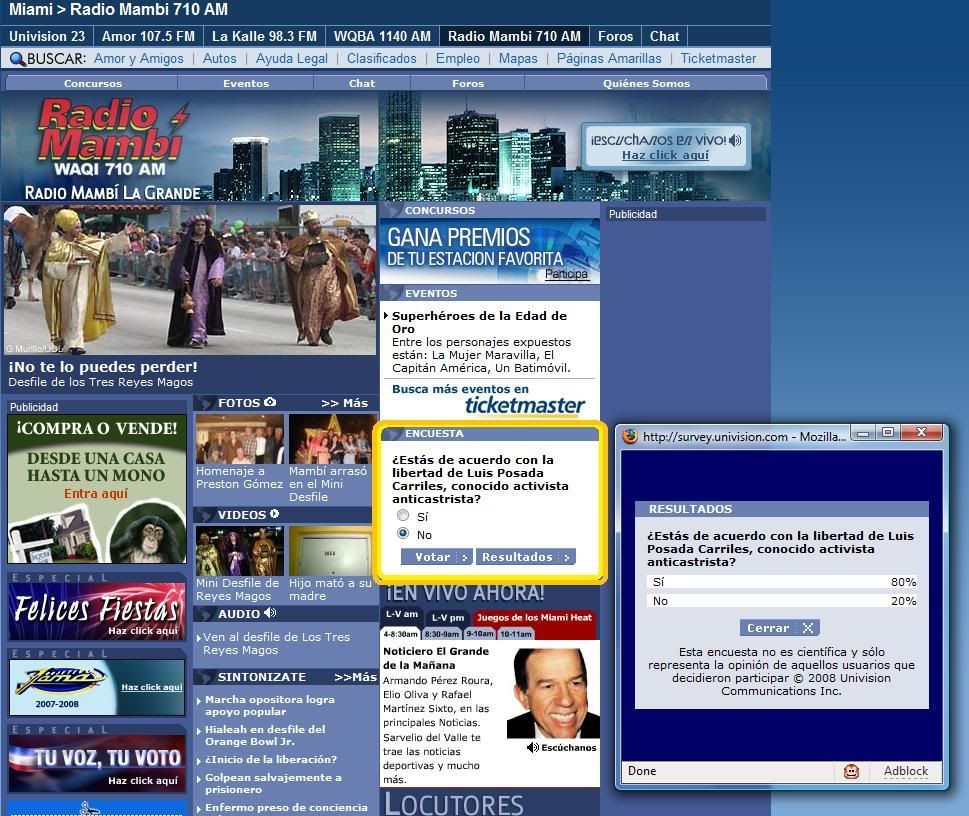
So what's up with the poll? (A response to the Code Pink demonstrations perhaps?)
And, if anyone knows about the declassified government documents on Posada Carriles, and his interviews with Ann Louise Bardach, then one should easily recognize that Posada is more than just an "activist."
Not surprisingly, the results of the Radio Mambi poll are 80% in favor of "freedom" for Luis Posada Carriles. But, the site does not reveal how many votes have been counted.
[Photo above of Luis Posada Carriles from the Robert Alonso documentary "The Trial of the Century"]
Thursday, January 3, 2008
Exile: Fear and Shame
 "Courage is not the absence of fear, but the determination to live with dignity, rejecting abuse and humiliation."
- Jorge Mas Canosa*
Looking back on some notes, I noticed that a lot of rhetoric by hard-line Cuban exiles focuses on honor and shame. Miguel A. De La Torre wrote thoroughly on this "religion of el macho" in his examination of the "exilic Cuban" through religion, culture and politics. The predominance of feelings of shame and honor may provide some insights into the history of the "intransigent" and past violence in Miami.
This past Saturday, veterans of the Bay of Pigs invasion, along with their friends and family, reunited at the historic Orange Bowl in Little Havana. It was here, 45 years ago on December 29, 1962, upon their return from a poorly-planned invasion to overthrow Fidel Castro, that President Kennedy promised the veterans a "free Cuba." Today, President Kennedy is regarded as the man who betrayed their cause, with some in Washington at the time regarded as the veterans' "most powerful enemies," but a cause still pursued in exile nonetheless. At Saturday's reunion, the Bay of Pigs Veterans Association also unveiled a new model for the future "Bay of Pigs Museum and Library," also known as the Cuban Exile Museum and Library.
If there are any men in exile who are held in the highest esteem, they are the veterans of Brigade 2506. For some hard-liners, men like Luis Posada Carriles and Orlando Bosch make that list too. They are considered the heroes of exile, those with dignity, who walk vertically, and continue the long history of Cuban militancy (like Martí and Maceo), towards freedom. These men embody the opposite of humiliation, cowardice and shame.
But, after the invasion, and once President Kennedy and Soviet Premier Khrushchev both agreed in October 1962 to remove their missile systems from Turkey and Cuba respectively, and end the Cuban Missile Crisis, exile militancy was AGAIN betrayed. On March 9th of this year (Radio Mambi - "En Caliente" Morning Show), Armando Peréz Roura put it this way:
"La beligerancia (the spirit of militancy) was lost when Kennedy sold us out... during the Missile Crisis, sold us out to the Soviet Union, when the fight was already won. And, when he signed the Kennedy/Khrushchev pact. Unfortunately, at that moment they sold us out and turned us into slaves of communism." [MP3]
According to hard-liners in Miami, since the loss at the Bay of Pigs, communism has been allowed (especially by the US) to spread over the rest of the Western hemisphere. In order to remedy this humilitation, Peréz Roura, program director of Miami's most-listened-to Spanish AM radio station (WAQI), has repeatedly and publicly stated his wish for a "crusade... against those terrible evils which threaten the entire continent."[MP3] This evil is, of course, communism of yesterday, and socialism of today. Peréz Roura sees no difference between the two and recently asserted (Tome Nota - Oct. 16) that socialism of the 21st Century is a "weapon of mass destruction" that has caused the death of some 60 million people in the last century. As a result, according to Peréz Roura and other hard-liners, there is "only ONE way" to confront this movement of communists/socialists:
"The way is [obvious] because all of this [Communist domination] would have already become reality years ago, if we [the US] had not acted with a heavy hand."[MP3]
The "heavy-handed" approach by the US across Latin America has many examples and seems to be widely supported in Miami by hard-liners and some in the media. The most extreme view was again repeated this past Saturday evening on Radio Mambi ("Puntos de Vista" Show - 10pm) with one of the hosts saying that all communists deserve to be six feet under, and that once all the communists die "we will finally breathe freely." But, according to the host (a self-described "man of action"), this war against communism will be a long struggle.
My interpretation of this acceptance for exile militancy by hard-liners can be better understood once we consider the shame felt of being in exile (due to communism), the arguments or moral justifications against the official enemy (communism), and the history of militancy and betrayal that some exiles have experienced or continue to suffer. But, the danger of militancy lies in the uncontrollable and implacable force for violence and revenge. There are no assurances of long-lasting peace when groups accept to use violence (or a "heavy hand") as a solution. In addition, drastic actions that risk the security (or potential cooperation) between regional neighbors only serve to endanger it. A militancy that is willing to sacrifice it all does not seem justified, and the "intransigent" who demands justice may inadvertently undermine it for the rest.
A propensity for hostility and aggression may stem from what James Gilligan refers to as "the primary or ultimate cause of all violence": the emotion of shame. This simple model may provide some insight, but only to a certain extent in explaining violent acts committed by some hard-line exiles (and not all exiles) towards the cause of a free Cuba.
Searching through the database at the Terrorism Knowledge Base, one will notice that Miami ranks among the cities with the highest incidents of terrorism in the US. New York, with the most, has 171 documented incidents, followed by Washington DC with 89 (total of city and capital), then Miami with 59, and Los Angeles with 39 (despite having a population almost five times larger than Miami). Most of the incidents listed from Miami are Cuba-related and dated from the seventies and eighties (almost half are from the seventies). Specific details of those incidents can also be found here and here.
Following James Gilligan's theory, "[t]he purpose of violence is to diminish the intensity of shame and replace it as far as possible with its opposite, pride, thus preventing the individual from being overwhelmed by the feeling of shame." Considering that during the seventies two US administrations (Ford and Carter) made attempts to normalize relations with Cuba, the reaction of hard-liners with acts of violence may have been actions in defense of perceived attacks to their image and identity: the honor of militancy (and the history of militancy) to overthrow the Castro regime (or oppressive governments) and being victim to communism (the origin of exile).
If the Cuban government (communism) is the source and cause of exile (with its inherent shame) then one can understand why hard-liners in Miami today reject normalization and propose a "total change" in Cuba. This also may explain why Unidad Cubana (a hard-line organization) has specifically forbidden the communist party from a possible future democratic Cuba. A "total change" in Cuba would accomplish eradicating (through political force or violence) any trace that caused exile in the first place and finally allow exiles to "breathe freely" again. In the meantime, as long as some trace of communism remains in Cuba (by negotiation or compromise), then there is no reason to return to Cuba, just as Jose Martí expressed in 1887. Pérez Roura has expressed repeatedly that if he is ever to return to Cuba it will be with his head held up high (pride), and not any other way (with shame). This is perhaps a predominant feature of what it means to be an "intransigent": [T]o diminish the intensity of shame and replace it as far as possible with [pride]. Following this logic, and considering other additional conditions, may explain why violence became widespread in exile.
There's are some moral principles involved that may have justified acts of violence in the past by hard-liners. I've identified three main principles:
1) "Bad behavior does not deserve a reward." Following this principle, actions by an individual or group are by default generally limited to hostility. All other actions, especially those that may appear to be ambiguous or positive, are forbidden. Thus, current US policy is justified since it is apparently hostile, while ending the embargo is forbidden since the action itself can be perceived as positive (even if it was not intented to be). Abandoning militancy also may be perceived as positive.
2) "Bad behavior deserves punishment." This principle justifies retribution (or revenge) against all enemies (in our case, the Cuban government). To do otherwise sets a dangerous precedent, harms lessons of the past, and allows shame and humiliation to spread. In exile, this principle is further strengthened by a militant history where violence (as punishment) is seen as the only path towards remediation.
3) "Threats and aggression suffered by enemies are justified for the greater good." With the ultimate aim to eradicate the origin of evil (communism) and free Cuba, exile militancy and violence is excused even if innocent people suffer. The intent here is towards a "free Cuba" by whatever means (including violence), not to harm people, but those that stand in the way shall not derail this goal. Not even the US government. This principle also describes the sometimes conflicting interests between the US government and exile militancy, such as in handling exile terrorists or attempting to reach agreements with the Cuban government on some issues.
Let's add the perceived betrayal throughout history of the hard-line exile that has added to its suffering, such as the Bay of Pigs invasion, the lack of reporting or bias from the American free press about the "real" Cuba, or the refusal by the US government to use the "heavy-hand" in solving problems in Latin America and Cuba. That betrayal is further worsened when one considers that the US is the country that has also helped exiles the most. This explains why some hard-line exiles feel extremely grateful (and patriotic) towards the US, but at the same time feel that they are on their own in the struggle for a free Cuba. That hard-liner feels confused when heroes like Luis Posada Carriles, Orlando Bosch, Eduardo Arocena or Santiago Alvarez are imprisoned. That hard-liner also wonders why the US has not already used the "heavy-hand" to confront Hugo Chavez, Evo Morales or Rafael Correa, and instead may consider that perhaps there is a conspiracy involving the US and its worst enemies.
The social conditions for violence must also be considered. Martha Minow has generally described these conditions as: "socially approved violence, tacit permission to discriminate, and pervasive violence in mass culture."
Assuming that "[n]o other military in world history has been so widely deployed as that of the United States," it seems easy to accept that a militant ideology is an integral part of our functioning society, along with the violence it may generate. When the US began its mission in Iraq, it didn't take long for the late Agustín Tamargo in 2004 to ask: "And Cuba, President Bush? What about Cuba? Why yes on Iraq and no on Cuba?" The tragic consequences of such actions don't dawn upon the militant. But, again, the hard-liner felt betrayed by the inaction of the US to intervene in Cuba.
Discrimination (especially political) is also common, especially on Radio Mambi where there is a virtual ban on divergent political views. In other outlets, voices opposed to US policy towards Cuba recieve little coverage locally, and if expressed must be immediately rebutted or delegitimized. On the other hand, supporters of US policy recieve ample media coverage and little criticism from their hosts. The general acts of discrimination easily label one a "communist" or "apologist" in order to discredit, render voiceless, or dismiss without consideration. Without an avenue of defense, these views (and its individual) are left vulnerable to acts of hostility.
Memory and history of the hard-line exile perhaps marks the most important element that allows exceptions for violence. Hard-liners are always prepared to recall and express how the Cuban people always had to settle their problems through armed struggle. From recollection of the heroes of Cuba's first struggle for indepence to the Bay of Pigs (or even the sabotage missions of the seventies), the spirit of militancy has been internalized through memory by some hard-liners, such as Alpha 66 (who say they still train with arms at their camp "Rumbo Sur") and the F-4 Commandos (who say they continue with sabotage missions inside of Cuba). Appeals to memory and selected history form the basis of the militant hard-liner and again identifies the exile as the displaced victim of disaster or betrayal.
Flora Keshgegian further articulates how "memories are key to diasporan identity" from the perspective of the Armenian diaspora:
"Diasporans are, by definition, displaced. One could well argue then that diasporans' lives are defined not by location so much as by memory. Having lost 'homeland' and place as a locator of identity, diasporans define themselves by their memorative narratives. In a sense, all that diasporans have of their homeland are the memories of it... If memories are key to diasporan identity, and if those memories are of disaster, [...] then letting go of the memories of disaster would constitute a further loss of place and identity. Diasporan identity is thus constituted, at least in part, in relation to a past trauma."
Since memory and identity are so close and dependent in exile, violence may be the defense to hard-liners who see themselves threatened by US normalization with Cuba. This policy attacks the essential elements of the hard-line exile, especially their vision (or memory) of a "free Cuba." Keshgegian continues:
"Further, these memories of disaster or catastrophe often are compared and contrasted with an idealized image of homeland and place... This interplay, and even mutual dependence, between the disaster memory and the idealization of homeland and how each holds the other in place may be said to be a key dynamic of diasporan identity. There remains a basic desire for what can no longer be (and, in reality, never was): a home not fraught by disaster or even turmoil, an Edenic existence. Loss is measured against this ideal. Life in diaspora is witness to the loss and to an attendant yearning for the idealized time and place of 'home.'"
The fear of losing a militant Cuban history through normalization may also foresee the end of experiencing the "free Cuba" some hard-liners wish for. Additionally, those who seek violence (or power) may also be defending their valuable "nationhood" threatened by the long wait in exile (close to a half-century). As Larry Ray remarks about those who would suppress "the plural nature of modern identities": "[N]ationalism is an allegory of irresolution, an expression of fear of the transient nature of the nation."
The building of the Bay of Pigs Museum and Library, and have it placed prominently in downtown Miami, seeks to preserve that "nationhood" and may be but another extension of the exile's desire to present a unified (and militant) identity, thus denying the fear of losing their history (and memory) and even their honor, embodied in their exile heroes.
Unfortunately, due to this exile identification with militancy (in order to fight threats of normalization with Cuba) many innocent families in Miami became victims of a cycle of violence, regardless of which side they where perceived to be on. Already mentioned, the seventies in Miami were notably violent, and as a result, families such as that of Juan Jose Peruyero still have to confront that violent past. While such violence no longer threatens our community, there are still victims of acts of intimidation and abuses of power. This is the atmosphere of the current battle of ideas in Miami.
*[Miami Herald, November 25, 2007, Cubans Cling to Faith (Op-ed) by Ninoska Pérez Castellón.]
[Photo of Brigade 2506 veteran at Orange Bowl, December 29, 1962, by Cecil Stoughton, JFK Presidential Library and Museum]
Subscribe to:
Posts (Atom)