Showing posts with label Florida Politics. Show all posts

Monday, April 1, 2013

Yoani Sanchez Live in Miami [Updated Interviews]


If you can't make it in person, here's where you can see Yoani Sanchez in her two public appearances today in Miami.

Her first appearance will be at the Freedom Tower at 2:00 pm and streamed by Miami-Dade College. Click here to view.

Her second appearance will be at Florida International University at 7:30 pm and streamed here.

Locally, some television and radio stations will broadcast her speeches. Any recorded video and audio will later be posted here.

--- [Update] ---

Thanks to The Miami Herald for posting video of Yoani Sanchez at the Freedom Tower [update - thanks to the Generacion Asere blog and Miami Ready Studio, you can view Sanchez receive accolades from local leaders after this event]:

[English translation]


[In Spanish click here]

And, thanks to Florida International University for posting video of Yoani Sanchez later that evening:

[English translation]


[In Spanish click here]

[Additional audio and video interviews with Yoani Sanchez in Miami updated below.]

- Interview with Oscar Haza on Radio Mambi click here.
- Interview with The Miami Herald editorial board click here.
- Sanchez at the Roots of Hope/Knight Foundation "Tweet Up" click here.
- Interview with reporters from Diario Las Americas click here.
- Sanchez on 'A Mano Limpia' (AmericaTeVe) click here.
- Interview with Jaime Bayly on MegaTV click here.

Tuesday, October 16, 2012

Marco Rubio's Speech at Unidad Cubana [Updated]

This past Sunday, Sen. Marco Rubio of Florida appeared at a public event hosted by Unidad Cubana, the militant/hard-line Cuban exile organization. Below is the speech he gave in Spanish. I will be translating portions of the speech into English and updating this post below.

Yet, there is one portion of the speech that was very interesting. Sen. Rubio at one moment seems to suggest that he has confidential information concerning changes coming to the Cuban government. At these kind of events, someone always says that change is coming soon to Cuba and it is implied that the change will come with the death of Fidel Castro. But, Sen. Rubio's remark about having secret information is much more interesting (though he has been known to lie). That audio is at 8:31...

"It's already been many years of everyone thinking 'Well, at any moment this has to change.' I know you've heard that many times. But I promise you, for reasons that I can't express publicly, the reality is that the moment is coming."

RUBIO'S CAUSE FOR FREEDOM

For those that don't know, Unidad Cubana was created in 1991 as a united front of several Cuban exile organizations to influence U.S. policy. Their main position was to reject the possibility of any softening of U.S. policy as Cuba was going through a difficult economic period. And, of course, preparing for an overthrow of the Cuban government.

According to El Nuevo Herald, Armando Perez-Roura (pictured above with Sen. Rubio, and current chairman of Unidad Cubana) said in 1991: "We in the exile community need to have our own political and military strategy because Castro must be removed from power." In that same article, it was reported that over 100 exile groups signed a joint agreement with Unidad Cubana, and that over 3000 people attended their inauguration event at the Miami-Dade County Auditorium, which was broadcast live on U.S.-funded Radio Marti*.

So, every October Unidad Cubana organizes an event remembering the "Great War" of 1868, and hosts speeches by distinguished guests that continue to push for a hard-line policy against the Cuban government. Previous guests have included Cuban-American legislators Lincoln Diaz-Balart, Mario Diaz-Balart and Ileana Ros-Lehtinen. And this year it was Sen. Marco Rubio's turn.

The essence of Sen. Rubio's speech centered on why he's taken a hard-line stance on policy toward Cuba, which is also based on his own "Cause for Freedom." According to Rubio, there are three basic reasons:

1) He supports the right of rebellion of people living under tyranny as written in the American Declaration of Independence;
2) He feels obligated to fulfill the "dreams" of the first wave of Cuban exiles because they suffered greatly due to the Cuban Revolution and "sacrificed" so much for his generation; and
3) He believes the U.S. government is obligated by principle to help Cuban exiles "free" Cuba.

In his speech, Sen. Rubio states that "if one studies six thousand years of recorded history" (which we assume Sen. Rubio has) one sees that "almost all people" throughout history have fought against tyranny, including the founders of the United States of America who expressed that right in the American Declaration of Independence, and also Cuba exiles at the Bay of Pigs. Sen. Rubio also states that the right to rebel comes from God, and that this historical battle against tyranny "will never end."

By suggesting that the right to rebel (or revolution) is God-given, and possibly an eternal human battle against tyranny (or evil), Sen. Rubio certainly reveals much about how he views events around the globe. It strikes me very similar to Cuban exile militants' war against global communism, or other battles that have been waged against some kind of global terror.

So, there should be no doubt that Sen. Rubio's "Cause for freedom" entails the "Cause for Cuba," and potentially other countries as well. As he explained, "if this country really believes these words [from the Declaration of Independence] then you have to apply them at every given opportunity, and for us [Cuban exiles] that opportunity exists 90 miles from our coast."

What other "opportunities" does Sen. Rubio see for his "Cause for Freedom."

[Photo by Arminda Espinosa and Libre Magazine]

*[El Nuevo Herald, July 13, 1991, "Cubanos Firman Acta de Unidad, Excluyen Dialogo" by Joel Gutierrez and Ivan Roman.]


Tuesday, August 14, 2012

Paul Ryan's Anti-Embargo Record

You've probably heard already. The Republican pick for vice-president, Rep. Paul Ryan (WI-1), has an anti-embargo voting record, and has been very clear about it. So, it's no wonder some hard-liners are trying to hide this fact.

A post on the (pro-embargo) Capitol Hill Cubans blog first raised my curiosity. It was apparent that the author was trying to hide Rep. Paul Ryan's voting record before 2007, and giving him an excuse by describing Rep. Ryan as an "unconditional free trader." (For hard-liners on Cuba, there is no room for other principles except unconditional sanctions.)

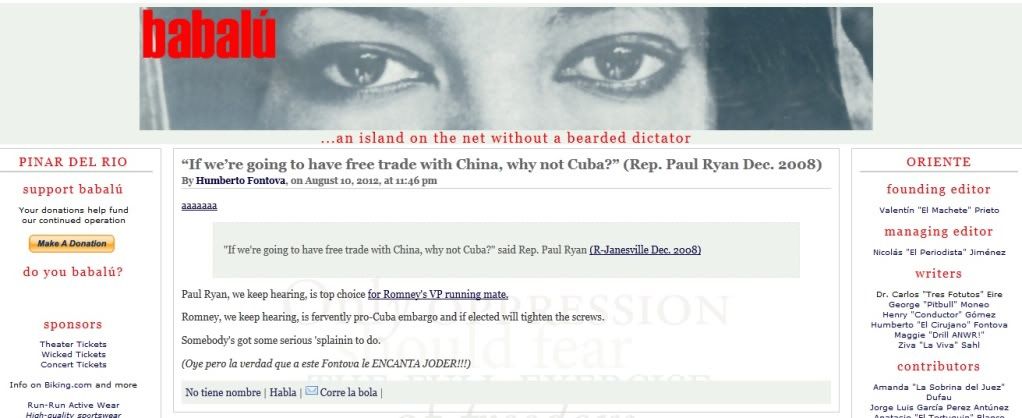
Even the boys at the Babalu blog did some quick work to hide Rep. Ryan's anti-embargo stance. Following the rumors that circulated on Friday, Humberto Fontova was the first to warn readers of Rep. Ryan's anti-embargo feelings. Fontova titled his post after a 2008 Ryan quote: "If we're going to have free trade with China, why not Cuba?"[cached link/screenshot] The post was soon removed. It was later responded with a post by Babalu economic super-genius Henry Louis Gomez who was an "economics major in college." According to Gomez, "99.9% of people" (including renowned libertarians like Milton Friedman and William F. Buckley who opposed the U.S. embargo towards Cuba) don't understand Cuba like he does.

In reality, national polling shows about 50% of Americans are opposed to the embargo (39% in favor, 10% undecided), so Gomez is being a little paranoid. But, it seems that Rep. Paul Ryan in 2002 was with the majority: 
"The embargo doesn't work. It is a failed policy. It was probably justified when the Soviet Union existed and posed a threat through Cuba. I think it's become more of a crutch for Castro to use to repress his people. All the problems he has, he blames the American embargo... [Cuban-Americans] have their reasons [for supporting the embargo] and they're very passionate about their reasons, I just don't agree with them and never have."
So, the question now is why did Rep. Ryan change his position on the embargo? Did a grown-man with strong free market convictions get "educated" on the embargo as Mauricio Claver-Carone told the Miami Herald?

I seriously doubt it.

--- [Below are Rep. Paul Ryan's House votes in opposition to the U.S. embargo on Cuba] ---
  • July 25, 2001: Amendment to prohibit funding to administer the Cuban Assets Control Regulations with respect to any travel or travel related transaction. Rep. Ryan (WI) voted Aye, [Roll Call 270, HR 2590].
  •  July 25, 2001: Amendment sought to prohibit the use of funds in the bill to implement, administer, or enforce the economic embargo of Cuba. Rep. Ryan (WI) voted Aye [Roll Call 271, HR 2590].
  • September 21, 2004: Amendment prohibits funds in the bill from being used to enforce certain regulations restricting family travel to Cuba. Rep. Ryan (WI) voted Aye [Roll Call 460, HR 5025].
  • September 22, 2004: An amendment to insert the following new section on page 166 after line 3: Sec. 647. None of the funds made available in this Act may be used to implement, administer, or enforce the economic embargo of Cuba, as defined in section 4(7) of the Cuban Liberty and Democratic Solidarity (LIBERTAD) Act of 1996 (Public Law 104-114), except that the foregoing limitation does not apply to the administration of a tax tariff. Rep. Ryan (WI) voted Aye [Roll Call 461, HR 5025].
  • June 15, 2005: An amendment to prohibit use of funds in the bill to implement, administer, or enforce regulations relating to amendments made to the Code of Federal Regulations relating to license exemptions for gift parcels and humanitarian donations for Cuba. Rep. Ryan (WI) voted Aye [Roll Call 254, HR 2862].

Saturday, January 14, 2012

Newt Gingrich Interview on Radio Mambi [Updated]

Republican Presidential candidate Newt Gingrich arrived in South Florida last Thursday just in time for an evening fundraiser in Coral Gables. The following day, Gingrich visited Little Havana where he pledged a hard-line policy towards Cuba in a written letter to Miami's most intransigent Cuban exile organization, Unidad Cubana. While Unidad Cubana seemed very pleased by Gingrich's promise, they were probably even more pleased that a Presidential candidate had actually endorsed such an extremist policy. The letter, undoubtedly written in Miami and not by Gingrich, has now raised policy expectations by the most hard-line in Little Havana.

ENTER DAVID RIVERA

Thursday's fundraiser was held at the luxurious Biltmore Hotel where Gingrich met up with Rep. David Rivera (FL-25) who, surprising some, is strongly endorsing and accompanied Gingrich while in Miami. Rep. Rivera was recently named one of the "most wanted corrupt politicians in Washington," and, according to Politico's Alex Isenstadt, accepting Rivera's endorsement shows Gingrich in a "scramble to put an organization in place" before the Florida primary. But, in Miami, Rivera is untouchable.

For years, David Rivera has been consistent with his hard-line policy towards Cuba (e.g. supporting 2006's Florida academic travel ban to terror-sponsoring nations like Cuba [now heading to the Supreme Court], proposing legislation to reform the Cuban adjustment act in order to punish Cubans in Miami who dare return to their homeland, and welcoming alleged criminals to Miami like Luis Posada Carriles). And, this is why Rivera still has many strong supporters in Miami, namely Cuban exile political leaders and other supporters of a "free Cuba."

ENTER LITTLE HAVANA

Perhaps knowing that Newt Gingrich was "scrambling" for support in South Florida, hard-liners in Miami most likely saw an opportunity to raise the political stakes and asked Gingrich to accept their extremist positions on Cuba in exchange for the coveted Cuban-American vote.

Disguised as a letter written by Gingrich himself, the four points outlined describe traditional and recent frustrations from hard-line exiles in Miami. Keeping the U.S. embargo towards Cuba is standard, while full implementation of Helms-Burton has been a long-time grievance in Miami, but frustrated due to international pressure on Washington. Seeking criminal indictments of Fidel and Raul Castro was proposed by Rivera earlier this year, but has been part of the Cuban American National Foundation's policy recommendations for years, and a local project headed by Cuban exile militant Santiago Alvarez at least since 2010. And, reversing the Obama administration's relaxed travel restrictions for Cubans would be a tremendous relief for hard-liners who find it outrageously immoral to see Cubans traveling back and/or sending remittances to Cuba. (In reality, the new Obama travel policies are very popular in Miami, but hard-liners don't care.)

ENTER RADIO MAMBI

Before the interview on Friday morning, Newt Gingrich and David Rivera held a press conference inside the Univision Radio offices (Univision 23 report). Surrounded by the press, and various members of the hard-line Cuban exile community, Gingrich officially presented his so-called Cuba policy letter to Unidad Cubana, Miami's most intransigent Cuban exile organization. At the table, Gingrich sat next to Armando Perez-Roura, chairman of Unidad Cubana and programming director of Radio Mambi. Also nearby were members of Vigilia Mambisa, such as Laura Vianello and Miguel Saavedra.

Once ready inside the studio of Radio Mambi, Perez-Roura began by expressing his pleasure with the Gingrich pledge to fulfill the initiatives outlined in the letter. But, besides the outlined policy, Gingrich hardly had any other original ideas. Following his answer regarding Cuba travel restrictions, Gingrich added his idea of a "very aggressive public relations policy" which would include a "daily report" about human rights abuses and other violations by the Cuban government. The purpose of course would be to convince the world about the evil nature of the Cuban regime. But, I seriously doubt any country would use these reports to change their long-established relationships with Cuba.

When asked what he would do about the Alan P. Gross case, Gingrich gave no practical solution and instead suggested something similar to his "public relations policy" from before. Then, as if related in some way, Gingrich proposed implementing a "much more effective program" of intelligence and counter-intelligence "against pro-castro infiltrators." Of course, this is a nod to espionage cases like Ana Belen Montes and the Myers. But, with the U.S spending about $80 billion (!) on intelligence services, I'm confident that those agencies are doing just fine without Gingrich proposing a "more effective program" for them.

EXIT MIAMI

After leaving Miami, Gingrich's Cuba policy certainly lifted spirits and expectations, like that of Manuel Malgor. Besides being a member of AMCVA, Malgor is also active in other local political organizations that focus on Cuba, and he "couldn't find a single defect in what [Gingrich] said" concerning Cuba.

Armando Perez-Roura has told listeners that he now expects to receive a similar pledge from Mitt Romney upon his next visit to Little Havana. It will be very interesting to see how Romney's advisors can top the letter to Unidad Cubana. As a reminder, Perez-Roura has translated Gingrich's letter for the recent publication of Libre Magazine. (It is the only Spanish version since the Gingrich campaign forgot to translate it for their Spanish-language website.)

Little Havana is certainly looking forward to seeing Mitt Romney's Cuba policy.

[Newt Gingrich Interview on Radio Mambi]

Newt Gingrich Interview on Radio Mambi by Mambi Watch

Friday, November 18, 2011

Herman Cain on Radio Mambi

Armando Perez-Roura, programming director of Radio Mambi, has boasted in the past about the impressive list of Republicans that have appeared on the air with him. He's taken on former Presidential candidates Fred Thompson, Mitt Romney and Sen. John McCain during their last campaigns. But, it seems this week Perez-Roura didn't have time for Herman Cain.

Armando Perez-Roura has made it clear that he chooses his guests very carefully (thus the absence of Democrats on Radio Mambi). Earlier this week, Perez-Roura discussed the Republican Presidential candidates with attorney Armando Lacasa and said he didn't care that Mitt Romney was not as "conservative" as Herman Cain, but Romney stood the best chance at winning the Presidency and that is all that mattered. Cain stood no chance according to Perez-Roura.

Cain arrived to South Florida this past Wednesday making several stops, including the traditional one at Versailles Restaurant in Little Havana (video). According to Marc Caputo of the Miami Herald, Cain didn't seem to have an outlined policy towards Cuba. His only policy remarks about Cuba were basically summed up as "freedom for Cuba now" and "put more pressure on Castro." Questions regarding current US-Cuba policy were ignored. As a result, the Miami Herald posted a video on YouTube revealing the hypocrisy of Cain's criticism against Pres. Obama's "foggy" foreign policy.

At Versailles Restaurant Cain was greeted by several supporters including Cuban exile hard-liners like Luis Conte Agüero and members of Vigilia Mambisa. According to a report by the Spanish news agency EFE, Miguel Saavedra, leader of Vigilia Mambisa, had a complaint about all the past Presidential candidates who have visited Versailles talking about Cuba:

"They have said more or less the same thing, but have done nothing later."

Meaning that no President so far has supported an actual military blockade or invasion of Cuba, like Armando Perez-Roura suggested to Presidential candidate John McCain in 2007. Nevertheless, in video taken by EFE of the gathering at Versailles, members of Vigilia Mambisa still showed their support for Herman Cain by holding up "Cain 2012" signs.

Interestingly, both the written and video report by EFE state that Cain proposed cooperation with Cuban exile leaders to formulate his U.S.-Cuba policy. This is not reported elsewhere, but it makes perfect sense given his apparent ignorance on the issue. (Back in 2007, Mitt Romney made similar remarks about his Cuba policy being influenced by Cuban exiles like Armando Perez-Roura.)

It seems that right before his Versailles stop Herman Cain was a few blocks west at the Radio Mambi radio station. There he was greeted by Armando Perez-Roura, but was not there to be interviewed by him. Instead, Lourdes D'Kendall (Bertot), host of "En Mi Opinion" (In My Opinion) which discusses more local politics, was assigned the duty. D'Kendall describes herself as a "conservative" and has spent past shows explaining how strongly she feels about being a "conservative." An interview with Cain seemed natural, but, strangely, they didn't talk about Cuba.

According to a report by Radio Mambi, posted on their Univision webpage (and based on the above EFE report), Cain and D'Kendall mostly talked about Cain's economic policy and his recent flub concerning a foreign policy question on Libya. (The Cuba policy comment in the Radio Mambi report is actually a quote from his Versailles speech.) The audio provided of the interview also does not include any comments about Cuba.

It's possible that Armando Perez-Roura didn't interview Herman Cain because his sidekick, Ninoska Perez-Castellon, has been on vacation this whole week. But, Perez-Roura could have also denied Cain an interview because he sees Cain as a poor Republican candidate, unqualified to be on his interview list like Thompson, Romney or McCain. Perez-Roura simply doesn't boast about Radio Mambi's impressive guests, he also prides himself at being influential. A king-maker perhaps. But, among the winners. Just like he sees freedom for Cuba right around the corner.

[Photo by Chuny Montaner/Univision, Herman Cain arrives at Radio Mambi with food from Versailles Restaurant and welcomed by programming director Armando Perez-Roura standing behind him.]

Friday, June 3, 2011

Cason, Rivera and Luis Posada Carriles

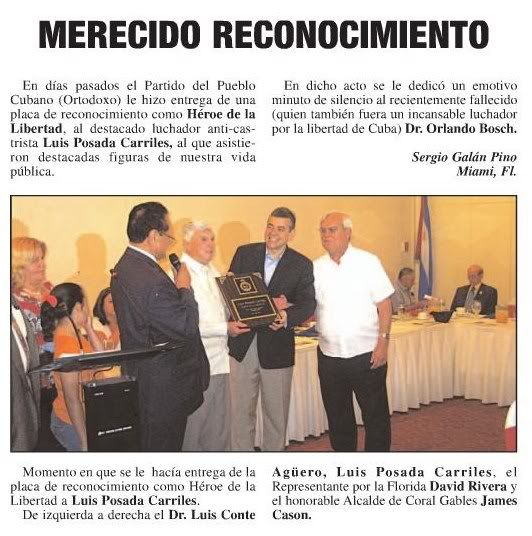
Last month, Humbert Fontova found out that Luis Posada Carriles, main suspect in the 1976 bombing of a civilian airliner and reputed terrorist, was publicly honored in Miami by Congressman David Rivera (FL-25) and Coral Gables Mayor James (Jim) Cason. It seems that Fontova (in his usual sarcastic manner) was disappointed that The Miami Herald didn't report on the event. Well, I'm so happy to oblige Mr. Fontova with the details.

Back in April, Luis Conte Agüero was elated to hear that Luis Posada Carriles, whom he considers a "Mambi," was acquitted of several charges of U.S. immigration fraud. So, Conte Agüero, one of Posada's strongest public supporters in Miami, arranged to celebrate the event at the Big Five Club on May 14th where the Cuban Orthodox People's Party was already scheduled to meet. Conte Agüero is the president of that organization.

According to Sergio Galán Pino for Libre Magazine (screenshot of article here), the meeting indeed took place, recognizing Posada as a "Hero of Liberty" and was attended by Rep. David Rivera and Mayor James Cason. Rep. Rivera is a long-time member of the Cuban Orthodox People's Party, and Mayor Cason was an honored guest of the organization in 2009. At that 2009 meeting, Mayor Cason told the Orthodox members that "the enmity of Fidel and Raul [Castro] with us [the United States] is real, it is genuine, they need an enemy to exist, we are that enemy and will always be."

Mayor Cason since 2009 has attended several meetings with other hard-line Cuban exile organizations, and campaigning discreetly among them. Due to this support by Cuban exiles, Cason became Mayor of Coral Gables last April. Mayor Cason was most likely celebrating his Mayoral victory at the May 14th meeting with the Orthodox Party.

[Photo by Libre Magazine - May 24, 2011, left to right: Luis Conte Agüero, Luis Posada Carriles, David Rivera, James Cason.]

Monday, May 16, 2011

Julio Robaina Promises To Be Hard-line

So, I was listening to Radio Mambi this morning (someone's got to do it), and heard something very interesting. A caller identifying himself as a member of an organization of Brigade 2506 veterans called in to publicly support the Mayoral candidacy of Julio Robaina. The caller said that of all the current candidates Robaina has "the toughest stance" on cultural exchanges with Cuba, and Robaina promised to keep that hard-line "wherever he is."

Next Tuesday Miami-Dade county voters will elect a new Mayor in special elections. Among the top candidates stands former Hialeah Mayor Julio Robaina. Over the past few years, Robaina has certainly presented himself as a hard-liner on U.S.-Cuba policy, such as preventing a Cuban music concert from taking place in Hialeah, to supporting anti-Castro militants like Luis Posada Carriles. These credentials will most likely help Robaina capture plenty of voters next Tuesday. But, the consequences of having another hard-line Mayor in Miami could prevent the city from becoming a culturally diverse center for the arts, perhaps increasing the potential for Cuba-related conflicts like many seen in the past.

The caller this morning to Radio Mambi stated that Julio Robaina made a "promise" to several hard-line/militant Cuba exile organizations to remain "tough" on cultural exchanges with Cuban artists. Unfortunately, I was unable to record the entire comments made by the caller, and therefore the comments are a bit vague, but the last few comments are interesting nonetheless (the "promise" quote is based only on my own recollections of the caller's comments.)

[Audio]

The caller states that Robaina's position on cultural exchanges is the "toughest" of all the current Mayoral candidates. I am assuming that the caller is Manuel L. Malgor, president of the American Missile Crisis Veterans Association, and a leading organizer of a local campaign to stop the Cuban cultural exchanges in Miami [here's an example of their work]. That campaign has successfully resulted in recent anti-cultural exchange resolutions in the City of Miami and Hialeah, yet no specific laws prohibiting Cuban artists from performing in Miami. The caller specifically mentions these resolutions in the audio clip.

The other interesting bit of information provided in the audio reveals that Julio Robaina has adopted a hard-line stance on Cuba because "an uncle of his was jailed for 18 years in Cuba." Most likely, this memory of injustice has influenced Julio Robaina in becoming a hard-liner, just like many other hard-liners with similar stories of injustice. But, it does not justify a government representative adopting political positions that satisfy individual interests that conflict with the interest of the greater community. In this case, encouraging cultural exchanges between Miami and the people of any other region has greater social benefits than maintaining a hard-line position.

But, the hard-line/militant position believes there are no benefits to cultural exchanges with Cuba. According to a copy of a letter sent to the City of Miami, anti-cultural exchange activists believe that "under the pretence of cultural exchange, that same [Cuban] regime is sending communist agents to infiltrate and provoke the Cuban Exile Community." The (sometimes paranoid) belief that the exile community is being targeted for provocation and infiltration is often used, most recently to stop a legitimate public campaign supporting the Cuban Five in Miami. But, Julio Robaina has adopted this position towards cultural exchanges with Cuba, recently telling El Nuevo Herald: "We don't want our people [the Cuban exile community] to continue being instigated with those kind of shows... that is why we are asking Congress to approve a law that will put an end to this matter [of Cuban cultural exchanges]." Last February, Robaina (then-Mayor of Hialeah) and the Hialeah City Council approved a resolution "urging the members of Congress to introduce legislation opposing cultural exchanges between Cuba and the United States so long as the Cuban government continues its violation of basic freedoms and human rights." [From City Council Agenda - February 8, 2011]

Once again, when it comes to Cuba, hard-liners and militants do as they please while continuing to ignore what the rest of the population think. There is no evidence of a majority of Miami residents opposing cultural exchanges with Cuba.

Back in 2000, Florida International University's Cuba poll found that 54.7% of Cubans in Miami supported Cuban artists performing locally, while 45.3% opposed (85.4% of all Miami residents supported these cultural exchanges). A more recent poll of Cuban-Americans in 2009 [PDF] showed that 52% favored cultural exchanges versus 32% opposed.

So, you might be perplexed about why Robaina is ignoring these majority opinions. Well, aside from Robaina's personal reasons concerning his uncle, Robaina is just being loyal to small but well-organized anti-Castro organizations that consistently vote come election day. The same loyalty helped James Cason win the Coral Gables mayoral election recently (Cason had been campaigning discreetly among Cuban exiles since 2009). Yet, despite all the criticism Cuban exile hard-liners and militants get from the local community, when election day arrives they know how to get their voters out.

But, in the end, democracy is only rhetoric, while elitism seems to rule in Miami.

- [Miami New Times - Julio Robaina campaign gave $350 to Luis Posada Carriles' defense fund.]
- [Julio Robaina accepts award from a local hard-line organization, Mario and Lincoln Diaz-Balart attending.]

Thursday, April 7, 2011

Hialeah Leaders Support Posada


Above shows Hialeah Mayor Julio Robaina and Hialeah Council President Carlos Hernandez expressing their affection for Luis Posada Carriles, a man accused of being a terrorist and a self-admitted unrepentant militant. In South Florida, support for Posada means you either justify his violent tactics in a global war against communism/evil/hate (which the Cuban government represents), or you, as an anti-communist, feel profound respect for someone who has sacrificed his/her life for anti-communism (in this case freedom for Cuba).

But, these are false choices. The violence or cause that Luis Posada Carriles represents is the most extreme form among other methods. Showing public support for Posada, especially as a community leader, serves to advocate these extreme forms of politics while ignoring more moderate ones.

While Robaina and Hernandez have the right to support whatever cause or agent they want in that cause, both Hialeah leaders should be aware that many other Cuban-Americans are not militants, or anti-communists.

As leaders of that community, will they listen to those voices?

-----

- Hialeah Mayor Robaina is currently running for Mayor of Miami-Dade County, while Council Pres. Hernandez is expected to become the interim Hialeah mayor and potential candidate for the seat.

- Recorded from radio program "Esquina de Pepe" hosted by Jose 'Pepe' Yedra on WWFE 670 AM, February 18, 2011. Jose 'Pepe' Yedra is broadcasting live from the Big Five club in West Miami where a fund-raising event is taking place supporting Luis Posada Carriles.

Thursday, February 11, 2010

Irrational

So why did Rep. Lincoln Diaz-Balart decide to finally end his political career in Florida's 21st Congressional District? I have yet to hear a rational answer.

This evening Rep. Ileana Ros-Lehtinen was very busy, appearing on Radio Mambi's "Mesa Redonda" for two hours, and then appearing for an interview with Maria Elvira Salazar which aired at 8pm. Later, by 9pm, she reappeared on Radio Mambi with Marta Flores. She spoke about Rep. Diaz-Balart's announcement today, but failed to give a clear answer as to why Lincoln was leaving. Instead, her goal seemed to be to reassure everyone that support for U.S. policy towards Cuba was still secure in Congress.

Also on tonight's broadcast with Maria Elvira Salazar was Rep. Mario Diaz-Balart (who will now run for Lincoln's seat), and Ana Carbonell, Lincoln's long-time Chief of Staff. Despite the host's attempts to probe for an answer, none gave in. All just repeated what Lincoln had announced earlier today: Lincoln decided that he would better serve the mission (or "la lucha") for a free Cuba as a private citizen. This explanation seems straightforward, but raises many questions.

It seems to imply that Rep. Lincoln Diaz-Balart felt he could no longer achieve anything more towards a free Cuba in Congress. (Could anymore be done after Helms-Burton?) It also implies then that Lincoln's ultimate goal in Congress was to influence U.S.-Cuba policy, while serving the other interests of his constituents was secondary, or not worth representing anymore.

Also, Lincoln could've stayed in Congress to achieve important positions like Rep. Ileana Ros-Lehtinen who has been serving in Congress for over 20 years and now expected to become chairman of the House Committee on Foreign Affairs. Lincoln was certainly in a safe Republican district, so why decide to leave it when he could have achieved more in Congress?

I think he did it for his brother Mario.

Rep. Mario Diaz-Balart is not in a safe Congressional district (FL-25). Since his first race in 2002, Mario's winning percentages have progressively decreased: 65% in 2002, 58% in 2006, and 53% in 2008 [source]. It was a dangerous trend. So, I figure that Lincoln sacrificed himself for his brother Mario, since the 21st district is much safer.

But, this is not a rational answer. It risks too much because Rep. Mario Diaz-Balart could still lose the district. An online poll by Telemundo51 today indicates that Mario is not favored as a replacement for Lincoln, 68% voting for "another candidate."

And, is Lincoln in a better position as a lobbyist, possibly working with the U.S. Cuba Democracy PAC? Lincoln is a firebrand, not really someone to work behind the scenes I think.

So far it all seems irrational. But, time will tell.

[Rep. Lincoln Diaz-Balart says he will continue working on a project called "The White Rose." It is a project started 50 years ago by his father, and outlines a comprehensive transition process for a free Cuba. It can be viewed here in Spanish.]

Lincoln Diaz-Balart Will Leave 21st District [Updated]

As I write this post, Rep. Lincoln Diaz-Balart is announcing that he will not run for re-election in Florida's 21st Congressional District. His speech was given this afternoon at Florida International University inside the Law Library, part of which is dedicated to his grandfather Rafael Diaz-Balart.

[Correction] The announcement was broadcast live in its entirety by local news reports. [Full video available here.]

The Miami Herald reports on the possibilities for Rep. Diaz-Balart, and his brother Rep. Mario Diaz-Balart.

[Update: Full speech by Rep. Lincoln Diaz-Balart, and the official announcement by Rep. Mario Diaz-Balart to run for the 21st District. And, questions by reporters after announcement.]

Thursday, June 18, 2009

TV Marti Under the Microscope

Yesterday, the U.S. House Subcommittee on International Organizations, Human Rights and Oversight heard important testimony concerning the effectiveness of TV Marti, the U.S.-funded television broadcast aimed at Cuba. (In 2006, TV Marti began transmitting from AeroMarti [photo] costing Americans at least $5 million annually.)

In sum, TV Marti is not reaching a significant or discernible audience inside Cuba, and its transmission should be terminated due to its weak signal. Instead, other options to reach a broader Cuban audience should be considered (such as satellite or internet), and an assessment of a reformed Radio and TV Marti (operating with a smaller budget) should be scheduled.

Jess T. Ford, one of the directors of the International Affairs and Trade department of the Government Accountability Office (GAO), submitted before the Subcommittee a report [PDF] stating that the Office of Cuba Broadcasting (OCB), which operates Radio and TV Marti, has trouble finding a good measure of their audience in Cuba, but telephone surveys nonetheless report a very small audience (less than 1% of the population).

"Due to the U.S. government’s lack of access to Cuba, OCB has difficulty obtaining nationally representative data on its audience size. In addition, decision-makers have limited information to help assess the relative success or return on investment from each of OCB’s various transmission methods... Specifically, less than 1 percent of respondents to [International Broadcasting Bureau (IBB)] telephone surveys since 2003 reported that they had watched TV Marti during the past week. Notably, results from the 2006 and 2008 telephone surveys show no increase in reported TV Marti viewership following the launch of AeroMarti and DirecTV broadcasting in 2006."

Tim Shamble [PDF of testimony], President of the American Federation of Government Employees, Local 1812, representing membership employees at the OCB, agreed that TV Marti transmission is the main problem and held reservations for changing the programming at OCB:

"Regular terrestrial television transmission was never a very good option for TV Marti... A better option would be to keep the long form news and information programming, eliminate terrestrial television broadcasting and use the savings to invest in newer technologies to deliver the video produced."

(Only recently, since late last year, has Radio and TV Marti started uploading video on YouTube for example.)

Philip Peters, Vice President of the Lexington Institute and blogger at the Cuban Triangle, added anecdotal evidence in support of TV Marti's non-existent audience inside Cuba [PDF of testimony]:

"I cannot recall how many times I have asked Cubans in Cuba, all across Cuba, about TV Marti and have received the same answer: 'No se ve' ('It's not seen'). For years, I have asked diplomats and clergy and journalists who travel regularly around the island, and get the same answer."

Peters also provided excellent alternatives to expensive broadcasts towards Cuba:

"... the flow of information and ideas on the part of individual travelers and our nation’s vibrant civil society – universities, professional associations, humanitarian and religious groups, cultural and sports organizations – would far outweigh the impact of two decades of funds spent on TV Marti."

One specific (and excellent) alternative Peters provides involves Nicholas Negroponte's One Laptop per Child Program:

"The program developed its own laptop, the XO, which costs about $200 and allows users to communicate with each other through a wireless mesh network, so that all users in a local area are interconnected. TV Marti’s 19-year budget would have paid for 950,000 XO laptops for Cuban children."

[...]

"It is more likely that the Congress can do far more to increase communication with Cuba by taking away restrictions on American liberties than by taking our tax dollars to spend on government programs."

Finally (saving the best for last), John S. Nichols also testified yesterday. Nichols [bio], in addition to being recognized as an outstanding university professor, has been doing research on Radio and TV Marti since their first transmissions, and has written about them extensively over the years. Most imporantly, he provided yesterday the most convincing testimony on TV Marti's weak signal towards Cuba based on his research from the island:

"The broadcast version of TV Marti is not seen in populated areas of Cuba and, almost without exception, has not been seen since the station went on the air in 1990... The TV Marti signal is very weak after it traverses the Strait of Florida and reaches the Cuban coastline. All the Cuban government needs to do is fill the same channel with its own, low-power signal and the TV Marti signal is disrupted and cannot be seen in the surrounding area."

And concerning, TV Marti's satellite broadcast:

"Surveys by both the U.S. and Cuban governments, in-country reporting by foreign journalists, and anecdotal evidence all indicate that the overwhelming majority of Cubans with access to satellite dish television strongly prefer other programming."

And, about AeroMarti:

"Virtually no one can see the broadcasts from AeroMarti, and Congress' continued investment in that technology is a complete and total waste of taxpayer dollars."

The Marti News website, along with the Voice of America, has already reported on yesterday's Subcommittee hearing. Both news outlets operate under the International Broadcasting Bureau of the Broadcasting Board of Governors. El Nuevo Herald also has the story, but with a very strange headline: "Congressman Launches Attack on TV Marti." Outside of Miami, the same story by Nestor Ikeda has a different (accurate and less hostile) headline. (What's with the editors at El Nuevo Herald?)

Anway, TV Marti seemed doomed from the start, but has been predictably exploited politically in Miami. An excellent book called "Psywar on Cuba" highlights some declassified documents showing how OCB management (Rolando Bonachea) tried to hide the poor numbers found in audience surveys of TV Marti in its first few years of broadcast [Page 296]. Instead, they preferred the use of flawed methodology to produce false audience numbers.

For Miami's Cuban-American political leadership, Radio and TV Marti represents something more than audience numbers, it is a moral obligation, and therefore an exploitable political position. Last year, when local journalist Kirk Nielsen questioned Rep. Mario Diaz-Balart over the effectiveness of Radio and TV Marti, he received ridiculous denials from the Congressman. "The reports aren't what you're saying, though!... They’re actually pretty good!" said Rep. Diaz-Balart to Nielsen. Nielsen then exposes the lie in his article.

Of course, the audience numbers of Radio and TV Marti have to be concealed from the public. Why? Because that's how the Broadcasting Board of Governors judges the effectiveness of its broadcast organizations, including Radio and TV Marti. Then, you must be wondering: how the heck did TV Marti get the extra budget in 2006 for AeroMarti?!

Easy, Pres. George W. Bush promised it to Rep. Lincoln Diaz-Balart.

[Photo by AP]

Wednesday, April 1, 2009

The Ignorance of Sen. Mel Martinez

Legislation in the House and Senate is ready to remove travel restrictions for Americans who want to visit Cuba. Both Rep. Bill Delahunt and Sen. Byron Dorgan have respectively introduced identical bills in the House and Senate that would prevent the President from regulating travel to Cuba, except in cases of immediate danger. Sen. Delahunt's bill has 121 co-sponsors so far, 93 more co-sponsors than in a similar bill from 2007.

Yesterday, Senators Byron Dorgan, Mike Enzi, and Chris Dodd held a press conference addressing the recent bill to remove travel restrictions [video available here].

Sen. Dorgan said that a travel ban to Cuba "is a failed policy that has failed for 50 years and its long past the time to change the policy... Punishing the American people in our effort to somehow deal a blow to the Castro government has not made any sense at all."

Sen. Dodd said: "Our goal is obviously to bring change to Cuba, democratic change to Cuba. I happen to believe that for 40 years this [travel restriction] policy has done just the opposite. I think it has perpetuated the situation."

In rebuttal to the bill, the AP quotes Sen. Mel Martinez saying: "This is the time to support pro-democracy activists in Cuba, not provide the Castro regime with a resource windfall."

The Miami Herald also quotes Sen. Martinez saying: "We should be siding with the oppressed, not with the oppressors."

Well, if Sen. Martinez is on the side of the oppressed pro-democracy activists in Cuba, then he should know that these activists are already opposed to travel restrictions to Cuba. I'm talking about well-known Cuban dissidents like Oswaldo Paya, Marta Beatriz Roque and Dr. Darsi Ferrer.

In fact, this should make people wonder about who's side Sen. Martinez is really on because, in the case of US travel to Cuba, Sen. Martinez is not on the side of the oppressed pro-democracy Cuban activists.

On the other hand, Sen. Dorgan does recognize that Cuban dissident Oswaldo Paya is opposed to travel restrictions to Cuba, namely those that restrict Cuban-Americans to travel. Read the very wise words of Paya concerning this matter:

"All of us within the Christian Liberation Movement have defended, and will continue to defend, the right of all Cubans to travel to any country and to enter and exit Cuba freely. We are therefore against any restriction that prevents Cubans from coming to Cuba whenever they desire, without conditions.

"Respecting the right of Cubans who live outside of Cuba to come to Cuba should not be conditioned on change in Cuba; this would inflict double punishment on the same victim. But Cubans living outside of Cuba must act in solidarity with their brothers and demand all the rights of Cubans living in Cuba, for in doing so, they are demanding their own rights."

This principle of universality also suggests that in defending your own freedoms, you set the example for the defense of freedom for others. The right of freedom of movement is expressed in Article 13 of the Universal Declaration of Human Rights.

[Photo above from the AP]

Wednesday, February 11, 2009

Polls Schmolls

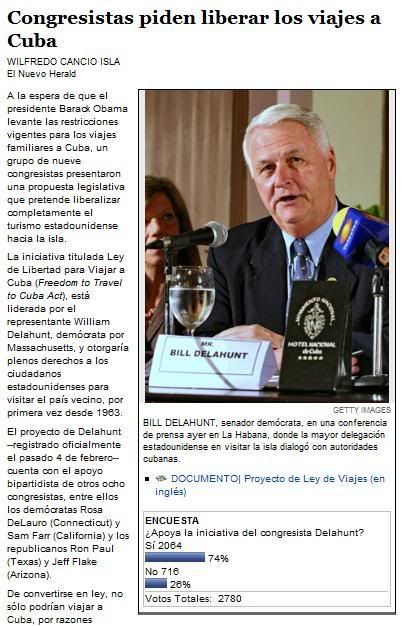
Yesterday on Radio Mambi, Ninoska Perez Castellon responded to an article in El Nuevo Herald reporting on the introduction of the Freedom to Travel to Cuba Act. The bill was introduced last week by Rep. William Delhunt [D-MA] and co-sponsored by Democrats and Republicans. In sum, the bill "prohibits the U.S. president from regulating or prohibiting travel to or from Cuba by U.S. residents, except in times of war between the two countries or of imminent danger to public health or the safety of U.S. travelers."

Phil Peters, Cuba expert from the Lexington Insitute, has hopes for the bill: "I think the conditions are good for it... The veto threat is gone and Obama has signaled that he is interested in revamping policy. I am not making any predictions, but is it a bill that gets introduced every year and has no chance? No."

Perez Castellon was outraged and described Rep. Delahunt as "anti-American" and "an apologist for the [Cuban] dictatorship." But, it seems that Perez Castellon was even more outraged with the local polling data showing support for Rep. Delahunt's bill. Perez-Castellon cannot accept that fact and has gone into denial.

The El Nuevo Herald article that Perez Castellon was referring to yesterday had an online poll attached to it. Perez Castellon could not believe the results. "Obviously they are not even scientific and lord knows who or how they are being manipulated," said Perez Castellon about the poll. She then began to insinuate a larger conspiracy:

"... in this poll that mysteriously is 75 percent in favor [for American travel]. That if you told me this happened in Arkansas, well OK it was in Arkansas, or in New York or in Boston, who are very liberal... no, no in Miami, right in the heart of the exile community. These are the results because this is consistent with the thesis that the exile community has changed. If the exile community has changed then the three [Cuban-American] members of congress would not have been re-elected." [MP3]

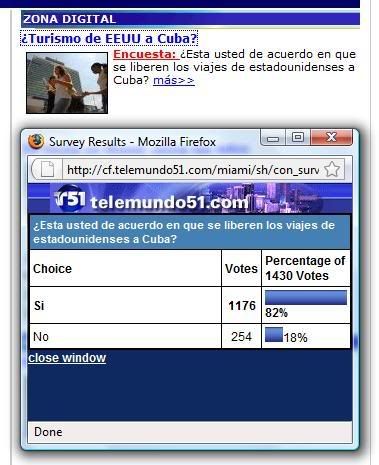
Later in the evening, Telemundo51 covered the same story on the Freedom to Travel to Cuba Act. They also asked their viewer to participate in an online poll. They asked: Are you in favor of easing travel to Cuba for Americans? From approximately 1500 votes, 82 percent(!) were in favor. The El Nuevo Herald poll had over 2800 votes.

These online results in fact support the scientific polling data presented by the 2008 Cuba/US Transition Poll, conducted by the Institute of Public Opinion Research at Florida International University and supported by the Brookings Institution and the Cuba Study Group. The poll questioned 800 Cuban-Americans in Miami-Dade County, with a 3.6% margin of error.

In that Transition Poll, concerning the question of unrestricted travel to Cuba by Americans, respondents age 18 to 44 favored unrestricted American travel by 75 percent. Respondents who left Cuba from 1980 to 1998 favored the idea by 67 percent, while those who left Cuba after 1998 were in favor by 80 percent.

People who favor unrestricted travel to Cuba sometimes call Radio Mambi. Of course, their comments are immediately denounced and their person insulted. Perez Castellon calls them "stupid" on the air, while loyal callers are allowed to call them "ratas" or rats. [MP3]

Ninoska Perez Castellon does not accept any reliable polling data such as the Transition Poll, which she called "bogus" when it first came out. Nor did she believe a more extensive version when it came out in 2007. But, of course, she supported the results of a recent poll that contradicted the Transition Poll. This one headed by a loyal Republican firm, and called a "joke" by Phil Peters.

I doubt anything would convince Ninoska Perez Castellon, or any Cuban exile militant, that opinions on US policy towards Cuba are drastically changing in Miami. It's called denial.

[Photo by Jeff Chiu/AP, McCain supporters from 2008]

Thursday, December 4, 2008

Mayor Calls Che Film a "Slap in the Face"

This morning on Spanish-language radio station WWFE (670 AM), Miami Beach Mayor Matti Bower called in to express her disapproval over a controversial film being screened this evening.

Mayor Bower was on the phone with Cuban exile activist Ruby Feria this morning, and mentioned that she was shocked when she heard that a "Che" film in Miami Beach would be shown this evening.

"Honestly, it gave me a shock when I found out this was happening. The last thing I thought was something like this to occur."

But, Mayor Bower, who was born in Cuba, added that she is opposed to stopping the scheduled screening of the film, and reminded everyone that "in a free country like this one, censorship is not acceptable..."

"Because we come from a country where there is censorship in art, in words, in religion, and censorship in though, and I wish never to fall into something like that."

Mayor Bower assured protesters that she will join them tonight at the Carlyle Theater because the screening of the film was a "slap in the face." She also stated: "I will fix this the best way I can because it is not fair that they do that [screen a film on Ernest 'Che' Guevara] without us being prepared."

Radio host Ruby Feria said that she "will excuse this instance with the promise to work so that in the future this will not happen again."

[Audio of Interview, MP3]

Wednesday, November 12, 2008

Must-Read

John McCauliff, executive director of the Fund for Reconciliation and Development (FFRD), has an excellent article on the Havana Note website. McCauliff makes some very important points and clarifications concerning Obama's stated policy towards Cuba and those that may have misinterpreted it.

"Sending direct aid to opposition personalities in Cuba hopelessly compromises their nationalist credentials and makes them vulnerable to prosecution as agents of a hostile foreign power, not unlike the attitude the US took to members of the US Communist Party in the 1950s. Buying into CANF's semi-soft regime change thesis also makes no sense if the new administration wants to develop the trust and mutual respect that are essential for successful negotiations.

"CANF and others in Miami presume they should be part of any negotiations between Washington and Havana, but that is pure poison to serious talks
."

[Full Article]

Also, take the time to go to the FFRD website. It's been improved and enhanced with several useful links concerning US Cuba relations. Cheers to the FFRD.

Thursday, November 6, 2008

Undeniable Shift [Updated]

While Babalu blog's Henry Gomez combs (almost obsessively) South Florida, trying to figure out how Cuban-Americans voted last Tuesday, the shift in political attitudes is apparent.

Today, the Miami Herald is reporting the polling data:

"According to [Bendixen and Associate's] exit polls, Obama won 35 percent of the Cuban-American vote in Miami-Dade County, nearly 10 points higher than Kerry's showing in 2004. Within that community, the generational difference was stark. For example, 84 percent of Miami-Dade Cuban-American voters 65 or older backed McCain, while 55 percent of those 29 or younger backed Obama."

But, if you are skeptical of polling data, then just go to Little Havana and see for yourself.

Once Sen. Barack Obama was declared the winner on Tuesday night, a crowd of Obama supporters gathered in Little Havana. And, it was not just anywhere in Little Havana, it was right across the street from the Versailles restaurant (!), home to the so-called Cuban "intransigent."

Watch the video here, courtesy of Univision. (Interestingly, the reporter in the video interviews two Cuban residents who fully support Sen. Obama, despite being unable to vote. Also, the video shows an apparently upset crowd right in front of Versailles.)

Those that don't see the "shift," don't want to see.

[Photo above of Obama celebration in front of Versailles Restaurant]

[Update: Carlos Miller's blog has the scoop and an excellent link to more photos of this particular celebration in front of Versailles.]

Tuesday, November 4, 2008

May the Best Candidate Win

Good luck to both candidates on this very exciting Election Day. May voters have chosen wisely and to the best of their abilities. Even after elections are over, there is still a long road ahead.

Concerning US-Cuba relations, here are the candidates in their own words.

Sen. John McCain:

"If I'm elected President, I won't meet unconditionally with the Castro brothers, while they keep political prisoners in jail, stifle free media and block free elections in Cuba. When I am President, we are going to pressure the Cuban government to free their people. The day is coming when Cuba will be free." (Oct. 17, 2008)

"I would increase [funding to] Radio Marti, increase TV Marti, increase the condemnation of this dictatorial regime. But, if you're asking me if I will send in troops for military action... I don't know." (March 21, 2007)


Sen. Barack Obama:

"I support the eventual normalization [with Cuba]. And it’s absolutely true that I think our policy has been a failure. I mean, the fact is, is that during my entire lifetime... you essentially have seen a Cuba that has been isolated, but has not made progress when it comes to the issues of political rights and personal freedoms that are so important to the people of Cuba. So I think that we have to shift policy. I think our goal has to be, ultimately, normalization. But that’s going to happen in steps. And the first step, as I said, is changing our rules with respect to remittances and with respect to travel... the Bush administration has done so much damage to American foreign relations that the president [must] take a more active role in diplomacy than might have been true 20 or 30 years ago.

"Because the problem is, if we think that meeting with the president [of the United States] is a privilege that has to be earned, I think that reinforces the sense that we stand above the rest of the world at this point in time. And I think that it’s important for us in undoing the damage that has been done over the last seven years, [and] for the president to be willing to take that extra step." (February 21, 2008)

Wednesday, October 22, 2008

Dinner with the Mambises

Just wanted to post this photo before it disappears from the net. Its another wide shot of the table where President Bush sat with SOME leaders of the Cuban exile community earlier this month (October 10th). Before this dinner, he met at the home of Sergio Pino, President of Century Homebuilders of South Florida (longtime Republican contributor). According to Republican officials, Bush raised more than $500,000 on this trip for the Florida Republican Party.

In the photo above are Armando Perez-Roura (far right, no pun intended) and Ninoska Perez-Castellon (in front). Both criticized Pres. Bush in May for not having done what he "should have done" to free Cuba. I wonder if they said the same thing (with the same attitude) to him at the dinner?

Florida Votes

If you haven't heard, there are long lines for early voters in South Florida. There seems to be several reasons for this, some political. Anyway, a large voter turnout is a good sign, but one that may cause concern for our favorite congressional incumbents: Reps. Ileana Ros-Lehtinen, Mario and Lincoln Diaz-Balart.

Below I have organized the results of recent polling by local Spanish-language news stations Telemundo51 and Univision23. The Telemundo51 poll used a sample of 300 registered voters in the following questions (margin of error: 5%). The Univision23 poll was conducted by The Metropolitan Center at Florida International University and used a sample of about 400 likely voters (margin of error not provided). All polling was conducted before or near the beginning of October.

What is very interesting of all the data is the number of undecided likely voters. Also, age and ethnicity seem to be a significant factor as well (click on links for more data). One thing I've learned about living in Miami, there's always a potential for a surprise. Below, results show all congressional incumbents leading the race so far.


REP. ILEANA ROS-LEHTINEN vs ANNETTE TADDEO

Telemundo51: 48% - 35%, Undecided 17%
Univision23/FIU: 52% - 27%, Undecided 21%


REP. LINCOLN DIAZ-BALART vs RAUL MARTINEZ

Telemundo51: 48% - 43%, Undecided 9%
Univision/FIU: 47% - 33%, Undecided 20%


REP. MARIO DIAZ-BALART vs JOE GARCIA

Telemundo51: 43% - 41%, Undecided 16%
Univision/FIU: 46% - 37%, Undecided 17%

Wednesday, October 8, 2008

It's Up to the Undecided [UPDATED]

This week Telemundo 51, one of South Florida's Spanish-language news stations, released interesting polling results about the anticipated Congressional races involving Rep. Lincoln and Mario Diaz-Balart, and Rep. Ileana Ros-Lehtinen. According to the results, the road to November will be very suspenseful.

DISTRICT 18

Rep. Ileana Ros-Lehtinen at first glace seems to have a very comfortable lead (48% v 35%) in front of her opponent, Annette Taddeo. But, Telemundo 51 and a recent FIU/Univision poll show a significant amount of potential voters still undecided. In both polls, undecided voters number about 20%!

DISTRICT 21

Rep. Lincoln Diaz-Balart leads (48% v 43%) in front of his opponent Raul Martinez, but undecided voters make up 9% of respondents.

DISTRICT 25

Rep. Mario Diaz-Balart and his opponent Joe Garcia are almost head to head in this race, Diaz-Balart leading 43% v 41%. But, undecided voters (16%) will certainly name the winner.

It's all very exciting, with less than a month to go until elections. It's important to note that these results come at a time when all candidates above are just beginning their massive media campaigns. These following weeks will be decisive.

Today, all six contenders appeared in a local forum, which the Naked Politics blog attended and provides some details.

The Babalu Blog, who loves to analyze polls, has not reported these findings yet. And Diario Las Americas, a local Spanish-language newspaper that regularly includes columns by Reps. Lincoln or Mario Diaz-Balart, has not reported these findings either. Instead, Diario today posts an article showing support for Ileana, Mario and Lincoln by a Cuban exile organization.

According to the article in Diario, the militant Cuban exile organization "Foro Patriótico Cubano" has endorsed Ileana, Mario and Lincoln for November. The endorsement is signed at the bottom by its members, which include Radio Mambi's Armando Perez Roura and Frank Alonso. Both Perez Roura and Alonso are leaders of the militant organization Unidad Cubana.

----- [Update: Oct. 17] -----

More polling results have been publicized by Univision/FIU. According to the new results, the race between Rep. Mario Diaz-Balart and Joe Garcia is not as close as it seems. Rep. Diaz-Balart leads over Garcia 46% v 37%. This is a larger lead than the one found by polling done for Telemundo51. Nevertheless, the number of undecided voters is almost identical (17%).

Meanwhile, the attack ads in the race between Rep. Lincoln Diaz-Balart and Raul Martinez are heating up. Telemundo51 has video of a confrontation between both candidates accusing each other of being the instigator.

In the video, Raul Martinez reveals that he approached Rep. Diaz-Balart and proposed a deal where they could agree to remove certain negative ads. Martinez says that Rep. Diaz-Balart refused to discuss the issue. Thus, Martinez says that he will continue his ads attacking his opponent as "corrupt."

Also in the video, Rep. Lincoln Diaz-Balart repeats that there is nothing personal about his ads. But, his ads against Martinez have been scrutinized as deceptive.

Raul Martinez has also recently been endorsed by the Miami Herald.