Wednesday, April 13, 2016

The Political Prisoner Game (Part 1)


Last month, during President Obama's historic visit to Cuba, a US reporter asked Cuban leader Raul Castro about political prisoners on the island. The subject of prisoners in Cuba is a perennial theme in the US media, and the question again provided journalists a convenient excuse to report unfavorably about the Cuban government. Raul Castro's denial of holding political prisoners was met with predictable urgency by several media outlets to prove him wrong and frame the Cuban government as an outlier in the region. But, ironically, the rush to defend Cuban political prisoners revealed poor judgement and irresponsibility by many reporters. Several outlets used a list of political prisoners with controversial and/or violent backgrounds, and other lists were unreliable and missing information. The response by the media showed traditional disregard of facts when reporting about the island, and denied the contentious issue of political prisoners the tactfulness it deserves.

DIFFERENT LISTS

Last month, during a rare press conference with Cuban leader Raul Castro, CNN's Jim Acosta (a Cuban-American) asked Castro a purposely naive question: "I wanted to know why your country has Cuban political prisoners and why you don't release them." Looking annoyed, Castro demanded that he be given a list of names and that he would release them all by the end of the day. But, his sarcasm became evident when he later asked out loud: "What political prisoners?" Back in January, the Cuban government released 53 prisoners as part of a deal with the US to restore normal relations. Way back in 2010, Raul Castro participated in the release of 52 high-profile Cuban political prisoners of the Black Spring. Perhaps Castro thought he had already solved this problem.

Immediately, Univision's Jorge Ramos was among the first to respond to Raul Castro with a list of 47 names of political prisoners provided by the Cuban American National Foundation (CANF). Many other news outlets soon followed using this list. TIME magazine provided a different list provided by the Directorio Democratico Cubano (Cuban Democratic Directorate). Directorio's list had 51 names, sharing some names with CANF but mostly using different names. In Cuba, the independent website 14ymedio published a list of 77 names provided by dissident Elizardo Sanchez of the Cuban Commission for Human Rights and National Reconciliation. And, an editorial by The Miami Herald presented readers with the CANF list and another list of 75 names by a Madrid-based organization called Observatorio Cubano de Derechos Humanos (Cuban Observatory for Human Rights). The four lists mentioned above have been the most prominently cited, and each one is very different.

Let's review some basic problems with the lists before analyzing the more complicated ones. REMINDER: This is not a thorough review of all names on the list, just the ones I could identify as problematic based on my limited time.

ALWAYS DOUBLE-CHECK

One of the reasons I'm providing this review is because I've seen this political game of lists before. Back in 2010, the not-so-independent Cuba Archive failed to check their list of Cuban prisoners who died from hunger strikes. Similar errors occurred here.

The Politifact website was the first to identify some errors when they reviewed and compared the Cuban political prisoners lists that flooded the media last month. Unknown to them, they used different versions of the CANF and Directorio lists. After creating a spreadsheet with all the names of prisoners, they discovered that some prisoners had already been released. The note at the bottom of the spreadsheet reads: "Victims of Communism [website] also listed several people who have since been released. They were not included in this spreadsheet." The VOC website updated their list after the errors were found. But, Politifact still has errors on their aggregate list of 97 names. Four prisoners on their list were released earlier in March and landed in Miami just a few days before President Obama arrived in Cuba. Also, there are names that repeat: Lazaro Avila Sierra (#5) and Lazario Avila Sierra (#70); Verdecia Amado Diaz (#7) and Amado Verdecia Diaz (#13).

The editorial by The Miami Herald also failed to double-check one of their lists. One link they used sent readers to the Observatorio list of political prisoners from 2015. That old list of 75 names includes the four released prisoners mentioned above. A new updated list by Observatorio now has only 66 names.

And, a closer look at the CANF lists shows a possible date error. The list shows Edilberto Alzuaga Alcala (#12) imprisoned in 2011, and given a one year sentence. A previous record of the CANF list showed that Alzuaga was added to the list in 2015, so the 2011 date is most likely an error. According to Cuban dissident Martha Beatriz Roque, Alzuaga was indeed imprisoned in 2015, but she writes he was imprisoned in February and serving a one year sentence. Given this information, it is possible that Alzuaga may already be free.

CONTRADICTORY OR MISSING INFORMATION

Other examples of contradictory or missing information, like that of Edilberto Alzuaga Alcala, include listed prisoners Liusban John Utra and Eglis Heredia Rodriguez.

A long-time member of the Cuban dissident group UNPACU (Union Patriotica de Cuba), John Utra's activism inside Cuba has been reported since 2012. According to the CANF list, John Utra (name #1) was imprisoned in 2013 with a 7 year sentence. Strangely, CANF, unlike other lists, did not provide the charges placed against all their prisoners. But, according to the Observatorio list, John Utra (# 47) was charged with "robo con fuerza" (burglary with forced entry). Eglis Heredia (#65), also a member of UNPACU, had the same charge.

After Raul Castro asked for a list of political prisoners, both UNPACU members appeared on some lists, but not all. They did not appear on the list provided by the Havana-based Cuban Commission for Human Rights and National Reconciliation led by long-time dissident Elizardo Sanchez. And when UNPACU founder Jose Daniel Ferrer was asked to provide a list of political prisoners, he also did not include John Utra or Eglis Heredia despite the fact that both are members of UNPACU. The reason for their exclusion was explained last year by long-time Cuban dissident Martha Beatriz Roque: "[Eglis Heredia's] sentence [for burglary with forced entry] is not related to his role in the opposition, as is stated on a list. Mr. Heredia is not a political prisoner, but he did join UNPACU upon being [temporarily] released from jail." The same discretion was most likely applied to Liusban John Utra.

And this highlights another problem about the lists of Cuban political prisoners: Cubans taking up political causes while serving sentences for non-political criminal acts. Unknown to many, some prisoners in Cuba are allowed conditional release from prison under a form of supervision based on the severity of their crime. A report from Radio Marti mentioned that Liusban John Utra was arrested in 2012 for his political activism while under conditional release for a "common crime." This was the same infraction that Eglis Heredia committed in 2014.

ONE MAN'S POLITICAL PRISONER...

In part two I will go over the more complicated subject of Cuban prisoners incarcerated for more violent acts. In these cases, it not clear where to draw the distinction between acts we can tolerate as politically benign or politically dangerous. In some cases, the so-called political prisoner was planning long-term armed violence. In others, violence was a means to a short-term selfish goal. In any case, these are examples that require more careful observation, and should not be glanced at from a list.

Wednesday, March 23, 2016

President Obama's Speech in Cuba

President Barack Obama's televised speech to Cubans on the island was a success given the reactions reported by the local press in Miami. The Miami Herald's Fabiola Santiago praised it as "masterful" and "a model display of leadership and humanity." Most notably, one of Miami's more hard-line radio station "La Poderosa" (WWFE 670 AM) re-broadcast the president's speech Tuesday evening. The announcement of the re-broadcast was made by the station's president himself, Jorge Rodriguez, speaking favorably of the speech. Other hard-line Cuban exiles may have given mixed reviews, but the more common reaction in Miami seemed positive.

El Nuevo Herald included an online poll of its readers asking "Do you believe Obama's message to the Cuban people will help create change on the island?" From a total of 777 readers, 71% said Yes, and 29% said No. A recent CBS/New York Times poll of Americans also showed major support for this administration's effort to restore diplomatic and economic relations with Cuba.

More Miami reactions to Obama's speech here and here.

Excerpt: "I’ve made it clear that the United States has neither the capacity nor the intention to impose change on Cuba. What changes come will depend upon the Cuban people. We will not impose our political or economic system on you. We recognize that every country, every people must chart its own course and shape its own model."

[Full transcript of speech]

Wednesday, July 1, 2015

Armando Perez Roura Leaves Radio Mambi [Updated]

Tuesday June 30, 2015 was Armando Perez Roura's last day at Radio Mambi (WAQI 710 AM). And I was very surprised to hear the news. That afternoon he broadcast his last radio announcement, seeming very humble and even apologizing to those he may have offended. (That was a shock to me.) For those who don't know yet, Perez Roura is considered the most celebrated voice of Miami's hard-line Cuban exile community.

According to recent rumors, Univision Radio decided to let his contract expire. Owners of Radio Mambi since 2002, Univision Radio had already been planning to retire Perez Roura over a year ago according to Nelson Horta. In 2013, Univision Radio dedicated a studio at Radio Mambi to Armando Perez Roura and celebrated his longtime radio career.

In 2012, both Radio Mambi and WQBA (1140 AM), traditionally the Spanish-language hard-line radio stations in Miami, went through significant restructuring. At Radio Mambi, Armando Perez Roura's most important daily talk program "La Mesa Redonda" was moved to Saturdays, and his daily news program was reduced to a half-hour.

This day was certainly coming, and Perez Roura without a doubt fought a long time to keep his place at Radio Mambi. Changing political landscapes and demographics were important factors here, concepts irrelevant to militants like Perez Roura.

Rumors indicate Perez Roura will move on to rival radio station "La Poderosa" (WWFE 670 AM), but, at 87 years old, he is already beyond the limits of intransigence.

[Update - Univision has provided audio of Armando Perez Roura's last radio announcement at Radio Mambi. And, on the morning of July 1, 2015 Perez Roura made his first appearance at "La Poderosa" (WWFE 670 AM, video here).]


(@0:57) "If I hurt someone, I ask for forgiveness because I am not perfect. But I am a whole-hearted Cuban and I'll never abandon the cause that brought me here."

[A short biography will be posted soon. Below are some related facts.]
  • Armando Perez Roura was born in the town of Ceiba Mocha in Matanzas, Cuba on January 11, 1928.
  • Perez Roura left Cuba for Miami in 1969.
  • Radio Mambi went on the air on October 23, 1985. Perez Roura was co-owner with Amancio V. Suarez, and Jorge Rodriguez (current owner of WWFE 670 AM). Suarez was reported to have made a $5 million investment on the station.
  • In 1995, Heftel Broadcasting Corp. acquired Radio Mambi (among other Miami radio stations). And then in 2002, Univision took over HBC stations including Radio Mambi.

Friday, June 26, 2015

Carlos M. Gutierrez Has a New Hypothesis (Part 1)

Carlos M. Gutierrez, former Commerce Secretary under George W. Bush, recently wrote a surprising op-ed admitting a reversal of his previous position on U.S.-Cuba policy. Basically, Gutierrez's reversal comes from a significant change in his assumption about the Cuban government: from hopeless enemy to potential ally. The reversal has been most disappointing to Cuban exile hard-liners who once admired Gutierrez as a model of Cuba exile intransigence in the highest positions of power. But, the reality is that Gutierrez is one example of the constantly changing face of the hard-line which has historically adapted to conditions set by the U.S. government.

This past Tuesday, the New York Times (or "Granma North" as the boys at Babalu Blog like to call it) published an op-ed by Carlos M. Gutierrez, former Commerce Secretary for George W. Bush, where he explained his "cautiously optimistic" support for Pres. Obama's new Cuba policy. In a nutshell, Gutierrez wrote he is "hopeful the Cuban government will allow its citizens to take full advantage of [American] assistance" to "support a new generation of Cuban-born entrepreneurs and Cuban-run small businesses." There are two assumptions operating here. One is the idea of the transformative power of "free markets" which Gutierrez writes he has seen operate in other parts of the world to help "raise living standards." And the other assumption concerns his newfound hope with the Cuban government now slowly improving economic ties with the Obama administration. That significant "glimmer of hope" he writes about is the result of a recent change in mindset.

Under the previous administration, Gutierrez strongly defended the decades-old hard-line position of the US embargo, along with restrictions on travel and remittances (which he described as a hardship worth sacrificing over). Gutierrez would reiterate that history has only shown the Cuban government does not want improved ties with the US, and instead was a sworn "anti-American" enemy like other tyrannies around the world. As Commerce Secretary, Gutierrez proudly took on the task as co-Chair of the Commission for Assistance to a Free Cuba (CAFC), a government-led program designed for regime change on the island. During this period, Gutierrez was convinced that this policy of sanctions would pressure Cubans to make necessary changes on the island.

When President Obama finally reversed course on this policy last December, Gutierrez remained adamant that this new policy was a mistake. He foresaw that the Cuban government would eventually block efforts to improve economic ties because "everything we have seen from the Cubans over the last 50 years is that they will not allow business to succeed." But, as months of negotiations passed between the two countries, Gutierrez seems to have had a change of heart. In video interviews conducted late last month, Gutierrez admitted that his low expectations had been surpassed, and that he never anticipated negotiations "to get this far." And, now that we've come this far "we should continue" with this new Cuba policy "and see where it takes us because [the U.S. has] nothing to lose" [NTN24 video interview]. Most importantly, Gutierrez questioned a hypothesis he long held: "My hypothesis has always been that Cuba never wanted the embargo to be lifted... and so [now] we have to prove if that hypothesis is incorrect, that [perhaps] Cuba DOES want closer ties with the U.S. Because until now it has appeared they didn't want [closer ties], and it suited them to have the U.S. as an enemy" [@6:24 in video interview].

Its fascinating to see how a few events helped Carlos M. Gutierrez to change his perception of the Cuban government and U.S.-Cuba policy. From pessimistic hard-liner under the Bush administration to optimistic advocate during the Obama administration. Many will be wondering how this change in mindset occurred with a man who not long ago defended sanctions against Cuba for many years. And in Miami, many hard-line Cuban exiles who once admired his previous position will be left baffled. And, some will be accusing him of betrayal.

[Also check out a similar articles on Gutierrez's policy turnaround from the Cuba Central blog and the Miami New Times.]

[Photo courtesy of Albright Stonebridge Group. Carlos M. Gutierrez is currently co-Chairman at Albright Stonebridge Group, a global advisory firm in Washington D.C. He joined ASG in April 2013, and became co-Chair in February 2014.]

Tuesday, April 14, 2015

Cuban Exiles and Protesters Clash in Panama (Pt.2)


THE FIGHT

Around 11am on Wednesday, FRENADESO (National Front for the Defense of Economic and Social Rights in Panama), a social activist group and independent media site, tweeted pictures of the M.A.R. Por Cuba press conference. The pictures showed Felix Rodriguez and Antunez standing together for the cameras. The tweet read "Cuban worms with Che's assassin." Through FRENADESO an urgent message went out that afternoon for an emergency demonstration at Porras Park. It seems the word got out that M.A.R. Por Cuba, Rodriguez and Antunez were planning to visit the park, and FRENADESO was hoping to derail those plans. By 1pm, FRENADESO and several members of Panamanian labor groups (SUNTRACS and SITRAFCOREBGASCELIS) gathered at Porras park [video]. Also in attendance was Cuban Ambassador to Panama Antonio Miguel Pardo Sanchez, and the Venezuelan Ambassador Jorge Luis Duran Centeno. The leader of SUNTRACS protested against the presence of Cuban dissidents at the Summit forums, and considered the presence of Cuban militant Felix Rodriguez as a provocation [video]. The demonstration ended and soon the news went out (around 2pm) that Felix Rodriguez never showed up at Porras Park.

Days later in Miami, Felix Rodriguez was interview by Radio Mambi over what happened that afternoon in Panama. He mentioned that he, Antunez and M.A.R. Por Cuba decided to visit Porras Park and leave flowers at the bust of Jose Marti. He also said that they were aware there had been an earlier demonstration at the park, so they arrived about an hour later and planned to hold a quick demonstration "to avoid having confrontations with the Cubans" who were there earlier. When they (Felix Rodriguez, Antunez, members of M.A.R. por Cuba, Orlando Gutierrez Boronat and other Cuban dissidents) arrived they left the flowers at the bust of Jose Marti, and started their demonstration [video]. Facing the Cuban Embassy just across the street from the park, they unfolded a flag that read "National Front of Civic Resistance" (a group led by Antunez in Cuba) and began chanting "libertad" (freedom) in front of a small but growing crowd of those (Cubans and Panamanians) who remained from the earlier demonstration. The counter-protest intensified with every second and Orlando Gutierrez placed himself in-between the two groups because no police were nearby. Then, Antunez led the group in singing the Cuban national anthem, but midway they found themselves outnumbered and heading back to their vans. As they retreated from the threatening crowd, Antunez continued shouting back and walking back slowly, with Gutierrez doing his best to act as a bodyguard. Then, from the hostile crowd, one person (Alexis Frutos Weeden) is seen pushing Orlando Gutierrez, and Gutierrez immediately pushing back. In a split second the fight broke out.


Video of violent clashes by Estrella de Panama
Video by NTN24
Video by AmericaTeVe

[Photo: Orlando Gutierrez Boronat (left), President of the Cuban Democratic Directorate, fights with Alexis Frutos Weeden (right), former Cuban Embassy spokesman in Panama. Photo source: La Prensa]

Friday, April 10, 2015

Cuban Exiles and Protesters Clash in Panama (Pt. 1)


Last Wednesday a group of Cuban exiles from Miami and accompanying Cuban dissidents visiting Panama were attacked at Porras Park in the capital city. The group of exiles and dissidents staged a demonstration at the park in front of the Cuban embassy which was immediately met by Cuban and Panamanian supporters of the Cuban government. The counter-demonstrators had been alerted through online media that one of the exiles at Porras Park was Felix Ismael Rodriguez Mendigutia, a former Cuban militant deemed a violent "mercenary" against the Cuban government. Hostility was further fueled by charges that the dissident demonstrators were also "traitors" against the Cuban government.

Spanish-language media, as expected, attempted to suggest that the attack on the Cuban exiles and dissidents was planned by the Cuban government or its clandestine intelligence agency, but failed to produce any supporting evidence. Instead, the violence that occurred was most likely spontaneous, and partially triggered by an online media campaign against Cuban exiles and dissidents coinciding with the arrival of young Cuban activists visiting Panama for the Summit of the Americas.

TUESDAY

Civil society groups from all over the Americas began arriving this week to Panama's capital city for the Summit of the Americas. It is the first Summit to include Cuba as a participant since its inception in 1994. Parallel forums on Civil Society took place on Wednesday and Thursday before the official start of the Summit on Friday. Inside these forums, civil society groups from Cuba would for the first time meet face to face with Cuban dissidents invited to attend. But, things didn't go smoothly.

On Tuesday, Official civil society groups from Cuba arrived in Panama already aware that Cuban dissidents such as Guillermo Fariñas and Berta Soler would be attending the Summit forums. They immediately held a press conference [video] stating that the invited dissidents did not represent the Cuban people and were "mercenaries" of the United States. In their hands they each held copies of a small newspaper distributed by the Union of Cuban Journalists. The tabloid  titled "Mercenaries in Panama" [PDF] included an editorial alleging that Cuban dissidents in Panama "receive direct financing from outside [of Cuba]" and "don't have any real connection with our people." Articles inside reminded readers when, in 2010, the top American diplomat for Cuba Jonathan Farrar wrote of seeing "little evidence" that Cuban dissidents "have much resonance among ordinary Cubans." Another page included eight profiles of Cuban dissidents (Fariñas and Soler among them) detailing their alleged links to Cuban exile groups and other international organizations.

Many of these allegations are true, and some are exaggerated. But, for years the Cuban government has waged a consistent media campaign against dissidents and have mostly won the propaganda war inside Cuba. Cuban dissidents then have little option but to look outside of Cuba for support, and often find it in Miami. While some help from Miami is often worthwhile, they should also consider the implications of getting public help from official enemies of the Cuban government. In those cases, while financial support is extremely helpful, an individual dissident or group could be sacrificing their entire legitimacy back home.

WEDNESDAY
 
Civil society groups gathered early at the El Panama hotel for the start of the parallel forums of the Summit. Delivery of accreditation badges had begun at 8am, but several Cuban civil society representatives had trouble acquiring their badges due to technical problems. As they waited for a solution, news had broken out on social media that Cuban exile militant Felix Rodriguez was in Panama.

The previous day, Cuban exile members of M.A.R. Por Cuba left Miami International Airport for Panama. Along with them came five Cuban dissidents representing different organizations on the island, and the president of the Cuban Democratic Directorate, Orlando Gutierrez Boronat. Among the dissidents was Jorge Luis Garcia Perez, better known as Antunez. In recent years, Antunez has become admired by hard-line Cuban exiles for his intransigent rhetoric against the Cuban government. Expecting his arrival, Antunez was among the eight dissidents profiled in the tabloid "Mercenaries in Panama." On Wednesday afternoon, M.A.R. Por Cuba held a press conference at their hotel. In the audience was Cuban exile Felix Ismael Rodriguez Mendigutia, a controversial figure better known for his militant past and involvement with the capture and execution of Ernesto "Che" Guevara. Rodriguez and M.A.R. Por Cuba were in Panama to attend a meeting the next day hosted by former Florida representative Lincoln Diaz-Balart. But, unknown to all of them, the presence of Rodriguez in Panama was already news on social media and causing outrage among Cuban activists at the Summit.

A photo of Rodriguez with Antunez taken in Miami was being distributed on social media. A press conference was held that afternoon condemning the presence of Rodriguez and his close association with Antunez who was invited to attend the Civil Society forums. Cuban activists and supporters were demanding Panama deport Rodriguez.

Already frustrated by accreditation problems, and angered by the presence of Rodriguez and "mercenaries" at the Summit, Cuban civil society representatives vented with a large protest outside the El Panama Hotel. They shouted for the removal of the Cuban dissidents attending the Forum. They refused to share space with dissidents like Guillermo Fariñas. On the cover of their tabloid, Fariñas was featured in a photo next to Cuban exile terrorist Luis Posada Carriles. Both had attended a forum at the University of Miami in 2013. Eventually, the protest ended when all Cuban representatives decided to leave the Civil Society Forum. But, the indignation would find a new place to reappear in the street of Panama.


Video of violent clashes by Estrella de Panama
Video by NTN24
Video by AmericaTeVe

[Photo: Orlando Gutierrez Boronat (left), President of the Cuban Democratic Directorate, fights with Alexis Frutos Weeden (right), former Cuban Embassy spokesman in Panama. Photo source: La Prensa]

Thursday, December 18, 2014

Local Polls Support New U.S.-Cuba Policy


Above is a sample of polls conducted by South Florida news websites in response to Wednesday's announcement of a new U.S. policy towards Cuba. The majority of the polls show strong support (above 60 percent) for the new policy.

Despite the local media's false presentation of a divided Miami, and constantly refocusing the debate around the opinion of the minority hard-line, the poll results above reflect the more accurate view of a rational Miami. Unfortunately, for as long as I've been monitoring the local media, the news stations have yet to center their reporting (and analysis) on this accurate widespread belief. 

Polls Results shown above (clockwise):

Americateve.com: Do you agree with the U.S. and Cuba re-establishing diplomatic relations? (Yes, 54%)
Elnuevoherald.com: Do you believe re-establishing relations between the U.S. and Cuba will benefit Cubans on the island? (Yes, 68%)
WFLA.com: Do you think vacation travel should be permitted to Cuba? (Yes, 66%)
Local10.com: Do you agree with the U.S. trying to normalize diplomatic relations with Cuba (Yes, 68%)

[The poll results also support the findings of the more recent Atlantic Council poll on U.S.-Cuba policy, and the FIU Cuba Poll.]

Wednesday, December 17, 2014

Alan Gross is Free


Alan Gross: "I also feel compelled to share with you my utmost respect for and fondness for the people of Cuba... It pains me to see them treated so unjustly as a consequence of two governments' mutually belligerent policies. Five and a half decades of history shows us that such belligerence inhibits better judgement. Two wrongs never make a right."

- Video and transcript available at C-Span website.

Friday, May 9, 2014

Manuel Alzugaray's Provocation Plan


Recent reports of four Miami men arrested in Cuba have also implicated some prominent Cuban exiles in the alleged terrorist plot against Cuban military installations (Miami Herald report). One of those prominent Cuban exiles is Dr. Manuel A. Alzugaray who has denied his involvement with the arrested Miami men. But five years ago Alzugaray mentioned a secret plan to provoke the Cuban government in certain vulnerable areas, possibly through divisions in the military. 

The Cuban government has yet to publicly present any evidence that Alzugaray or any Cuban exile was behind this recent terrorist plot. And we should assume all men allegedly involved are innocent until proven guilty.

Back in 2009, Dr. Manuel Alzugaray, then re-elected as President of the Municipios de Cuba en El Exilio boasted of a secret plan to "provoke" the Cuban government and create the conditions where the Cuban people would "throw themselves [onto the streets]."

What is interesting about the comments in the video above are the details Alzugaray mentions. Alzugaray, as past and current president of the Miami Medical Team (MMT), spoke of plans to use MMT links with dissident groups inside Cuba to cause the provocation. "We have information of where we have to make the provocation," he said. According to the MMT, they have established links with dissident groups inside Cuba through their "Cuba Project" which sends humanitarian packages and provides humanitarian training (more information here). Another detail is Alzugaray mentioning that "we are going to provoke them because inside their military there is a division."

The Cuban government in 2011 accused Manuel A. Alzugaray of being a provocateur which he had also denied. His accuser, a Cuban spy, had infiltrated the MMT and its "Cuba Project."

[Transcript for video above.]

"The youth committee, the labor committee that will work on some programs inside Cuba which shall be with the Miami Medical Team [or] Doctors Without Borders creating what are known as the independent medical clinics.

"We are going to provoke them. And we know where we are going to provoke them because we have information of where they are weak [or vulnerable]. We have information of where we have to make the provocation.

"And, we are going to provoke them because inside their military there is a division. But, that division there that wants to throw itself [onto the streets] needs for the people to throw themselves [out into the streets] so that they can [finally] throw themselves [onto the streets]. They [the military] are not going to throw themselves first. The people need to throw themselves [first].

"We are going to provoke them. Yes, we are going make a humanitarian provocation and with humanitarian things [or actions] because we can't do anything else, but we know how to do what must be done well.

"We have been preparing these last two years since I left the presidency, methodically preparing [to] now begin the provocation against the [Castro] regime. If they accept the provocation they are going to look bad. If they don't accept it, then they are going to look bad as well."

Friday, April 18, 2014

Today in 1961...


If you go to the new Cuban (Exile) Memorial in Sweetwater you will notice a specific series of plaques. Those plaques identify tragic events such as the "Rastra de la Muerte" ("Cargo Container of Death" where nine captured Brigade 2506 soldiers died by asphyxiation) and the 1994 sinking of "El Remolcador 13 de Marzo." But, among those plaques, is the historic tragedy of the Bay of Pigs invasion.

The Bay of Pigs (namely its failure) seems to be one of the origins of the Cuban exile narrative focused on tragedy and suffering.

[Correction: I just recalled that the Cuban Memorial has a plaque for the anti-Castro guerrillas who operated in the Escambray Mountains. This event occurred before the Bay of Pigs and forms the earliest part of the Cuban exile narrative. These guerrillas were formed after the 1959 Cuban Revolution from "disgruntled officers from the revolutionary army" and formed an early potential operating area for the Bay of Pigs invasion. These guerrillas received weapons from the U.S. which were dropped by air. But, the guerrillas suffered from low numbers (around a thousand), lack of support (from nearby residents), and resources (such as food, and weapons would often be intercepted). American William A. Morgan was among the early leaders of the Escambray counter-revolution, but soon arrested and executed on March 11, 1961. Sources: here, here and here.]

[Cuban American Bar Association's 2011 Anniversary Issue on the Bay of Pigs (PDF)]
[ Link to the full April 18, 1961 St. Petersburg Times edition from above]

Monday, April 1, 2013

Yoani Sanchez Live in Miami [Updated Interviews]


If you can't make it in person, here's where you can see Yoani Sanchez in her two public appearances today in Miami.

Her first appearance will be at the Freedom Tower at 2:00 pm and streamed by Miami-Dade College. Click here to view.

Her second appearance will be at Florida International University at 7:30 pm and streamed here.

Locally, some television and radio stations will broadcast her speeches. Any recorded video and audio will later be posted here.

--- [Update] ---

Thanks to The Miami Herald for posting video of Yoani Sanchez at the Freedom Tower [update - thanks to the Generacion Asere blog and Miami Ready Studio, you can view Sanchez receive accolades from local leaders after this event]:

[English translation]


[In Spanish click here]

And, thanks to Florida International University for posting video of Yoani Sanchez later that evening:

[English translation]


[In Spanish click here]

[Additional audio and video interviews with Yoani Sanchez in Miami updated below.]

- Interview with Oscar Haza on Radio Mambi click here.
- Interview with The Miami Herald editorial board click here.
- Sanchez at the Roots of Hope/Knight Foundation "Tweet Up" click here.
- Interview with reporters from Diario Las Americas click here.
- Sanchez on 'A Mano Limpia' (AmericaTeVe) click here.
- Interview with Jaime Bayly on MegaTV click here.

Thursday, March 21, 2013

Radio Mambi Attacks Yoani Sanchez, Unknowingly Puts Foot in Mouth


As famed Cuban blogger Yoani Sanchez gets closer and closer to her Miami visit, militant and hard-line Cuban exiles are going through an interesting phase of introspection: How much respect or support should they show Sanchez during her internationally publicized trip around the world, while withholding their deep displeasure by her public opposition to the U.S. embargo towards Cuba and the presence of the U.S. Naval Base in Guantanamo. This is how Radio Mambi responded.

DIVISION

On Monday, the day before Yoani Sanchez's historic visit to Washington D.C., Radio Mambi's Armando Perez-Roura (founder and programming director) decided to make his position clear on the famous Cuban blogger. Some weeks ago, Perez-Roura admitted he thought about it carefully, especially after Sanchez's public comments in Brazil. He debated the issue with his group Unidad Cubana one Saturday, where he described the discussion as very divisive. I recall years ago Perez-Roura showing much admiration for Yoani Sanchez.

But, given her recent comments against U.S. policy, it seems that Perez-Roura can no longer give Yoani Sanchez his full support. Instead, on Monday Perez-Roura invited Tito Rodriguez Oltmans to his two-hour show "Tome Nota" to reflect their displeasure with Sanchez, and cast doubt on her motives.

PARANOIA

Tito Rodriguez Oltmans, former exile militant of the group Salva a Cuba (Save Cuba) and Unidad Revolucionaria (Revolutionary Unity), is the long-time host of Radio Mambi's show "Puntos de Vista" (Points of View) which airs every Saturday at 8pm. In his two-hour show, Rodriguez talks about all sorts of conspiracies related to international communism, the infiltration of communists in the U.S., and his deep distrust of some dissidents inside Cuba. According to Rodriguez, Cuba's Ministry of the Interior has such complete control of communications inside the island that any regular mention of dissident activities in the international media is actually being permitted by the Cuban government. In other words, behind Yoani Sanchez lurks a communist plot in the shadows.

Armando Perez-Roura said he invited Rodriguez to his show because he had heard Rodriguez's previous show on Yoani Sanchez. Clearly, Perez-Roura had approved of those comments, as he approves of most guests who appear on his show, and continues to ban others he disapproves of, namely Democrats.

But, Tito Rodriguez Oltmans unknowingly made a huge error on Monday. As Rodriguez raised several questions about Yoani Sanchez and her blog, calling into question her motives for visiting Miami, and making absurd allegations, he was actually relying on questions being raised by Cuban government supporters who also oppose the famous dissident blogger. In other words, Tito Rodriguez Oltmans on Monday did a huge favor for his long-time enemy, the Cuban government.

If you listen carefully to the audio excerpts above, you'll notice that Rodriguez raised some of the same questions mentioned in Salim Lamrani's recent article titled "40 Questions for Yoani Sanchez" (If you were lucky to hear the entire show, Rodriguez relied heavily on this document). Lamrani is a journalist who writes frequently on several topics related to Cuba. To get an idea where he stands on U.S. policy towards Cuba, then check out his edited volume titled "Superpower Principles: U.S. Terrorism Against Cuba." He's written several other books about U.S. policy towards Cuba, which have been published in Spanish by Editorial Jose Marti, a publisher based in Havana. Lamrani has also been a long-time critic of Yoani Sanchez.]

I find it hard to believe that Tito Rodriguez Oltmans would use this material if he knew the author, especially given Lamrani's political stance on U.S. policy and support of the Cuban government. Most likely, Rodriguez was unconcerned about who wrote these questions, and more interested in his own agenda to defame Yoani Sanchez.

SELF-DESTRUCTION

In their paranoid world, Rodriguez and Perez-Roura believe that Sanchez's message being transmitted throughout the world is another attack against their militant cause. They don't like the division and introspection that Sanchez's messages provoke. They prefer the unity of mind that exile militants are used to, where friend and enemy are easily recognized, and where the right solution for Cuba is clear: a political transition through righteous violence.

For those militants, Yoani Sanchez doesn't fit.

Tuesday, March 5, 2013

Radio Mambi Says "Celebrate the Death of Chavez"


Radio Mambi host Armando Perez-Roura said this evening people should "celebrate the death of [Hugo] Chavez." Perez-Roura made this comment in response to suggestions that Venezuelans in Miami be respectful in their response to the recent death of Venezuelan President Hugo Chavez.

Perez-Roura believes celebration is due because Chavez's death means "freedom for Venezuela and possibly for other countries." No doubt Perez Roura is referring to Cuba.

Radio Mambi (WAQI 710 AM), owned by Univision Radio, is the highest-rated AM station in Miami.

Thursday, February 21, 2013

Miami Herald Errs Against Yoani Sanchez


In their rush to grab readers, yesterday El Nuevo Herald chose to err against Yoani Sanchez by misinterpreting her recent comments in Brazil. As a result, the Herald not only violated a basic code of journalistic ethics ("Make certain that headlines... do not misrepresent"), but also helped skeptics of Yoani Sanchez in Miami to never trust her again.

MATTER OF ETHICS

Yesterday in Brazil, famous Cuban blogger Yoani Sanchez was invited by legislators of the Brazilian Social Democracy party to the Chamber of Deputies. At the event, Sanchez was questioned over her various political positions, including the case of the Cuban Five. Among her comments, she said this:  
"[The Cuban government] cannot continue financing a disproportionate campaign [to free the Cuban Five] going already over 14 years. That is my position as the mother of an adolescent child, as a concerned citizen over the treasury of my country... I would prefer [the Cuban Five] be free to see if [our country] would save more [revenue]. And, there are other matters to deal with."

This was no "call" to release anyone.

No one honestly calls out or takes up a cause out of preference. Imagine someone saying: "I would prefer the cause of human rights, if it would solve our financial problems." Such a comment wouldn't be taken seriously as a motive for defending such an important issue. Just ask anyone who supports freedom for the Cuban Five, or anyone who supports freedom for Cuba. So, the Herald who interviews many Cuban exile activists should've known this, and also been aware of the sensitivity in Miami over political opinion concerning the Cuban Five.

The headline was quickly changed Wednesday evening after Yoani Sanchez directly responded to the Herald article through Facebook. Sanchez clarified by writing she was being ironic and apologized if her "words didn't leave a clear message." But, it was too late. The headline had already spread through the internet, local Spanish-language radio and television, leaving some in Miami shocked, upset or filled with mistrust.

UNCONTROVERSIAL

Yoani Sanchez's comments over the U.S. embargo against Cuba and the U.S. Naval Base in Guantanamo (which she believes is illegal) actually resemble popular, public and academic opinion. Saying that the U.S. embargo is hegemonic, a failure, or an excuse for the Cuban government's inefficiency is uncontroversial. Even in Miami. Also, notice that her comments regarding the U.S. Naval Base in Guantanamo being illegal gets little attention. That's because if anyone (not aware of the history of the base) puts themselves in the shoes of a Cuban (like Sanchez), the U.S. Naval Base can be easily viewed as a violation of a nation's sovereignty. It's difficult to justify to a Cuban, so its ignored.

So, the only ones that are bothered by Yoani Sanchez and her comments are hard-liners and militants opposed to the Cuban government. They don't like the media attention her individual and personal comments are receiving because those comments are not sufficiently opposed or against the Cuban government and its policy. They believe her comments so far have been "far from perfect" or "misinformed" or just plain erroneous.

They prefer the blogger whose opinion and bravery is limited to her immediate surroundings in Cuba, but God forbid Yoani Sanchez has a strong opinion about international issues. (I wonder how they would react when they discover she's also pro-choice.) They will praise her if her message is "perfect," but ignore her or distance themselves if it isn't. Or, like the Herald, are comfortable leaving her behind to fend for herself.

Tuesday, February 19, 2013

Yoani Sanchez in Brazil [Updated]


Above is a short video of famous Cuban blogger Yoani Sanchez making her first public appearance yesterday in Brazil. She was at the Museu Parque do Saber in the city of Feira de Santana where a screening of a documentary was planned. Sanchez was welcomed by Brazilian Senator Eduardo Suplicy and also met by a crowd of protesters calling her a "mercenary" and "traitor." The group of protesters seemed to be made up of local members from the Union of Young Socialists and the Jose Marti Cultural Association.

In the video, Yoani Sanchez explains her position on the U.S. embargo against Cuba:

"I don't fear problems. I'm not afraid of problems. I'm not afraid of oppressors. OK? And so, I am against the embargo for various reasons which I want to share with you.

"One, it appears to me 'inherencista' [meaning a policy seen as interventionist and/or hegemonic].

"Two, it appears to me a fossil of the Cold War that makes no sense in the modern world in which we live in.

"And three, it seems to be the best argument the Cuban government has to explain its economic inefficiency. On my plate there's no tomatoes! There's no potatoes!"

Other video of Sanchez in Brazil has her stating that the current economic reforms in Cuba are "on the right path," but still lack "velocity and depth" in their implementation. And, a much longer version of her appearance yesterday in Feira de Santana can be found here and here (in Spanish). In those videos Sanchez attempts to explain her purpose of blogging about everyday life in Cuba, and her dreams about a future Cuba. According to Sanchez, among the Cuban people there is diversity of opinion and political thought which is curtailed by the oppressive institutions of the Cuban government.  "Where's the Cuba they promised me as a small girl?" asked Sanchez out loud.

In her most recent blog post at Generation Y, Sanchez described the protest at this event as "unprecedented" in her life.

"They wanted to lynch me, I talked. They were responding to orders, I am a free soul. At the end of the night I had the same feelings as after a battle against the demons of the same extremism that fueled those acts of repudiation in 1980 in Cuba. The difference is that this time I understood the mechanism that foments these attitudes, I could see the long arm that controls them from the Plaza of the Revolution in Havana."

Yoani Sanchez will be traveling South America, the U.S. and other countries for the next 3 months. The quotes above against the embargo have been censored out by Carlos Santana in his report today for Radio Mambi.

--- [Update] ---

During an appearance with Brazilian legislators on Wednesday, Yoani Sanchez made more headlines with her comments about the U.S. embargo against Cuba, the U.S. military base at Guantanamo, and the Cuban Five.

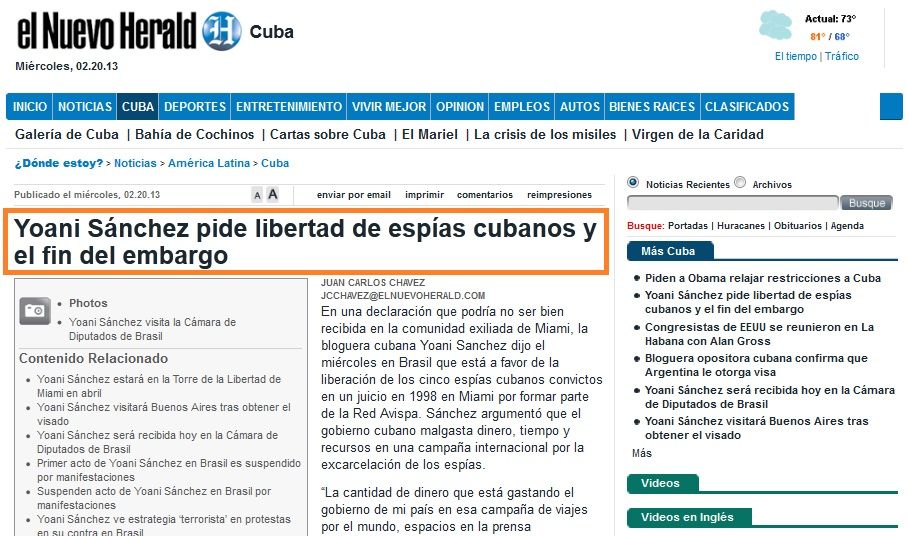
Juan Carlos Chavez of El Nuevo Herald on Wednesday wrote an article titled "Yoani Sanchez calls for release of Cuban spies and the end to the embargo." (The Herald article follows the reporting of a Spanish journalist who blogs about Cuba at Punt de Vista.) Interestingly, the original Herald article begins with a forwarning:

"In a statement that might not be well-received in the exile community of Miami, the Cuban blogger Yoani Sanchez said on Wednesday in Brazil that she is in favor of the liberation of the [Cuban Five]."

Unfortunately, Yoani Sanchez didn't say this. If one views video of her full comments, Sanchez states that she would "prefer" the liberation of the Cuban Five IF their freedom would lead to revenue and attention re-directed back to important educational priorities in Cuba.

The Herald has now attempted to correct their error with a new article titled "Blogger Yoani Sanchez says comment on ‘Cuban Five’ was ironic, misunderstood." This comes after Sanchez posted a response to the Herald article through her facebook account. But, if anyone knows the hard-liners in the exile community (as Juan Carlos Chavez knows), a correction or clarification sometimes isn't good enough. With Yoani Sanchez now scheduled to be at the Miami Freedom Tower in April, many Cuban exiles (especially the hard-liners who never trusted her, and might never trust her now) will most likely protest the event.

Way to go Miami Herald.

Tuesday, October 16, 2012

Marco Rubio's Speech at Unidad Cubana [Updated]

This past Sunday, Sen. Marco Rubio of Florida appeared at a public event hosted by Unidad Cubana, the militant/hard-line Cuban exile organization. Below is the speech he gave in Spanish. I will be translating portions of the speech into English and updating this post below.

Yet, there is one portion of the speech that was very interesting. Sen. Rubio at one moment seems to suggest that he has confidential information concerning changes coming to the Cuban government. At these kind of events, someone always says that change is coming soon to Cuba and it is implied that the change will come with the death of Fidel Castro. But, Sen. Rubio's remark about having secret information is much more interesting (though he has been known to lie). That audio is at 8:31...

"It's already been many years of everyone thinking 'Well, at any moment this has to change.' I know you've heard that many times. But I promise you, for reasons that I can't express publicly, the reality is that the moment is coming."

RUBIO'S CAUSE FOR FREEDOM

For those that don't know, Unidad Cubana was created in 1991 as a united front of several Cuban exile organizations to influence U.S. policy. Their main position was to reject the possibility of any softening of U.S. policy as Cuba was going through a difficult economic period. And, of course, preparing for an overthrow of the Cuban government.

According to El Nuevo Herald, Armando Perez-Roura (pictured above with Sen. Rubio, and current chairman of Unidad Cubana) said in 1991: "We in the exile community need to have our own political and military strategy because Castro must be removed from power." In that same article, it was reported that over 100 exile groups signed a joint agreement with Unidad Cubana, and that over 3000 people attended their inauguration event at the Miami-Dade County Auditorium, which was broadcast live on U.S.-funded Radio Marti*.

So, every October Unidad Cubana organizes an event remembering the "Great War" of 1868, and hosts speeches by distinguished guests that continue to push for a hard-line policy against the Cuban government. Previous guests have included Cuban-American legislators Lincoln Diaz-Balart, Mario Diaz-Balart and Ileana Ros-Lehtinen. And this year it was Sen. Marco Rubio's turn.

The essence of Sen. Rubio's speech centered on why he's taken a hard-line stance on policy toward Cuba, which is also based on his own "Cause for Freedom." According to Rubio, there are three basic reasons:

1) He supports the right of rebellion of people living under tyranny as written in the American Declaration of Independence;
2) He feels obligated to fulfill the "dreams" of the first wave of Cuban exiles because they suffered greatly due to the Cuban Revolution and "sacrificed" so much for his generation; and
3) He believes the U.S. government is obligated by principle to help Cuban exiles "free" Cuba.

In his speech, Sen. Rubio states that "if one studies six thousand years of recorded history" (which we assume Sen. Rubio has) one sees that "almost all people" throughout history have fought against tyranny, including the founders of the United States of America who expressed that right in the American Declaration of Independence, and also Cuba exiles at the Bay of Pigs. Sen. Rubio also states that the right to rebel comes from God, and that this historical battle against tyranny "will never end."

By suggesting that the right to rebel (or revolution) is God-given, and possibly an eternal human battle against tyranny (or evil), Sen. Rubio certainly reveals much about how he views events around the globe. It strikes me very similar to Cuban exile militants' war against global communism, or other battles that have been waged against some kind of global terror.

So, there should be no doubt that Sen. Rubio's "Cause for freedom" entails the "Cause for Cuba," and potentially other countries as well. As he explained, "if this country really believes these words [from the Declaration of Independence] then you have to apply them at every given opportunity, and for us [Cuban exiles] that opportunity exists 90 miles from our coast."

What other "opportunities" does Sen. Rubio see for his "Cause for Freedom."

[Photo by Arminda Espinosa and Libre Magazine]

*[El Nuevo Herald, July 13, 1991, "Cubanos Firman Acta de Unidad, Excluyen Dialogo" by Joel Gutierrez and Ivan Roman.]


Thursday, August 23, 2012

Welcome "On Two Shores"

Here's another new blog about Cuba and US policy: "On Two Shores."

They describe themselves as "a moderate, forward-thinking voice, from the heart of Miami, for Cuban Americans and Cubans in the diaspora." And their goal is "to represent the silent majority within our [Cuban?] community who believe that a change of policy vis-a-vis Cuba is long overdue, and to counteract the influence of the hardliners on both sides."


I'm not a fan of the profanity, but some of the posts are pretty good. For example check this one out titled "Leaving the Hardliners Behind" by William Vidal.

The editor is Alex Barreras, former blogger (with Giancarlo Sopo) from the now-defunct "Generation Miami" blog and "Stuck on the Palmetto" blog. He was born and raised in Cuba, so his insight about the country and our policy is enlightening.

Tuesday, August 14, 2012

Paul Ryan's Anti-Embargo Record

You've probably heard already. The Republican pick for vice-president, Rep. Paul Ryan (WI-1), has an anti-embargo voting record, and has been very clear about it. So, it's no wonder some hard-liners are trying to hide this fact.

A post on the (pro-embargo) Capitol Hill Cubans blog first raised my curiosity. It was apparent that the author was trying to hide Rep. Paul Ryan's voting record before 2007, and giving him an excuse by describing Rep. Ryan as an "unconditional free trader." (For hard-liners on Cuba, there is no room for other principles except unconditional sanctions.)

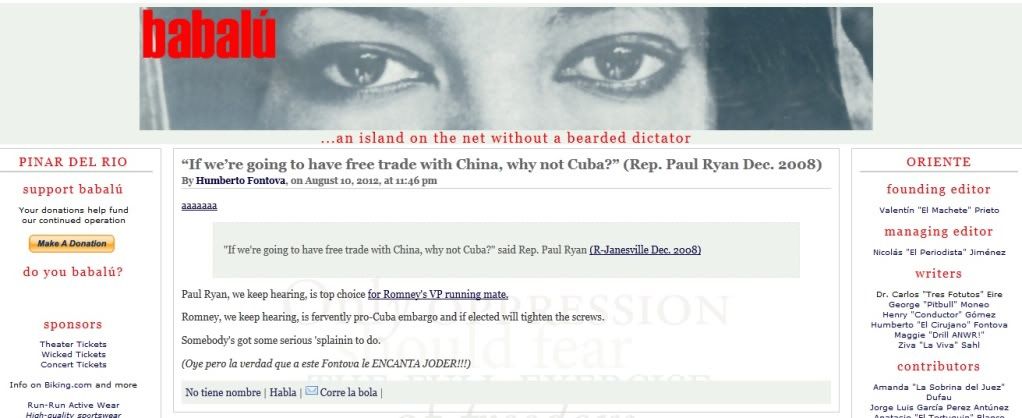
Even the boys at the Babalu blog did some quick work to hide Rep. Ryan's anti-embargo stance. Following the rumors that circulated on Friday, Humberto Fontova was the first to warn readers of Rep. Ryan's anti-embargo feelings. Fontova titled his post after a 2008 Ryan quote: "If we're going to have free trade with China, why not Cuba?"[cached link/screenshot] The post was soon removed. It was later responded with a post by Babalu economic super-genius Henry Louis Gomez who was an "economics major in college." According to Gomez, "99.9% of people" (including renowned libertarians like Milton Friedman and William F. Buckley who opposed the U.S. embargo towards Cuba) don't understand Cuba like he does.

In reality, national polling shows about 50% of Americans are opposed to the embargo (39% in favor, 10% undecided), so Gomez is being a little paranoid. But, it seems that Rep. Paul Ryan in 2002 was with the majority: 
"The embargo doesn't work. It is a failed policy. It was probably justified when the Soviet Union existed and posed a threat through Cuba. I think it's become more of a crutch for Castro to use to repress his people. All the problems he has, he blames the American embargo... [Cuban-Americans] have their reasons [for supporting the embargo] and they're very passionate about their reasons, I just don't agree with them and never have."
So, the question now is why did Rep. Ryan change his position on the embargo? Did a grown-man with strong free market convictions get "educated" on the embargo as Mauricio Claver-Carone told the Miami Herald?

I seriously doubt it.

--- [Below are Rep. Paul Ryan's House votes in opposition to the U.S. embargo on Cuba] ---
  • July 25, 2001: Amendment to prohibit funding to administer the Cuban Assets Control Regulations with respect to any travel or travel related transaction. Rep. Ryan (WI) voted Aye, [Roll Call 270, HR 2590].
  •  July 25, 2001: Amendment sought to prohibit the use of funds in the bill to implement, administer, or enforce the economic embargo of Cuba. Rep. Ryan (WI) voted Aye [Roll Call 271, HR 2590].
  • September 21, 2004: Amendment prohibits funds in the bill from being used to enforce certain regulations restricting family travel to Cuba. Rep. Ryan (WI) voted Aye [Roll Call 460, HR 5025].
  • September 22, 2004: An amendment to insert the following new section on page 166 after line 3: Sec. 647. None of the funds made available in this Act may be used to implement, administer, or enforce the economic embargo of Cuba, as defined in section 4(7) of the Cuban Liberty and Democratic Solidarity (LIBERTAD) Act of 1996 (Public Law 104-114), except that the foregoing limitation does not apply to the administration of a tax tariff. Rep. Ryan (WI) voted Aye [Roll Call 461, HR 5025].
  • June 15, 2005: An amendment to prohibit use of funds in the bill to implement, administer, or enforce regulations relating to amendments made to the Code of Federal Regulations relating to license exemptions for gift parcels and humanitarian donations for Cuba. Rep. Ryan (WI) voted Aye [Roll Call 254, HR 2862].

Monday, July 23, 2012

Oswaldo Payá Sardiñas (1952 - 2012) [Updated]

According to reports from witnesses and family, Cuban dissident Oswaldo Payá Sardiñas died Sunday (July 22) afternoon in a car accident near the city of Bayamo. According to the Cuban website CubaDebate, the accident occurred around 1:50 p.m., 14 miles from Bayamo. Another passenger, Harold Cepero Escalante, died in the crash and two others survived.

As expected, there are already conflicting reports about the cause of the car accident. CubaDebate reports the car "lost control and crashed into a tree" based on eyewitnesses. But, according to Cuban blogger Yoani Sanchez, Paya's vehicle "was hit by another [car] and went off the road" according to witnesses. Oswaldo Payá's daughter, Rosa Maria, also makes the assertion that the car was intentionally hit based on "information we received from the young men who were traveling with [Payá]."

Investigations are currently underway.

In 2002, Oswaldo Payá became one of Cuba's best known dissidents when he led a petition campaign, the Varela Project, for political reforms and collected over 11,000 signatures. Days later, Jimmy Carter visited Cuba and mentioned the Varela Project during a nationally televised speech at the University of Havana. In 2003, the Varela Project was able to collect over 14,000 signatures in its continued campaign for political reforms.

In Miami, the Varela Project was rejected by Cuban exile militants and hard-liners who felt that petitioning within the legal system would create "a dangerous legitimation of the dictatorship." For some militants it was total betrayal. In its detail and character, the Varela Project also posed a philosophical challenge to post-Castro transition plans designed by Miami hard-liners who reject ideas of amnesty and forgiveness of past crimes.

Now, in response to Payá's death, many will debate where the Varela Project stands. In recent public comments, Cuban exile Marcelino Miyares has said that "the moment of the [Varela] Project has passed. I don't think it will have a resurrection."

--- [Update 1] ---

Recent reports reveal that Oswaldo Payá had been in another car accident last month in Havana. According to Oswaldo's brother Carlos, Oswaldo was riding in a van that flipped over after being hit by another car. Oswaldo suffered only bruises, and did not inform the international media out of prudence. Carlos is demanding an investigation to clarify what happened yesterday. On the other hand, Oswaldo Paya's widow, Ofelia Acevedo, is rejecting reports that Payá's car lost control, and believes that the car was intentionally attacked by another vehicle. She cites "friends" that have heard this information directly from the survivors of the car accident.

The two survivors of the car accident that killed Oswaldo Payá have been identified as Ángel Carromero and Jens Aron Modig, both associated with political organizations wishing to cooperate with Cuban dissidents. According to this report from Spain, Carromero was driving at the time of the accident, but was released from the Bayamo hospital with only a minor head injury. Carromero has been in contact with friends in Spain and being accompanied by Álvaro Kirpatrick, Spanish Consul in Havana. Carromero has already his eyewitness account to police in Cuba, but has yet to make public statements to the media.

Nevertheless, Spanish-language media is already presenting Oswaldo Payá's death as "premeditated." Telemundo 51 and Univision 23 both use the word "premeditated" in their reports to describe the car accident. On the radio today, Ramon Saul Sanchez described the car accident as part of a "gradual extermination" of Cuban dissidents. And Diario Las Americas today describes yesterday's tragedy as what "responsible people call a provoked accident."

An online poll conducted yesterday by Telemundo 51 showed that 93% of viewers (from over 200 votes) believe the death of Oswaldo Payá was "premeditated."

--- [Update 2] ---

The reported driver of the car which crashed on Sunday, killing Cuban dissident Oswaldo Payá, is still in the city of Bayamo and being questioned by police. According to recent reports, Ángel Carromero again has been questioned about the tragic accident and being kept in Bayamo until investigations are complete. He is still being accompanied by Álvaro Kirpatrick, Spanish Consul in Havana.

Interestingly, but not yet confirmed, a recent Univision article reports that Carromero "did not see a traffic sign to reduce speed. For that reason he lost control of the vehicle and fell by an incline." The local website Cafe Fuerte has also found two photos of the crashed vehicle that killed Payá and Harold Cepero. The damage looks like the car did indeed hit a tree near the back, killing both Payá and Cepero who reportedly sat in the back.

--- [Update 3] ---

A report from Reuters (Rosa Tania Valdes) cites "european diplomats" close to survivors of the crash confirming the crash was accidental: "The diplomats, who asked not to be identified, said it appeared the vehicle, traveling at well above the speed limit, hit a large pot hole, veered off the road and hit a tree." It also appears that the driver, Ángel Carromero, may also face criminal charges of reckless driving and involuntary manslaughter.

--- [Update 4] ---

On Friday (July 27), the Cuban Interior Ministry released an official statement (BBC/Miami Herald) concerning the car crash that killed Cuban dissidents Oswaldo Payá and Harold Cepero earlier this week. According to the statement, Ángel Carromero was driving the vehicle carrying Oswaldo Payá and Harold Cepero in the backseat. Another passenger, Jens Aron Modig, was sitting in the front passenger seat, asleep just before the accident. The car spun out of control after it suddenly stopped on top of an unpaved road under construction, hitting a tree and fatally injuring Payá and Cepero. It is suspected that the car was traveling over 70 mph.

The details of the crash were prepared by four experts in Cuba, each with over 8 years of experience in different fields. The statement provides the names of the experts and the Cuban eyewitnesses that provided statements to the police. The note ends stating that official investigations are still underway.

In response, the widow of Oswaldo Payá, Ofelia Acevedo, has rejected the official note and is demanding to speak with the survivors of the crash (who remain in Cuba while the investigation is underway), and a review of the evidence by independent experts in Cuba.

--- [Update 5] ---

On Monday (July 30), the Cuban government arranged a press conference allowing survivor of the crash Aron Modig to answer questions for the international press. Modig, who was asleep just before the accident, told reporters he had no recollection of a second vehicle involved in the crash. He also assured the press that his statements were sincere and would not change when he leaves Cuba. Modig explained that his goals inside Cuba were to help organize a youth-led version of Oswaldo Payá's Christian Liberation Movement. He planned to donate thousands of dollars to those dissidents. Modig later apologized saying he didn't know it was illegal to fund a dissident movement inside Cuba.

The press conference (edited video) also included a video presentation with recorded statements by Modig, Ángel Carromero, the other crash survivor, and a computer-generated reconstruction of the accident. In the video, Carromero stated that there was no second vehicle involved in the crash and that he had simply lost control of the vehicle after braking on a gravel section of an unfinished road. He also confirmed that Modig and himself planned to help organize a youth-led dissident movement, and visit dissidents with Payá in Santiago de Cuba. [Sources: Miami Herald/BBC/BBC Mundo (includes video)]

--- [Update 6] ---

On July 31, Ángel Carromero was officially charged with "homicide while driving a vehicle on public roads" and now faces one to ten years in prison. Meanwhile in Madrid, investigations found that Carromero had committed several traffic infractions (45 fines since March 2011, including 3 for speeding) and was notified last May that his license faced suspension. On August 9 his license was officially suspended.

The other survivor of the tragic accident, Aron Modig, gave his first interview since leaving Cuba to a Swedish newspaper. It was published on August 10 (Google English translation/Spanish translation), and reveals some important details of Modig's experience after the crash. Modig, clearly free from any form of persuasion, reiterated that he was asleep just before the accident and only remembers seeing the car out of control before he lost consciousness. Modig describes being regularly interrogated by Cuban police about his plans in Cuba (but not about the accident), and confined five days in a house where he was kept until his appearance before the international press. Modig was allowed to leave the country thereafter. Modig says he's very concerned about Ángel Carromero in Cuba.

In Spain, International Cooperation Secretary of State for Ibero-America Jesús Gracia Aldaz has publicly stated that he is optimistic in getting Carromero released from prison, and working with the Cuban government to achieve this despite "difficult" relations over the years.

[Official biography of Oswaldo Payá Sardiñas]

[Tracy Eaton from Along the Malecon blog interviewed Oswaldo Payá last year at length. It is here in Spanish.]

[Photo by Getty Images / Oswaldo Payá posing by a sculpture that represents the oppression of the Cuban people on December 13, 2002 in Havana.]