Showing posts with label Local Media Bias. Show all posts
Thursday, December 18, 2014
Local Polls Support New U.S.-Cuba Policy
Above is a sample of polls conducted by South Florida news websites in response to Wednesday's announcement of a new U.S. policy towards Cuba. The majority of the polls show strong support (above 60 percent) for the new policy.
Despite the local media's false presentation of a divided Miami, and constantly refocusing the debate around the opinion of the minority hard-line, the poll results above reflect the more accurate view of a rational Miami. Unfortunately, for as long as I've been monitoring the local media, the news stations have yet to center their reporting (and analysis) on this accurate widespread belief.
Polls Results shown above (clockwise):
Americateve.com: Do you agree with the U.S. and Cuba re-establishing diplomatic relations? (Yes, 54%)
Elnuevoherald.com: Do you believe re-establishing relations between the U.S. and Cuba will benefit Cubans on the island? (Yes, 68%)
WFLA.com: Do you think vacation travel should be permitted to Cuba? (Yes, 66%)
Local10.com: Do you agree with the U.S. trying to normalize diplomatic relations with Cuba (Yes, 68%)
[The poll results also support the findings of the more recent Atlantic Council poll on U.S.-Cuba policy, and the FIU Cuba Poll.]
Labels:
Local Media Bias,
US embargo
Thursday, February 21, 2013
Miami Herald Errs Against Yoani Sanchez
In their rush to grab readers, yesterday El Nuevo Herald chose to err against Yoani Sanchez by misinterpreting her recent comments in Brazil. As a result, the Herald not only violated a basic code of journalistic ethics ("Make certain that headlines... do not misrepresent"), but also helped skeptics of Yoani Sanchez in Miami to never trust her again.
MATTER OF ETHICS
Yesterday in Brazil, famous Cuban blogger Yoani Sanchez was invited by legislators of the Brazilian Social Democracy party to the Chamber of Deputies. At the event, Sanchez was questioned over her various political positions, including the case of the Cuban Five. Among her comments, she said this:
"[The Cuban government] cannot continue financing a disproportionate campaign [to free the Cuban Five] going already over 14 years. That is my position as the mother of an adolescent child, as a concerned citizen over the treasury of my country... I would prefer [the Cuban Five] be free to see if [our country] would save more [revenue]. And, there are other matters to deal with."
This was no "call" to release anyone.
No one honestly calls out or takes up a cause out of preference. Imagine someone saying: "I would prefer the cause of human rights, if it would solve our financial problems." Such a comment wouldn't be taken seriously as a motive for defending such an important issue. Just ask anyone who supports freedom for the Cuban Five, or anyone who supports freedom for Cuba. So, the Herald who interviews many Cuban exile activists should've known this, and also been aware of the sensitivity in Miami over political opinion concerning the Cuban Five.
The headline was quickly changed Wednesday evening after Yoani Sanchez directly responded to the Herald article through Facebook. Sanchez clarified by writing she was being ironic and apologized if her "words didn't leave a clear message." But, it was too late. The headline had already spread through the internet, local Spanish-language radio and television, leaving some in Miami shocked, upset or filled with mistrust.
UNCONTROVERSIAL
Yoani Sanchez's comments over the U.S. embargo against Cuba and the U.S. Naval Base in Guantanamo (which she believes is illegal) actually resemble popular, public and academic opinion. Saying that the U.S. embargo is hegemonic, a failure, or an excuse for the Cuban government's inefficiency is uncontroversial. Even in Miami. Also, notice that her comments regarding the U.S. Naval Base in Guantanamo being illegal gets little attention. That's because if anyone (not aware of the history of the base) puts themselves in the shoes of a Cuban (like Sanchez), the U.S. Naval Base can be easily viewed as a violation of a nation's sovereignty. It's difficult to justify to a Cuban, so its ignored.
So, the only ones that are bothered by Yoani Sanchez and her comments are hard-liners and militants opposed to the Cuban government. They don't like the media attention her individual and personal comments are receiving because those comments are not sufficiently opposed or against the Cuban government and its policy. They believe her comments so far have been "far from perfect" or "misinformed" or just plain erroneous.
They prefer the blogger whose opinion and bravery is limited to her immediate surroundings in Cuba, but God forbid Yoani Sanchez has a strong opinion about international issues. (I wonder how they would react when they discover she's also pro-choice.) They will praise her if her message is "perfect," but ignore her or distance themselves if it isn't. Or, like the Herald, are comfortable leaving her behind to fend for herself.
Labels:
Dissidents,
Local Media Bias,
The Hard-Line
Monday, July 23, 2012
Oswaldo Payá Sardiñas (1952 - 2012) [Updated]
According to reports from witnesses and family, Cuban dissident Oswaldo Payá Sardiñas died Sunday (July 22) afternoon in a car accident near the city of Bayamo. According to the Cuban website CubaDebate, the accident occurred around 1:50 p.m., 14 miles from Bayamo. Another passenger, Harold Cepero Escalante, died in the crash and two others survived.
As expected, there are already conflicting reports about the cause of the car accident. CubaDebate reports the car "lost control and crashed into a tree" based on eyewitnesses. But, according to Cuban blogger Yoani Sanchez, Paya's vehicle "was hit by another [car] and went off the road" according to witnesses. Oswaldo Payá's daughter, Rosa Maria, also makes the assertion that the car was intentionally hit based on "information we received from the young men who were traveling with [Payá]."
Investigations are currently underway.
In 2002, Oswaldo Payá became one of Cuba's best known dissidents when he led a petition campaign, the Varela Project, for political reforms and collected over 11,000 signatures. Days later, Jimmy Carter visited Cuba and mentioned the Varela Project during a nationally televised speech at the University of Havana. In 2003, the Varela Project was able to collect over 14,000 signatures in its continued campaign for political reforms.
In Miami, the Varela Project was rejected by Cuban exile militants and hard-liners who felt that petitioning within the legal system would create "a dangerous legitimation of the dictatorship." For some militants it was total betrayal. In its detail and character, the Varela Project also posed a philosophical challenge to post-Castro transition plans designed by Miami hard-liners who reject ideas of amnesty and forgiveness of past crimes.
Now, in response to Payá's death, many will debate where the Varela Project stands. In recent public comments, Cuban exile Marcelino Miyares has said that "the moment of the [Varela] Project has passed. I don't think it will have a resurrection."
--- [Update 1] ---
Recent reports reveal that Oswaldo Payá had been in another car accident last month in Havana. According to Oswaldo's brother Carlos, Oswaldo was riding in a van that flipped over after being hit by another car. Oswaldo suffered only bruises, and did not inform the international media out of prudence. Carlos is demanding an investigation to clarify what happened yesterday. On the other hand, Oswaldo Paya's widow, Ofelia Acevedo, is rejecting reports that Payá's car lost control, and believes that the car was intentionally attacked by another vehicle. She cites "friends" that have heard this information directly from the survivors of the car accident.
The two survivors of the car accident that killed Oswaldo Payá have been identified as Ángel Carromero and Jens Aron Modig, both associated with political organizations wishing to cooperate with Cuban dissidents. According to this report from Spain, Carromero was driving at the time of the accident, but was released from the Bayamo hospital with only a minor head injury. Carromero has been in contact with friends in Spain and being accompanied by Álvaro Kirpatrick, Spanish Consul in Havana. Carromero has already his eyewitness account to police in Cuba, but has yet to make public statements to the media.
Nevertheless, Spanish-language media is already presenting Oswaldo Payá's death as "premeditated." Telemundo 51 and Univision 23 both use the word "premeditated" in their reports to describe the car accident. On the radio today, Ramon Saul Sanchez described the car accident as part of a "gradual extermination" of Cuban dissidents. And Diario Las Americas today describes yesterday's tragedy as what "responsible people call a provoked accident."
An online poll conducted yesterday by Telemundo 51 showed that 93% of viewers (from over 200 votes) believe the death of Oswaldo Payá was "premeditated."
--- [Update 2] ---
The reported driver of the car which crashed on Sunday, killing Cuban dissident Oswaldo Payá, is still in the city of Bayamo and being questioned by police. According to recent reports, Ángel Carromero again has been questioned about the tragic accident and being kept in Bayamo until investigations are complete. He is still being accompanied by Álvaro Kirpatrick, Spanish Consul in Havana.
Interestingly, but not yet confirmed, a recent Univision article reports that Carromero "did not see a traffic sign to reduce speed. For that reason he lost control of the vehicle and fell by an incline." The local website Cafe Fuerte has also found two photos of the crashed vehicle that killed Payá and Harold Cepero. The damage looks like the car did indeed hit a tree near the back, killing both Payá and Cepero who reportedly sat in the back.
--- [Update 3] ---
A report from Reuters (Rosa Tania Valdes) cites "european diplomats" close to survivors of the crash confirming the crash was accidental: "The diplomats, who asked not to be identified, said it appeared the vehicle, traveling at well above the speed limit, hit a large pot hole, veered off the road and hit a tree." It also appears that the driver, Ángel Carromero, may also face criminal charges of reckless driving and involuntary manslaughter.
--- [Update 4] ---
On Friday (July 27), the Cuban Interior Ministry released an official statement (BBC/Miami Herald) concerning the car crash that killed Cuban dissidents Oswaldo Payá and Harold Cepero earlier this week. According to the statement, Ángel Carromero was driving the vehicle carrying Oswaldo Payá and Harold Cepero in the backseat. Another passenger, Jens Aron Modig, was sitting in the front passenger seat, asleep just before the accident. The car spun out of control after it suddenly stopped on top of an unpaved road under construction, hitting a tree and fatally injuring Payá and Cepero. It is suspected that the car was traveling over 70 mph.
The details of the crash were prepared by four experts in Cuba, each with over 8 years of experience in different fields. The statement provides the names of the experts and the Cuban eyewitnesses that provided statements to the police. The note ends stating that official investigations are still underway.
In response, the widow of Oswaldo Payá, Ofelia Acevedo, has rejected the official note and is demanding to speak with the survivors of the crash (who remain in Cuba while the investigation is underway), and a review of the evidence by independent experts in Cuba.
--- [Update 5] ---
On Monday (July 30), the Cuban government arranged a press conference allowing survivor of the crash Aron Modig to answer questions for the international press. Modig, who was asleep just before the accident, told reporters he had no recollection of a second vehicle involved in the crash. He also assured the press that his statements were sincere and would not change when he leaves Cuba. Modig explained that his goals inside Cuba were to help organize a youth-led version of Oswaldo Payá's Christian Liberation Movement. He planned to donate thousands of dollars to those dissidents. Modig later apologized saying he didn't know it was illegal to fund a dissident movement inside Cuba.
The press conference (edited video) also included a video presentation with recorded statements by Modig, Ángel Carromero, the other crash survivor, and a computer-generated reconstruction of the accident. In the video, Carromero stated that there was no second vehicle involved in the crash and that he had simply lost control of the vehicle after braking on a gravel section of an unfinished road. He also confirmed that Modig and himself planned to help organize a youth-led dissident movement, and visit dissidents with Payá in Santiago de Cuba. [Sources: Miami Herald/BBC/BBC Mundo (includes video)]
--- [Update 6] ---
On July 31, Ángel Carromero was officially charged with "homicide while driving a vehicle on public roads" and now faces one to ten years in prison. Meanwhile in Madrid, investigations found that Carromero had committed several traffic infractions (45 fines since March 2011, including 3 for speeding) and was notified last May that his license faced suspension. On August 9 his license was officially suspended.
The other survivor of the tragic accident, Aron Modig, gave his first interview since leaving Cuba to a Swedish newspaper. It was published on August 10 (Google English translation/Spanish translation), and reveals some important details of Modig's experience after the crash. Modig, clearly free from any form of persuasion, reiterated that he was asleep just before the accident and only remembers seeing the car out of control before he lost consciousness. Modig describes being regularly interrogated by Cuban police about his plans in Cuba (but not about the accident), and confined five days in a house where he was kept until his appearance before the international press. Modig was allowed to leave the country thereafter. Modig says he's very concerned about Ángel Carromero in Cuba.
In Spain, International Cooperation Secretary of State for Ibero-America Jesús Gracia Aldaz has publicly stated that he is optimistic in getting Carromero released from prison, and working with the Cuban government to achieve this despite "difficult" relations over the years.
[Official biography of Oswaldo Payá Sardiñas]
[Tracy Eaton from Along the Malecon blog interviewed Oswaldo Payá last year at length. It is here in Spanish.]
[Photo by Getty Images / Oswaldo Payá posing by a sculpture that represents the oppression of the Cuban people on December 13, 2002 in Havana.]
As expected, there are already conflicting reports about the cause of the car accident. CubaDebate reports the car "lost control and crashed into a tree" based on eyewitnesses. But, according to Cuban blogger Yoani Sanchez, Paya's vehicle "was hit by another [car] and went off the road" according to witnesses. Oswaldo Payá's daughter, Rosa Maria, also makes the assertion that the car was intentionally hit based on "information we received from the young men who were traveling with [Payá]."
Investigations are currently underway.
In 2002, Oswaldo Payá became one of Cuba's best known dissidents when he led a petition campaign, the Varela Project, for political reforms and collected over 11,000 signatures. Days later, Jimmy Carter visited Cuba and mentioned the Varela Project during a nationally televised speech at the University of Havana. In 2003, the Varela Project was able to collect over 14,000 signatures in its continued campaign for political reforms.
In Miami, the Varela Project was rejected by Cuban exile militants and hard-liners who felt that petitioning within the legal system would create "a dangerous legitimation of the dictatorship." For some militants it was total betrayal. In its detail and character, the Varela Project also posed a philosophical challenge to post-Castro transition plans designed by Miami hard-liners who reject ideas of amnesty and forgiveness of past crimes.
Now, in response to Payá's death, many will debate where the Varela Project stands. In recent public comments, Cuban exile Marcelino Miyares has said that "the moment of the [Varela] Project has passed. I don't think it will have a resurrection."
--- [Update 1] ---
Recent reports reveal that Oswaldo Payá had been in another car accident last month in Havana. According to Oswaldo's brother Carlos, Oswaldo was riding in a van that flipped over after being hit by another car. Oswaldo suffered only bruises, and did not inform the international media out of prudence. Carlos is demanding an investigation to clarify what happened yesterday. On the other hand, Oswaldo Paya's widow, Ofelia Acevedo, is rejecting reports that Payá's car lost control, and believes that the car was intentionally attacked by another vehicle. She cites "friends" that have heard this information directly from the survivors of the car accident.
The two survivors of the car accident that killed Oswaldo Payá have been identified as Ángel Carromero and Jens Aron Modig, both associated with political organizations wishing to cooperate with Cuban dissidents. According to this report from Spain, Carromero was driving at the time of the accident, but was released from the Bayamo hospital with only a minor head injury. Carromero has been in contact with friends in Spain and being accompanied by Álvaro Kirpatrick, Spanish Consul in Havana. Carromero has already his eyewitness account to police in Cuba, but has yet to make public statements to the media.
Nevertheless, Spanish-language media is already presenting Oswaldo Payá's death as "premeditated." Telemundo 51 and Univision 23 both use the word "premeditated" in their reports to describe the car accident. On the radio today, Ramon Saul Sanchez described the car accident as part of a "gradual extermination" of Cuban dissidents. And Diario Las Americas today describes yesterday's tragedy as what "responsible people call a provoked accident."
An online poll conducted yesterday by Telemundo 51 showed that 93% of viewers (from over 200 votes) believe the death of Oswaldo Payá was "premeditated."
--- [Update 2] ---
The reported driver of the car which crashed on Sunday, killing Cuban dissident Oswaldo Payá, is still in the city of Bayamo and being questioned by police. According to recent reports, Ángel Carromero again has been questioned about the tragic accident and being kept in Bayamo until investigations are complete. He is still being accompanied by Álvaro Kirpatrick, Spanish Consul in Havana.
Interestingly, but not yet confirmed, a recent Univision article reports that Carromero "did not see a traffic sign to reduce speed. For that reason he lost control of the vehicle and fell by an incline." The local website Cafe Fuerte has also found two photos of the crashed vehicle that killed Payá and Harold Cepero. The damage looks like the car did indeed hit a tree near the back, killing both Payá and Cepero who reportedly sat in the back.
--- [Update 3] ---
A report from Reuters (Rosa Tania Valdes) cites "european diplomats" close to survivors of the crash confirming the crash was accidental: "The diplomats, who asked not to be identified, said it appeared the vehicle, traveling at well above the speed limit, hit a large pot hole, veered off the road and hit a tree." It also appears that the driver, Ángel Carromero, may also face criminal charges of reckless driving and involuntary manslaughter.
--- [Update 4] ---
On Friday (July 27), the Cuban Interior Ministry released an official statement (BBC/Miami Herald) concerning the car crash that killed Cuban dissidents Oswaldo Payá and Harold Cepero earlier this week. According to the statement, Ángel Carromero was driving the vehicle carrying Oswaldo Payá and Harold Cepero in the backseat. Another passenger, Jens Aron Modig, was sitting in the front passenger seat, asleep just before the accident. The car spun out of control after it suddenly stopped on top of an unpaved road under construction, hitting a tree and fatally injuring Payá and Cepero. It is suspected that the car was traveling over 70 mph.
The details of the crash were prepared by four experts in Cuba, each with over 8 years of experience in different fields. The statement provides the names of the experts and the Cuban eyewitnesses that provided statements to the police. The note ends stating that official investigations are still underway.
In response, the widow of Oswaldo Payá, Ofelia Acevedo, has rejected the official note and is demanding to speak with the survivors of the crash (who remain in Cuba while the investigation is underway), and a review of the evidence by independent experts in Cuba.
--- [Update 5] ---
On Monday (July 30), the Cuban government arranged a press conference allowing survivor of the crash Aron Modig to answer questions for the international press. Modig, who was asleep just before the accident, told reporters he had no recollection of a second vehicle involved in the crash. He also assured the press that his statements were sincere and would not change when he leaves Cuba. Modig explained that his goals inside Cuba were to help organize a youth-led version of Oswaldo Payá's Christian Liberation Movement. He planned to donate thousands of dollars to those dissidents. Modig later apologized saying he didn't know it was illegal to fund a dissident movement inside Cuba.
The press conference (edited video) also included a video presentation with recorded statements by Modig, Ángel Carromero, the other crash survivor, and a computer-generated reconstruction of the accident. In the video, Carromero stated that there was no second vehicle involved in the crash and that he had simply lost control of the vehicle after braking on a gravel section of an unfinished road. He also confirmed that Modig and himself planned to help organize a youth-led dissident movement, and visit dissidents with Payá in Santiago de Cuba. [Sources: Miami Herald/BBC/BBC Mundo (includes video)]
--- [Update 6] ---
On July 31, Ángel Carromero was officially charged with "homicide while driving a vehicle on public roads" and now faces one to ten years in prison. Meanwhile in Madrid, investigations found that Carromero had committed several traffic infractions (45 fines since March 2011, including 3 for speeding) and was notified last May that his license faced suspension. On August 9 his license was officially suspended.
The other survivor of the tragic accident, Aron Modig, gave his first interview since leaving Cuba to a Swedish newspaper. It was published on August 10 (Google English translation/Spanish translation), and reveals some important details of Modig's experience after the crash. Modig, clearly free from any form of persuasion, reiterated that he was asleep just before the accident and only remembers seeing the car out of control before he lost consciousness. Modig describes being regularly interrogated by Cuban police about his plans in Cuba (but not about the accident), and confined five days in a house where he was kept until his appearance before the international press. Modig was allowed to leave the country thereafter. Modig says he's very concerned about Ángel Carromero in Cuba.
In Spain, International Cooperation Secretary of State for Ibero-America Jesús Gracia Aldaz has publicly stated that he is optimistic in getting Carromero released from prison, and working with the Cuban government to achieve this despite "difficult" relations over the years.
[Official biography of Oswaldo Payá Sardiñas]
[Tracy Eaton from Along the Malecon blog interviewed Oswaldo Payá last year at length. It is here in Spanish.]
[Photo by Getty Images / Oswaldo Payá posing by a sculpture that represents the oppression of the Cuban people on December 13, 2002 in Havana.]
Friday, October 28, 2011
"The Murder of Laura Pollán" (Part 3)
Yesterday, Rep. Mario Diaz-Balart appeared on Radio Mambi with Ninoska Perez-Castellon. He was there to talk about the recent passage of H.R. 674, but also made comments about the death of Laura Pollán. Rep. Diaz-Balart said that despite not having any evidence to prove that Pollán was murdered by the Cuban government, he still believed that she was. Lately, this has been the position of many in Miami. And, it makes for good propaganda*.Just like Rep. Mario Diaz-Balart, Nancy Perez Crespo, radio show host on WWFE 670AM, made the same claim. Earlier this week on her 2pm show, Perez Crespo (photo above, lower right) acknowledged that she had no hard facts to prove that Laura Pollán was murdered, and had to rely on certain assumptions. She began to explain to listeners how Cuba is a closed society with a government-controlled press which makes it hard to find reliable and credible sources. And, she added that sometimes exiles in Miami have to rely on anonymous sources for news in order to protect those sources from government retaliation. What a bad excuse.
First, in the case of Laura Pollán, all sources of information concerning her death and allegations of dissidents being injected with a toxic substances have come from named sources. There are no anonymous sources in this case. Second, the use of anonymous sources by exiles in Miami is rare. Over the past few years, independent news sources from Cuba have become part of our online world, where it is very hard to keep anonymity for long (just ask me).
Nevertheless, despite the lack of evidence and neglect for the burden of proof, many still insist that Laura Pollán was murdered. If you attended last Friday's act of remembrance for Laura Pollán in Coral Gables you heard repeated claims (video) that Pollán was "killed" (by Sylvia Iriondo, President of M.A.R por Cuba), or "strangled by a murderous hand" (by Cary Roque, ex-political prisoner), or chanting of "murderers." Also this week, Rep. David Rivera (FL-25) of South Florida spoke about the "ruthless murder by the Castro dictatorship" of Laura Pollán on the House floor (video). (He got the date wrong saying "last Friday," but facts seem trivial at this point.)
So why do hard-liners persist on this claim?
After decades insisting (and investing into the narrative) that the Cuban government is a ruthless and evil force on the planet, after blaming tragic acts solely on the Cuban government, after years and years of propaganda, what explanation is one likely to accept? But, more precisely, what explanation is acceptable in the exile community? One that is simple and identifies the evil perpetrator, or a more complicated one that describes the complexity of a half-century conflict? For someone who identifies oneself as an "exile," there seems to be little room for a complicated story about why one has struggled for so many years "in exile."
[Video of Sylvia Iriondo's speech at act of remembrance for Laura Pollán in Coral Gables.]
[*Definition and characteristics of propaganda are described by Jay Black.]
[Part One]
[Part Two]
Thursday, October 20, 2011
"The Murder of Laura Pollán" (Part 2)
Because Laura Pollán's death was reported late Friday evening (some believing deliberately so), it wasn't until Monday when Pollán's murder theory was presented. Roberto Rodriguez Tejera and Helen Aguirre Ferre probably heard Armando Perez Roura (Univision Radio colleague) on Radio Mambi Saturday make the bold and baseless claim that Laura Pollán was murdered, and surely they wanted to make the same claim. But, Rodriguez and Ferre are not militants like Perez Roura, and neither is their audience on WQBA 1140AM, so they knew that they had to present some kind of evidence.CONFIRMATION BIAS*
"... a phenomenon wherein decision makers have been shown to actively seek out and assign more weight to evidence that confirms their hypothesis, and ignore or underweigh evidence that could disconfirm their hypothesis."
So, on Monday at 4pm on WQBA the show "Prohibido Callarse" (Silence is Prohibited) started by announcing a "special program" examining the death of Laura Pollán (You can listen to an excerpt here courtesy of Univision.com). Rodriguez and Ferre had three guests from Cuba on the phone: Carlos Rios Otero (independent journalist for Cubanet), Mercedes Fresneda Castillo (dissident), and Sara Martha Fonseca Quevedo (dissident). Rios Otero mainly spoke as a witness to dissident accounts of ailments following confrontations with Cuban officials during political demonstrations. Both female dissidents, who march alongside the Ladies in White, gave personal testimony to ailments they suffered after confrontations with Cuban officials. Both claimed that during a past confrontation they felt a prick or pierce on their body which they attributed to a toxic injection.
Both ladies also mentioned 2 other female dissidents who have described a variety of ailments following a pricking sensation during past demonstrations: Caridad Caballero Batista and Mayra Morejon Hernandez. Also, Rios Otero reported that dissident Rita Maria Montes de Oca was currently hospitalized due to ailments suffered following a possible toxic injection.
After these testimonies, without any kind of scrutiny or interrogation of them, Roberto Rodriguez Tejera claims "proof" of toxic injections against dissidents by Cuban officials, and therefore "everything seems to indicate" that Laura Pollán was also the victim of a toxic injection before her sudden death.
FACTS
Unfortunately, the whole show was an example of journalistic laziness, manipulation, and lack of ethics. Rodriguez and Ferre's story is actually borrowed (without credit) from a blogger named Angelica Mora. During the time Laura Pollán was hospitalized with a serious respiratory illness, and right before her death, Mora began a two-part post [1 and 2] provoking the possibility that Pollán was secretly injected with a virus. Carlos Rios Otero, Mercedes Fresneda Castillo, Sara Martha Fonseca, Rita Maria Montes de Oca and Mayra Morejon Hernandez all appear in Mora's story.
Also the supposed pricking and ailment stories may be months or years old. Rodriguez or Ferre commit a serious lapse of journalistic ethics by not establishing a timeline of events. In the Univision clip, Mercedes Fresneda mentions getting a blood test after suffering some ailments, but never mentions the date. According to this recently uploaded interview, Mayra Morejon Hernandez was with Fresneda when she claimed to be pricked and her blood tested. It was in 2009. Sara Martha Fonseca mentions she was injected during a march with the Ladies in White, but she's not asked for a date. Fonseca has been marching with the Ladies in White as far back as March 2010 (check bio here).
Carlos Rios Otero is mentioned in the Angelica Mora story because last month he wrote a story called "Toxic Injections" for Cubanet. In the story, Otero writes that "according to reports... many dissidents [during political repression by Cuban officials] have been given injections that have provoked toxic reactions." The reactions are made up of various forms of physical ailments. But, no names of dissidents are given, and no other sources are provided, just "reports" and speculation. On WQBA Otero claimed to have conducted various interviews with dissidents, and the testimony was mostly the same: various ailments followed by alleged injections during a protest. Also, the various ailments suffered are always different from the other, and never the same symptoms.
Finally, the only testimony that seems strongest comes from Mercedes Fresneda. She claims that she received a blood test (in 2009) in response to her ailments and alleged injection. The results of the test showed a high level of lead in her blood. When Roberto Rodriguez Tejera heard this testimony he gasped.
Fortunately, next week is National Lead Poisoning Prevention Week and it should provide the team at WQBA and the show "Prohibido Callarse" (looking at you Roberto and Helen) an opportunity to learn more about lead poisoning, and give us a better clue about why Mercedes Fresneda may have high levels of lead in her body.
According to some basic information about lead poisoning (a "major environmental health problem" in the US), adults are vulnerable to this hazard for various reasons, such as exposure to dust from common renovation activities, especially on home structures older than 1978.
So, quite simply, Rodriguez and Ferre may have highly exaggerated their claims of "proof." And, their theory where "everything seems to indicate" that Pollán was injected by a toxic substance is still merely an allegation no different than Armando Perez Roura's.
Unfortunately for Miami, the (propaganda) damage seems to have been done.
[*Excellent link about confirmation bias.]
[Part One]
[Part Three]
Labels:
Dissidents,
Local Media Bias
Wednesday, October 19, 2011
"The Murder of Laura Pollán" (Part 1)
If you've been listening to Spanish-language radio in Miami lately, then you might be thinking that Laura Pollán was secretly murdered by the Cuban government. Local Spanish media outlets have waged a strong campaign to convince listeners that this conspiracy is true. But, upon review, the little (if any) facts produced are not convincing. Nevertheless, it seems hard-liners won't be bothered by facts at this point and are only looking for more self-confirmation of who the real murderous enemy is: the Cuban government.For the past few days, local Spanish news outlets have been making the case that Laura Pollán was indeed infected/murdered by some form of lethal (or near lethal) injection made through a needle, scratch or bite. The Cuban government's motive of course was that Pollán was developing into a powerful enemy of the state. And, since the assumption in Miami is that the Cuban government is only motivated by evil intentions, then it seems logical that Pollán was most likely murdered.
MIAMI PROPAGANDA
As I mentioned in my previous post, the allegation that Laura Pollán was infected with a near lethal virus was being spread by local Spanish news stations since last week. The sources of those allegations were mainly coming from Cuban exiles in Miami. Operating on the assumption of communism's unrelenting evil, the only explanation for Pollán's sudden illness must've been a conspiracy from the common enemy: the Cuban government.
After Pollán's death, it all made more sense allegedly. The gut reaction was that she was "murdered." At least that's how Radio Mambi's Armando Perez Roura (upper right photo above) put it the day after the tragic news broke. But Perez Roura, like other Cuban exile militants, have a war mindset. That is, when it comes to Cuba, they are more likely to view strange and difficult events as part of the battle against the Cuban government. They may have good reasons to be cautious, but looking for facts and evidence are not the priority. Instead, a gut instinct to confront the known enemy is activated.
Before you knew it, the murder allegation soon developed into a theory. Local Spanish radio station WQBA 1140AM (owned by Univision Radio) began their Monday broadcast with a "special program" aimed to convince listeners that Pollán was most likely murdered. Roberto Rodriguez Tejera (former news director of Radio Marti, left on large photo above) and Helen Aguirre Ferre (opinion page editor of Diario Las Americas, right on large photo above), hosts of the 4pm show "Prohibido Callarse" (Silence is Prohibited), introduced witnesses, testimonies, conjectures and coincidences. At the end of the show, they were convinced that no other alternative explanation existed for Laura Pollán's death.
But, their supposedly strongest piece of evidence, an official blood test, doesn't withstand a simple test of proof. Yet, inside Miami's Cuban exile community it is good propaganda.
[Part Two]
[Part Three]
Labels:
Dissidents,
Local Media Bias
Saturday, October 15, 2011
Laura Pollán (1948 - 2011)
Tragic news came from Cuba yesterday with the announcement that Ladies in White leader Laura Pollán died in a Havana hospital from cardiac arrest. Since October 7 Pollán was being treated at the Calixto Garcia hospital for a serious respiratory illness.According to interviews by BBC Mundo reporter Fernando Ravsberg, Pollán contracted the Human respiratory syncytial virus (RVS). Recent reports indicate that Pollán's family has cremated her body, while her husband Hector Maseda thanked the doctors who "tried to save my wife's life until the last minute." Berta Soler, another member of the Ladies in White, also made positive comments about the medical treatment Pollán received saying the doctors "are fulfilling their oath to save lives, without concern over ideology."
Meanwhile in Miami, Radio Mambi's Armando Perez Roura (programming director) announced "the murder of Laura Pollán" at the top of today's noon news program "El Grande del Mediodia." Perez Roura, who traditionally introduces the top news stories, made the baseless claim which seems to be resonating inside the Cuban exile community.
(For days now local Spanish news has been spreading the allegation that Laura Pollán may have been deliberately infected with RVS in a Cuban government conspiracy. Fausto Malave for Telemundo51 spread the allegation using interviews with Silvia Iriondo from M.A.R. por Cuba and Janisset Rivero from Directorio Democratico Cubano. Rolando Napoles from AmericaTeVe spread the allegation using interviews with Dr. Julio Cesar Alfonso of local organization Solidaridad Sin Fronteras.)
Last night, upon hearing the tragic news, militant group Vigilia Mambisa made their way to Little Havana's Versailles restaurant where they made a small demonstration. But, they were mainly there to make the 11pm news, where local news stations instinctively flock to when Cuba is the headline. Florida Rep. Ileana Ros-Lehtinen knew the drill, so there she was at Versailles along with Reina Luisa Tamayo, mother of another Cuban dissident who last year died in a Cuban hospital. Telemundo51 reported live from Versailles as the crowd (except Rep. Ros-Lehtinen) chanted "murderers" and "terrorists."
Telemundo51 reporter Adriana Delgado includes interviews with the members of Vigilia Mambisa alleging that Laura Pollán's death was part of a Cuban government conspiracy. Delgado also interviewed Reina Luisa Tamayo who likewise alleges that Pollán was murdered, just like she alleges her son Orlando Zapata Tamayo was murdered. Delgado then interviewed Rep. Ros-Lehtinen who immediately went into how she was "concerned" over the Obama administration's Cuba policy, clearly exploiting this tragic event for political purposes.
None of this surprises me. The most hard-line members of the Cuban exile community never miss an opportunity to take advantage of a tragic (or near tragic) event coming from Cuba. And, that's because they know well that a hard-line position can only be maintained through shocking examples like Pollán's death. Even better if the death or serious injury is linked to the Cuban government. And, when it comes to Cuba, the local news easily makes itself available to the hard-line.
Don't expect to hear in Miami the positive descriptions made by Pollán's husband, or Berta Soler quoted above concerning the treatment Pollán received. It just doesn't fit the Miami narrative against Cuba.
[Along the Malecon blog has video of Laura Pollán before her illness.]
Labels:
Dissidents,
Local Media Bias
Sunday, May 8, 2011
Controversy Over Death of Juan Wilfredo Soto [Updated]
Cuban dissident Juan Wilfredo Soto Garcia (left) was buried this Sunday, but there is controversy over what lead to his death. Some believe it was the result after being "savagely beaten" by Cuban state security agents, while others attribute his death to unrelated health complications that occurred after his arrest.Juan Wilfredo was arrested during a protest last Thursday in Santa Clara where, according to some witnesses, he was beaten by security agents. One witness, dissident Guillermo Fariñas, told Radio/TV Marti that Juan Wilfredo was "savagely beaten" while in handcuffs. Supposedly, Juan Wilfredo was then taken to a hospital where he stayed until his death Sunday morning. But, events that happened after his arrest have produced conflicting reports.
According to this report on the El Nuevo Herald website, but attributed to an AFP copy, Juan Wilfredo "was taken by the [state security] agents" to the hospital after his arrest. The original AFP story doesn't include this specific information about how Juan Wilfredo arrived at the hospital. Other news outlets (such as CNN and BBC) have also assumed that Juan Wilfredo was so badly beaten that he was sent to the hospital after the protest due to injuries, and therefore have not reported that Juan Wilfredo was actually taken to the hospital for other reasons.
According this Radio/TV Marti report, Juan Wilfredo was arrested by state agents on Thursday and then "taken home instead of being taken to a jail cell." That information comes from Cuban dissident Idania Yanez Contreras. But, Idania is much more specific in her audio comments linked to the report. She says that Juan Wilfredo was arrested, taken to the hospital by the police because of his already known poor health, and then released home.
Marc Frank for Reuters similarly reports that Juan Wilfredo "was quickly released [by state security agents] but then checked into the Arnaldo Milian Hospital," but Frank doesn't specify by whom. According to Idania, after being taken home Juan Wilfredo's family, concerned over his worsening health, checked him into the hospital on Saturday. Juan Wilfredo was complaining of pain around his kidneys.
Several reports have mentioned Juan Wilfredo's already poor health, stricken with diabetes and hypertension, but Radio/TV Marti also includes "renal insufficiency" among his ailments. According to Marc Frank, "various bloggers close to the government quoted Dr. Ruben Aneiro Medina of the hospital as saying [Juan Wilfredo] Soto died of pancreatitis and kidney failure and there were no signs of physical violence."
But, Radio/TV Marti insists that Juan Wilfredo was a "victim of respiratory failure, caused by the beating ... of police agents." And, several Cuban dissidents have taken a similar position in blaming the Cuban security agents, or the Castro's themselves.
In local news, Telemundo51 has produced a report that constructs a more sinister plot against Juan Wilfredo Soto. According to Telemundo, Juan Wilfredo was already targeted by the Cuban government since July of last year (!) when he was threatened by a security agent who told him: "look out for the consequences that can happen to you." The threat came after Juan Wilfredo showed his solidarity with another Cuban dissident on a hunger strike.
At the conclusion of the Telemundo report, online comments posted on their website are reproduced for viewers alleging that the Cuban government was behind the death of Juan Wilfredo Soto. Undoubtedly, this conspiratorial allegation of murder will be repeated by the most militant in Miami for the next few days.
[Also note that no reports so far have interviewed the family of Juan Wilfredo Soto, and instead have relied on Cuban dissidents.]
- [UPDATE: The family of Juan Wilfredo Soto said that when they took him to the hospital he never mentioned the police beating, nor show signs of having been beaten.]
- [Amnesty International: "The Cuban authorities need to immediately establish an independent inquiry into the causes of Juan Wilfredo Soto's death. If he ultimately died as a result of a police beating in Park Vidal, those responsible must face justice."]
Friday, January 7, 2011
Do You Favor Democracy?
So, as a new Congress convenes I'm getting ready to keep a good eye on our South Florida representatives, and the ambitious Senator Marco Rubio. And, boy! I thought the hard-line could not get any tougher. Now, here comes David Rivera and Marco Rubio, two known hard-liners on U.S. policy towards Cuba, and Rep. Ros-Lehtinen heading the House Foreign Affairs Committee and appointing other hard-liners as Subcommittee Chairmen. Yikes!And, maybe some of you are wondering why being a hard-liner* is a cause of concern. Well, the answer is simple: hard-liners tend to ignore the opinion of others, namely their own constituents. Put more bluntly, they don't believe in democracy. Why am I so convinced? A quick review of public opinion concerning U.S. policy towards Cuba is a good start.
Over several years, Gallup polling has documented a strong and consistent American opinion that differs greatly with hard-liners' policy for Cuba. For several years, surveyed Americans have strongly favored (with an average of 59% since 2000) re-establishing diplomatic relations with Cuba if it was a key issue up for a referendum.
Ending the U.S. embargo towards Cuba has also seen strong approval in some polling. A recent online survey by Widmeyer Communications showed a majority of Americans supporting the end of the embargo by 47%, with 22% in opposition and 31% unsure. These results are similar to those reached by Gallup, and several other surveys.
So what about South Florida's opinion on the embargo? A 2008 survey from Florida International University's Institute for Public Opinion Research (IPOR) found a slight majority of Cuban-Americans favoring the end of the embargo, but a 2000 survey (also by IPOR) had already shown that 60% of Miami non-Cubans opposed continuing the embargo.
Of course, the local media continues to present the issue of public opinion concerning Cuba as divided. Last March, the Miami Herald (Juan O. Tamayo) reported on a BBC World News/Harris Interactive online poll showing "no clamor for change in U.S. Cuba policy." The online poll seemed to show support for the embargo (40% in favor, 36% opposed), but the questionnaire used Likert scaling (agree-disagree) on the statement "The embargo towards Cuba should remain in effect." The measurement was clearly vulnerable to bias because it implied one policy option.
Interestingly, after the Herald published this report (the only ones who reported on this poll according to a NewsBank search), another survey was conducted as a direct response. That survey was from the National Association of Evangelicals (NAE). The NAE conducts a monthly survey of its Board of Directors, and last March they found that 63% of evangelical leaders opposed the U.S. embargo towards Cuba. According to the NAE:
"The embargo’s impact on the poor, its failure to influence the leadership in Cuba toward greater openness and respect for human rights, and the potential benefit the lift would have on the spread of the gospel are the primary reasons evangelical leaders support the embargo’s end."
This survey by the NAE, who represent "40,000 local churches" was not reported by the Herald. In fact, according to NewsBank, it got no coverage at all.
So, when I read about South Florida hard-liners being proud over their tough stance on Cuba by supporting the embargo, all I can conclude is that they don't believe in democracy. And, all their talk about the "civilized world" seems like a joke.
And, I haven't even gotten to the part about Cuban dissident opposition to the embargo and travel restrictions!
[*A good definition of "hard-line" comes from George Mason University professor Colin Dueck.]
Monday, January 25, 2010
Lies Upon Lies
Not that long ago I came to the conclusion that the local media in Miami functions as a sophisticated propaganda system that mainly depicts the Cuban government (and sometimes its people) as pariahs. While these broadcasts generally express support for U.S. policy toward Cuba, they mostly serve the local political agenda directed by influential hard-liners in Miami. The history of this agenda in Miami is rooted in the ideological (and media) battles of the Cold War and its persistence as a cultural trait in Miami deserves a post of its own.And you may wonder how this hard-line ideology persists in the media. Well, first it is rooted in Cuban exile politics that for decades has presented the Cuban government as a totally immoral manifestation (which also infects all that associate with it), and the reliance on culturally imposed prejudice about Cuba which results in misinformation and lies. Lies upon lies, and misinformation upon misinformation, for years the media made sure to let its audience know that the Cuban government was the bad guy. And, like Cuba, the government of Venezuela and its President, Hugo Chavez, have become the new pariahs in the eyes of the local media. And, a recent story proves how bias in the media manifests itself.
On January 20th, many news outlets around the world were reporting that Venezuelan President Hugo Chavez said the United States military caused the 7.0 magnitude earthquake in Haiti. Despite the absence of evidence that Pres. Chavez made these comments, this did not stop the media from perpetuating this lie. Why? Because of media propaganda that feeds upon its own lies and misinformation, all rooted in culturally imposed prejudice.
Here's what really happened.
- On the 19th of January, Spain's ABC Newspaper published a report headlined: "Chavez accuses the U.S. of provoking Haiti earthquake." The misinformation spread quickly in Spain, and across Latin America from Peru to Columbia. And, of course, Radio Mambi couldn't help itself either. In the afternoon, Armando Perez-Roura relished reporting this absurd account, showing his radio audience that Pres. Chavez finally went mad.
- The next day, Russian television picked it up and posted it on YouTube, spreading wildly as video. Soon, American political websites like Reason.com, Fox News, and Prison Planet picked up the story and ran with it. (Guess what they have in common.)
- Even the Miami Herald's Cuban Colada blog, after investigating the rumor, came to the wrong conclusion that Pres. Chavez did make these comments. The Cuban Triangle blog also blamed Pres. Chavez.
- If any of the above had considered how absurd these comments were, and suspended their prejudices for a moment, they might have presented real facts for their readers. Just like the Anchorage Daily News did for their readers, with a little commonsense.
You see, if Renato Perez Pizarro DID read the Russian articles that he links to in his Cuban Colada post, he might have found the right answer: Hugo Chavez never made comments that the U.S. military caused the Haiti earthquake, instead the comments come from a Russian website "which clearly gives conspiracy fabrications."
Suspicions should have been immediate because the first ABC article from Spain on the 19th sourced their information to an internet article that was immediately taken down. Other reports should have led readers to the original story that was posted in Spanish on the 16th of January on some blog which suspiciously sources to an agency called "Panorama Alternativo." (This Spanish article eventually made it to a Venezuelan socialist website.) It was on the 16th that the original fabricated Russian report was posted on the internet. That Russian website I found thanks to the links on the Cuban Colada post, but Perez Pizarro for some strange reason came to another conclusion.
Must be that media bias going around.
Saturday, October 3, 2009
Credibility You Say?
Not much time to post nowadays. But, here goes. Also, thanks to all those who share their comments. I will try to respond to all, and attempt to interact more with readers since I will be posting less.Now where was I? Oh, yes. So, there was a new poll taken concerning last month's Peace without Borders concert in Cuba [PDF]. According to the new numbers, the majority of Cuban-Americans interviewed (53%) had a favorable opinion of the concert (a stark change from a previous poll showing a majority opposed to the planned concert [PDF]). I had commented elsewhere that perhaps Cubans in Miami had changed their minds about the concert after it aired live on several local channels in Miami. Indications in the local media proved accurate.
What I found most interesting in the new poll (conducted by the Cuba Study Group and Bendixen and Associates), aside from the significant change in general opinion about the concert, was the data from the 50 and over category.
According to the new poll, Cuban-Americans over 49 years old were the largest group who watched the concert, and also the group that most changed their minds about the concert (about 10% more than younger Cubans). And, the most popular response given for the favorable views about the concert was: it "uplifted Cuban people" (51%).
So how did hard-liners in the media respond? As usual, they totally dismissed the poll. Aside from the fact that Radio Mambi generally ignores all facts that conflict with their propaganda goals, they sometimes have some reasons behind their behavior.
1) Radio Mambi hosts have concluded that the Peace without Borders concert was a secretly planned effort by the Obama administration to normalize relations with Cuba. Therefore, it should be viewed as a failed attempt at doing so, and condemned for trying. The new poll is merely another part of the conspiracy to normalize relations.
2) The new poll was conducted by Bendixen and Associates, a polling firm that has no credibility according to the hosts of Radio Mambi. Earlier this week, host Ninoska Perez-Castellon [photo above] cited two reasons: Bendixen polling was inaccurate in one Nicaraguan election, and inaccurate in the 2004 U.S. Presidential election.
She's correct in one example, but lying in the other.
According to Perez-Castellon, Bendixen polling totally missed the mark in 1990 (that's right, almost 20 years ago!) when it predicted an election victory for Daniel Ortega over Violeta Chamorro by 53% to 35%. Chamorro instead won with 55%.
What Perez-Castellon doesn't say is that Bendixen polling, by 1990, had several accurate predictions throughout Latin America. Also, Bendixen was not alone in its flawed data concerning Nicaragua, several other surveys had Ortega as the winner over Chamorro, with only a few polls reporting accurately.* Here's an explanation of what really happened.
Next, Perez-Castellon says that Bendixen polling predicted that John Kerry would win over George W. Bush in the 2004 elections. That's a lie. A review of Florida newspaper articles (via Newsbank) during the 2004 campaign shows that Bendixen polling never predicted a Kerry win (nationally or in Florida), but instead consistently revealed important data about hispanic and Cuban voting [article "Cuban Americans Split on Kerry"]. While Bendixen and Associates worked diligently with Democrats, providing information about changing attitudes within hispanic and Cuban voters, it never predicted a victory for John Kerry.
The only one whose credibility is suspect is Radio Mambi's.
*[Feb. 27, 1990, The Miami Herald, "For Pollsters, Upset Carries a Bitter Sting" by Tom Fiedler.]
Labels:
Local Media Bias,
Miami Intolerance
Friday, September 18, 2009
Gorki has Arrived [Updated]
The local Spanish media in Miami loves Gorki. Not necessarily because they like punk rock, but because they like his anti-Castro message. Gorki has recently appeared repeatedly on local Spanish news interviews (such as Telemundo 51), Spanish talk show interviews (like Maria Elvira Live), and (surprise, surprise) Radio Marti. In the case of the upcoming Peace without Borders concert in Cuba, Gorki has publicly stated that he supports the event, but believes that the artists, especially Juanes, should inform himself about the Cuban government (because Juanes is naive of course), and place blame on the Castro brothers for the lack of peace in Cuba.
This is music to the ears of the local Spanish media.
But, Gorki honestly despises the Castro brothers. And, its understandable because he's been incarcerated, I believe, three times in Cuba for his "deviant" behavior, and he attributes it all to the repressive machinery of the Cuban government.
Before his arrival to Miami, Gorki had been living and working in Mexico, since April or May, as a waiter in his sister's restaurant (he was shocked that the Cuban government gave him an exit visa). Both his older sister and mother live in Mexico now. He has a 13 year old daughter still in Cuba.
It is also being reported that Gorki's "Freedom Tour" is being sponsored by an organization called the "Global Cuba Solidarity Movement." Looking at their website, this organization seems to have been dormant for about a year since the last Cuba Solidarity Day (which got plenty of attention from the Bush Administration). Looking at the links they provide on their "library" page, you'll get an indication to whom this organization is mostly directed towards (yes, the Babalu blog is there).
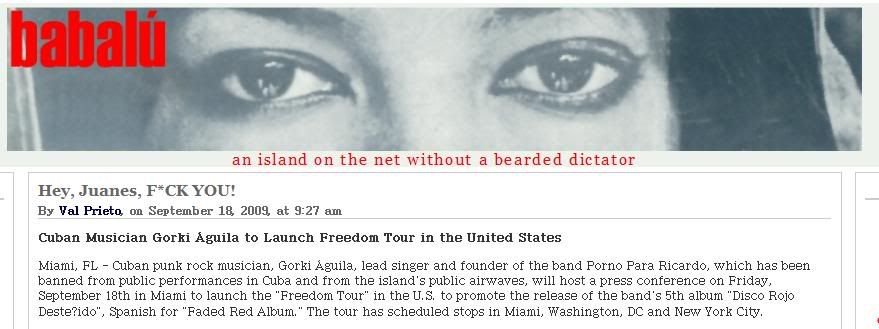
Speaking of the Babalu blog, when "founding editor" Val Prieto found out that Gorki was coming to Miami, he got all excited and posted the press release with this title: "Hey Juanes, F*CK YOU!" [screenshot]
Oh, those boys!
Anyway, another excited fan of Gorki's was at today's press conference: Telemundo 51 reporter Fausto Malave. Malave loves to give leading questions, especially when he knows what the answer is gonna be. (Last year, Malave asked former Venezuelan President Carlos Andres Perez in Miami what he thought should be done about Hugo Chavez. Perez replied exactly as he did four years before.) Today at the press conference, Malave (innocently, of course) asked Gorki [video]:
"What do you wish on the Castro brothers?"
Gorki immediately laughed at the question because he knew what Malave was doing. Gorki eventually responded saying: "It so awful to say, but if the freedom of a country depends on the death of a tyrant, then, of course, so be it welcomed." This reply by Gorki also made it on the airwaves of Radio Mambi.
Welcome to Miami Gorki. It's an entirely different propaganda game here.
--- [Update]---
Gorki made his local television debut last night on Mano Limpia with Oscar Haza [video]. The two other guests on with Gorki shared identical views with him concerning the Peace concert tomorrow in Cuba.
Also, this afternoon Gorki appeared before a large crowd of his fans in Little Havana. The Free Cuba Foundation has some video of the event on their YouTube channel.
Gorki was surprised by the large turnout, and looks like he signed and sold plenty of CDs [video]. There's even video of Gorki playing one of his songs dedicated to Raul Castro [video]. One line in the songs goes: "Raul you are a phony, there's no one that can tolerate you."
You can view lots of music videos of Gorki Aguila and his band, Porno for Ricardo, here.
Here's an excellent video by Generacion Asere:
[Photo by PedroPortal/El Nuevo Herald]
Subscribe to:
Posts (Atom)