Thursday, February 15, 2007

Insulza makes a Boo Boo, Good for Him

Today, Radio Mambi has gotten a fever over the recent statements by the OAS secretary general, Jose Miguel Insulza. For some hardliners there is a "bad word" that starts with a "D" that Insulza said. And, no its not doo doo.

In 2005, the secretary general for the Organization of American States, Jose Miguel Insulza, was elected to the position for a five-year term. Since then, this "moderate Chilean socialist," has stood out in the headlines every now and then. Concerning Cuba, on May 23, 2006, Insulza was reported as saying "There is no transition and it is not your country." Insulza was responding to the appointment of Caleb McCarry as a coordinator for the US Commission for Assistance to a Free Cuba.

This disagreement between Insulza and US plans for Cuba has recently been further clarified. When visiting Jamaica last week, and Peru this week, Insulza has been saying the "D" word like a drunken sailor. Or should I say, like a brave sailor.

In Jamaica, Insulza was reported to have said: "
I hope that the lack of DIALOGUE about or with Cuba is only a temporary situation. We cannot help the people of Cuba if we cannot talk to them." In Peru, Insulza commented that "it seems to me that the OAS should get involved in at least initiating a significant DIALOGUE with Cuba." What a potty-mouth!

Radio Mambi, since hearing these words, have decided to defame and condemn Insulza for his insult to Cuban exiles. Armando Perez-Roura, in a bit of creativity, called Insulza a "comunista." (Wait a second, he calls everyone he disagrees with a "comunista.") Anyway, Ninoska Perez-Castellon spent a good portion of her afternoon show on Insulza's comments. Basically, her argument goes along the lines that dialogue is forbidden with assassins, vampires, and the Boogeyman. But, most of all its insulting to the victims of the Cuban government, and its exiled community. You should know this by now, its the same policy that has lasted almost a half-century.

Anyway, did I mention that virtually the whole world disagrees with Ninoska Perez-Castellon's position? And no, I don't mean the one about vampires and the Boogeyman.

Tuesday, February 13, 2007

America's Favorite Tyrant (part 4)

The world sometimes may seem very "bizarro," but to ExxonMobil things are fine. During questioning from a 2004 Senate Hearing on corruption, executive vice president Andrew P. Swiger said:

"Business arrangements we have entered into [with Equatorial Guinea] have been entirely commercial, have been at market-based rates, arm's length transactions, fully recorded on our books. They are a function of completing the work that we're there to do, which is to develop the country's petroleum resources and, through that and our work in the community, make Equatorial Guinea a better place."

What does this all have to do with Cuba? EVERYTHING.

The US position on dictators is clear: they don't care for their human rights abuses. If they say they do, it's a lie. The US government looks for profits before principles. It's not the other way around. It explains why they ignore the calls of Cuban dissidents on the island, the majority of which reject US policy. It explains why much of US policy towards Cuba is counter-productive in addressing human rights abuses, policies which most human rights organizations condemn year after year. This explains why many nations, besides Cuba, point at US hypocrisy. Some would say that this is cold reality, but some of these people still consider governments as moral agents. Institutions (the US government) are not moral agents, people (citizens) are.

Looking at the Parade list the other day, at those cruel faces of tyranny, each one with hands that have caused someone to suffer harshly, made me wonder: how can such power over people still exist in the world? The answer can only be that the concerns of people all over the world are secondary to the demands for profits of corporations all over the world.

And only people, not governments, can refuse to be accomplices to such abuse of power.

America's Favorite Tyrant (part 3)

Last year, Fidel Castro (Hollywood's favorite tyrant) made some headlines when he appeared on Forbes Magazine's list of wealthy rulers with an estimated $900 million worth of riches. Forbes reports that their estimate is based on assumptions of Fidel's economic control over state-owned companies, former Cuban officials, and "rumors of large stashes in Swiss bank accounts." Clearly the estimate is not based on hard facts, but nevertheless it is worthwhile to assume.

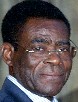
But, there was another dictator that year on the Forbes list that got little attention, and whose vast riches and corruption are based on hard facts and respectable sources: America's favorite tyrant - Teodoro Obiang Nguema Mbasogo.

According to the Forbes article, "Equatorial Guinea's president Teodoro Obiang Nguema Mbasogo and his government deposited up to $700 million in U.S.' Riggs Bank." And this all came to light when "[a] U.S. Senate subcommittee's 2004 investigation criticized Riggs for failing to report potential money laundering in the Equatorial Guinea accounts." The article quotes a director from Human Rights Watch who says that "[u]nder Obiang, the country's wealth is basically a presidential ATM."

Ken Silverstein, investigative journalist writing for Harper's last year, quoted a member of the House Subcommittee on Africa suggesting the clear corruption of Obiang and his family's wealth in the US, saying "[e]ither that [he's corrupt]…or he's an assiduous saver." In his blog, Wallechinsky quotes a former U.S. ambassador to Equatorial Guinea, John Bennett, saying that Obiang's regime "is not really a government," but rather "an ongoing family criminal conspiracy."

Also last year, Forbes magazine reported that the son of America's favorite tyrant "dropped $35 million [in cash] on an eight-bedroom ocean front mansion [in Malibu] despite a job in his father's government with an on the books salary of $5,000 a month." It's a story that will surely result in another Senate investigation.

The corruption of Equatorial Guinea goes on and on. And, similar to Cuba's plans for a succession of power, Equatorial Guinea is preparing for its own. It has been speculated that America's favorite tyrant is suffering from prostate cancer, and is preparing to hand powers over to his son, Teodorin'.

Will the US allow THIS succession?

America's Favorite Tyrant (part 2)

Despite Equatorial Guinea's politically motivated kidnappings and torture, the US State Department describes that "[t]he conditions of jails and prisons in the country remained harsh and life threatening; inmates frequently were not provided with sufficient and consistent food, medical care, working toilets, drinkable water, or clean and healthful living space."

"The lack of a published penal code allows for frequent abuses by security forces... Several of the persons had been detained for months or years without judicial proceedings. They were brought before a judge during the year for brief hearings and remanded back to prison for unspecified crimes against the state, rebellion, or terrorism, to be held in 'preventive detention' until trial."

"…there were reports that officials tortured political opposition activists and other persons during the year...During the year authorities reportedly detained members of political opposition parties. Prominent members of the 'illegal' opposition Republican Democratic Forces (FDR), the PP, and the NPU remain detained at Black Beach Prison for their political activities. It remained difficult to estimate the number of political detainees..."

"During the year the government monitored journalists, the media remained firmly under government control, and journalists practiced self-censorship... The government did not tolerate criticism of public institutions and public sector mismanagement and permitted no criticism of the president or the security forces."

"An independent or privately owned press was nearly nonexistent... Journalists were subject to harassment…"

Freedom of assembly, association and movement are highly restricted.

"There have been no free, fair, and transparent elections since independence in 1968."

"The president exercised strong powers as head of state, commander of the armed forces, and founder and head of the government party... Leadership positions within the government in general were restricted to the president's party or the coalition... Membership in the ruling party generally was a great advantage for hiring and promotion, both in the public and private sectors."

This is all in the latest Country Report on Human Rights by the US State Department, yet on April 12 of that year (35 days after the release of the report), Teodoro Obiang Nguema Mbasogo was welcomed into the White House by Condoleezza Rice and called a "good friend."

It's funny how the world works. And, if we go by the logic of the caller to Radio Mambi yesterday morning, the United States of America is an "accomplice" to the tyranny in Equatorial Guinea. Is this reality?

America's Favorite Tyrant (part 1)

This weekend, Parade magazine released its annual "The World's Ten Worst Dictators" list. Faster than you can say "President Raul Castro," a caller to Radio Mambi Monday morning pointed out that the Parade list did not include "Hollywood's favorite tyrant" (wink to Humberto Fontova), Fidel Castro. The caller recommend that listeners should write letters to the Miami Herald (who distribute the Parade down here every Sunday), in another attempt to point out how the Herald is an "accomplice" to Fidel's tyranny. It was another normal Monday morning on Radio Mambi.

Obviously, the caller did not read the opening paragraph to the Parade list, where David Wallechinsky (who blogs for the Huffington Post) wrote that Fidel was not included because he had "relinquished power in Cuba to his brother." Yet, Wallechinsky reminds us that Fidel was on last year's list, "coming in at number 15 on the countdown." (My best Casey Kasem)

So, I was looking at this list and I noticed that there were a few faces that I hadn't seen before, but some faces that were very familiar. Wallechinsky writes that the list is based on reports by Amnesty International, Human Rights Watch, Reporters Without Borders and the US State Department (most likely its annual Country Reports on Human Rights). The list is enlightening, yet it is a very short summary of each country's human rights abuses, and fails to highlight the historical background of each case. I recommend the annual reports by those organizations mentioned above.

Anyway, aside from the interest of finding everyone's favorite tyrant on some list, there's one dictator that I notice keeps popping up on these lists, and just so happens to be "a good friend" to the US. His name is Teodoro Obiang Nguema Mbasogo, president of Equatorial Guinea. Now, before I lose you, this has EVERYTHING to do with Cuba, because if you read the latest US State Department Country Reports on Human Rights, you will notice that Teodoro Obiang Nguema Mbasogo is basically Fidel Castro himself. The differences between the two dictators are miniscule.

Friday, February 9, 2007

What was Fidel for Cuba?

The current January/February edition of Foreign Policy magazine has a debate on the question: “Was Fidel Good for Cuba?”

I was about to describe the question as a quintessential one, but I don’t think it merits the title because of the wording. To question if something had a good (or bad) effect, essentially places an unequal burden of proof on one side of the debate, and can also be perceived as condescending. In order to be fair, I believe the question should’ve been “What was Fidel for Cuba?”

THIS is the quintessential question. It applies to that which curses all leading political figures of history. And, Foreign Policy magazine has pitted two (good or bad?) men to debate this issue: Ignacio Ramonet (from Le Monde Diplomatique) and Carlos Alberto Montaner (of whom I’ve written about).

Anyway, it was a pretty good debate, but very familiar points are exchanged, and anyone who is familiar with these points may be bored at reading them again. Yet, a person who may want a beginner’s guide to the Cuba debate may find this exchange very informative.

My opinion is that there is no convincing argument on either side. It’s quite a stalemate between opposing views, reflecting how in general there are little attempts to bridge the political gap. Still, I encourage anyone to go read it at your local bookstore or library.

Here are some highlights:

Montaner:
In the Americas, at the turn of the 21st century, a dictatorship where human rights are not respected… cannot be sustained.

Ramonet:
Castro’s death will not dismantle a movement hundreds of years in the making. To disavow this national character is to ignore some of the regime’s essential dimensions.

Montaner:
The reason communism has not tumbled in Cuba, just as it has not in North Korea, is because of the country’s complete repression. It’s a brand of repression linked entirely to one dying man. When he goes, so too will much of the fear that his regime instills in its people.

Ramonet:
In Fidel Castro’s Cuba, however, there have been no major uprisings. When Castro eventually succumbs to his illness, there is nothing to suggest that Cubans will suddenly rise up against socialism.

Montaner:
Castro will not be remembered as a luminary or upholder of human rights. The Cuban people will look back on the Castro era with sadness.

Ramonet:
It is a shame that while you look back with heated reproaches, you do not see the truth of what is happening in Cuba today and do not know how to decode the permanence of its socialist regime.

There’s plenty more (about 7 pages worth of) debate and controversial facts in this edition of Foreign Policy magazine, check it out as soon as you can. There are pictures too.

Wednesday, February 7, 2007

Enrique Encinosa in the Spotlight


Aside from Ileana's supporting role in the documentary "638 Ways to Kill Castro," Univision's own Enrique Encinosa plays a small role as "man who justifies terrorism."(my title)

Just yesterday, I posted Encinosa's comment about what he thinks Cubans should do with a thousand boxes of matches. Well, now its pretty clear that Radio Mambi's Enrique Encinosa, who works as their news editor, favors terrorist methods. In this part of the documentary, when he's asked about the hotel bombings in Cuba in 1997, Encinosa replies:

"I personally think its an acceptable method. Its a way of damaging the tourist economy. The message that [almost says YOU, as if he's done it before]... one tries to get across is that Cuba is not a healthy place for tourists. So, if Cuba is not a healthy place for tourist, because there's a few windows being blown out of hotels, that's fine."

There's an interesting psychology involved here. It seems that acceptance for this form of terrorism, which seems to target property only and not civilians, totally denies the fact that there are financial victims nonetheless. And, furthermore, does not account for use of explosives, which can cause accidental bodily harm, or death. Incidentally, the bombing campaign in '97 led to the death of an Italian tourist, of which suspected terrorist mastermind Luis Posada Carriles responded: "It is sad that someone is dead, but we can't stop... That Italian was sitting in the wrong place at the wrong time.''

According to the US Department of Defense, terrorism is defined as:

"... the unlawful use or threatened use of force or violence against individuals or property to coerce or intimidate governments or societies, often to achieve political, religious, or ideological objectives."

There's no question that Posada Carriles' aims are political, and not alone economically focused. In his 1998 interview with Ann Louise Bardach, Posada Carriles passed her a three-page manifesto that read at one point:

"The absence of freedom of expression, of freedom of movement for a hungry people oppressed and terrorized by communist repression... This gives all free Cubans a right to take up arms against the tyrant, using violence or whatever means at our disposal to derail this terrible system and bring freedom to our country."

Enrique Encinosa has mentioned many times on radio that he keeps in touch with Posada Carriles, who is now in prison for federal charges, and how he's a patriot above all. Just last week, Encinosa said that if things get worse, Posada Carriles was prepared to hunger strike to his death!

I can't say I would admire such an act.