Showing posts with label The Hard-Line. Show all posts
Thursday, February 21, 2013
Miami Herald Errs Against Yoani Sanchez
In their rush to grab readers, yesterday El Nuevo Herald chose to err against Yoani Sanchez by misinterpreting her recent comments in Brazil. As a result, the Herald not only violated a basic code of journalistic ethics ("Make certain that headlines... do not misrepresent"), but also helped skeptics of Yoani Sanchez in Miami to never trust her again.
MATTER OF ETHICS
Yesterday in Brazil, famous Cuban blogger Yoani Sanchez was invited by legislators of the Brazilian Social Democracy party to the Chamber of Deputies. At the event, Sanchez was questioned over her various political positions, including the case of the Cuban Five. Among her comments, she said this:
"[The Cuban government] cannot continue financing a disproportionate campaign [to free the Cuban Five] going already over 14 years. That is my position as the mother of an adolescent child, as a concerned citizen over the treasury of my country... I would prefer [the Cuban Five] be free to see if [our country] would save more [revenue]. And, there are other matters to deal with."
This was no "call" to release anyone.
No one honestly calls out or takes up a cause out of preference. Imagine someone saying: "I would prefer the cause of human rights, if it would solve our financial problems." Such a comment wouldn't be taken seriously as a motive for defending such an important issue. Just ask anyone who supports freedom for the Cuban Five, or anyone who supports freedom for Cuba. So, the Herald who interviews many Cuban exile activists should've known this, and also been aware of the sensitivity in Miami over political opinion concerning the Cuban Five.
The headline was quickly changed Wednesday evening after Yoani Sanchez directly responded to the Herald article through Facebook. Sanchez clarified by writing she was being ironic and apologized if her "words didn't leave a clear message." But, it was too late. The headline had already spread through the internet, local Spanish-language radio and television, leaving some in Miami shocked, upset or filled with mistrust.
UNCONTROVERSIAL
Yoani Sanchez's comments over the U.S. embargo against Cuba and the U.S. Naval Base in Guantanamo (which she believes is illegal) actually resemble popular, public and academic opinion. Saying that the U.S. embargo is hegemonic, a failure, or an excuse for the Cuban government's inefficiency is uncontroversial. Even in Miami. Also, notice that her comments regarding the U.S. Naval Base in Guantanamo being illegal gets little attention. That's because if anyone (not aware of the history of the base) puts themselves in the shoes of a Cuban (like Sanchez), the U.S. Naval Base can be easily viewed as a violation of a nation's sovereignty. It's difficult to justify to a Cuban, so its ignored.
So, the only ones that are bothered by Yoani Sanchez and her comments are hard-liners and militants opposed to the Cuban government. They don't like the media attention her individual and personal comments are receiving because those comments are not sufficiently opposed or against the Cuban government and its policy. They believe her comments so far have been "far from perfect" or "misinformed" or just plain erroneous.
They prefer the blogger whose opinion and bravery is limited to her immediate surroundings in Cuba, but God forbid Yoani Sanchez has a strong opinion about international issues. (I wonder how they would react when they discover she's also pro-choice.) They will praise her if her message is "perfect," but ignore her or distance themselves if it isn't. Or, like the Herald, are comfortable leaving her behind to fend for herself.
Labels:
Dissidents,
Local Media Bias,
The Hard-Line
Tuesday, October 16, 2012
Marco Rubio's Speech at Unidad Cubana [Updated]
This past Sunday, Sen. Marco Rubio of Florida appeared at a public event hosted by Unidad Cubana, the militant/hard-line Cuban exile organization. Below is the speech he gave in Spanish. I will be translating portions of the speech into English and updating this post below.
Yet, there is one portion of the speech that was very interesting. Sen. Rubio at one moment seems to suggest that he has confidential information concerning changes coming to the Cuban government. At these kind of events, someone always says that change is coming soon to Cuba and it is implied that the change will come with the death of Fidel Castro. But, Sen. Rubio's remark about having secret information is much more interesting (though he has been known to lie). That audio is at 8:31...
RUBIO'S CAUSE FOR FREEDOM
For those that don't know, Unidad Cubana was created in 1991 as a united front of several Cuban exile organizations to influence U.S. policy. Their main position was to reject the possibility of any softening of U.S. policy as Cuba was going through a difficult economic period. And, of course, preparing for an overthrow of the Cuban government.
According to El Nuevo Herald, Armando Perez-Roura (pictured above with Sen. Rubio, and current chairman of Unidad Cubana) said in 1991: "We in the exile community need to have our own political and military strategy because Castro must be removed from power." In that same article, it was reported that over 100 exile groups signed a joint agreement with Unidad Cubana, and that over 3000 people attended their inauguration event at the Miami-Dade County Auditorium, which was broadcast live on U.S.-funded Radio Marti*.
So, every October Unidad Cubana organizes an event remembering the "Great War" of 1868, and hosts speeches by distinguished guests that continue to push for a hard-line policy against the Cuban government. Previous guests have included Cuban-American legislators Lincoln Diaz-Balart, Mario Diaz-Balart and Ileana Ros-Lehtinen. And this year it was Sen. Marco Rubio's turn.
The essence of Sen. Rubio's speech centered on why he's taken a hard-line stance on policy toward Cuba, which is also based on his own "Cause for Freedom." According to Rubio, there are three basic reasons:
1) He supports the right of rebellion of people living under tyranny as written in the American Declaration of Independence;
2) He feels obligated to fulfill the "dreams" of the first wave of Cuban exiles because they suffered greatly due to the Cuban Revolution and "sacrificed" so much for his generation; and
3) He believes the U.S. government is obligated by principle to help Cuban exiles "free" Cuba.
In his speech, Sen. Rubio states that "if one studies six thousand years of recorded history" (which we assume Sen. Rubio has) one sees that "almost all people" throughout history have fought against tyranny, including the founders of the United States of America who expressed that right in the American Declaration of Independence, and also Cuba exiles at the Bay of Pigs. Sen. Rubio also states that the right to rebel comes from God, and that this historical battle against tyranny "will never end."
By suggesting that the right to rebel (or revolution) is God-given, and possibly an eternal human battle against tyranny (or evil), Sen. Rubio certainly reveals much about how he views events around the globe. It strikes me very similar to Cuban exile militants' war against global communism, or other battles that have been waged against some kind of global terror.
So, there should be no doubt that Sen. Rubio's "Cause for freedom" entails the "Cause for Cuba," and potentially other countries as well. As he explained, "if this country really believes these words [from the Declaration of Independence] then you have to apply them at every given opportunity, and for us [Cuban exiles] that opportunity exists 90 miles from our coast."
What other "opportunities" does Sen. Rubio see for his "Cause for Freedom."
[Photo by Arminda Espinosa and Libre Magazine]
*[El Nuevo Herald, July 13, 1991, "Cubanos Firman Acta de Unidad, Excluyen Dialogo" by Joel Gutierrez and Ivan Roman.]
Yet, there is one portion of the speech that was very interesting. Sen. Rubio at one moment seems to suggest that he has confidential information concerning changes coming to the Cuban government. At these kind of events, someone always says that change is coming soon to Cuba and it is implied that the change will come with the death of Fidel Castro. But, Sen. Rubio's remark about having secret information is much more interesting (though he has been known to lie). That audio is at 8:31...
"It's already been many years of everyone thinking 'Well, at any moment this has to change.' I know you've heard that many times. But I promise you, for reasons that I can't express publicly, the reality is that the moment is coming."
RUBIO'S CAUSE FOR FREEDOM
For those that don't know, Unidad Cubana was created in 1991 as a united front of several Cuban exile organizations to influence U.S. policy. Their main position was to reject the possibility of any softening of U.S. policy as Cuba was going through a difficult economic period. And, of course, preparing for an overthrow of the Cuban government.
According to El Nuevo Herald, Armando Perez-Roura (pictured above with Sen. Rubio, and current chairman of Unidad Cubana) said in 1991: "We in the exile community need to have our own political and military strategy because Castro must be removed from power." In that same article, it was reported that over 100 exile groups signed a joint agreement with Unidad Cubana, and that over 3000 people attended their inauguration event at the Miami-Dade County Auditorium, which was broadcast live on U.S.-funded Radio Marti*.
So, every October Unidad Cubana organizes an event remembering the "Great War" of 1868, and hosts speeches by distinguished guests that continue to push for a hard-line policy against the Cuban government. Previous guests have included Cuban-American legislators Lincoln Diaz-Balart, Mario Diaz-Balart and Ileana Ros-Lehtinen. And this year it was Sen. Marco Rubio's turn.
The essence of Sen. Rubio's speech centered on why he's taken a hard-line stance on policy toward Cuba, which is also based on his own "Cause for Freedom." According to Rubio, there are three basic reasons:
1) He supports the right of rebellion of people living under tyranny as written in the American Declaration of Independence;
2) He feels obligated to fulfill the "dreams" of the first wave of Cuban exiles because they suffered greatly due to the Cuban Revolution and "sacrificed" so much for his generation; and
3) He believes the U.S. government is obligated by principle to help Cuban exiles "free" Cuba.
In his speech, Sen. Rubio states that "if one studies six thousand years of recorded history" (which we assume Sen. Rubio has) one sees that "almost all people" throughout history have fought against tyranny, including the founders of the United States of America who expressed that right in the American Declaration of Independence, and also Cuba exiles at the Bay of Pigs. Sen. Rubio also states that the right to rebel comes from God, and that this historical battle against tyranny "will never end."
By suggesting that the right to rebel (or revolution) is God-given, and possibly an eternal human battle against tyranny (or evil), Sen. Rubio certainly reveals much about how he views events around the globe. It strikes me very similar to Cuban exile militants' war against global communism, or other battles that have been waged against some kind of global terror.
So, there should be no doubt that Sen. Rubio's "Cause for freedom" entails the "Cause for Cuba," and potentially other countries as well. As he explained, "if this country really believes these words [from the Declaration of Independence] then you have to apply them at every given opportunity, and for us [Cuban exiles] that opportunity exists 90 miles from our coast."
What other "opportunities" does Sen. Rubio see for his "Cause for Freedom."
[Photo by Arminda Espinosa and Libre Magazine]
*[El Nuevo Herald, July 13, 1991, "Cubanos Firman Acta de Unidad, Excluyen Dialogo" by Joel Gutierrez and Ivan Roman.]
Tuesday, August 14, 2012
Paul Ryan's Anti-Embargo Record
You've probably heard already. The Republican pick for vice-president, Rep. Paul Ryan (WI-1), has an anti-embargo voting record, and has been very clear about it. So, it's no wonder some hard-liners are trying to hide this fact.
A post on the (pro-embargo) Capitol Hill Cubans blog first raised my curiosity. It was apparent that the author was trying to hide Rep. Paul Ryan's voting record before 2007, and giving him an excuse by describing Rep. Ryan as an "unconditional free trader." (For hard-liners on Cuba, there is no room for other principles except unconditional sanctions.)
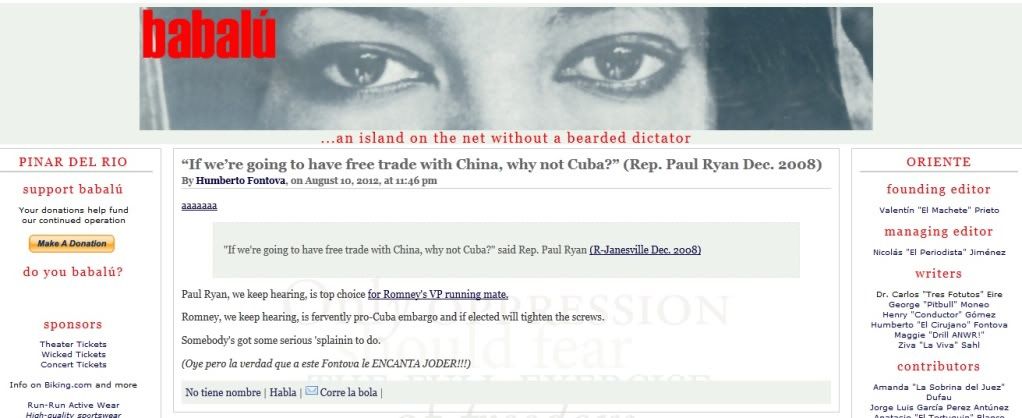
Even the boys at the Babalu blog did some quick work to hide Rep. Ryan's anti-embargo stance. Following the rumors that circulated on Friday, Humberto Fontova was the first to warn readers of Rep. Ryan's anti-embargo feelings. Fontova titled his post after a 2008 Ryan quote: "If we're going to have free trade with China, why not Cuba?"[cached link/screenshot] The post was soon removed. It was later responded with a post by Babalu economic super-genius Henry Louis Gomez who was an "economics major in college." According to Gomez, "99.9% of people" (including renowned libertarians like Milton Friedman and William F. Buckley who opposed the U.S. embargo towards Cuba) don't understand Cuba like he does.
In reality, national polling shows about 50% of Americans are opposed to the embargo (39% in favor, 10% undecided), so Gomez is being a little paranoid. But, it seems that Rep. Paul Ryan in 2002 was with the majority:
I seriously doubt it.
--- [Below are Rep. Paul Ryan's House votes in opposition to the U.S. embargo on Cuba] ---
A post on the (pro-embargo) Capitol Hill Cubans blog first raised my curiosity. It was apparent that the author was trying to hide Rep. Paul Ryan's voting record before 2007, and giving him an excuse by describing Rep. Ryan as an "unconditional free trader." (For hard-liners on Cuba, there is no room for other principles except unconditional sanctions.)
Even the boys at the Babalu blog did some quick work to hide Rep. Ryan's anti-embargo stance. Following the rumors that circulated on Friday, Humberto Fontova was the first to warn readers of Rep. Ryan's anti-embargo feelings. Fontova titled his post after a 2008 Ryan quote: "If we're going to have free trade with China, why not Cuba?"[cached link/screenshot] The post was soon removed. It was later responded with a post by Babalu economic super-genius Henry Louis Gomez who was an "economics major in college." According to Gomez, "99.9% of people" (including renowned libertarians like Milton Friedman and William F. Buckley who opposed the U.S. embargo towards Cuba) don't understand Cuba like he does.
In reality, national polling shows about 50% of Americans are opposed to the embargo (39% in favor, 10% undecided), so Gomez is being a little paranoid. But, it seems that Rep. Paul Ryan in 2002 was with the majority:
"The embargo doesn't work. It is a failed policy. It was probably justified when the Soviet Union existed and posed a threat through Cuba. I think it's become more of a crutch for Castro to use to repress his people. All the problems he has, he blames the American embargo... [Cuban-Americans] have their reasons [for supporting the embargo] and they're very passionate about their reasons, I just don't agree with them and never have."So, the question now is why did Rep. Ryan change his position on the embargo? Did a grown-man with strong free market convictions get "educated" on the embargo as Mauricio Claver-Carone told the Miami Herald?
I seriously doubt it.
--- [Below are Rep. Paul Ryan's House votes in opposition to the U.S. embargo on Cuba] ---
- July 25, 2001: Amendment to prohibit funding to administer the Cuban Assets Control Regulations with respect to any travel or travel related transaction. Rep. Ryan (WI) voted Aye, [Roll Call 270, HR 2590].
- July 25, 2001: Amendment sought to prohibit the use of funds in the bill to implement, administer, or enforce the economic embargo of Cuba. Rep. Ryan (WI) voted Aye [Roll Call 271, HR 2590].
- September 21, 2004: Amendment prohibits funds in the bill from being used to enforce certain regulations restricting family travel to Cuba. Rep. Ryan (WI) voted Aye [Roll Call 460, HR 5025].
- September 22, 2004: An amendment to insert the following new section on page 166 after line 3: Sec. 647. None of the funds made available in this Act may be used to implement, administer, or enforce the economic embargo of Cuba, as defined in section 4(7) of the Cuban Liberty and Democratic Solidarity (LIBERTAD) Act of 1996 (Public Law 104-114), except that the foregoing limitation does not apply to the administration of a tax tariff. Rep. Ryan (WI) voted Aye [Roll Call 461, HR 5025].
- June 15, 2005: An amendment to prohibit use of funds in the bill to implement, administer, or enforce regulations relating to amendments made to the Code of Federal Regulations relating to license exemptions for gift parcels and humanitarian donations for Cuba. Rep. Ryan (WI) voted Aye [Roll Call 254, HR 2862].
Labels:
Florida Politics,
The Hard-Line,
US embargo
Friday, February 17, 2012
What Embargo? [Part 2]
Over the decades, countless arguments have been made for keeping the US embargo (e.g. Soviet threat, property nationalization, approaching success, violation of human rights). In Miami, no two defenders will have the same defense. And, asking "What embargo?" is not only an effective excuse from again defending a half-century of sanctions, but it also expresses widespread exhaustion and disappointment with the effectiveness of current policy. But, despite its accepted failure, embargo defenders still view the embargo as the fine line that protects the Cuban exile identity, the necessary line that divides friend and enemy.EXILE NEWS BUBBLE
I was listening to Nancy Perez Crespo on WWFE (670 AM) last week. She appeared shocked to see that Diario Las Americas, whose editors are hard-liners on Cuba policy, published an EFE article on the 50th Anniversary of the embargo which she thought was intolerable. She barely got halfway through reading the article on-air because she refused to accept the article's contention that economic reforms have been implemented in Cuba. "What reforms?," she asked. Maybe not the reforms that Perez Crespo had in mind. But, it seems, even to suggest any change in the cruelty of your enemy is unacceptable. God forbid the enemy does change and produces the need for a new strategy.
Upon the 50th anniversary, embargo defenders in Miami had to remind themselves why they should remain committed. One example came from Jesus Marzo Fernandez, former Cuban official who defected in 1996, and now a local "expert" on the Cuban economy (appearing countless times on Spanish-language TV and radio). Last week, Fernandez outlined chronologically why the US embargo was justified. Fernandez begins: "1960 - During this year 473 citizens were executed by firing squad, unprecedented in Cuban history." Interestingly, his chronology ends on October 24, 1960 when supposedly all American companies in Cuba have been nationalized. In fact, most of the dates in the timeline have to do with Cuban intervention and nationalization of foreign companies during the 60s, and therefore we can assume that Fernandez, like others in Miami, believe the embargo is justified because of these nationalizations (without fair compensation).
But, as usual, the timeline is incorrect and misleading.
There's no mention that both Washington and Havana did attempt to negotiate for fair compensation of future nationalized properties during 1959. But, the U.S. eventually rejected the compensation offer of 20-year bonds. (Of course, there were huge disagreements over what was "fair" compensation, such as the case of United Fruit properties which Cuba estimated at around $6 million, but the company wanted around $38 million!) By the time 1960 came around, negotiation attempts were replaced with escalating threats. And, as mentioned in the previous post, throughout the 60s the Eisenhower administration already had plans to overthrow the Cuban government with a covert war.
This is the context missing from Marzo Fernandez's chronology defending the embargo. In addition, his timeline has errors. According to Fernandez, on Jan. 3, 1960 "all phosphorous plants are confiscated." I assume he means sulphur plants, which the biggest one (Moa Bay Mining Co.) was intervened upon (not confiscated) in March 1960.
Also, Fernandez doesn't mention the accurate date the U.S. embargo began on (Oct. 19, 1960), and instead makes the chronology look like the embargo followed a long series of Cuban nationalizations. On the contrary, the Cuban government confiscated over 100 American companies in reaction to the Eisenhower embargo. (Interestingly, Moa Bay Mining Co. was not yet confiscated.)
WHO'S SIDE ARE YOU ON?
Over the years, I've heard countless excuses on why the U.S. embargo towards Cuba should be kept. None make much sense to me, but that's because the embargo means something deeper than rational thinking. It's more about exile identity and its corresponding narrative of combating an eternal enemy. Recently, Jaime Suchlicki made it very clear (and revealing his militant side) in a recent op-ed for El Nuevo Herald, arguing that "[a]ll forms of struggle for liberty are legitimate. The last recourse of a defenseless and oppressed people is violence. Cuba is on that road. Let us hope the last sacrifice is coming soon."
Preserving the line between friend and enemy is something that draws hard-liners and militants together. And those voices are also our political leaders. As Rep. Ileana Ros-Lehtinen once said on Radio Mambi: "[it's] not very difficult Ninoska. The intellectuals want to make it like - Oh, this is so difficult, you have to look at this as very complex. No, no, no. There are friends and there are enemies. Who's side are you on?"
In this world of eternal battle, who knows when intolerance, ignorance or violence may fall on either side.
Friday, February 10, 2012
What Embargo? [Part 1]
That's an often repeated line from callers and guests on Radio Mambi. The denial seems to be premised on the US being one of Cuba's top trading partners since 2000 when Congress allowed exceptions for agricultural exports (with several restrictions which you can look up here). In 2007, the US became Cuba's fifth-largest trading partner with approx. $582 million in agricultural sales (and approx. $710 million in 2008). In 2010, sales in food products dropped to approx. $410 million (seventh-largest trade partner with Cuba).Of course the embargo exists (just ask the US-Cuba Democracy PAC), but, in Miami, hard-liners towards Cuba have grown incredibly frustrated defending the policy. The easiest way out of an argument is to say: "What embargo?" And, even the most adamant defenders of the policy know they don't have much to stand on. Let's take a look.
THE EMBARGO BEGAN IN 1960
Lot of articles were written this week about the US embargo towards Cuba, and its 50th year in operation. But, the embargo actually began in 1960 under the Eisenhower administration when US exports were cut. You can see from the picture above (courtesy of The Miami News on Google Archives), the top headline is from 1960, and the bottom one is the Kennedy administration's ban on imports from Cuba in 1962 (good chronology of US sanctions on Cuba here [PDF]). This is an important distinction because the Eisenhower administration made the goals of economic sanctions against Cuba very clear. Last year, historian Robert S. McElvaine wrote this in his op-ed to the L.A. Times:
"Noting in a 1960 memorandum that 'the majority of Cubans support Castro,' Lester D. Mallory, deputy assistant secretary of State for inter-American affairs, argued that 'the only foreseeable means of alienating internal support is through disenchantment and disaffection based on economic dissatisfaction and hardship.' The objective, he wrote, was 'to decrease monetary and real wages, to bring about hunger, desperation and overthrow of government.'"And, it was throughout the 60s that the US was secretly planning a covert war against Cuba. You can check this great chronology from the National Security Archive to get an idea of how extensive American plans were to overthrow the Cuban government (also good is "The Castro Obsession" by Don Bohning).
EMBARGO DEFENDERS
The above context is important, especially when you hear today about how "moral" it is to keep the US embargo. While it certainly won't topple the Cuban government today, the embargo is perceived in Cuba as a policy of aggression, as it was in 1960 and 1962.
So, last Tuesday our four Cuban-American representatives in Congress came out with their defense of the US embargo. According to Rep. Ros-Lehtinen, "the embargo is a moral stance against the brutal dictatorship. Over the last 50 years, the embargo has served as a constant form of solidarity with the Cuban people."
What Rep. Ros-Lehtinen really means when she says "moral stance" is to say that the embargo is a symbol of our confrontation against Cuba. A message that should be interpreted by the Cuban government as "we are enemies, not friends." (Nevermind the preamble of the Universal Declaration of Human Rights suggesting " it is essential to promote the development of friendly relations between nations.") Also, the embargo is not a "form of solidarity" with the people of Cuba. The majority of Cubans oppose the embargo (a 1994 poll inside Cuba found widespread opposition, and a 2006 poll showed Cubans highly favoring the US as an ideal trading partner.) Anyway, our foreign policy should not ignore the majority voice of Americans that oppose the US embargo.
Reps. Mario Diaz-Balart and Albio Sires make similar comments defending the embargo, but Rep. David Rivera seems to describe the need for expanding sanctions on Cuba because of their "Chavista and Mullah" allies. If we follow this logic, the US should expand their embargo to the rest of the western hemisphere.
Speaking of irrationality, let's not forget the other intransigents in Miami.
Friday, June 3, 2011
Cason, Rivera and Luis Posada Carriles
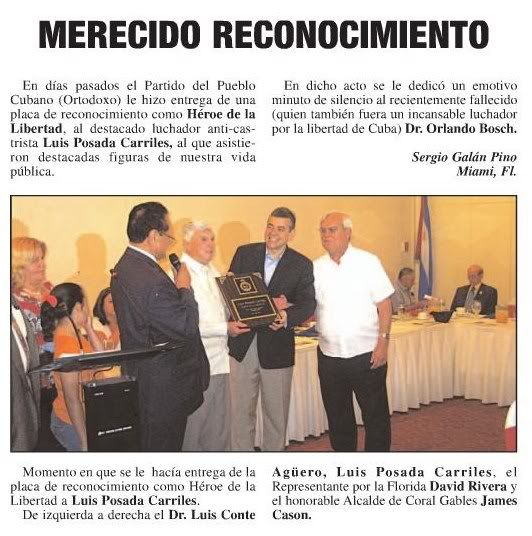
Last month, Humbert Fontova found out that Luis Posada Carriles, main suspect in the 1976 bombing of a civilian airliner and reputed terrorist, was publicly honored in Miami by Congressman David Rivera (FL-25) and Coral Gables Mayor James (Jim) Cason. It seems that Fontova (in his usual sarcastic manner) was disappointed that The Miami Herald didn't report on the event. Well, I'm so happy to oblige Mr. Fontova with the details.Back in April, Luis Conte Agüero was elated to hear that Luis Posada Carriles, whom he considers a "Mambi," was acquitted of several charges of U.S. immigration fraud. So, Conte Agüero, one of Posada's strongest public supporters in Miami, arranged to celebrate the event at the Big Five Club on May 14th where the Cuban Orthodox People's Party was already scheduled to meet. Conte Agüero is the president of that organization.
According to Sergio Galán Pino for Libre Magazine (screenshot of article here), the meeting indeed took place, recognizing Posada as a "Hero of Liberty" and was attended by Rep. David Rivera and Mayor James Cason. Rep. Rivera is a long-time member of the Cuban Orthodox People's Party, and Mayor Cason was an honored guest of the organization in 2009. At that 2009 meeting, Mayor Cason told the Orthodox members that "the enmity of Fidel and Raul [Castro] with us [the United States] is real, it is genuine, they need an enemy to exist, we are that enemy and will always be."
Mayor Cason since 2009 has attended several meetings with other hard-line Cuban exile organizations, and campaigning discreetly among them. Due to this support by Cuban exiles, Cason became Mayor of Coral Gables last April. Mayor Cason was most likely celebrating his Mayoral victory at the May 14th meeting with the Orthodox Party.
[Photo by Libre Magazine - May 24, 2011, left to right: Luis Conte Agüero, Luis Posada Carriles, David Rivera, James Cason.]
Monday, May 16, 2011
Julio Robaina Promises To Be Hard-line
Next Tuesday Miami-Dade county voters will elect a new Mayor in special elections. Among the top candidates stands former Hialeah Mayor Julio Robaina. Over the past few years, Robaina has certainly presented himself as a hard-liner on U.S.-Cuba policy, such as preventing a Cuban music concert from taking place in Hialeah, to supporting anti-Castro militants like Luis Posada Carriles. These credentials will most likely help Robaina capture plenty of voters next Tuesday. But, the consequences of having another hard-line Mayor in Miami could prevent the city from becoming a culturally diverse center for the arts, perhaps increasing the potential for Cuba-related conflicts like many seen in the past.
The caller this morning to Radio Mambi stated that Julio Robaina made a "promise" to several hard-line/militant Cuba exile organizations to remain "tough" on cultural exchanges with Cuban artists. Unfortunately, I was unable to record the entire comments made by the caller, and therefore the comments are a bit vague, but the last few comments are interesting nonetheless (the "promise" quote is based only on my own recollections of the caller's comments.)
[Audio]
The caller states that Robaina's position on cultural exchanges is the "toughest" of all the current Mayoral candidates. I am assuming that the caller is Manuel L. Malgor, president of the American Missile Crisis Veterans Association, and a leading organizer of a local campaign to stop the Cuban cultural exchanges in Miami [here's an example of their work]. That campaign has successfully resulted in recent anti-cultural exchange resolutions in the City of Miami and Hialeah, yet no specific laws prohibiting Cuban artists from performing in Miami. The caller specifically mentions these resolutions in the audio clip.
The other interesting bit of information provided in the audio reveals that Julio Robaina has adopted a hard-line stance on Cuba because "an uncle of his was jailed for 18 years in Cuba." Most likely, this memory of injustice has influenced Julio Robaina in becoming a hard-liner, just like many other hard-liners with similar stories of injustice. But, it does not justify a government representative adopting political positions that satisfy individual interests that conflict with the interest of the greater community. In this case, encouraging cultural exchanges between Miami and the people of any other region has greater social benefits than maintaining a hard-line position.
But, the hard-line/militant position believes there are no benefits to cultural exchanges with Cuba. According to a copy of a letter sent to the City of Miami, anti-cultural exchange activists believe that "under the pretence of cultural exchange, that same [Cuban] regime is sending communist agents to infiltrate and provoke the Cuban Exile Community." The (sometimes paranoid) belief that the exile community is being targeted for provocation and infiltration is often used, most recently to stop a legitimate public campaign supporting the Cuban Five in Miami. But, Julio Robaina has adopted this position towards cultural exchanges with Cuba, recently telling El Nuevo Herald: "We don't want our people [the Cuban exile community] to continue being instigated with those kind of shows... that is why we are asking Congress to approve a law that will put an end to this matter [of Cuban cultural exchanges]." Last February, Robaina (then-Mayor of Hialeah) and the Hialeah City Council approved a resolution "urging the members of Congress to introduce legislation opposing cultural exchanges between Cuba and the United States so long as the Cuban government continues its violation of basic freedoms and human rights." [From City Council Agenda - February 8, 2011]
Once again, when it comes to Cuba, hard-liners and militants do as they please while continuing to ignore what the rest of the population think. There is no evidence of a majority of Miami residents opposing cultural exchanges with Cuba.
Back in 2000, Florida International University's Cuba poll found that 54.7% of Cubans in Miami supported Cuban artists performing locally, while 45.3% opposed (85.4% of all Miami residents supported these cultural exchanges). A more recent poll of Cuban-Americans in 2009 [PDF] showed that 52% favored cultural exchanges versus 32% opposed.
So, you might be perplexed about why Robaina is ignoring these majority opinions. Well, aside from Robaina's personal reasons concerning his uncle, Robaina is just being loyal to small but well-organized anti-Castro organizations that consistently vote come election day. The same loyalty helped James Cason win the Coral Gables mayoral election recently (Cason had been campaigning discreetly among Cuban exiles since 2009). Yet, despite all the criticism Cuban exile hard-liners and militants get from the local community, when election day arrives they know how to get their voters out.
But, in the end, democracy is only rhetoric, while elitism seems to rule in Miami.
- [Miami New Times - Julio Robaina campaign gave $350 to Luis Posada Carriles' defense fund.]
- [Julio Robaina accepts award from a local hard-line organization, Mario and Lincoln Diaz-Balart attending.]
Labels:
Florida Politics,
Julio Robaina,
The Hard-Line
Tuesday, March 29, 2011
Carter in Cuba: Day One
It's been interesting to read the optimistic speculation about Jimmy Carter's visit to Cuba. On the first day, many reports indicated the possibility of Carter's intervention in the case of Alan P. Gross, the jailed USAID contractor, and others saw Carter as a promising interlocutor between Washington and Havana. Meanwhile in Miami, the hard-liners went on the offensive to attack Carter and paint a negative image of the visit.ARRIVING IN HAVANA
On Monday, Jimmy Carter again arrived in Havana at the invitation of the Cuban government. Back in May 2002 Carter first arrived at the invitation of Fidel Castro, this year by his brother Raul. Carter landed at Jose Marti International Airport with his wife Rosalynn, his former National Security Advisor for Latin American Affairs, Robert Pastor, and directors of the Carter Center. They were greeted by Cuba's Foreign Minister Bruno Rodriguez, including Jonathan Farrar, chief of the U.S. Interests Section in Havana, among others.
Jimmy Carter and his guests soon made their way to the Patronato Jewish center and Temple Beth Shalom where they were greeted by Adela Dworin, president of the temple, and other members of the Jewish community (video of tour). (Dworin later told reporters that they did not discuss the Gross case or any politics at all.) Later, Carter and his guests met with Cardinal Jaime Ortega of the Catholic Archdiocese in Havana. (Reports say they met behind closed doors for about an hour where Carter expressed his satisfaction with Ortega's role in the release of Cuban political prisoners.)
Several early reports seemed to indicate that Carter arrived with the intent to return to the U.S. with Alan P. Gross, but later in the day reports (such as Jeff Franks') revealed that Cuban officials would not allow it. Nevertheless, CBS News (Portia Siegelbaum) speculated that Carter was working in the background to gain access to Gross, and CNN (Shasta Darlington) confirmed that Carter met with Secretary Hillary Clinton before his trip perhaps sharing her concerns over the case.
IN THE MIDDLE
There were many articles that expressed optimism about the Carter visit to Cuba. The Miami Herald published an article by Matthew Brady from Freedom House suggesting that "Carter’s visit could kick-start U.S.-Cuba relations through a relatively moderate interlocutor." Brady argues well that the time is right.
Other commentators, like Cuban professor Esteban Morales and Lilia Lopez from the Havana Note blog, see Jimmy Carter as a someone influential enough to provide a "realistic" (Morales) assessment of Cuba with "fresh eyes" (Lopez) directly to President Barack Obama.
It should be noted too that Jimmy Carter is traveling with Robert Pastor, another optimist who is confident that the Obama administration could improve U.S.-Cuba relations with an envoy between Washington and Havana.
ATTACKING CARTER
Meanwhile in Miami, some hard-liners have taken an ambivalent stand, and others are just being offensive. It seems most militants/hard-liners oppose the trip because it "legitimizes" the Cuban government they see as totally immoral or dangerous. But, seeing that the media is mostly optimistic about the visit, the strategy seems to be to attack Carter's character, or to misrepresent the intent of the visit.
On Monday, Radio Mambi's Ninoska Perez-Castellon tried her tired tactic of presenting the subject (Carter) as a fool. She began reading from Jimmy Carter's 2002 Cuba Trip Report, but it soon became apparent that she wasn't prepared to thoroughly challenged the well-detailed and highly-informative report. Perez-Castellon had obviously not read the report before and ended up skipping several paragraphs of important information (including the paragraph that mentioned the Varela Project) and telling listeners that Carter was just repeating Cuban propaganda and lies.
(The attacks continued today too. Armando Perez-Roura's daily radio editorial described Carter today as an "ultra-leftist-pacifist" and Rep. Mario Diaz-Balart called in to Perez-Castellon's radio show and called Carter an "extremist" and "anti-semite.")
In the evening, the Spanish-language political talk show Maria Elvira Live (on MegaTV) invited CANF President Jose "Pepe" Hernandez and ICCAS analyst Jose Azel to talk about the Carter visit (video). Both didn't say if they supported or opposed the visit, but instead focused on speculating about Jimmy Carter's possible intentions in Cuba. Of course, they ignored Carter's stated reasons for going to Cuba because both believe that improving relations is virtually impossible with the current Cuban government. Hernandez argued that Cuba was using Carter to improve its international image, and Azel agreed adding that the Cuban government had nothing to offer the U.S. in a negotiation anyway (and therefore there's no reason to improve relations).
(It should be noted that CANF took a stronger position against Carter's 2002 Cuba visit. CANF, through Joe Garcia, first opposed the Carter visit saying that Carter should only go to demand the removal of Fidel Castro: "However, if his purpose is to better U.S.-Cuban relations with the 43-year-old dictatorship, his time would be better spent elsewhere.")
In the evening news, Telemund051 also attempted to misrepresent Carter's visit (video). Telemundo put their best reporter on the job: Fausto Malave. In typical fashion, Malave mocks the importance and the reason for Carter's visit, barely mentioning Carter's stated purpose. And, instead, attempts to portray the visit as showing little concern for internal political repression and the case of Alan P. Gross. Of course, Malave interviews one person, Janisset Rivero, of the hard-line Directorio Democratico Cubano who erroneously equates the voice of Cuban dissidents with the voice of the entire Cuban people.
Univision23 also does a poor job reporting on the visit. In this report (video), Carter's stated purpose is never mentioned. Instead, the report focuses on the Gross case, and includes Alfredo Duran and James Cason making comments about the Gross case. Fortunately, the report includes comments from Cuban dissident Oswaldo Paya saying: "Jimmy Carter is a person that inspires us with confidence... and someone you can expect good from."
It's interesting to see how hard-line commentators in Miami have ignored Carter's personal views about U.S.-Cuba relations. (His views actually coincide with the larger intellectual community and the majority of Americans.) He made them very clear before he first visited Cuba in 2002. Instead, most Spanish-language pundits have tried to portray Carter as possibly having mysterious goals, or being a naive fool while in Cuba. Only in Miami.
[Below, Jimmy Carter in March 2002]
"I think the best way to bring about democratic changes in Cuba is obviously to have maximum commerce and trade and visitation by Americans and others who know freedom, and to let the Cuban people know the advantages of freedom. That's the best way to bring about change. And not to punish the Cuban people themselves by imposing an embargo on them, which makes Castro seem to be a hero, because he's defending his own people against the abusive Americans."
[Reps. Lincoln Diaz-Balart and Ileana Ros-Lehtinen tried to block Carter's 2002 Cuba visit by writing to the President: "We write to request that you deny permission for Mr. Carter to visit the Cuban dictator. While U.S. law authorizes the granting of licenses by the Treasury Department to U.S. officials and members of Congress to visit Cuba on official business for the U.S. government, it does not do so for former presidents seeking to appease anti-American dictators.'']
Labels:
International Politics,
The Hard-Line
Wednesday, January 19, 2011
The Hand of Fidel
Last week, the trial of Luis Posada Carriles began and I was not surprised to read about how Posada's lawyers wanted to turn the trial around against the Cuban government. I found it typical because one thing I've noticed from my focus on militants and hard-liners in Miami is the constant blaming of the Cuban government for involvement in almost all things that go wrong. It's something that they themselves joke about, but also something that seriously borders on paranoia. In the world of militancy and the hard-line, one is naturally in constant vigilance against the enemy's possible interference in all matters. In the case of Miami, the hand of Fidel Castro and the Cuban government is constantly plotting against Cuban exiles. And, the Posada trial is yet another example of "The Hand of Fidel."
Last week, Arturo Hernandez (above), one of Posada's lawyers, demanded he be allowed to argue in court about "the Cuban government's motive to fabricate" evidence against Posada. (Some evidence collected inside Cuba will be presented in court.) Hernandez argued that this motive originates from the fact that "[i]n a long life of 83 years, [Posada] has made some very powerful enemies. None more powerful than Fidel Castro and his regime." The demand was soon dismissed by the judge as irrelevant. And, prosecutors agreed saying: "This is not the History Channel . . . The regime in Cuba is not the defendant in this case... This is not for The Miami Herald.'' (Ouch.)
[Reality is the FBI alone has gathered enough evidence to criminally charge Posada. Evidence collected from Cuba represents cooperation from two countries that should have better bi-lateral relations.]
No doubt Posada's defense was upset by the decision, but so was Alberto de la Cruz at the Babalu blog. De la Cruz called the trial a "kangaroo court trial" where the judge "has in effect banned the truth from the trial" and the prosecution has "partner[ed] up with a brutal and murderous totalitarian regime." And, no one would have noticed this gross and outrageous blunder of a post from the boys at Babalu if the Miami Herald had not published it this past Sunday.
It seems that the Miami Herald did eventually live up to the expectations of the prosecution at the Posada trial. And there's more, because the Herald managed to squeeze the Babalu commentary (which had the highest word count) in between two other comments by distinguished scholars (Julia Sweig and Peter Kornbluh) and a renowned journalist (Stephen Kinzer). Which means that, despite all the pathetic criticism the Herald gets from Babalu, the Herald has no problems disguising that obscene blog blundering as serious commentary.
That's Miami for you. Some still see Luis Posada Carriles as a hero that fought against modern-day evil, and thus worthy of some kind of defense. But, Posada's violent life and corporal sacrifice also represent something greater: self-confirming evidence proving the existence of the "Hand of Fidel," which is a threat to Cuban exiles and can only be fought with equal intensity.
- Video above of Arturo Hernandez (from local program "A Mano Limpia"), in his own words (@3:35):
"The important thing is that there can be no truthful testimony while those individuals [in Cuba] are in the hands of a dictatorship like that of Fidel Castro and Raul Castro. In other words, its not a question of whether philosophically thinking a person who cooperates is gonna tell the truth or not. No. There is no truth there [in Cuba]. The only thing that exists there is the will of the dictator."
[Related articles]
- Cuban Exile on Trial by Julia Sweig and Peter Kornbluh
- Trial of the Terrorist Who Almost Killed Me by Stephen Kinzer
Labels:
Luis Posada Carriles,
The Hard-Line
Tuesday, January 11, 2011
Why Support Posada?
So, maybe some of you might be baffled why Luis Posada Carriles, a person with such a violent history, gets so much support around Miami. Every supporter may have their own personal reason, but the general explanation seems to be that Posada is a symbolic hero of "la causa" (the collective exile mission to defeat the Castro government by any means). But, support for Posada should not be confused with support for violence (despite some Cuban exile leaders who continue to believe in the effective use of violence). Rather, aside from the militant politics he promotes, Posada also represents a politics of force without democracy: this is the hard-line.I recently posted some reasons why the hard-line is a non-democratic idea, and it is this contempt for the public that it shares with militancy. Those who feel that violence is an effective use of force generally have no regard for public opinion. I'll present some examples. The photo above shows a gathering of Cuban exile groups at the Presidio Politico Historico Cubano, a center in Little Havana that documents past and current abuse of political prisoners inside Cuba. This gathering took place on October 2006 [PDF, Page 14] to protest the detention of Luis Posada Carriles while he awaited criminal immigration charges.
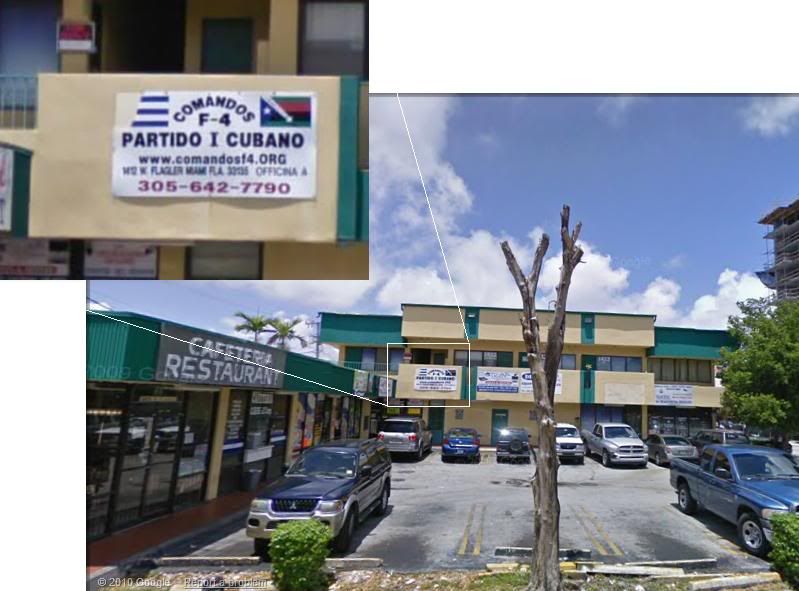
In the photo is Rodolfo Frometa (center, black beard), leader of the recently defunct group F4 Commandos (the website is down and the office has been put for rent). Frometa made it very clear to listeners of Radio Mambi that violence was necessary to bring change to Cuba. Frometa, of course, rarely appeared before any other media outlets in Miami because of the anticipated public rejection. Frometa, without the F4 Commandos, was last seen publicly among the marchers at last year's march supporting the (non-violent) Ladies in White in Little Havana.
Also, in the photo is Miguel Saavedra (center, red tie), leader of Vigilia Mambisa. Back in 2007, Saavedra and other members of Vigilia Mambisa physically attacked a small group of protesters in Little Havana after the small group held up a sign calling Luis Posada Carriles a terrorist. Saavedra is also a member of the militant group Unidad Cubana, and in 2009 was found to be an unpopular figure after a poll found a majority of Cubans (74%) in Miami opposed his protests.
Ernesto Diaz Rodriguez (center, blue shirt), secretary general of Alpha 66, also appears in the photo. Diaz was arrested in 1968 inside Cuba while attempting to "set up a base" and "infiltrate guerrillas." Diaz was released in 1991 after serving 22 years of a 40-year sentence. Alpha 66 long ago gave up its violent campaign, but now advocates the use of "sabotage" inside Cuba by dissidents. (I once heard him suggest on Radio Mambi the burning of Cuban government vehicles.)
Enrique Encinosa (front, dark glasses), also a strong defender of Posada's and news editor at Radio Mambi, was featured in a documentary defending the bombing campaign of Cuban hotels. Encinosa says: "I personally think its an acceptable method. Its a way of damaging the tourist economy. The message that one tries to get across is that Cuba is not a healthy place for tourists. So, if Cuba is not a healthy place for tourist because there's a few windows being blown out of hotels, that's fine."
The individuals and groups above represent a political idea which includes a strong disdain for the public. They don't care if you detest their use of force because for many years they have ignored the public and done as they pleased. Not just because of "la causa," but also because the public (or their representatives) never really tried to stop them. And, neither were any alternatives considered.
Monday, January 10, 2011
Important links:
- Summary of Luis Posada Case by Peter Kornbluh and relevant documents.
- Center for Democracy in the Americas press conference on Posada Case.
- The Posada Files by Ann Louise Bardach
Labels:
Luis Posada Carriles,
The Hard-Line
Posada's Supporters in Miami
Luis Posada Carriles' trial over criminal immigration charges started today. Laura Wides-Munoz for the AP provides an interesting report and interview with Posada revealing deep concern at the possibility of being jailed. "If I go to jail, my life ends in jail," says Posada.Posada was arrested by U.S. immigration officials back in May 2005. It wasn't until January 2007 that Posada was charged with making false statements on his naturalization application and interview. But, in May 2007 Posada was exonerated of these charges because the federal judge believed Posada was the victim of entrapment during the naturalization process. That ruling was later overturned in August of 2008 by a federal appeals court, and after much delay Posada is finally back in court.
[Check a list of important court documents at the Along the Malecon blog.]
Since his release in 2007, Posada has been very active throughout Miami. The main mission of course was to collect funds for his legal expenses, thus public appearances seemed obligatory. Through the years, Posada has met with several important leaders in the Cuba exile community as shown in the collection of photos above.
- Rep. David Rivera (top left) - Newly elected, Rep. Rivera showed his support for Luis Posada Carriles on December 30, 2010 at a public solidarity event [video] in front of the Versailles Restaurant. Rep. Rivera is a member of the hardline/militant organization called the Cuban Orthodox People's Party (Partido del Pueblo Cubano Ortodoxo) which is headed by Cuban exile militant Luis Conte Aguero. Conte Aguero was the main speaker at the Posada solidarity event, and is a fervent Posada supporter. Rep. Rivera showed up at the event, not just to regurgitate platitudes, but to show his solidarity with Cuba exile militancy. Also at the event were Antonio Esquivel, president of the Cuban exile organization Junta Patriotica Cubana, representing the organization's support for Posada and Nelis Rojas Morales, one of the main organizers of Posada's legal fund.
- Mayor Julio Robaina (bottom left) - Hialeah Mayor Julio Robaina allowed the City of Hialeah to present artwork by Luis Posada Carriles at the Walker Community Center on November 15, 2007 (check this schedule). In the photo, Posada stands in front of the Mayor with human rights activist Armando Valladares in the back. The photo was taken during an exhibition of Valladares' artwork on September 14, 2007. (Photos of both events can be found on the City of Hialeah website here.) Mayor Robaina is hoping to become the next Mayor of Miami-Dade County in 2012.
Others in the photo include, Sylvia Iriondo (bottom middle) and Bertha Antúnez Pernet (top right). Both women work prominently with the Cuban Democratic Directorate, a hard-line human rights organization in Miami that has received money from USAID. Both Iriondo and Antúnez travel overseas to promote a hard-line policy towards Cuba while documenting the political repression inside the island. Antunez is also the sister of Jorge Luis Garcia Perez, Cuban dissident whose recorded editorials now appear regularly on Radio Mambi.
Finally, there's Alex Hanna (bottom right), the traffic ticket attorney whose face appears on many billboards and bus benches around Miami. In the photo above he appears next to Posada receiving artwork by Posada during a meeting of the Cuban Orthodox People's Party where Hanna is also a member. Hanna seems to be a very successful attorney who also sponsors many programs on local station America TeVe, which regularly features hard-liners in Miami.
The photos above, mostly collected from the archives of Libre magazine, while only a few, represent the strong support for Posada in Miami. Previous posts related to Luis Posada Carriles also show local support by some Cuban exiles.
[Correction: Radio/TV Marti has reported on the start of the Luis Posada Carriles trial. They include news from EFE news agency reporting that Luis Posada was met with protesters calling him an "assassin" as he left his hotel. The report interviews a supporter of Posada saying that Posada was "verbally attacked" by the ANSWER Coalition. The Nuevo Accion blog reports that the protesters "tried to physically attack" Posada "inside the hotel," but were thwarted by Posada supporters. Nuevo Accion has a consistent record of misinformation.]
[Watch the ANSWER Coalition peacefully demonstrate before the Posada trial.]
Labels:
Luis Posada Carriles,
The Hard-Line
Monday, July 12, 2010
Olga Guillot (1922 - 2010)
Listening to the reports in the local Spanish media it's obvious that many in the Cuban exile community are deeply saddened by this loss. But, along with her musical talents, many are remembering Guillot for her politics. Rep. Ileana Ros-Lehtinen says: "There will never be another Olga Guillot. Her patriotism, love for her homeland, talented voice and caring heart will be missed." And, Rep. Lincoln Diaz-Balart remembers that "above all, Olga Guillot was a Cuban patriot." Several callers to Radio Mambi today made the same references to Guillot's patriotism.
Guillot was intransigent when it came to Cuba, and many in Miami loved her for that. According to El Nuevo Herald, a friend said Guillot's house in Cuba was repossessed in 1960, and soon thereafter she decided to leave and she never went back.
I've always read more about Guillot's politics than her music here in Miami. (This is the result of the coordinated anti-Castro propaganda that thrives in the local Spanish media.) When the "Peace without Borders" concert was about to take place in Cuba last year (dubbed the "Concert of Discord" by the local Spanish media), Olga Guillot was given an increased amount of airtime on TV and radio because she opposed the concert. (After the concert, a poll of Cuban-Americans showed a majority with favorable views of the concert.)
When the concert was over, she was asked in an interview about it. Guillot said that she was not impressed by the presentations and described the whole thing as "bien pobre" (very poor or poorly done). Guillot expressed the reasons for her political intransigence: she would never return as long as "the [Castro] regime" was in power. And, when asked what she thought of Cucu Diamantes, a young Cuban-American artist who traveled to Cuba to perform at the "Peace Without Borders" concert, she replied that Diamantes "has no character, and if she does then she is 'una infiltrada' (an infiltrator or spy)... here there are many people, many people who have been against the Cuba exile community because we are against that concert."
When asked what Guillot would do if she ever ran into any of the artists, such as Juanes or Olga Tañon, from the concert in Cuba, she replied: "Nothing. I am not going to see them as persons, or people. To me they are already strangers."
But, despite being mostly intransigent about Cuba, Guillot was also someone who could see beyond Cuban politics. In April 2009 it was reported that Olga Guillot and Omara Portuondo (another famous Cuban artist and supporter of the Cuban government) "embraced after 48 years separated spiritually and territorially."
The power of music can bring people together, if only for a while. Even the most intransigent.
--- Olga Guillot, in her own words ---
"God knows that we all want to [celebrate] in a free Cuba. But, since it will not happen, at least here [in exile] we can give each other greetings, the fraternal embrace of us all [Cubans] so we can feel alive. And we are loyal to our homeland, loyal to our traditions and to our roots because that is the only thing we should not forget.
"When they hear us say 'la Cuba mia' [that Cuba of mine] its because that Cuba of mine was so beautiful and so different to that Cuba of ours that suffers so much. And, one of the things that makes me sad is knowing that Cuba has not been lost, but kidnapped. Our island was kidnapped.
"I carry inside me and in my heart a map, [shaped like an alligator], I love that alligator, a beautiful alligator, I love her, Cuba, always Cuba.
[Photo courtesy of Guije.com]
Friday, June 11, 2010
Fariñas versus Radio Mambi [Updated]
An interesting interview/debate occurred this afternoon on Radio Mambi. Guillermo Fariñas, the Cuban dissident currently on a hunger strike (which has already passed 100 days) was interviewed by Ninoska Perez-Castellon today on Radio Mambi, and basically told to explain his recent actions in support of H.R. 4645.Anya Landua French on The Havana Note blog has some details about what happened, and how some hard-line/militant exiles are surprised by the recent letter by Cuban dissidents in support of this bill.
Click here to hear audio of the Radio Mambi interview with Guillermo Fariñas.
[Excerpt of debate below]
Ninoska: You [Fariñas] have signed a letter supporting the bill [H.R. 4645] to reform [U.S] travel restrictions and promote trade. And this bill is supported by organizations whose only interests... are commercial and not the welfare of the Cuban people. I don't know if you all are aware of that.
Fariñas: We are aware of that Ninoska.
Ninoska: Then you are in agreement that credits be allowed to the [Cuban] regime.
Fariñas: The letter that I signed spoke nothing about credits.
[...]
Ninoska: Yes it does. You didn't see it, but...
Fariñas: The letter I signed says nothing about credits.
Ninoska: Well, the letter where your signature appears supports the bill that is asking it be given...
Fariñas: Supports the bill, but it says nothing about credits.
Ninoska: But Fariñas I'm trying to explain that this letter doesn't say it, but this bill in Congress is seeking to give credits to the Cuban government. [And] that is what the letter says.
[More related posts at the Cuban Triangle here and here.]
Wednesday, June 9, 2010
One Last Chance
The Spanish presidency at the Council of the European Union ends this month, and before they leave they want one last chance to change the EU's "common position" towards Cuba. But, it won't be easy, especially when you still have South Florida's favorite Congressmen, Rep. Mario and Lincoln Diaz-Balart, ready to thwart any policy changes towards Cuba.Of course, there are several factors that will result in any possible change to the EU's policy towards Cuba, some of which were outlined last June. But, the Spanish government is hoping that other European nations will take notice of recent events inside Cuba, namely the Cuban government's negotiations with the Catholic Church to alleviate the harsh conditions of a few political prisoners. Spain's minister of foreign affairs, Miguel Angel Moratinos, believes that the "common position" is not working and that increased dialogue between Cuba and European nations would yield better results to achieve changes inside Cuba. As an example, Moratinos highlights the decrease in the number of political prisoners since Spain's new policy of dialogue with Cuba. (In 2008, the release and exile of four Cuban political prisoners was attributed to talks between Cuban and Spanish diplomats.)
But, this past Saturday the debate over EU policy towards Cuba got a bit nasty.
The EU and the U.S. held their regular bi-annual meeting of the Transatlantic Legislators' Dialogue (TLD) over in Madrid. It was a three-day conference where European and American legislators could discuss important global issues and achieve the goals of "strengthening cooperation" (at least that's part of what the TLD mission entails). Miguel Angel Moratinos was present for Saturday's session on foreign policy which was titled "Reducing Tensions in Distinct Geographic Areas." One of those areas was Cuba, and tensions at the event increased.
Reports are not very clear, but during this meeting Reps. Mario and Lincoln Diaz-Balart made statements in opposition to changing EU policy towards Cuba. According to Lincoln, the statements were directed towards the EU representatives and not at Moratinos. But within the statements was a direct reference to Miguel Angel Moratinos and at some point Mario directs a question to Moratinos asking him a question related to Cuba.
At this point it seems that Moratinos interpreted the protest by the Daiz-Balarts as a personal attack and responded back loudly. Reports indicate that Moratinos described Mario as "ignorant" and later, after the session, continued to insult him. Lincoln's version of the story, which he also repeated for Radio Marti, says that Moratinos spoke with an "insolent and offensive tone." But, today on Radio Mambi, Lincoln told Ninoska Perez-Castellon that Moratinos was so angry he was shaking.
If I were Moratinos I would also have little patience with Reps. Mario and Lincoln Diaz-Balart.
When it comes to Cuba, both Diaz-Balarts are only capable of protest and not dialogue. It is very clear from Lincoln's version of the story that both Diaz-Balart brothers came only to protest Moratinos and not have a dialogue. Promoting dialogue and cooperation with the EU is the ultimate goal of the TLD meetings, and the Diaz-Balart brothers chose to ignore those ideals.
The offensive language by Moratinos towards U.S. Congressmen is unfortunate, but a typical response (familiar in Miami) when one meets an "intransigent" on Cuba policy. This incident should only remind us again that our political decorum should rise above insults and impatience.
--- [Addendum]---
On Thursday, Miguel Angel Moratinos is planning to meet with Cuba's foreign minister Bruno Rodriguez. After that meeting Moratinos will join Spanish president Zapatero at the Vatican where both Spanish diplomats will meet with Pope Benedict XXVI to discuss the human rights situation in Cuba, among other topics. These talks are in preparation for next week's EU decisions to possibly change the "common position" towards Cuba.
Labels:
International Politics,
The Hard-Line
Wednesday, March 24, 2010
Gloria Supports Ladies in White [Updated]
Alfonso Chardy from the Herald notes that "it's not often that a world-class celebrity like singer Gloria Estefan talks about Cuba," and its true. Gloria Estefan has mostly kept herself out of politics, but her personal opinion about the Cuban government has been made clear:
"[Fidel Castro] just needs to go away... I wish he would, that would be the best for the Cuban people, obviously, with no violence and no bloodshed."
Which puts Estefan's ideology along with hardliners (many of whom were present at the press conference), and not exactly with the militants (some of whom were also present at the press conference). But, Gloria Estefan's description of Cuba yesterday [from Herald video] as a country where "the Cuban people ... are enslaved right now" is an exaggeration more likely to come from militants.
But, Cuban exiles of all political stripes are invited to march on Thursday in Little Havana, a demonstration which seems to be part of a larger effort to keep Cuba's political prisoners in the headlines. Since the recent death of political prisoner Orlando Zapata Tamayo and the international outrage that followed, some Cuban exile organizations (and other political hard-liners) have made it clear that this is an opportune time to highlight Cuba's human rights record, and justify the use of political sanctions on the island nation.
Of course, the recommendations by human rights organizations to improve the desperate situation of Cuba's political prisoners are totally ignored. But, the message of a "free Cuba" that will be often heard at the march should be clear: a Cuba free from Fidel and Raul Castro. Until then, the U.S. government shouldn't change a thing about its policy towards Cuba. Welcome to Little Havana, everyone.
(Telemundo51, in an obvious promotional stunt, asks viewers if they will attend Thursday's march: 75% say "yes.")
---[Update]---
The Miami Herald and El Nuevo Herald websites will be live-streaming the march tomorrow, and local news stations are planning to provide live coverage during the march which begins at 6pm. It will be interesting to see what effect this maximum coverage will have in Miami and Cuba.
[Gloria Estefan interviewed on Maria Elvira Live!]
[Photo by AP, Ladies in White march in Havana.]
Labels:
political prisoners,
The Hard-Line
Monday, March 1, 2010
Postponed Cuba Conference [Updated]
Rep. Mario Diaz-Balart was very upset this afternoon on Radio Mambi. He called Ninoska Perez-Castellon and appeared on her 3pm show today telling listeners that the Greater Miami Chamber of Commerce needs to apologize to Cuban exiles in Miami.The Greater Miami Chamber of Commerce (GMCC) has a Cuba Committee that every year presents a report on trade possibilities with Cuba. Along with a report, it also conducts conferences about Cuba and related issues. Last year's report was a significant departure from earlier hard-line attitudes, and included trade possibilities with an unchanged Cuban government. Trading with Cuba they argued was "potentially perhaps one of the greatest if not the greatest economic opportunity that Miami has or will have." This year, the GMCC was planning to hold its Cuba Conference on March 16th. But, they recently had to postpone the date.
Today it seems Radio Mambi and Rep. Diaz-Balart found out about this event. Even though they were slightly satisfied that it was postponed, they found it appalling that such an event would occur at the Freedom Tower, and sponsored by Miami-Dade College. They saw the Cuba Conference as a great insult, and demanded explanations and an apology from the GMCC.
But, one of the scheduled speakers at the conference really bothered Perez-Castellon and Rep. Diaz-Balart: Martin Aragones, representing Sol Melia, the Spanish hotel chain that currently operates 24 resorts in Cuba. They see Sol Melia as an accomplice to human rights violations in Cuba.
Several other speakers were scheduled to appear at the Cuba Conference, including Florida Governor Charlie Christ, former Miami Mayor Manny Diaz, and former Governor Jeb Bush. Of course, these speakers got a pass from Radio Mambi because they are likely ignorant of what the Cuba Conference is all about. Sure.
According to the GMCC website, the Cuba Conference was postponed due to "scheduling issues by key presenters" and "will be restructured and held later this year." It will be interesting to see how this conference changes in the future.
--- [Update: 3/3/10] ---
One thing that had me wondering when I first heard about this event was the reason Rep. Mario Diaz-Balart was suddenly on Radio Mambi. Was this such an outrageous event that he was compelled to call his favorite AM station in Miami? Or is Radio Mambi at the beck and call to whatever is on the mind of Mario Diaz-Balart?
Rep. Diaz-Balart occasionally appears on Radio Mambi, but usually when he has lots to say, such as on U.S.-Cuba policy or other national issues. He rarely (if ever) appears for short periods to express his outrage over domestic issues in Miami.
But, I recently became aware of possible reasons this Cuba Conference was such a thorn in the side of Mario. It was so obvious.
Miami Dade College, sponsors of the GMCC Cuba Conference, depend on the Diaz-Balarts (and Rep. Ileana Ros-Lehtinen) for crucial federal grants. For years (ever since Mario Diaz-Balart was Chairman of Florida's Senate Ways and Means Committee in the mid-90s) Eduardo J. Padron, President of Miami Dade College, has depended on Mario, Lincoln and Ileana for government funds.
Just last year, Rep. Mario Diaz-Balart presented Padron a $142,500 federal grant for the Kendall campus. It was only one part of federal appropriations obtained for the College, Rep. Ileana Ros-Lehtinen also obtained a $95,000 grant for the Medical Center Campus. Rep. Lincoln-Diaz-Balart helped too, obtaining a total of $900,000 for both the Hialeah Campus, and the historic Freedom Tower, which Miami Dade College now owns. Of course, there have been other ways these three Florida legislators have helped Eduardo J. Padron.
So, it seems clear why Rep. Mario Diaz-Balart suddenly called Radio Mambi to voice his outrage at the Cuba Conference (sponsored by Miami Dade College). It is also no surprise why he was demanding an explanation from Eduardo J. Padron, whose name was specifically mentioned:
Rep. Mario Diaz-Balart believes he has done a favor for Eduardo J. Padron, and therefore Miami Dade College should return the favor and grant him tacit allegiance to his hard-line attitude towards Cuba.
Looks like that federal grant came with baggage.
[Article on U.S.-Cuba trade possibilities]
[Tampa Chamber of Commerce cancels trip to Cuba]
[Photo above of the original title of the Cuba Conference]
Subscribe to:
Posts (Atom)