Showing posts with label henry gomez. Show all posts

Tuesday, September 11, 2007

Damage Control by Mr. Gomez

Henry Gomez, over at the Babalu blog, made sure yesterday to let readers know about his feelings on a recent article from the Wall Street Journal. In two posts, Mr. Gomez responds to an article from Micheal Phillips about a 24-year old Cuban-American, Giancarlo Sopo, and his unwavering support for Barack Obama amid the hard-liners in Miami.

Mr. Gomez acknowledges that the Phillips article "did not contain a single factual error," but was biased nonetheless. Let's examine Mr. Gomez's charge of bias.

First, it is apparent that the Phillips article focuses on the experiences of Giancarlo Sopo, a supporter of Democratic Presidential candidate Barack Obama, and thus his profile will not be easily digested by loyal readers of Babalu blog (or the Wall Street Journal). Lord have mercy that an opposing view is published by the Wall Street Journal!

Many of the other grievances (dare I say whining) by Mr. Gomez has more to do with personal negative attributions, rather than fair observation. What Mr. Gomez calls an "obligatory attack," is really a quote from Sopo (most likely being honest) and an important part of the entire Phillips article.

What Mr. Gomez calls an "allegation of pandering" and an attempt to "pump up his messenger's bona fides" (or any other charges of partiality), are but standard reporting practices by Phillips to inform readers.

At the end, what really seems to irk Mr. Gomez is what he believes is an attempt by Phillips to peddle the myth that "the old [] order of things has crumbled" (meaning the hard-line position of Cubans in Miami). By reporting of "a few dozen older protesters waving signs," Mr. Gomez believes that Phillips "is like those jerks who think that there aren't any conservatives because we don't do rallies. We have better things to with our time, assholes."

The fact is that the story is about a 24-year old Cuban-American, and the truth is that members of Vigilia Mambisa (who were the protesters that day), and Cuban-Americans in general (median age is 40.7 according to the 2000 US census), are just OLDER than him. No its not a sin.

Mr. Gomez wraps up his thoughts with a second post of more grievances of bias. He believes that Ninoska Perez-Castellon, quoted by Phillips, was made to look bad. I doubt that is possible since she is a beacon of sunshine. But, Mr. Gomez repeats TWO FACTS that he believes Phillips (and the rest of the media) should have included in his article.

1) The political party affiliations of Cubans in Miami, as pointed out by the FIU Cuba Poll since 1991. No doubt that the great majority of Cuban-Americans are Republicans, and most likely vote along party lines, but the upcoming Presidential elections are not viewed like district elections (which Mr. Gomez points out), and neither are the issues or voter turnouts the same. But, don't tell that to Mr. Gomez who believes that a his calculations and theories will stand the test of time.

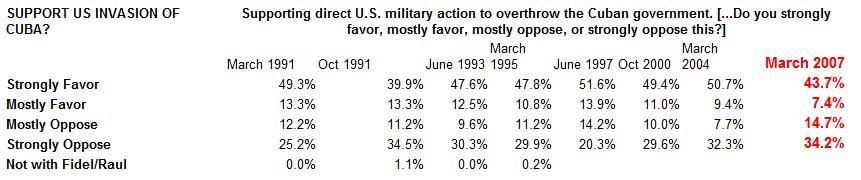
2) Phillips "leaves out the fact that in the same poll a majority of registered Cuban American voters favored direct U.S. military action to overthrow the Cuban government." I don't know where Mr. Gomez gets his numbers, but I couldn't find them on the FIU Cuba Poll. Instead, the recent 2007 poll shows [data table] that 43.7% strongly favor and 7.4% mostly favor (51.1% together favor) a US invasion to overthrow the Cuban government (a significant drop from 2000 and 2004). But, Cubans together OPPOSED to a US invasion come in at 48.9% (a steady rise from 2000 and 2004). How 51.1% is a majority over 48.9% (with a margin or error of 3.2%) is something you will ONLY SEE on Babalu blog.

And then to top it all off, Mr. Gomez accuses Michael Phillips of a "subtle manipulation" of the facts. You can't make this stuff up ladies and gentlemen.

Finally, in related news, the college newspaper over at Florida International University, "which boasts the largest number of undergraduate students of Cuban origin of any university (including the University of Havana)," yesterday published an editorial titled "Anti-Obama Protesters Don't Speak for Miami." It's a good read, unless you're Henry Gomez.

[Update 9/12: Blogger Alex from Stuck on the Palmetto has his thoughts on the Phillips article.]

Tuesday, May 29, 2007

Mr. Gomez's False Analysis (Part 2)

Mr. Gomez mentions that his "job [in 'account planning'] is to know what consumers are thinking and feeling." It sounds like Mr. Gomez works in the field of applied psychology, but the evidence and explanations that Mr. Gomez proceeds to give is barren of any scientific evidence. Instead, Mr. Gomez gives us a collection of his general assumptions and simple conclusions.

He mentions that "there is general psychology and behavior common to most immigrants. For example a new immigrant will probably settle where he has family or friends living." This is accurate. Mr. Gomez is describing a general phenomenon known as ethnic solidarity. Perhaps unknown to Mr. Gomez, a study done two years ago examined ethnic solidarity in the Cuban-American community in an attempt to explain the "internal divisions" of this so-called monolith. The author (Heike C. Alberts) provides some insight into possible reasons why cohort waves are responding differently in polls. She states that since the 1980's the ethnic cohesiveness of the "Cuban enclave" in Miami has decreased due to a merging with the overall US economy, increased competition with other immigrant groups, and decreased preferential treatment within Cubans. Alberts believes that "deep rifts now exist among Cubans of different refugee generations, due to different class background, values, ideologies, religious beliefs, and race."(p.246)[*]

But, Mr. Gomez prefers to give his own interpretation based on his experiences alone, not scientific research. He most likely agrees that there are "internal divisions" within the Cuban-American community, but seems to be in denial over whether these divisions are authentic. Over time Mr. Gomez believes that "[t]here is a slow discovery process in which the [new Cuban immigrant] begins to, perhaps for the first time, reflect on the veracity (or lack thereof) of what the regime told them during their formative years... But eventually that exhaustion wears off and certain realities set in." Mr. Gomez then concludes that "[i]t’s far more likely that those younger Cubans [from the July 31 celebrations] will become more outspoken and intransigent than their forerunners." And, that newly arrived Cubans will also assume an "outspoken and intransigent" stance once they assimilate in Miami and watch the local Spanish channels, such as the increasingly popular America TeVe and Mega TV.

I have never heard of this "slow discovery process" theory, and neither does Mr. Gomez provide any evidence to support it.

Yet, Mr. Gomez is correct in stating that a "static model" for how people think is incompetent. But, I have never seen anyone (Ana Menendez or Joe Garcia) argue that the "static model" is appropriate. This is Mr. Gomez's false argument.

On the other hand, many have cited the FIU Cuba Poll to examine past and current attitudes of Cuban-Americans. Evidently, Mr. Gomez is arguing about a possible future which is likely, or not likely, to happen. Mr. Gomez offers no evidence to support his prediction, instead he only has faith that Cubans in Miami will become "more outspoken or intransigent." Only time will tell.

But, of course, Mr. Gomez would have a difficult time challenging the methodology and results of the FIU Cuba Poll or the Bendixen Poll. This may explain why he argues against interpretations and false arguments, not facts.

Guillermo Grenier, one of the principle authors of the FIU Cuba Poll, has written extensively on the factors explaining the growing political diversity within Cuban-Americans. In a 2004 study, Grenier attributed the growth of a stronger dissident movement in Cuba, unique immigration experiences of wave cohorts, political abandonment of the Cuba issue, and the natural passing away of a hard-line "exile ideology" as factors in political changes in Miami.

In 2006, Grenier added more factors to consider: the general political "relaxation" after the end of the Cold War, political diversity from new Cuban-American political groups, and Cubans living outside of South Florida (Cubans in New Jersey are more likely to favor a "national dialogue" with the Cuban government).

These are arguments that are supported by facts. Grenier never suggests a "static model." In fact, Mr. Gomez's "slow discovery process" theory may be accurate, but operating against its own inventor.

Comparing the 2000 FIU Cuba Poll with the 2007 Poll, one reaches a startling conclusion. On the question of a "national dialogue," Cubans who immigrated between 1974-1984 changed their minds in support from 40.2% in 2000, to 50.4 in 2007! That's some "slow discovery." And, about those young Cubans that Mr. Gomez mentions... they (US born Cubans) support a "national dialogue" more than ever! From 67.9% in 2000, to 82.5% in 2007! I guess living in Miami with that "historic exile" community does that to you.

There's plenty of more data to go over and interpret. But, the real question is: who's peddling a myth?

[*]Alberts, H. C. (2005). Changes in ethnic solidarity in Cuban Miami. The Geographical Review, 95, 231-248.

[Part 1]

Mr. Gomez's False Analysis (Part 1)

On May 16, 2007, Henry Gomez from the Babalu Blog wrote a lengthy post titled "The Peddling of a Myth." Mr. Gomez, provoked by a Miami Herald (Ana Menendez) column published that day, argues that a "miniscule [sic] Cuban-American left" (of whom Mr. Gomez mentions Ana Menendez and Joe Garcia as examples) are perpetuating a lie: "That the historical exile community is old, that it’s losing its power and that the Cuban-American community is fractured in its thinking on the Cuba problem."

Mr. Gomez believes this lie has two functions:

- The egotistical Left "desperately want to believe that people are joining them;"
- The surreptitious Left "tell a lie so many times that it begins to be perceived as truth," and as a consequence "there are some Cuban-Americans that believe exactly what these false prophets believe."

To support his argument, Mr. Gomez says that the Left "cite surveys, which they conduct. They splice the data by date of arrival and attempt to show that the growing portion of the Cuban-American community, the most recent arrivals do not identify with the 'historical' exile community."

Mr. Gomez is obviously referring to the recent Bendixen and FIU Cuba Poll, both of which have been commented on Babalu Blog upon their release. You can read Mr. Gomez's earlier posts on Bendixen and FIU at your leisure. But, this is the first time I have seen Mr. Gomez comment on the interpretation of the waves of arrival for Cuban immigrants.

Analysis of statistical data through cohorts (what Mr. Gomez calls "splic[ing] the data") is standard practice. The wave cohorts of Cuban immigrants used by FIU and Bendixen have been used by other studies, with some variation. Some identify four waves of Cuban immigration since 1959, and others identify six. But, there isn't a hidden agenda behind this common research practice, as may be implied by Mr. Gomez.

Looking at the latest results of the FIU Cuba Poll, there were clear differences in the response of Cubans depending on their arrival to the US. On the question of a "national dialogue" (one example that Mr. Gomez mentions), the majority of Cubans (56.8%) who arrived between 1959-1964 oppose the idea of a "national dialogue among Cuban exiles, Cuban dissidents, and representatives of the Cuban government." But, among Cubans who arrived between 1985-1994, the majority (65.5%) favor a "national dialogue." Those are stark differences to interpret.

Nevertheless, Mr. Gomez believes that the Left's "analysis is flawed in one major way. They assume that these recently arrived Cubans will maintain the same ideas the[y] presently have over the rest of their lives. It’s a static model, which doesn’t account for migration away from their dialoguero ["national dialogue"] position. Logic and hard evidence would seem to dictate that this is an improbable scenario."

Let's examine Mr. Gomez's "logic and hard evidence."

[Part 2]

Tuesday, April 3, 2007

A Ten Foot Poll (Part 2)

And then there are the deniers. When you cannot dispute the findings on how people feel, then you make sure you reduce the strength of the results. NewsMax reports the findings of the new Cuba Poll with a Reuters article. Oddly, its the only news article I could find that quotes Daniel Erikson, a senior associate at the "independent" think-tank Inter-American Dialogue, a group whose members include the "Corporate Circle" (no surprise, its a long list of US and foreign corporations) . Daniel Erikson is quoted as saying: "Many of them (the people surveyed) aren't citizens and if they are citizens they are not big campaign contributors, so their voice doesn't matter as much as the voice of the hard-liners." Welcome to America, where if you don't vote, then you ain't squat!

Also, not surprisingly, Mr. Gomez from BabaluBlog, and Humberto Fontova's favorite poll analyst, comes to the SAME conclusion. He says: "
the reality is that what's important is what registered voters and likely voters think." Of course, the rest of you (working folks who still pay their taxes) don't matter.

Mr. Gomez has a very peculiar way of interpreting polls. He was ecstatic when he found out that an Ipsos poll this past February confirmed his dreams: that the "next time they tell you that the majority of Americans want to end the embargo you can tell them that's hogwash." According to Mr. Gomez' calculations of that poll "a solid majority of 54.5 [percent] want to continue the embargo vs. 45.5." But, I had to break the news [in the comments section] to Mr. Gomez that this poll was but a few that showed support for the US embargo, while many other polls over the years showed opposition. You can check out our classic exchange here. But, I have been banned since then because such exchanges are forbidden on BabaluBlog.

Mr. Gomez has new peculiar interpretations about this new Cuba Poll, but they clearly miss the point. The most important fact about this new poll is its comparison with prior results which Mr. Gomez conveniently ignores. Since 1997, support for the embargo has reduced from 78.2% (valid percent), to 57.4% in 2007. Support for a national dialogue among Cuban exiles, Cuban dissidents, and representatives of the Cuban government has increased from 29.7% (1997) to 50.3% (2007) in "strong favor." Mr. Gomez points out that "most Cubans don't want American companies or the taxpayers to get duped into paying deadbeat castro's bills" when he sees that only 34.1% of respondents favor expanding the Agricultural trade with Cuba. But, what Mr. Gomez misses is that this percentage is actually higher from the 2004 Cuba Poll, where only 26% percent were in favor of expansion. Mr. Gomez' interpretations are obviously faulty.

But, most importantly, the new Cuba Poll shows that a strong majority of Cuban-Americans in Miami want an end to the family travel restrictions of 2004. Hopefully, hard-liners and politicians will give these findings some consideration and decide what is best for the greater community. And, hopefully, in the future, everyone will consider the polls that show strong opposition to current US policy towards Cuba altogether.

Wednesday, March 7, 2007

Mr. Gomez

As stated, I have been busy with other matters, but plan to post by Friday. I've been motivated by my recent exchange with Mr. Gomez from BabaluBlog and Cuban American Pundits. Our recent discussion showed an extremely disparaging side of Mr. Gomez. According to an old post, Mr.Gomez has no problems lowering the standards of civil debate, its part of his character.

Anyway, I will be writting about Mr.Gomez's false arguments supporting the US embargo, and other absurd apologies for a failed policy.

Best to all.