Showing posts with label Dissidents. Show all posts

Monday, April 1, 2013

Yoani Sanchez Live in Miami [Updated Interviews]


If you can't make it in person, here's where you can see Yoani Sanchez in her two public appearances today in Miami.

Her first appearance will be at the Freedom Tower at 2:00 pm and streamed by Miami-Dade College. Click here to view.

Her second appearance will be at Florida International University at 7:30 pm and streamed here.

Locally, some television and radio stations will broadcast her speeches. Any recorded video and audio will later be posted here.

--- [Update] ---

Thanks to The Miami Herald for posting video of Yoani Sanchez at the Freedom Tower [update - thanks to the Generacion Asere blog and Miami Ready Studio, you can view Sanchez receive accolades from local leaders after this event]:

[English translation]


[In Spanish click here]

And, thanks to Florida International University for posting video of Yoani Sanchez later that evening:

[English translation]


[In Spanish click here]

[Additional audio and video interviews with Yoani Sanchez in Miami updated below.]

- Interview with Oscar Haza on Radio Mambi click here.
- Interview with The Miami Herald editorial board click here.
- Sanchez at the Roots of Hope/Knight Foundation "Tweet Up" click here.
- Interview with reporters from Diario Las Americas click here.
- Sanchez on 'A Mano Limpia' (AmericaTeVe) click here.
- Interview with Jaime Bayly on MegaTV click here.

Thursday, March 21, 2013

Radio Mambi Attacks Yoani Sanchez, Unknowingly Puts Foot in Mouth


As famed Cuban blogger Yoani Sanchez gets closer and closer to her Miami visit, militant and hard-line Cuban exiles are going through an interesting phase of introspection: How much respect or support should they show Sanchez during her internationally publicized trip around the world, while withholding their deep displeasure by her public opposition to the U.S. embargo towards Cuba and the presence of the U.S. Naval Base in Guantanamo. This is how Radio Mambi responded.

DIVISION

On Monday, the day before Yoani Sanchez's historic visit to Washington D.C., Radio Mambi's Armando Perez-Roura (founder and programming director) decided to make his position clear on the famous Cuban blogger. Some weeks ago, Perez-Roura admitted he thought about it carefully, especially after Sanchez's public comments in Brazil. He debated the issue with his group Unidad Cubana one Saturday, where he described the discussion as very divisive. I recall years ago Perez-Roura showing much admiration for Yoani Sanchez.

But, given her recent comments against U.S. policy, it seems that Perez-Roura can no longer give Yoani Sanchez his full support. Instead, on Monday Perez-Roura invited Tito Rodriguez Oltmans to his two-hour show "Tome Nota" to reflect their displeasure with Sanchez, and cast doubt on her motives.

PARANOIA

Tito Rodriguez Oltmans, former exile militant of the group Salva a Cuba (Save Cuba) and Unidad Revolucionaria (Revolutionary Unity), is the long-time host of Radio Mambi's show "Puntos de Vista" (Points of View) which airs every Saturday at 8pm. In his two-hour show, Rodriguez talks about all sorts of conspiracies related to international communism, the infiltration of communists in the U.S., and his deep distrust of some dissidents inside Cuba. According to Rodriguez, Cuba's Ministry of the Interior has such complete control of communications inside the island that any regular mention of dissident activities in the international media is actually being permitted by the Cuban government. In other words, behind Yoani Sanchez lurks a communist plot in the shadows.

Armando Perez-Roura said he invited Rodriguez to his show because he had heard Rodriguez's previous show on Yoani Sanchez. Clearly, Perez-Roura had approved of those comments, as he approves of most guests who appear on his show, and continues to ban others he disapproves of, namely Democrats.

But, Tito Rodriguez Oltmans unknowingly made a huge error on Monday. As Rodriguez raised several questions about Yoani Sanchez and her blog, calling into question her motives for visiting Miami, and making absurd allegations, he was actually relying on questions being raised by Cuban government supporters who also oppose the famous dissident blogger. In other words, Tito Rodriguez Oltmans on Monday did a huge favor for his long-time enemy, the Cuban government.

If you listen carefully to the audio excerpts above, you'll notice that Rodriguez raised some of the same questions mentioned in Salim Lamrani's recent article titled "40 Questions for Yoani Sanchez" (If you were lucky to hear the entire show, Rodriguez relied heavily on this document). Lamrani is a journalist who writes frequently on several topics related to Cuba. To get an idea where he stands on U.S. policy towards Cuba, then check out his edited volume titled "Superpower Principles: U.S. Terrorism Against Cuba." He's written several other books about U.S. policy towards Cuba, which have been published in Spanish by Editorial Jose Marti, a publisher based in Havana. Lamrani has also been a long-time critic of Yoani Sanchez.]

I find it hard to believe that Tito Rodriguez Oltmans would use this material if he knew the author, especially given Lamrani's political stance on U.S. policy and support of the Cuban government. Most likely, Rodriguez was unconcerned about who wrote these questions, and more interested in his own agenda to defame Yoani Sanchez.

SELF-DESTRUCTION

In their paranoid world, Rodriguez and Perez-Roura believe that Sanchez's message being transmitted throughout the world is another attack against their militant cause. They don't like the division and introspection that Sanchez's messages provoke. They prefer the unity of mind that exile militants are used to, where friend and enemy are easily recognized, and where the right solution for Cuba is clear: a political transition through righteous violence.

For those militants, Yoani Sanchez doesn't fit.

Thursday, February 21, 2013

Miami Herald Errs Against Yoani Sanchez


In their rush to grab readers, yesterday El Nuevo Herald chose to err against Yoani Sanchez by misinterpreting her recent comments in Brazil. As a result, the Herald not only violated a basic code of journalistic ethics ("Make certain that headlines... do not misrepresent"), but also helped skeptics of Yoani Sanchez in Miami to never trust her again.

MATTER OF ETHICS

Yesterday in Brazil, famous Cuban blogger Yoani Sanchez was invited by legislators of the Brazilian Social Democracy party to the Chamber of Deputies. At the event, Sanchez was questioned over her various political positions, including the case of the Cuban Five. Among her comments, she said this:  
"[The Cuban government] cannot continue financing a disproportionate campaign [to free the Cuban Five] going already over 14 years. That is my position as the mother of an adolescent child, as a concerned citizen over the treasury of my country... I would prefer [the Cuban Five] be free to see if [our country] would save more [revenue]. And, there are other matters to deal with."

This was no "call" to release anyone.

No one honestly calls out or takes up a cause out of preference. Imagine someone saying: "I would prefer the cause of human rights, if it would solve our financial problems." Such a comment wouldn't be taken seriously as a motive for defending such an important issue. Just ask anyone who supports freedom for the Cuban Five, or anyone who supports freedom for Cuba. So, the Herald who interviews many Cuban exile activists should've known this, and also been aware of the sensitivity in Miami over political opinion concerning the Cuban Five.

The headline was quickly changed Wednesday evening after Yoani Sanchez directly responded to the Herald article through Facebook. Sanchez clarified by writing she was being ironic and apologized if her "words didn't leave a clear message." But, it was too late. The headline had already spread through the internet, local Spanish-language radio and television, leaving some in Miami shocked, upset or filled with mistrust.

UNCONTROVERSIAL

Yoani Sanchez's comments over the U.S. embargo against Cuba and the U.S. Naval Base in Guantanamo (which she believes is illegal) actually resemble popular, public and academic opinion. Saying that the U.S. embargo is hegemonic, a failure, or an excuse for the Cuban government's inefficiency is uncontroversial. Even in Miami. Also, notice that her comments regarding the U.S. Naval Base in Guantanamo being illegal gets little attention. That's because if anyone (not aware of the history of the base) puts themselves in the shoes of a Cuban (like Sanchez), the U.S. Naval Base can be easily viewed as a violation of a nation's sovereignty. It's difficult to justify to a Cuban, so its ignored.

So, the only ones that are bothered by Yoani Sanchez and her comments are hard-liners and militants opposed to the Cuban government. They don't like the media attention her individual and personal comments are receiving because those comments are not sufficiently opposed or against the Cuban government and its policy. They believe her comments so far have been "far from perfect" or "misinformed" or just plain erroneous.

They prefer the blogger whose opinion and bravery is limited to her immediate surroundings in Cuba, but God forbid Yoani Sanchez has a strong opinion about international issues. (I wonder how they would react when they discover she's also pro-choice.) They will praise her if her message is "perfect," but ignore her or distance themselves if it isn't. Or, like the Herald, are comfortable leaving her behind to fend for herself.

Tuesday, February 19, 2013

Yoani Sanchez in Brazil [Updated]


Above is a short video of famous Cuban blogger Yoani Sanchez making her first public appearance yesterday in Brazil. She was at the Museu Parque do Saber in the city of Feira de Santana where a screening of a documentary was planned. Sanchez was welcomed by Brazilian Senator Eduardo Suplicy and also met by a crowd of protesters calling her a "mercenary" and "traitor." The group of protesters seemed to be made up of local members from the Union of Young Socialists and the Jose Marti Cultural Association.

In the video, Yoani Sanchez explains her position on the U.S. embargo against Cuba:

"I don't fear problems. I'm not afraid of problems. I'm not afraid of oppressors. OK? And so, I am against the embargo for various reasons which I want to share with you.

"One, it appears to me 'inherencista' [meaning a policy seen as interventionist and/or hegemonic].

"Two, it appears to me a fossil of the Cold War that makes no sense in the modern world in which we live in.

"And three, it seems to be the best argument the Cuban government has to explain its economic inefficiency. On my plate there's no tomatoes! There's no potatoes!"

Other video of Sanchez in Brazil has her stating that the current economic reforms in Cuba are "on the right path," but still lack "velocity and depth" in their implementation. And, a much longer version of her appearance yesterday in Feira de Santana can be found here and here (in Spanish). In those videos Sanchez attempts to explain her purpose of blogging about everyday life in Cuba, and her dreams about a future Cuba. According to Sanchez, among the Cuban people there is diversity of opinion and political thought which is curtailed by the oppressive institutions of the Cuban government.  "Where's the Cuba they promised me as a small girl?" asked Sanchez out loud.

In her most recent blog post at Generation Y, Sanchez described the protest at this event as "unprecedented" in her life.

"They wanted to lynch me, I talked. They were responding to orders, I am a free soul. At the end of the night I had the same feelings as after a battle against the demons of the same extremism that fueled those acts of repudiation in 1980 in Cuba. The difference is that this time I understood the mechanism that foments these attitudes, I could see the long arm that controls them from the Plaza of the Revolution in Havana."

Yoani Sanchez will be traveling South America, the U.S. and other countries for the next 3 months. The quotes above against the embargo have been censored out by Carlos Santana in his report today for Radio Mambi.

--- [Update] ---

During an appearance with Brazilian legislators on Wednesday, Yoani Sanchez made more headlines with her comments about the U.S. embargo against Cuba, the U.S. military base at Guantanamo, and the Cuban Five.

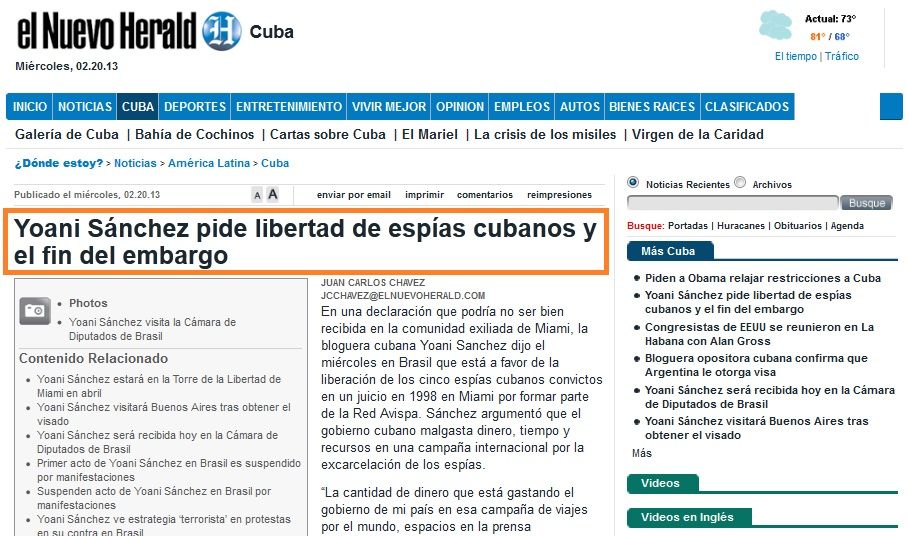
Juan Carlos Chavez of El Nuevo Herald on Wednesday wrote an article titled "Yoani Sanchez calls for release of Cuban spies and the end to the embargo." (The Herald article follows the reporting of a Spanish journalist who blogs about Cuba at Punt de Vista.) Interestingly, the original Herald article begins with a forwarning:

"In a statement that might not be well-received in the exile community of Miami, the Cuban blogger Yoani Sanchez said on Wednesday in Brazil that she is in favor of the liberation of the [Cuban Five]."

Unfortunately, Yoani Sanchez didn't say this. If one views video of her full comments, Sanchez states that she would "prefer" the liberation of the Cuban Five IF their freedom would lead to revenue and attention re-directed back to important educational priorities in Cuba.

The Herald has now attempted to correct their error with a new article titled "Blogger Yoani Sanchez says comment on ‘Cuban Five’ was ironic, misunderstood." This comes after Sanchez posted a response to the Herald article through her facebook account. But, if anyone knows the hard-liners in the exile community (as Juan Carlos Chavez knows), a correction or clarification sometimes isn't good enough. With Yoani Sanchez now scheduled to be at the Miami Freedom Tower in April, many Cuban exiles (especially the hard-liners who never trusted her, and might never trust her now) will most likely protest the event.

Way to go Miami Herald.

Monday, July 23, 2012

Oswaldo Payá Sardiñas (1952 - 2012) [Updated]

According to reports from witnesses and family, Cuban dissident Oswaldo Payá Sardiñas died Sunday (July 22) afternoon in a car accident near the city of Bayamo. According to the Cuban website CubaDebate, the accident occurred around 1:50 p.m., 14 miles from Bayamo. Another passenger, Harold Cepero Escalante, died in the crash and two others survived.

As expected, there are already conflicting reports about the cause of the car accident. CubaDebate reports the car "lost control and crashed into a tree" based on eyewitnesses. But, according to Cuban blogger Yoani Sanchez, Paya's vehicle "was hit by another [car] and went off the road" according to witnesses. Oswaldo Payá's daughter, Rosa Maria, also makes the assertion that the car was intentionally hit based on "information we received from the young men who were traveling with [Payá]."

Investigations are currently underway.

In 2002, Oswaldo Payá became one of Cuba's best known dissidents when he led a petition campaign, the Varela Project, for political reforms and collected over 11,000 signatures. Days later, Jimmy Carter visited Cuba and mentioned the Varela Project during a nationally televised speech at the University of Havana. In 2003, the Varela Project was able to collect over 14,000 signatures in its continued campaign for political reforms.

In Miami, the Varela Project was rejected by Cuban exile militants and hard-liners who felt that petitioning within the legal system would create "a dangerous legitimation of the dictatorship." For some militants it was total betrayal. In its detail and character, the Varela Project also posed a philosophical challenge to post-Castro transition plans designed by Miami hard-liners who reject ideas of amnesty and forgiveness of past crimes.

Now, in response to Payá's death, many will debate where the Varela Project stands. In recent public comments, Cuban exile Marcelino Miyares has said that "the moment of the [Varela] Project has passed. I don't think it will have a resurrection."

--- [Update 1] ---

Recent reports reveal that Oswaldo Payá had been in another car accident last month in Havana. According to Oswaldo's brother Carlos, Oswaldo was riding in a van that flipped over after being hit by another car. Oswaldo suffered only bruises, and did not inform the international media out of prudence. Carlos is demanding an investigation to clarify what happened yesterday. On the other hand, Oswaldo Paya's widow, Ofelia Acevedo, is rejecting reports that Payá's car lost control, and believes that the car was intentionally attacked by another vehicle. She cites "friends" that have heard this information directly from the survivors of the car accident.

The two survivors of the car accident that killed Oswaldo Payá have been identified as Ángel Carromero and Jens Aron Modig, both associated with political organizations wishing to cooperate with Cuban dissidents. According to this report from Spain, Carromero was driving at the time of the accident, but was released from the Bayamo hospital with only a minor head injury. Carromero has been in contact with friends in Spain and being accompanied by Álvaro Kirpatrick, Spanish Consul in Havana. Carromero has already his eyewitness account to police in Cuba, but has yet to make public statements to the media.

Nevertheless, Spanish-language media is already presenting Oswaldo Payá's death as "premeditated." Telemundo 51 and Univision 23 both use the word "premeditated" in their reports to describe the car accident. On the radio today, Ramon Saul Sanchez described the car accident as part of a "gradual extermination" of Cuban dissidents. And Diario Las Americas today describes yesterday's tragedy as what "responsible people call a provoked accident."

An online poll conducted yesterday by Telemundo 51 showed that 93% of viewers (from over 200 votes) believe the death of Oswaldo Payá was "premeditated."

--- [Update 2] ---

The reported driver of the car which crashed on Sunday, killing Cuban dissident Oswaldo Payá, is still in the city of Bayamo and being questioned by police. According to recent reports, Ángel Carromero again has been questioned about the tragic accident and being kept in Bayamo until investigations are complete. He is still being accompanied by Álvaro Kirpatrick, Spanish Consul in Havana.

Interestingly, but not yet confirmed, a recent Univision article reports that Carromero "did not see a traffic sign to reduce speed. For that reason he lost control of the vehicle and fell by an incline." The local website Cafe Fuerte has also found two photos of the crashed vehicle that killed Payá and Harold Cepero. The damage looks like the car did indeed hit a tree near the back, killing both Payá and Cepero who reportedly sat in the back.

--- [Update 3] ---

A report from Reuters (Rosa Tania Valdes) cites "european diplomats" close to survivors of the crash confirming the crash was accidental: "The diplomats, who asked not to be identified, said it appeared the vehicle, traveling at well above the speed limit, hit a large pot hole, veered off the road and hit a tree." It also appears that the driver, Ángel Carromero, may also face criminal charges of reckless driving and involuntary manslaughter.

--- [Update 4] ---

On Friday (July 27), the Cuban Interior Ministry released an official statement (BBC/Miami Herald) concerning the car crash that killed Cuban dissidents Oswaldo Payá and Harold Cepero earlier this week. According to the statement, Ángel Carromero was driving the vehicle carrying Oswaldo Payá and Harold Cepero in the backseat. Another passenger, Jens Aron Modig, was sitting in the front passenger seat, asleep just before the accident. The car spun out of control after it suddenly stopped on top of an unpaved road under construction, hitting a tree and fatally injuring Payá and Cepero. It is suspected that the car was traveling over 70 mph.

The details of the crash were prepared by four experts in Cuba, each with over 8 years of experience in different fields. The statement provides the names of the experts and the Cuban eyewitnesses that provided statements to the police. The note ends stating that official investigations are still underway.

In response, the widow of Oswaldo Payá, Ofelia Acevedo, has rejected the official note and is demanding to speak with the survivors of the crash (who remain in Cuba while the investigation is underway), and a review of the evidence by independent experts in Cuba.

--- [Update 5] ---

On Monday (July 30), the Cuban government arranged a press conference allowing survivor of the crash Aron Modig to answer questions for the international press. Modig, who was asleep just before the accident, told reporters he had no recollection of a second vehicle involved in the crash. He also assured the press that his statements were sincere and would not change when he leaves Cuba. Modig explained that his goals inside Cuba were to help organize a youth-led version of Oswaldo Payá's Christian Liberation Movement. He planned to donate thousands of dollars to those dissidents. Modig later apologized saying he didn't know it was illegal to fund a dissident movement inside Cuba.

The press conference (edited video) also included a video presentation with recorded statements by Modig, Ángel Carromero, the other crash survivor, and a computer-generated reconstruction of the accident. In the video, Carromero stated that there was no second vehicle involved in the crash and that he had simply lost control of the vehicle after braking on a gravel section of an unfinished road. He also confirmed that Modig and himself planned to help organize a youth-led dissident movement, and visit dissidents with Payá in Santiago de Cuba. [Sources: Miami Herald/BBC/BBC Mundo (includes video)]

--- [Update 6] ---

On July 31, Ángel Carromero was officially charged with "homicide while driving a vehicle on public roads" and now faces one to ten years in prison. Meanwhile in Madrid, investigations found that Carromero had committed several traffic infractions (45 fines since March 2011, including 3 for speeding) and was notified last May that his license faced suspension. On August 9 his license was officially suspended.

The other survivor of the tragic accident, Aron Modig, gave his first interview since leaving Cuba to a Swedish newspaper. It was published on August 10 (Google English translation/Spanish translation), and reveals some important details of Modig's experience after the crash. Modig, clearly free from any form of persuasion, reiterated that he was asleep just before the accident and only remembers seeing the car out of control before he lost consciousness. Modig describes being regularly interrogated by Cuban police about his plans in Cuba (but not about the accident), and confined five days in a house where he was kept until his appearance before the international press. Modig was allowed to leave the country thereafter. Modig says he's very concerned about Ángel Carromero in Cuba.

In Spain, International Cooperation Secretary of State for Ibero-America Jesús Gracia Aldaz has publicly stated that he is optimistic in getting Carromero released from prison, and working with the Cuban government to achieve this despite "difficult" relations over the years.

[Official biography of Oswaldo Payá Sardiñas]

[Tracy Eaton from Along the Malecon blog interviewed Oswaldo Payá last year at length. It is here in Spanish.]

[Photo by Getty Images / Oswaldo Payá posing by a sculpture that represents the oppression of the Cuban people on December 13, 2002 in Havana.]

Friday, January 20, 2012

Wilman Villar Mendoza (1980-2012)


"Villar Mendoza was charged with 'contempt' (desacato) and sentenced to four years in prison in a hearing that lasted less than an hour, his wife told Human Rights Watch. While she was allowed to attend the trial, dissidents who tried to enter the courtroom were denied access. Villar Mendoza was not given the opportunity to speak in his defense, nor was he represented by a defense lawyer, she said. His wife said he initiated his hunger strike to protest his unjust trial and imprisonment."

[Video of demonstration that landed Villar in jail, courtesy of Directorio Cubano Democratico]

Friday, October 28, 2011

"The Murder of Laura Pollán" (Part 3)

Yesterday, Rep. Mario Diaz-Balart appeared on Radio Mambi with Ninoska Perez-Castellon. He was there to talk about the recent passage of H.R. 674, but also made comments about the death of Laura Pollán. Rep. Diaz-Balart said that despite not having any evidence to prove that Pollán was murdered by the Cuban government, he still believed that she was. Lately, this has been the position of many in Miami. And, it makes for good propaganda*.

Just like Rep. Mario Diaz-Balart, Nancy Perez Crespo, radio show host on WWFE 670AM, made the same claim. Earlier this week on her 2pm show, Perez Crespo (photo above, lower right) acknowledged that she had no hard facts to prove that Laura Pollán was murdered, and had to rely on certain assumptions. She began to explain to listeners how Cuba is a closed society with a government-controlled press which makes it hard to find reliable and credible sources. And, she added that sometimes exiles in Miami have to rely on anonymous sources for news in order to protect those sources from government retaliation. What a bad excuse.

First, in the case of Laura Pollán, all sources of information concerning her death and allegations of dissidents being injected with a toxic substances have come from named sources. There are no anonymous sources in this case. Second, the use of anonymous sources by exiles in Miami is rare. Over the past few years, independent news sources from Cuba have become part of our online world, where it is very hard to keep anonymity for long (just ask me).

Nevertheless, despite the lack of evidence and neglect for the burden of proof, many still insist that Laura Pollán was murdered. If you attended last Friday's act of remembrance for Laura Pollán in Coral Gables you heard repeated claims (video) that Pollán was "killed" (by Sylvia Iriondo, President of M.A.R por Cuba), or "strangled by a murderous hand" (by Cary Roque, ex-political prisoner), or chanting of "murderers." Also this week, Rep. David Rivera (FL-25) of South Florida spoke about the "ruthless murder by the Castro dictatorship" of Laura Pollán on the House floor (video). (He got the date wrong saying "last Friday," but facts seem trivial at this point.)

So why do hard-liners persist on this claim?

After decades insisting (and investing into the narrative) that the Cuban government is a ruthless and evil force on the planet, after blaming tragic acts solely on the Cuban government, after years and years of propaganda, what explanation is one likely to accept? But, more precisely, what explanation is acceptable in the exile community? One that is simple and identifies the evil perpetrator, or a more complicated one that describes the complexity of a half-century conflict? For someone who identifies oneself as an "exile," there seems to be little room for a complicated story about why one has struggled for so many years "in exile."

[Video of Sylvia Iriondo's speech at act of remembrance for Laura Pollán in Coral Gables.]
[*Definition and characteristics of propaganda are described by Jay Black.]

[Part One]
[Part Two]

Thursday, October 20, 2011

"The Murder of Laura Pollán" (Part 2)

Because Laura Pollán's death was reported late Friday evening (some believing deliberately so), it wasn't until Monday when Pollán's murder theory was presented. Roberto Rodriguez Tejera and Helen Aguirre Ferre probably heard Armando Perez Roura (Univision Radio colleague) on Radio Mambi Saturday make the bold and baseless claim that Laura Pollán was murdered, and surely they wanted to make the same claim. But, Rodriguez and Ferre are not militants like Perez Roura, and neither is their audience on WQBA 1140AM, so they knew that they had to present some kind of evidence.

CONFIRMATION BIAS*

"... a phenomenon wherein decision makers have been shown to actively seek out and assign more weight to evidence that confirms their hypothesis, and ignore or underweigh evidence that could disconfirm their hypothesis."

So, on Monday at 4pm on WQBA the show "Prohibido Callarse" (Silence is Prohibited) started by announcing a "special program" examining the death of Laura Pollán (You can listen to an excerpt here courtesy of Univision.com). Rodriguez and Ferre had three guests from Cuba on the phone: Carlos Rios Otero (independent journalist for Cubanet), Mercedes Fresneda Castillo (dissident), and Sara Martha Fonseca Quevedo (dissident). Rios Otero mainly spoke as a witness to dissident accounts of ailments following confrontations with Cuban officials during political demonstrations. Both female dissidents, who march alongside the Ladies in White, gave personal testimony to ailments they suffered after confrontations with Cuban officials. Both claimed that during a past confrontation they felt a prick or pierce on their body which they attributed to a toxic injection.

Both ladies also mentioned 2 other female dissidents who have described a variety of ailments following a pricking sensation during past demonstrations: Caridad Caballero Batista and Mayra Morejon Hernandez. Also, Rios Otero reported that dissident Rita Maria Montes de Oca was currently hospitalized due to ailments suffered following a possible toxic injection.

After these testimonies, without any kind of scrutiny or interrogation of them, Roberto Rodriguez Tejera claims "proof" of toxic injections against dissidents by Cuban officials, and therefore "everything seems to indicate" that Laura Pollán was also the victim of a toxic injection before her sudden death.

FACTS

Unfortunately, the whole show was an example of journalistic laziness, manipulation, and lack of ethics. Rodriguez and Ferre's story is actually borrowed (without credit) from a blogger named Angelica Mora. During the time Laura Pollán was hospitalized with a serious respiratory illness, and right before her death, Mora began a two-part post [1 and 2] provoking the possibility that Pollán was secretly injected with a virus. Carlos Rios Otero, Mercedes Fresneda Castillo, Sara Martha Fonseca, Rita Maria Montes de Oca and Mayra Morejon Hernandez all appear in Mora's story.

Also the supposed pricking and ailment stories may be months or years old. Rodriguez or Ferre commit a serious lapse of journalistic ethics by not establishing a timeline of events. In the Univision clip, Mercedes Fresneda mentions getting a blood test after suffering some ailments, but never mentions the date. According to this recently uploaded interview, Mayra Morejon Hernandez was with Fresneda when she claimed to be pricked and her blood tested. It was in 2009. Sara Martha Fonseca mentions she was injected during a march with the Ladies in White, but she's not asked for a date. Fonseca has been marching with the Ladies in White as far back as March 2010 (check bio here).

Carlos Rios Otero is mentioned in the Angelica Mora story because last month he wrote a story called "Toxic Injections" for Cubanet. In the story, Otero writes that "according to reports... many dissidents [during political repression by Cuban officials] have been given injections that have provoked toxic reactions." The reactions are made up of various forms of physical ailments. But, no names of dissidents are given, and no other sources are provided, just "reports" and speculation. On WQBA Otero claimed to have conducted various interviews with dissidents, and the testimony was mostly the same: various ailments followed by alleged injections during a protest. Also, the various ailments suffered are always different from the other, and never the same symptoms.

Finally, the only testimony that seems strongest comes from Mercedes Fresneda. She claims that she received a blood test (in 2009) in response to her ailments and alleged injection. The results of the test showed a high level of lead in her blood. When Roberto Rodriguez Tejera heard this testimony he gasped.

Fortunately, next week is National Lead Poisoning Prevention Week and it should provide the team at WQBA and the show "Prohibido Callarse" (looking at you Roberto and Helen) an opportunity to learn more about lead poisoning, and give us a better clue about why Mercedes Fresneda may have high levels of lead in her body.

According to some basic information about lead poisoning (a "major environmental health problem" in the US), adults are vulnerable to this hazard for various reasons, such as exposure to dust from common renovation activities, especially on home structures older than 1978.

So, quite simply, Rodriguez and Ferre may have highly exaggerated their claims of "proof." And, their theory where "everything seems to indicate" that Pollán was injected by a toxic substance is still merely an allegation no different than Armando Perez Roura's.

Unfortunately for Miami, the (propaganda) damage seems to have been done.

[*Excellent link about confirmation bias.]

[Part One]
[Part Three]

Wednesday, October 19, 2011

"The Murder of Laura Pollán" (Part 1)

If you've been listening to Spanish-language radio in Miami lately, then you might be thinking that Laura Pollán was secretly murdered by the Cuban government. Local Spanish media outlets have waged a strong campaign to convince listeners that this conspiracy is true. But, upon review, the little (if any) facts produced are not convincing. Nevertheless, it seems hard-liners won't be bothered by facts at this point and are only looking for more self-confirmation of who the real murderous enemy is: the Cuban government.

For the past few days, local Spanish news outlets have been making the case that Laura Pollán was indeed infected/murdered by some form of lethal (or near lethal) injection made through a needle, scratch or bite. The Cuban government's motive of course was that Pollán was developing into a powerful enemy of the state. And, since the assumption in Miami is that the Cuban government is only motivated by evil intentions, then it seems logical that Pollán was most likely murdered.

MIAMI PROPAGANDA

As I mentioned in my previous post, the allegation that Laura Pollán was infected with a near lethal virus was being spread by local Spanish news stations since last week. The sources of those allegations were mainly coming from Cuban exiles in Miami. Operating on the assumption of communism's unrelenting evil, the only explanation for Pollán's sudden illness must've been a conspiracy from the common enemy: the Cuban government.

After Pollán's death, it all made more sense allegedly. The gut reaction was that she was "murdered." At least that's how Radio Mambi's Armando Perez Roura (upper right photo above) put it the day after the tragic news broke. But Perez Roura, like other Cuban exile militants, have a war mindset. That is, when it comes to Cuba, they are more likely to view strange and difficult events as part of the battle against the Cuban government. They may have good reasons to be cautious, but looking for facts and evidence are not the priority. Instead, a gut instinct to confront the known enemy is activated.

Before you knew it, the murder allegation soon developed into a theory. Local Spanish radio station WQBA 1140AM (owned by Univision Radio) began their Monday broadcast with a "special program" aimed to convince listeners that Pollán was most likely murdered. Roberto Rodriguez Tejera (former news director of Radio Marti, left on large photo above) and Helen Aguirre Ferre (opinion page editor of Diario Las Americas, right on large photo above), hosts of the 4pm show "Prohibido Callarse" (Silence is Prohibited), introduced witnesses, testimonies, conjectures and coincidences. At the end of the show, they were convinced that no other alternative explanation existed for Laura Pollán's death.

But, their supposedly strongest piece of evidence, an official blood test, doesn't withstand a simple test of proof. Yet, inside Miami's Cuban exile community it is good propaganda.

[Part Two]
[Part Three]

Saturday, October 15, 2011

Laura Pollán (1948 - 2011)

Tragic news came from Cuba yesterday with the announcement that Ladies in White leader Laura Pollán died in a Havana hospital from cardiac arrest. Since October 7 Pollán was being treated at the Calixto Garcia hospital for a serious respiratory illness.

According to interviews by BBC Mundo reporter Fernando Ravsberg, Pollán contracted the Human respiratory syncytial virus (RVS). Recent reports indicate that Pollán's family has cremated her body, while her husband Hector Maseda thanked the doctors who "tried to save my wife's life until the last minute." Berta Soler, another member of the Ladies in White, also made positive comments about the medical treatment Pollán received saying the doctors "are fulfilling their oath to save lives, without concern over ideology."

Meanwhile in Miami, Radio Mambi's Armando Perez Roura (programming director) announced "the murder of Laura Pollán" at the top of today's noon news program "El Grande del Mediodia." Perez Roura, who traditionally introduces the top news stories, made the baseless claim which seems to be resonating inside the Cuban exile community.

(For days now local Spanish news has been spreading the allegation that Laura Pollán may have been deliberately infected with RVS in a Cuban government conspiracy. Fausto Malave for Telemundo51 spread the allegation using interviews with Silvia Iriondo from M.A.R. por Cuba and Janisset Rivero from Directorio Democratico Cubano. Rolando Napoles from AmericaTeVe spread the allegation using interviews with Dr. Julio Cesar Alfonso of local organization Solidaridad Sin Fronteras.)

Last night, upon hearing the tragic news, militant group Vigilia Mambisa made their way to Little Havana's Versailles restaurant where they made a small demonstration. But, they were mainly there to make the 11pm news, where local news stations instinctively flock to when Cuba is the headline. Florida Rep. Ileana Ros-Lehtinen knew the drill, so there she was at Versailles along with Reina Luisa Tamayo, mother of another Cuban dissident who last year died in a Cuban hospital. Telemundo51 reported live from Versailles as the crowd (except Rep. Ros-Lehtinen) chanted "murderers" and "terrorists."

Telemundo51 reporter Adriana Delgado includes interviews with the members of Vigilia Mambisa alleging that Laura Pollán's death was part of a Cuban government conspiracy. Delgado also interviewed Reina Luisa Tamayo who likewise alleges that Pollán was murdered, just like she alleges her son Orlando Zapata Tamayo was murdered. Delgado then interviewed Rep. Ros-Lehtinen who immediately went into how she was "concerned" over the Obama administration's Cuba policy, clearly exploiting this tragic event for political purposes.

None of this surprises me. The most hard-line members of the Cuban exile community never miss an opportunity to take advantage of a tragic (or near tragic) event coming from Cuba. And, that's because they know well that a hard-line position can only be maintained through shocking examples like Pollán's death. Even better if the death or serious injury is linked to the Cuban government. And, when it comes to Cuba, the local news easily makes itself available to the hard-line.

Don't expect to hear in Miami the positive descriptions made by Pollán's husband, or Berta Soler quoted above concerning the treatment Pollán received. It just doesn't fit the Miami narrative against Cuba.

[Along the Malecon blog has video of Laura Pollán before her illness.]

Sunday, May 8, 2011

Controversy Over Death of Juan Wilfredo Soto [Updated]

Cuban dissident Juan Wilfredo Soto Garcia (left) was buried this Sunday, but there is controversy over what lead to his death. Some believe it was the result after being "savagely beaten" by Cuban state security agents, while others attribute his death to unrelated health complications that occurred after his arrest.

Juan Wilfredo was arrested during a protest last Thursday in Santa Clara where, according to some witnesses, he was beaten by security agents. One witness, dissident Guillermo Fariñas, told Radio/TV Marti that Juan Wilfredo was "savagely beaten" while in handcuffs. Supposedly, Juan Wilfredo was then taken to a hospital where he stayed until his death Sunday morning. But, events that happened after his arrest have produced conflicting reports.

According to this report on the El Nuevo Herald website, but attributed to an AFP copy, Juan Wilfredo "was taken by the [state security] agents" to the hospital after his arrest. The original AFP story doesn't include this specific information about how Juan Wilfredo arrived at the hospital. Other news outlets (such as CNN and BBC) have also assumed that Juan Wilfredo was so badly beaten that he was sent to the hospital after the protest due to injuries, and therefore have not reported that Juan Wilfredo was actually taken to the hospital for other reasons.

According this Radio/TV Marti report, Juan Wilfredo was arrested by state agents on Thursday and then "taken home instead of being taken to a jail cell." That information comes from Cuban dissident Idania Yanez Contreras. But, Idania is much more specific in her audio comments linked to the report. She says that Juan Wilfredo was arrested, taken to the hospital by the police because of his already known poor health, and then released home.

Marc Frank for Reuters similarly reports that Juan Wilfredo "was quickly released [by state security agents] but then checked into the Arnaldo Milian Hospital," but Frank doesn't specify by whom. According to Idania, after being taken home Juan Wilfredo's family, concerned over his worsening health, checked him into the hospital on Saturday. Juan Wilfredo was complaining of pain around his kidneys.

Several reports have mentioned Juan Wilfredo's already poor health, stricken with diabetes and hypertension, but Radio/TV Marti also includes "renal insufficiency" among his ailments. According to Marc Frank, "various bloggers close to the government quoted Dr. Ruben Aneiro Medina of the hospital as saying [Juan Wilfredo] Soto died of pancreatitis and kidney failure and there were no signs of physical violence."

But, Radio/TV Marti insists that Juan Wilfredo was a "victim of respiratory failure, caused by the beating ... of police agents." And, several Cuban dissidents have taken a similar position in blaming the Cuban security agents, or the Castro's themselves.

In local news, Telemundo51 has produced a report that constructs a more sinister plot against Juan Wilfredo Soto. According to Telemundo, Juan Wilfredo was already targeted by the Cuban government since July of last year (!) when he was threatened by a security agent who told him: "look out for the consequences that can happen to you." The threat came after Juan Wilfredo showed his solidarity with another Cuban dissident on a hunger strike.

At the conclusion of the Telemundo report, online comments posted on their website are reproduced for viewers alleging that the Cuban government was behind the death of Juan Wilfredo Soto. Undoubtedly, this conspiratorial allegation of murder will be repeated by the most militant in Miami for the next few days.

[Also note that no reports so far have interviewed the family of Juan Wilfredo Soto, and instead have relied on Cuban dissidents.]

- [UPDATE: The family of Juan Wilfredo Soto said that when they took him to the hospital he never mentioned the police beating, nor show signs of having been beaten.]

- [Amnesty International: "The Cuban authorities need to immediately establish an independent inquiry into the causes of Juan Wilfredo Soto's death. If he ultimately died as a result of a police beating in Park Vidal, those responsible must face justice."]

Friday, June 11, 2010

Fariñas versus Radio Mambi [Updated]

An interesting interview/debate occurred this afternoon on Radio Mambi. Guillermo Fariñas, the Cuban dissident currently on a hunger strike (which has already passed 100 days) was interviewed by Ninoska Perez-Castellon today on Radio Mambi, and basically told to explain his recent actions in support of H.R. 4645.

Anya Landua French on The Havana Note blog has some details about what happened, and how some hard-line/militant exiles are surprised by the recent letter by Cuban dissidents in support of this bill.

Click here to hear audio of the Radio Mambi interview with Guillermo Fariñas.

[Excerpt of debate below]

Ninoska: You [Fariñas] have signed a letter supporting the bill [H.R. 4645] to reform [U.S] travel restrictions and promote trade. And this bill is supported by organizations whose only interests... are commercial and not the welfare of the Cuban people. I don't know if you all are aware of that.

Fariñas: We are aware of that Ninoska.

Ninoska: Then you are in agreement that credits be allowed to the [Cuban] regime.

Fariñas: The letter that I signed spoke nothing about credits.

[...]

Ninoska: Yes it does. You didn't see it, but...

Fariñas: The letter I signed says nothing about credits.

Ninoska: Well, the letter where your signature appears supports the bill that is asking it be given...

Fariñas: Supports the bill, but it says nothing about credits.

Ninoska: But Fariñas I'm trying to explain that this letter doesn't say it, but this bill in Congress is seeking to give credits to the Cuban government. [And] that is what the letter says.

[More related posts at the Cuban Triangle here and here.]

Thursday, June 10, 2010

Cuban Dissidents Support H.R. 4645 [Updated]

Haven't seen this reported on Radio Marti yet.

Seventy-four Cuban dissidents have signed a letter in support of H.R. 4646, the Travel Restriction Reform and Export Enhancement Act. This bill was also supported by the Conference of Catholic Bishops [PDF of letter] and Human Rights Watch back in March.

The Havana Note and El Yuma blog have all the details. Ted Henken of El Yuma blog describes some of the names that stand out:

"The bloggers associated with DesdeCuba/VocesCubanas.com Juan Juan Almeida, Claudia Cadelo, Dimas Castellanos, Miriam Celaya, Martha Cortizas, Reinaldo Escobar, Eugenio Leal, Pablo Pacheco, and Yoani Sánchez; the well-known government critics and opposition figures Elizardo Sánchez Santa Cruz, Manuel Cuesta Morúa, Héctor Palacios, Oscar Espinosa Chepe, Miriam Leiva, Guillermo Fariñas, and Félix Bonne Carcassés; leaders of Convivencia (the new on-line project of the original Vitral group) Karina Gálvez, Virgilio Toledo, and Dagoberto Valdés; and the Santiago priest José Conrado."

---[Update]---

Radio Marti has provided not one but TWO reports concerning this letter of support by Cuban dissidents. The first one mentions the letter and some of its more popular signatories, and includes an interview with signatory Dagoberto Valdez, the director of the wonderful online magazine Convivencia (Co-Existence).

The second report is about the Center for Democracy in the Americas (CDA) and their support of the letter. The report includes an interview with Sarah Stephens, executive director of the CDA.

Hooray for Radio Marti! Though they should report more often about how Cubans in general oppose US policy towards Cuba.

Wednesday, November 18, 2009

"Have You No Conscience?"


That's Rep. Lincoln Diaz-Balart [FL-21] from last Monday. It seems that our favorite Congressman from Miami took the time on the House floor to remind everyone of Cuba's oppressed Cuban dissident movement, and comparing their repression to Jewish persecution, and shaming members of the American press for not doing enough to shed light on this genocide.

Rep. Diaz-Balart centered his speech on the health of political dissident Martha Beatriz Roque, who last week was described as gravely ill due to a hunger strike. But, Rep. Diaz-Balart on Monday declared that Roque was "close to death." Yesterday, Roque revealed herself to reporters in Havana who instead described her as "unsteady but far from death."

Huh? This is what happened...

Late last week, Miami Herald reporter Juan O. Tamayo reported about the deteriorating health of Martha Beatriz Roque during a hunger strike which began around Tuesday. (Local Spanish-language news stations America Teve and Telemundo51 also reported on the health of Roque.) The reports described Roque's condition jumping from extremely grave to stable based on examinations by an ambulance crew and one doctor. Tamayo's only source seemed to be political dissident Vladimiro Roca, who was also protesting alongside Roque. Then, on Sunday Roca reported [audio by Radio Marti] on Roque's latest diagnosis by one doctor. The diagnosis included a "sudden case of decompensation" (heart dysfunction by overload), "tachycardia" (abnormal rapid beating of the heart), paleness, sweating, and loss of consciousness.

By Monday morning, Marc Masferrer from the Uncommon Sense blog was convinced that "Cuban Dissident Martha Beatriz Roque is Dying." Masferrer wrote to his readers that this was "not a dramatic exaggeration" but "an accurate assessment of facts on the ground." By Monday evening on the House floor, Rep. Lincoln Diaz-Balart was also convinced that this was the case. (Rep. Diaz-Balart also clearly exaggerated the number of dissidents on a hunger strike with Roque as "dozens" when all reports indicate less than ten) Therefore, he wondered why there was no media coverage about the dying Roque and asked:

"Members of the press, have you no conscience? Do not continue to treat the suffering, oppressed people of Cuba, and their heroes, as non-persons. Please do your duty."

I agree, the press must do its duty. Yesterday, after appearing before reporters Martha Beatriz Roque refused to answer specific questions about her health. Reporters must not allow the rumors of her health go unaccounted for. Did she, Vladimiro Roca, or any doctor exaggerate her condition for increased media coverage? Did their hunger strike end because of Rep. Diaz-Balart's inaccurate public statements?

Cuba's dissidents cannot allow their credibility to be tainted. Their actions must be transparent and without doubt about their goals advocating human rights. Neither should their actions be concerned with politicians who exploit their suffering for selfish gain.

Wednesday, October 24, 2007

More Reactions

From International Herald Tribune:

"Our policy really is one of utter sterility," said Wayne Smith, a senior fellow at the Center for International Policy and a onetime chief of mission at the U.S. Interests Section in Havana. "We warn the Cubans not to go for transition but it has already happened, and short of some kind of massive military action, which we're in no position to take, there's nothing that we can do."

John Kavulich, senior policy adviser at the U.S.-Cuba Trade and Economic Council, said the administration demands would most likely be nonstarters. He said the technology and educational opportunities Bush offered are being provided to Cuba by Venezuela and China.

Bush has remained largely silent, [Phil] Peters said, while Raúl Castro consolidated his control over Cuban institutions by establishing his own relationships with world leaders and opening dialogue with the Cuban people.

Meanwhile, the doomsday scenarios predicted for Cuba once Fidel Castro left power - a violent uprising by dissidents and an exodus of Cuban refugees - never materialized. "The administration realized they had missed the boat," Peters said. "Succession has already happened."

From Associated Press(Will Weissert):

"I really hoped for something more," said dissident economist Oscar Espinosa Chepe. "Change in Cuba will never be radical and happen overnight like President Bush said."

He said he would like the U.S. embargo loosened to let Cuban-Americans travel more freely to the island and suggested it shouldn't rule out talks with Raul Castro, who has shown signs of being open to some economic reforms.

"The United States negotiated with North Korea and the results were something positive. I don't see why they can't negotiate with Cuba."

But another leading dissident, Martha Beatriz Roque, said she was pleased that Bush said Cubans themselves must bring about change. "There's no intention to invade Cuba," she said. "That's important, because the Cuban government wants to make us believe there is."

From Associated Press (Ben Feller):

"The president, in his commendable desire to make Cuba free, has unwittingly made it more likely that both Raul and Fidel will celebrate the revolution's 50th anniversary in January 2009," [Vicky] Huddleston said. "And Fidel — aging and infirm — will probably be around to celebrate having outmaneuvered two Bush administrations and 10 American presidents."

From UK Member of Parliament Colin Burgon:

"The ignorance of international law of the current US President is very well known. However, this latest statement on the internal affairs of a Cuba is tantamount to calling for a coup against a sovereign state. The UN position on US interference in Cuba is crystal clear in its condemnation, as is that of the UK government, or so we are told. It is time for our government to state publicly that it cannot be acceptable for the US to dictate affairs in other countries and to remind our special friend of the UN Charter. The arrogance of the US is both worrying and lamentable."

From Cuban Foreign Minister Felipe Perez Roque:

"You will never force us to our knees," Cuban Foreign Minister Felipe Perez Roque said in response to Bush's speech, which came 15 months after ailing leader Fidel Castro handed over power to his brother.

Perez said that was an "invitation to violence" by Bush. "Cuba categorically rejects the stimulation of violence and the invocation of the use of force," he said at a news conference.

Tuesday, February 20, 2007

Definitely Not "Mesa Redonda"

I've been very busy lately, so I have decided to post links to these great round table discussions from the Council on Foreign Relations and the New Democrat Network(NDN).

On January 23, 2007, the Council on Foreign Relations held a round table discussion called: "Cuba After Castro - The Future of US/Cuba Relations." It was moderated by Julia Sweig, who spoke with Jo Ann Emerson, Republican Congresswoman from Missouri, and James P. McGovern, Democrat Congressman from Massachusetts.

On February 7, 2007, the New Democrat Network held a round table discussion called: "After Fidel: A New Day for America's Relations with Cuba and Latin America." It was moderated by Joe Garcia, Senior Vice President of NDN, who spoke with Democrat Congressman William Delahunt, Julia Sweig, from the Council on Foreign Relations, Janice O'Connell, staff member of the Senate Foreign Relations Committee, Sergio Bendixen, president of Bendixen and Associates, and Miriam Leiva, Cuban dissident in Cuba (by phone).

In the NDN discussion with Miriam Leiva, she brings up the possibility of an international effort to help Cuba. This is another argument against the US embargo, it states that the unilateral sanctions on Cuba has actually been an obstacle to finding a multilateral policy. Its a position that many European nations have been supporting for a long time.

"It would also enable friendly countries, such as the European Union members, to devise together with the United States more effective means to assist the Cuban people on the path to democracy."

- Miriam Leiva