[Events from March 1986]
"It appeared that many eggs had been hurled, and some rocks. It appeared that at least one onion had been hurled, hitting the president of the Dade County Young Democrats...
"From noon of that Saturday until about three, when a riot squad was called and the South Florida Peace Coalition physically extracted from the fray, the police had apparently managed to keep the Alpha 66 demonstrators on the Alpha 66 side of the barricades... The two thousand Alpha 66 demonstrators had apparently spent the three hours trying to rush the barricades, tangling with police, and shouting down the folksingers with chants of 'Comunismo no, Democracia si,' and 'Rusia no, Reagan si.'
"The mayor of Miami, Xavier Suarez, had apparently stayed on the Alpha 66 side of the barricades, at one point speaking from the back of a Mazda pickup, a technique he later described in a letter to the [Miami] Herald as 'mingling with the people and expressing my own philosophical agreement with their ideas - as well as my disagreement with the means by which some would implement those ideas.'
"'Unfortunately, they have the right to be on the other side of the street' was what [Xavier Suarez] apparently said as the time, from the back of the Mazda pickup... but the fevers of the moment continued for some weeks to induce a certain exhortatory delirium in the pages of the Herald.
"'I was raised to believe that the right to peaceful dissent was vital to our freedoms,' one such letter read, from a woman who noted that she had been present at the Peace Coalition demonstration... 'Apparently,' she continued, 'some in the Cuban community do not recognize my right.... Evidently, their definition of human rights is not the same as that of the most native-born Americans.'
"Voltaire was quoted, somewhat loosely ('I disagree with what you say, but I will defend to the death your right to say it'), and even Wendell Willkie, the inscription on whose grave marker ('Because we are generous with our freedom, we share our rights with those who disagree with us') was said to be 'our American creed, as spelled out in the Constitution.'
"A Herald columnist, Carl Hiaasen, put the matter even more flatly: 'They have come to the wrong country,' he wrote about those pro-contra demonstrators who had that Saturday afternoon attacked a young man named David Camp, 'a carpenter and stagehand who was born here, and has always considered himslef patriotic... They need to go someplace where they won't have to struggle so painfully with the concept of free speech, or the right to dissent. Someplace where the names of Paine and Jefferson have no meaning, where folks wouldn't know the Bill of Rights if it was stapled to their noses.'"
(p.71-75)
[Didion, Joan. (1987). Miami. New York: Simon and Schuster.]
[Miami-Dade Public Library - FLA 301.4537 d556m]

Tuesday, May 8, 2007

Monday, May 7, 2007
Towards May 11th
 Last week presented some interesting news related to the case of Luis Posada Carriles.
The most surprising was the Miami Herald article revealing that three FBI agents traveled to Havana, Cuba "to interview witnesses, review Cuba's forensic evidence -- including bombing materials -- and visit crime scenes..." concerning the case of Luis Posada Carriles.
That very same day, three leading Cuban-American US Representatives held a press conference condemning the actions of the FBI and the US Justice Department. The three politicians stated that "[t]he only 'evidence' that the terrorist regime in Havana could provide... would be fabricated evidence." The following day the local newspaper Diario Las Americas supported the statements of the three Cuban-American Representatives with an editorial saying:
"Fidel Castro must have had a ball making fun of the tree [sic] FBI agents who went to the Cuban government for information... Unfortunately, when least expected, things like this happen in the United States that have no logical explanation before the nation or international public opinion that knows that the mentioned tyranny rarely tells the truth and even less in matters of this nature."
It seems that Diario Las Americas has little confidence or respect for the information-gathering expertise of the US Department of Justice and its three FBI special agents, and may even doubt their commitment to the security of the nation.
Also on that day (Friday), National Public Radio (by ) followed on the FBI story and reported that the "The Department of Justice has been torn about how to handle [the case of Luis Posada Carriles]." NPR quotes Peter Kornbluh, director of the Cuba Documentation Project at the National Security Archive, saying that "[t]he FBI going down to Havana looks like an indication of the Bush administration's seriousness... [about holding Posada accountable]."
Meanwhile, in the legal front, Radio Mambi reported early last week that Posada Carriles' lawyer, Arturo Hernandez, filed a motion arguing that his client's history with the CIA is relevant to his immigration trial on the 11th. The US government filed their own motion on the contrary, stating that Luis Posada Carriles and the CIA have not had links for more than 30 years, and that his history with the US is irrelevant to his immigration trial.
By Friday last week, Arturo Hernandez attempted another legal maneuver to have his client's 2006 naturalization interview excluded from trial. Hernandez argues that "U.S. officials entrapped Posada during the two-day naturalization interview." It is in this 2006 interview, according to the Department of Justice, that "Posada allegedly made several false statements regarding his March 2005 entry into the United States, including statements about the transportation routes and methods used, as well as individuals who accompanied him."
This week, US News and World Report (by Liz Holloran) publishes an article that describes the general ambivalent sentiments of the media towards the case of Luis Posada Carriles. Hollaran, just like Temple-Raston (NPR), writes that "Posada has been a political hot potato for a slew of U.S. government agencies." She quotes a local Cuban-American saying:
"All the leaders of the counterrevolution should be living free among us... Yes, some people call it terrorism, and unfortunately, some people have to die. But an armed struggle is an armed struggle... [Posada's] heart is still in the right place... You die with your convictions and beliefs."
Luis Posada Carriles is scheduled to go on trial this Friday (May 11th). Several organizations are planning to hold demonstrations in El Paso, Texas, outside the courthouse that day, and possibly as many days as the trial endures. Additional information can be found here.
Luis Posada Carriles' former immigration attorney, Eduardo Soto, is planning to make a movie of his former client's life. He plans to call it: Made in the USA. How touching.
[Addendum: Democracy Now! has an excellent interview with Peter Kornbluh from the National Security Archives. He responds to the recent FBI trip to Cuba:
"[N]ow we have a situation where the FBI is obviously working again with the Cuban authorities to gather information on the hotel bombings, and if Luis Posada is actually indicted in New Jersey, and other co-conspirators from the New Jersey area, of funding and conducting these attacks against the hotels, I do believe that this will be a very, very important statement by the Justice Department to bring terrorists to justice, frankly, and could be a turning point in the history of US-Cuban relations."]
Sunday, May 6, 2007
More on Luis Posada Carriles
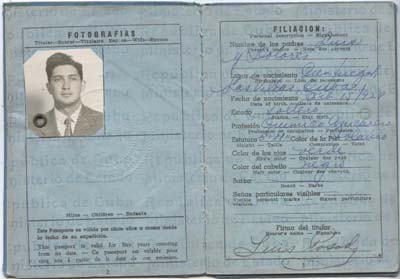 This past Thursday, the National Security Archive posted new information connected to Luis Posada Carriles and his alleged involvement in the Cubana airline bombing of 1976. The newly released documents reveal information gathered by Venezuelan authorities. One document, describing other possible targets for terrorism, was allegedly found in Posada Carriles' Venezuelan office where he employed Hernán Ricardo Lozano.
Another document released by the National Security Archive is an official police report recording the confession of Hernán Ricardo Lozano of the 1976 bombing while working for Luis Posada Carriles' investigation office, Investigaciones Comerciales y Industriales (ICA).
Hernán Ricardo Lozano is reported in the official statement as being "violently against the Castro government" and also mentions Luis Posada Carriles and Orlando Bosch, both of whom were primary suspects at the time by US intelligence services.
Friday, May 4, 2007
Searching for Evidence
The same day that the Miami Herald published their report on cooperation by the FBI and the Cuban government on the case of Luis Posada Carriles, our three favorite US Representatives, Lincoln and Mario Diaz-Balart, and Ileana Ros-Lehtinen, "condemned" the actions of the US Department of Justice.
Today the Herald publishes the statements of the three US Representatives saying:
"By asking a state sponsor of terrorism for 'evidence' regarding terrorism, the Bush administration Justice Department demonstrates a shockingly profound ignorance of the nature of terrorism, of its origins and its state sponsors... The only 'evidence' that the terrorist regime in Havana could provide the United States with regard to the twice-acquitted-in-Venezuela-Mr. Posada or anyone else would be fabricated evidence."
Ironically, the statements above are fabricated as well.
Luis Posada Carriles has NOT been acquitted twice. The Miami Herald points out that Posada Carriles was once acquitted by a military tribunal in Venezuela, but this was for charges of treason and not an investigation on the 1976 bombing. Nevertheless, that military acquittal was annulled when a "higher military court found that the lower one lacked jurisdiction."
The myth of the "twice-acquitted-in-Venezuela-Mr. Posada" has been repeated by many news outlets, even the BBC, but its all false. One need only read the reports.
As for the description of Cuba as a "state sponsor of terrorism," according to the Center for International Policy, the US State Department "actually offers no evidence that Cuba is involved in terrorist activities." Also, the US list of state-sponsors of terrorism "has no set of criteria for inclusion or removal from the list," thus its purely political and arbitrary.
It seems that Lincoln, Mario and Ileana are also guilty of "fabricated evidence."
Today the Herald publishes the statements of the three US Representatives saying:
"By asking a state sponsor of terrorism for 'evidence' regarding terrorism, the Bush administration Justice Department demonstrates a shockingly profound ignorance of the nature of terrorism, of its origins and its state sponsors... The only 'evidence' that the terrorist regime in Havana could provide the United States with regard to the twice-acquitted-in-Venezuela-Mr. Posada or anyone else would be fabricated evidence."
Ironically, the statements above are fabricated as well.
Luis Posada Carriles has NOT been acquitted twice. The Miami Herald points out that Posada Carriles was once acquitted by a military tribunal in Venezuela, but this was for charges of treason and not an investigation on the 1976 bombing. Nevertheless, that military acquittal was annulled when a "higher military court found that the lower one lacked jurisdiction."
The myth of the "twice-acquitted-in-Venezuela-Mr. Posada" has been repeated by many news outlets, even the BBC, but its all false. One need only read the reports.
As for the description of Cuba as a "state sponsor of terrorism," according to the Center for International Policy, the US State Department "actually offers no evidence that Cuba is involved in terrorist activities." Also, the US list of state-sponsors of terrorism "has no set of criteria for inclusion or removal from the list," thus its purely political and arbitrary.
It seems that Lincoln, Mario and Ileana are also guilty of "fabricated evidence."
Thursday, May 3, 2007
FBI, Cuba, and Posada Carriles
 Alfonso Chardy, Jay Weaver and Oscar Corral of the Miami Herald today share new facts on the developing case of Luis Posada Carriles.
Basically adding little and new information from a November 2006 article (by Chardy and Weaver), the Herald reporters write that an "extraordinary effort at cooperation" has taken place between the Cuban government and the FBI. They continue:
"Three federal law enforcement officers familiar with the case described the trip [to Cuba] as 'pretty amazing' and 'unheard of' because Cuba had for years blocked FBI access to witnesses, crime scenes, forensic evidence and more information in the bombing."
There's a good reason that Cuba blocked the FBI in the past. In 1998, the Cuban government invited the FBI to share gathered evidence on terrorism against Cuba originating from Miami. They presented "331 pages, record sheets of 64 known terrorists, 4 hours and 38 minutes of secret filming and 21 telephone interceptions." About 3 months later, the FBI detained the "Cuban Five" (WASP Network) who gathered some of the evidence. By the time the trial against the Five began in 2000, Cuba blocked the FBI from any more investigation.
Chardy, Weaver and Corral write that this time the FBI "agents were able to interview witnesses, review Cuba's forensic evidence -- including bombing materials -- and visit crime scenes."
Most of today's article is based on the Nov. 2006 article that highlights the 10-page affidavit by the Justice Department of June 2005. An FBI special agent, Thomas Rice, is quoted in the affidavit as saying that "the FBI is unable to rule out the possibility that Posada Carriles poses a threat to the national security of the United States." Rice is also reported as describing Posada Carriles "as a dangerous man bent on killing Castro and spreading terror on the communist-run island to destroy its tourism economy." If it is found that Posada Carriles is in fact a "threat to national security," then he runs the risk of being indefinitely detained under the Patriot Act.
The evidence against Posada Carriles that is found in the June 2005 affidavit can be best read in the November 2006 article. In addition, todays online Miami Herald article has links to several PDF's that are worth reading related to the Posada Carriles case.
In the meantime, the federal grand jury in New Jersey continues to gather evidence on the crimes of Luis Posada Carriles, as the latter waits his immigration trial on May 11, in El Paso.
Wednesday, May 2, 2007
In Other News...
Yesterday saw the debut of another local Spanish TV show that will discuss Cuban issues. Here in South Florida there are three local Spanish stations that are not network affiliated: MegaTV, AmericaTeVe, and GenTV. At 8pm, both MegaTV and AmericaTeve compete with local political talk shows, mainly discussing Cuba. Both shows regularly feature supporters of US policy towards Cuba, thus any opposition hardly gets noticed.
We can now add GenTV at 7pm with more support for US policy towards Cuba, and best of all the show is co-hosted by one of the fiercest supporters of the US embargo: Ninoska Perez-Castellon. The show is called Ultima Palabra (Last Word) and follows the blueprint and footsteps of the 8pm shows.
Perez-Castellon, who also has her own show on Radio Mambi, belongs to the Cuban Liberty Council (CLC), a group that opposes "any attempt by any group or political force, inside or outside Cuba, to impose an accord or form of government on the Cuban people that would represent the continuance of the totalitarian regime." This means no negotiation, compromise, or mediation concerning the conflict between Cuba and the US. According to a (December) 2004 interview with Perez-Castellon, the CLC recommended some of the restrictions that followed the (May) 2004 report by the Commission for Assistance to a Free Cuba. One of those restrictions was towards Cuban family travel, which has been denounced by many human rights organizations.
Yesterday on her talk radio show (Ninoska en Mambi - 3pm), Perez-Castellon received a call from a person who was arguing against the Cuban family travel restrictions. He argued that while he was a strong nationalist against Fidel Castro, his first priorities were to his family. Perez-Castellon countered with expressions of the suffering families of political prisoners. "What about them?," she asked.
Despite the strong opposition (64%) to the 2004 Cuban family travel restrictions, Perez-Castellon couldn't care less. As a result, Cuban families that are negatively affected by the restrictions are being held hostage to policy supporters like Perez-Castellon. She has ignored the condemnation of human rights organizations, and wants to force unwillingly Cubans to join her movement. Unfortunately, Ninoska Perez-Castellon has not realized that a forced policy on a population for a "free Cuba" has not been effective for decades, and very likely will never be.
We can now add GenTV at 7pm with more support for US policy towards Cuba, and best of all the show is co-hosted by one of the fiercest supporters of the US embargo: Ninoska Perez-Castellon. The show is called Ultima Palabra (Last Word) and follows the blueprint and footsteps of the 8pm shows.
Perez-Castellon, who also has her own show on Radio Mambi, belongs to the Cuban Liberty Council (CLC), a group that opposes "any attempt by any group or political force, inside or outside Cuba, to impose an accord or form of government on the Cuban people that would represent the continuance of the totalitarian regime." This means no negotiation, compromise, or mediation concerning the conflict between Cuba and the US. According to a (December) 2004 interview with Perez-Castellon, the CLC recommended some of the restrictions that followed the (May) 2004 report by the Commission for Assistance to a Free Cuba. One of those restrictions was towards Cuban family travel, which has been denounced by many human rights organizations.
Yesterday on her talk radio show (Ninoska en Mambi - 3pm), Perez-Castellon received a call from a person who was arguing against the Cuban family travel restrictions. He argued that while he was a strong nationalist against Fidel Castro, his first priorities were to his family. Perez-Castellon countered with expressions of the suffering families of political prisoners. "What about them?," she asked.
Despite the strong opposition (64%) to the 2004 Cuban family travel restrictions, Perez-Castellon couldn't care less. As a result, Cuban families that are negatively affected by the restrictions are being held hostage to policy supporters like Perez-Castellon. She has ignored the condemnation of human rights organizations, and wants to force unwillingly Cubans to join her movement. Unfortunately, Ninoska Perez-Castellon has not realized that a forced policy on a population for a "free Cuba" has not been effective for decades, and very likely will never be.
Posada Carriles News
Earlier this week, Radio Mambi reported that Luis Posada Carriles' lawyer, Arturo Hernandez, believes that his client's history with the CIA is relevant to his upcoming case on immigration fraud and will seek to present that evidence at trial. It seems that it will be argued that the false passport that was found with an alias for Posada Carriles originated from his CIA days. As for the other charges, it is not clear how the CIA is relevant.
As Posada Carriles' May 11th trial approaches, the US government has taken the steps to insure that any information related to the CIA be barred from the immigration trial. According to the AFP, the US federal prosecutors filed a 9-page motion stating that "Posada Carriles's relationship with the Central Intelligence Agency ended more than 30 years ago and that as testimony or questioning about those ties were not relevant to his trial on immigration charges."
It seems that Arturo Hernandez will attempt to ignore that motion.
As Posada Carriles' May 11th trial approaches, the US government has taken the steps to insure that any information related to the CIA be barred from the immigration trial. According to the AFP, the US federal prosecutors filed a 9-page motion stating that "Posada Carriles's relationship with the Central Intelligence Agency ended more than 30 years ago and that as testimony or questioning about those ties were not relevant to his trial on immigration charges."
It seems that Arturo Hernandez will attempt to ignore that motion.
Subscribe to:
Posts (Atom)