Thursday, July 8, 2010

Cuba Will Free 52 Political Prisoners [Updated]

The news yesterday came as a big surprise to almost everyone including Guillermo Fariñas, the hunger striker who in February initially demanded the release of 26 political prisoners reportedly ill. Now, according to Radio Marti, Fariñas will stop his hunger strike once "10 to 12 prisoners" are reported free. But, once Cuban dissident Laura Pollan (photo) heard the news of this possible mass liberation (which includes her husband), she called Fariñas and told him: "Trust a little bit... Stop the hunger strike. You are more valuable alive than dead."

Just like those moments of joy when an expert negotiator successfully gains the release of hostages, yesterday may soon be celebrated as a big political victory for Spain's minister of foreign affairs Miguel Angel Moratinos and Cuba's catholic leader Jaime Ortega for their negotiated release of Amnesty International's Cuban "prisoners of conscience." But, just like a hostage situation, more difficult problems lie in the background that prisoner exchanges cannot solve. The militant or hard-liner would say that the problem is simply solved through force or coercion, while others may propose less rigid alternatives. Spain's Miguel Angel Moratinos has chosen dialogue, and has scored big. Here in Miami we should expect a devastating blow to militancy.

So what does Cuba gain from releasing 52 political prisoners who have been unfairly incarcerated since 2003?

Well, we cannot say for certain what details were discussed between Moratinos, Ortega and Raul Castro that led to this possible mass liberation, but there are some hints. The most obvious being the potential end of the European Union's "common position" towards Cuba which Moratinos has vowed to permanently lift. Yesterday, Moratinos made it clear that the "common position" is no longer justified, mainly because before traveling to Cuba Moratinos made a deal with other EU members: "They told me that if the problem of [Cuban political] prisoners was solved the Common Position would be lifted." The EU will be reviewing the "common position" in September after Moratinos delayed the vote from June expecting promising results from the ongoing negotiations. Lifting or revising the "common position" will allow Cuba to extend economic cooperation with EU nations at a time when it desperately needs it.

Thus, focus on the economy is the other possible reason Raul Castro has negotiated this prisoner release. As Cuba expert Jorge I. Dominguez explained last month at a conference that discussed the Cuban economy, finding a solution (albeit short-term) to international condemnation of Cuba's human rights violations was important to achieve a greater goal: "President Raul Castro's desire to focus on problems--such as the economy with its declining growth rate--that are central to his office and remove others that distract from this."

And finally, this is another ideological victory for supporters of increasing dialogue with the Cuban government, especially once all 52 political prisoners are finally freed.[Reports indicate that prisoners are not being forced into exile as a condition for their release, but are free to choose emigration to Spain.] History has shown that the Cuban government has repeatedly sought out favorable partners to negotiate with and address certain problems, such as political prisoners. Mass liberation of Cuban prisoners occurred in the 70s and 90s with different types of negotiating partners, and the potential exists today. But, negotiating the release of prisoners ignores the central problem: historically fraught U.S.-Cuba relations.

The U.S. must eventually accept other political alternatives to using force or coercion against the Cuban government. Negotiation and dialogue are alternatives that may yield good results. So why wait any longer?

[Press Release by the Cuban Catholic Church on the release of political prisoners.]

[Recent list of Amnesty International's Cuban "Prisoners of Conscience," the list includes Ariel Sigler and Darsi Ferrer who were recently freed from prison. Rolando Jimenez Posada is the only prisoner not scheduled to be released.]

[Update: Guillermo Fariñas has ended his hunger strike Thursday, July 8, according to Yoani Sanchez, and other reports from Cuba's dissidents.]

[Photo by Reuters]

Friday, June 11, 2010

Fariñas versus Radio Mambi [Updated]

An interesting interview/debate occurred this afternoon on Radio Mambi. Guillermo Fariñas, the Cuban dissident currently on a hunger strike (which has already passed 100 days) was interviewed by Ninoska Perez-Castellon today on Radio Mambi, and basically told to explain his recent actions in support of H.R. 4645.

Anya Landua French on The Havana Note blog has some details about what happened, and how some hard-line/militant exiles are surprised by the recent letter by Cuban dissidents in support of this bill.

Click here to hear audio of the Radio Mambi interview with Guillermo Fariñas.

[Excerpt of debate below]

Ninoska: You [Fariñas] have signed a letter supporting the bill [H.R. 4645] to reform [U.S] travel restrictions and promote trade. And this bill is supported by organizations whose only interests... are commercial and not the welfare of the Cuban people. I don't know if you all are aware of that.

Fariñas: We are aware of that Ninoska.

Ninoska: Then you are in agreement that credits be allowed to the [Cuban] regime.

Fariñas: The letter that I signed spoke nothing about credits.

[...]

Ninoska: Yes it does. You didn't see it, but...

Fariñas: The letter I signed says nothing about credits.

Ninoska: Well, the letter where your signature appears supports the bill that is asking it be given...

Fariñas: Supports the bill, but it says nothing about credits.

Ninoska: But Fariñas I'm trying to explain that this letter doesn't say it, but this bill in Congress is seeking to give credits to the Cuban government. [And] that is what the letter says.

[More related posts at the Cuban Triangle here and here.]

Thursday, June 10, 2010

Cuban Dissidents Support H.R. 4645 [Updated]

Haven't seen this reported on Radio Marti yet.

Seventy-four Cuban dissidents have signed a letter in support of H.R. 4646, the Travel Restriction Reform and Export Enhancement Act. This bill was also supported by the Conference of Catholic Bishops [PDF of letter] and Human Rights Watch back in March.

The Havana Note and El Yuma blog have all the details. Ted Henken of El Yuma blog describes some of the names that stand out:

"The bloggers associated with DesdeCuba/VocesCubanas.com Juan Juan Almeida, Claudia Cadelo, Dimas Castellanos, Miriam Celaya, Martha Cortizas, Reinaldo Escobar, Eugenio Leal, Pablo Pacheco, and Yoani Sánchez; the well-known government critics and opposition figures Elizardo Sánchez Santa Cruz, Manuel Cuesta Morúa, Héctor Palacios, Oscar Espinosa Chepe, Miriam Leiva, Guillermo Fariñas, and Félix Bonne Carcassés; leaders of Convivencia (the new on-line project of the original Vitral group) Karina Gálvez, Virgilio Toledo, and Dagoberto Valdés; and the Santiago priest José Conrado."

---[Update]---

Radio Marti has provided not one but TWO reports concerning this letter of support by Cuban dissidents. The first one mentions the letter and some of its more popular signatories, and includes an interview with signatory Dagoberto Valdez, the director of the wonderful online magazine Convivencia (Co-Existence).

The second report is about the Center for Democracy in the Americas (CDA) and their support of the letter. The report includes an interview with Sarah Stephens, executive director of the CDA.

Hooray for Radio Marti! Though they should report more often about how Cubans in general oppose US policy towards Cuba.

Wednesday, June 9, 2010

One Last Chance

The Spanish presidency at the Council of the European Union ends this month, and before they leave they want one last chance to change the EU's "common position" towards Cuba. But, it won't be easy, especially when you still have South Florida's favorite Congressmen, Rep. Mario and Lincoln Diaz-Balart, ready to thwart any policy changes towards Cuba.

Of course, there are several factors that will result in any possible change to the EU's policy towards Cuba, some of which were outlined last June. But, the Spanish government is hoping that other European nations will take notice of recent events inside Cuba, namely the Cuban government's negotiations with the Catholic Church to alleviate the harsh conditions of a few political prisoners. Spain's minister of foreign affairs, Miguel Angel Moratinos, believes that the "common position" is not working and that increased dialogue between Cuba and European nations would yield better results to achieve changes inside Cuba. As an example, Moratinos highlights the decrease in the number of political prisoners since Spain's new policy of dialogue with Cuba. (In 2008, the release and exile of four Cuban political prisoners was attributed to talks between Cuban and Spanish diplomats.)

But, this past Saturday the debate over EU policy towards Cuba got a bit nasty.

The EU and the U.S. held their regular bi-annual meeting of the Transatlantic Legislators' Dialogue (TLD) over in Madrid. It was a three-day conference where European and American legislators could discuss important global issues and achieve the goals of "strengthening cooperation" (at least that's part of what the TLD mission entails). Miguel Angel Moratinos was present for Saturday's session on foreign policy which was titled "Reducing Tensions in Distinct Geographic Areas." One of those areas was Cuba, and tensions at the event increased.

Reports are not very clear, but during this meeting Reps. Mario and Lincoln Diaz-Balart made statements in opposition to changing EU policy towards Cuba. According to Lincoln, the statements were directed towards the EU representatives and not at Moratinos. But within the statements was a direct reference to Miguel Angel Moratinos and at some point Mario directs a question to Moratinos asking him a question related to Cuba.

At this point it seems that Moratinos interpreted the protest by the Daiz-Balarts as a personal attack and responded back loudly. Reports indicate that Moratinos described Mario as "ignorant" and later, after the session, continued to insult him. Lincoln's version of the story, which he also repeated for Radio Marti, says that Moratinos spoke with an "insolent and offensive tone." But, today on Radio Mambi, Lincoln told Ninoska Perez-Castellon that Moratinos was so angry he was shaking.

If I were Moratinos I would also have little patience with Reps. Mario and Lincoln Diaz-Balart.

When it comes to Cuba, both Diaz-Balarts are only capable of protest and not dialogue. It is very clear from Lincoln's version of the story that both Diaz-Balart brothers came only to protest Moratinos and not have a dialogue. Promoting dialogue and cooperation with the EU is the ultimate goal of the TLD meetings, and the Diaz-Balart brothers chose to ignore those ideals.

The offensive language by Moratinos towards U.S. Congressmen is unfortunate, but a typical response (familiar in Miami) when one meets an "intransigent" on Cuba policy. This incident should only remind us again that our political decorum should rise above insults and impatience.

--- [Addendum]---

On Thursday, Miguel Angel Moratinos is planning to meet with Cuba's foreign minister Bruno Rodriguez. After that meeting Moratinos will join Spanish president Zapatero at the Vatican where both Spanish diplomats will meet with Pope Benedict XXVI to discuss the human rights situation in Cuba, among other topics. These talks are in preparation for next week's EU decisions to possibly change the "common position" towards Cuba.

Thursday, June 3, 2010

Callous

I won't get into the details over Monday's violent confrontation between the Free Gaza Movement flotilla and the Israeli Defense Forces (IDF). But, I will say that there is a larger context to consider in this case, and it is very likely that the Israeli government violated international law when they intercepted the flotilla.

But, despite the growing global condemnation against the Israeli government, here in Miami some Cuban exiles militants are quickly coming to the defense of the IDF raid. On Wednesday, Radio Mambi's Ninoska Perez Castellon dedicated her entire hour-long show in defense of the IDF raid, and even the Babalu blog has dedicated some posts in support of the raid. For years hardline Cuban exiles have looked at Jewish political intransigence as an inspirational model, even going so far to equate Cuba's internal situation as genocidal.

But, sometimes the level of apologetics for their ideological allies becomes absurd and callous.

On Tuesday, the Nuevo Accion blog, a news and tabloid website about Cuba wrote a post that revealed outright contempt for their readers. They presented recent photos of an injured and bloodied American student Emily Henochowicz. Emily was hit in the eye with a tear gas canister during a demonstration in Jerusalem in support of the Free Gaza flotilla and was photographed bleeding severely from her left eye.

But, according to Nuevo Accion (directed by Aldo Rosado Tuero, above) if you look closely at the photographs "it is not blood, but instead red paint... and what she is holding is a handkerchief completely soaked with red paint."

Of course, don't expect Nuevo Accion to provide any convincing evidence for their callous accusation. Instead, Nuevo Accion expects you to believe that the mainstream media is conspiring against the Israeli government.

If there is one consistent characteristic of militant ideology, it is their constant perception of conspiracy by an overwhelming enemy, regardless of any contrary evidence.

[More information on Emily Henochowicz's condition.]

Tuesday, June 1, 2010

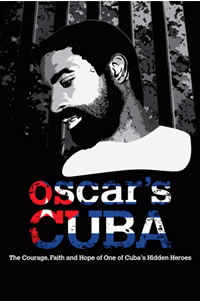
Film Review: Oscar's Cuba

Last month I went to the Tower Theater in Little Havana and saw the documentary Oscar's Cuba directed by Jordan Allott and John Gyovai. In sum, it was a decent hour-long introduction to a few of Cuba's old and new dissidents, with Oscar Elias Biscet (now serving a 25-year sentence since 2002) as its central figure. But, the project clearly suffers from the fact that independent film-making inside Cuba is difficult (due to its politically repressive climate) and therefore had to be shot clandestinely, and the obvious fact that its central character is behind bars and was unable to directly participate with the filming. As a result, the documentary is not really about Oscar Elias Biscet, but instead about the general hardships of Cuba's internal dissidents which Oscar's story seems to symbolize.

But why Oscar?

This is a question I immediately asked myself after noticing that the documentary spent a considerable amount of time NOT talking about Oscar Elias Biscet. Instead, the film included interviews with several other Cuban dissidents not related to Oscar's story, such as young dissidents Yoani Sanchez, Claudia Caudelo, Gorki Aguilar, and older ones like Armando Valladares and Oswaldo Paya. And, the film dedicated time to Cuba's 2003 Black Spring and the Ladies in White movement, both events not related to Oscar Elias Biscet. In fact, given the attention other dissidents received, the film could have easily been titled "Yoani's Cuba" or "Oswaldo's Cuba."

But, after some research, it soon became apparent why Oscar Elias Biscet became the central figure: Biscet is a pro-life activist that compares abortion to genocide. And this is also the main reason why many other people, namely "conservatives," support Oscar Elias Biscet.

Jordan Allott, the film's co-director and executive producer, has mentioned repeatedly in interviews and speeches that he became aware of Cuba's internal dissidents through the pro-life activism of Oscar Elias Biscet. Jordan Allott and his twin brother Daniel (associate producer of Oscar's Cuba) are both pro-life activists themselves. Jordan and Daniel make faith-inspired documentaries for In Altum Productions, while Daniel also works for the non-profit organization American Values, which mainly writes articles for "conservative" magazines and declares that "from any perspective abortion is wrong."

As a result, fund-raising and promotion for Oscar's Cuba has mainly occurred within "conservative" circles, such as writing articles for the American Spectator and networking with hardline Cuban exiles, such as Rep. Lincoln Diaz-Balart. In fact, after a successful fund-raising event in Miami last year, Jordan Allott was able to include interviews from three of the most hardline, pro-embargo activists in the U.S.: former Cuban political prisoner Armando Valladares, former Interest Section chief James Cason, and Rep. Chris Smith of New Jersey. Just like Allott, Rep. Smith is a big supporter of Oscar Elias Biscet, and is also pro-life.

Therefore, the film presents a very specific, hardline perspective about Cuba's internal political repression: that the Cuban government strictly represses dissent without restraint on its brutality or sympathy for its victims or families.

But, the truth is more complex than that. Over the years, Cuba has dealt with political prisoners very differently, sometimes negotiating their release with Cuban exiles, or with other foreign governments. And, as we can see now, the Cuban government is also open to negotiating prisoners with the American government, or even their prison conditions with the Catholic Church in Cuba. This long history is not mentioned in the Allott documentary.

Instead, when I left the Tower Theater after the film had finished I felt depressed. Oscar's Cuba left the impression that there was virtually little hope for Cuba's political prisoners. And, the few internal dissidents mentioned in the film also revealed how little influence they have inside Cuba's repressive system.

But, the documentary's official website gives us some suggestions on how to help Cuba's political prisoners. Let's review those suggestions:

1) Spread the word and hold a screening of Oscar's Cuba - In my opinion this would not be much help because the film is depressing without a larger context, and it would be difficult to place Cuba's political prisoners over greater world concerns, such as global poverty and international tensions.

2) Get political - This section of the website suggests writing letters to the U.S. and Cuban governments, and human rights organizations. This is better than the first suggestion, but the U.S. government holds zero influence in these matters due to its hardline position on Cuba. The Cuban government itself is unlikely to make any changes because the general Cuban population is not concerned over its political prisoners. And, human rights organizations are also generally ignored by the Cuban government.

3) Pray - It couldn't hurt, but its already been over 7 years (!) for those political prisoners arrested in the Black Spring.

The awful truth is that our hands (in the U.S.) are tied. The fate of Cuba's political prisoners depends on changes inside Cuba, and the hope that someone will effectively transmit how prisoners and their families suffer to the ears of the Cuban government.


--- [Addendum] ---

There's a great short documentary about Cuba dissident Oswaldo Paya called Dissident: Oswaldo Paya and the Varela Project [Video: Part 1 and 2]. It packs so much in just 10 minutes. It was directed by Heidi Ewing and Produced by Rachel Grady, the same team that has since made other wonderful documentaries.

Friday, April 2, 2010

Throwing Money at the Problem [Updated]

As usual, the Cuban Triangle by Phil Peters provides essential information about Cuba and U.S. policy towards Cuba, and two recent posts made me think about how expensive U.S. policy towards Cuba can be, and without any measure of its effectiveness.

In this post, Peters notices that the 20th(!) anniversary of TV Marti, the U.S.-funded television station that transmits a variety of programs to Cuba (and which seems to lack an audience), passed last week without anyone else noticing. Surprised? (I myself couldn't find any mention of it on their website, or in the archives.) "But the program chugs on, about $10 million per year, a monument to the idea that in this corner of U.S. foreign policy, intentions can count for more than results," concludes Peters.

[Radio and TV Marti's estimated budget last year was $34.8 million, this year the Office of Cuba Broadcasting has requested $32.4 million [PDF, Broadcasting Board of Governors 2010 budget requests]

And in an earlier post, Peters notes how USAID, the government-funded agency that provides "foreign assistance" to a host of countries, has proposed $20 million for "civil society initiatives" inside Cuba. Peters links to a copy of the budget plan [PDF] and it seems that $1.7 million will be directed towards Cuba's political prisoners and their families, such as the Ladies in White. (One can immediately imagine how the Cuban government will react to this plan.)

Other funds go to organizations like Freedom House and the International Republican Institute. But, Peters argues that President Obama should restore "people-to-people" licenses (suspended since 2003) and allow American civil society to travel to Cuba, and do for free what we are now paying millions for without any indication of effectiveness.

But, what concerns me most is the appearance that USAID is essentially funding Cuba's dissident groups, and this can become problematic on many levels. But, most importantly how do Americans feel about their government supporting a dissident movement in Cuba?

One analysis of polling data found that American don't really approve of government support towards dissidents of a non-democratic country. Instead, a majority of Americans seem to favor democracy-promoting efforts that are more cooperative and (not surprisingly) multilateral in nature towards countries that are headed towards democracy.

---[Update]---

The Cuban Triangle links to a recent article from Laura Rozen at Politico describing the temporary hold on USAID initiatives towards Cuba. The article says that the Cuba plans are under review and quotes a "former senior State Department official" saying:

"These are counterproductive programs...are completely ineffective coming from the U.S.," the former official said. They are done in a "ham-handed" way that is ineffectual and causes a backlash against the [Cuban] civil society activists they intend to support.