Friday, March 7, 2008

Comments by John McAuliff

[Below are excellent comments by John McAuliff, executive director of the Fund for Reconciliation and Development, from a recent Brookings conference on Cuba. (Unedited transcript PDF)]

When Americans go to Cuba, they see a complex reality, not the ideological hero of the left or the ideological villain of the right. They meet Cubans who have all kinds of views and are prepared to talk about those views. They begin to recognize the role of nationalism and the respect for sovereignty in the dynamic. This is not a history that begins in '59; it's a history that begins in the 19th Century or the 18th Century and certainly was a major factor in the development of Cuban self-awareness throughout the 20th Century. It is not the same country as portrayed by exiles who have their own agenda.

Now, I'm Irish-American. I portrayed the Brits' role in Northern Ireland to equal one-sidedness, as I hear Cuba now described today, but that's not the reality and that's not what Americans need to be knowing if they're trying to determine their country's policies.

It's also totally inconsistent for [the US] to have this policy towards [no] other country in the world. No other country suffers from this travel restriction, whether it is a country that [has] virtually the same political system, [or] legal system -- [such as] China or Vietnam. [T]he U.S. is a leading source of tourists to Vietnam today aside from China, which is a next door neighbor. And Vietnam's political system is not so different than Cuba's. We don't object in an organized fashion to the Vietnamese party or the state, [and] that doesn't inhibit our tourists at all. There are other countries that are far worse that you can go to [such as] North Korea, Saudi Arabia, Iran. Also, our limits on travel... give attention to a special interest group. As intense as its feelings are, it's a tiny percentage of the American population. It's even now a minority of it's own population. It does not reflect two-thirds of Americans who think we should have normal relations with Cuba and believe there should no longer be travel restrictions, nor does it, as I said, reflect the 40 percent that would travel there on vacation, nor the 55 percent of Cuban-Americans that think all restrictions should be ended, not just the revenue restrictions.

According to the [latest] GAO report [WP article], 120,000 Americans every year go to Cuba through third countries without any license. A lot of those are Cuban-Americans, but a lot of them aren't. The Cuban figures have about 40,000 non-Cuban American Americans traveling there and it cannot be controlled.

Finally, and I'm still just talking about the United States, the ending of travel restrictions can restore our national reputation faster than anything else. Our policy towards Cuba is as damaging as our war in Iraq. We're considered an arrogant bully ["greatest threat" (PDF)] by much of the hemisphere and much of the world. They think we're obsessed. It's an echo of the Monroe Doctrine, the Platt Amendment, the concept of the Caribbean as a U.S. lake. [O]ther countries share our goals, but they think we [use] silly and counterproductive means; that is, they'd like to see a Cuba more democratic [with] greater respect for human rights, but they think engagement leads to change, [and] isolation doesn't.

Thursday, March 6, 2008

No Better Time Than Now

I think it's a good time for a long hiatus. It seems everybody's in a wait-and-see mood with respect to Cuba. With Raul Castro now officially President, and the Director of US National Intelligence saying that the "political situation probably will remain stable during at least the initial months now that Fidel Castro has handed off power to his brother Raul" [PDF of recent Annual Threat Assessment], now would be a good time for a break.

I personally don't see big changes happening inside Cuba for MANY months to come. The Luis Posada case may get interesting, but I don't see it having a big impact in US/Cuba relations. And, hard-liners in Miami seem more radical than ever, but facing more challenges than ever.

Now, with the Ecuador/Colombia diplomatic conflict growing, but not leading to military violence, hard-liners have shown how isolated and dangerous their thinking is: they support militarism as a just solution to the vast problems they see in South America. According to Armando Perez-Roura (program director of Radio Mambi), "the medicine is armed conflict" (Mar. 4, 2008 - La Noticia y Usted). And, callers to Radio Mambi were virtually unanimous in support because if armed conflict did break out they had "the opportunity" to rid themselves of enemies like Hugo Chavez (President of Venezuela) or Rafael Correa (President of Ecuador). Yeesh!

Inside Cuba, despite the signing of some human rights agreements (with reservations which is usual for many countries, even the US), there's already stories of dissident arrests and unfair trials by the Cuban government. Check the Uncommon Sense Blog.

But, we may see slight changes ahead. So, I will take a back seat.

Honestly, I've been wanting to end this blog since late last year, with the desire to concentrate fully on other interests, but sometimes the blog just draws me in easily. But, now the time is right. So I will be posting about two final matters this week, and then taking a year-long hiatus, after which I may return to review the developments and predictions made by some.

This week's final posts will be about what I think the hard-line strategy will be as we draw closer to the end of the US embargo, and my own thoughts about what I envision to be a good solution to quelling the US/Cuba conflict. These future posts have already been researched, so they are just waiting to be posted, as much as I am anxious to take a break.

I want to say that the support I have received by some readers has been incredibly kind, and much appreciated. This blog served many purposes, and was a growing experience for me throughout. I hope that one lesson that can be drawn from this blog is the idea that regular people in the US can make the effort to understand very complex international issues, avoid those that wish to reduce (or force) its complexity to something conveniently simple, and be able to become an informed citizen capable of independently taking a political position, and even changing position if so necessary.

In essence, to be free.

Wednesday, March 5, 2008

Louder Than Words

Yesterday, the Cuba Journal Blog posted about a recent TV program from Frontline/World on PBS. The short video segment was about a Cuba-based art group called Los Carpinteros (the carpenters) and their success in the international art market. This art group is considered by the renowned Tate galleries in Britain as "among the most important contemporary artists living and working in Cuba" [PDF]. Their work has been exhibited in New York City at the MOMA and Guggenheim Museum, and they have several other exhibitions planned around the world.

Currently, the Montreal Museum of Fine Arts is hosting "the most comprehensive retrospective of Cuban art ever held outside Cuba's borders." The grand exhibition includes Cuban colonial art from the 19th Century to more contemporary pieces, such as work from Los Carpinteros. Diane Foulds for the Boston Globe writes:

"The fact that Canada is hosting the exhibit and not the United States, even though US institutions have larger collections of Cuban art, is a subtle reminder of the price the US public is paying for the embargo."

In 2005, the University of South Florida's Contemporary Art Museum held an impressive survey of the work of Los Carpinteros. Unfortunately, a recent state law now bans Florida public universities from using their funds to travel to Cuba (and other nations selectively designated by the US as terrorist states) for academic purposes. As a result, university museum curators, like Noel Smith from USF, are not allowed to continue their work collaborating with other academics and artists from Cuba's contemporary arts scene. According to Smith, the university travel ban has "been very destructive" to USF's Institute for Research in Art. [The university travel ban is currently being disputed in Florida courts.]

When Frontline/World asked Marc Castillo from Los Carpinteros about politics in Cuba he said:

"I don’t want this country to be conservative and on the right; I’d like it to continue being socialist. But to the leftist fanatics, I would like to tell them that this is not the paradise that they dream it to be. This is a very difficult country, and it needs to change."

When asked specifically about change, he said: "A new government for starters." His partner from Los Carpinteros, Dago Rodriguez, immediately laughs at the suggestion.

But both agreed about US travel restrictions: "I don’t think it’s working in political terms... The only thing it’s doing is cutting the interchange of ideas, which is very important at this moment for this country... For both countries."

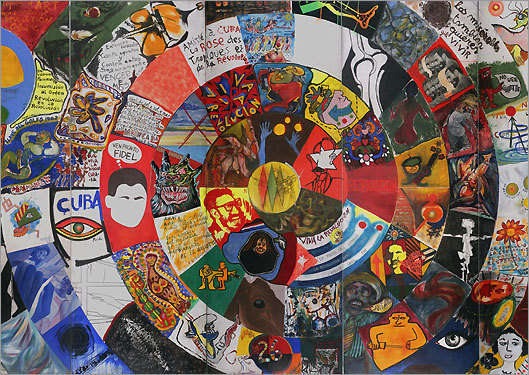
[Photo above of "Salon de Mai Mural" (1967) by Cuban artist Wilfredo Lam and exhibited at the Cuban Art exhibition at the Montreal Museum of Fine Arts. Don't miss Wilfredo Lam currently at the Miami Art Museum.]

Tuesday, March 4, 2008

Hypocrisy? [Updated]

You be the judge.

I've been writing this blog a bit over a year now, and I've been supported and hated. And then there's Antonio De la Cova. Yeah, he's got a Ph.D. and all, but his actions speak louder than his intellect. And, ever since we had our Internet row, I've enlightened myself more about Mr. De la Cova's past actions, and now see why his aberrant behavior is usually ignored by others.

In addition, I recently discovered some information on the Internet that further casts doubt on Mr. De la Cova's reputation. So, I'll set up the evidence and let you decide.

1) Ever since Henry Gomez from the Babalu Blog posted a You Tube video from a profile called "Yabazon" I became suspicious that perhaps this profile belonged to Mr. De la Cova. The video in question was from the late eighties and included a younger Antonio De la Cova. The profile includes other rare video with Antonio De la Cova, and a commercial of a publication that he worked for. Who else would post such videos I asked myself. The "Yabazon" profile also includes a more recent video with Antonio De la Cova on the History Channel. Was "Yabazon" a fan of Mr. De la Cova? Suure.

2) One month later, I notice Mr. De la Cova promoting the videos from "Yabazon" on the Babalu Blog and this raised my suspicions again.

3) Then, last week, I found the connection. After a Google search, I found a Topix internet forum with a comment by "Yabazon." The address underneath it said Bloomington, Indiana. And, as some might know, Mr. De la Cova is from Bloomington, where he is former professor from Indiana University.

All the other pieces fall together. "Yabazon" is Mr. De la Cova. But, this information does not jive with a Mr. De la Cova who gets upset when confronted with anonymous comments. Here's Mr. De la Cova saying: "I do not cowardly hide behind a false name." So I checked out if this is true.

1) On May 26, 2006 Mr. De la Cova commented on the Babalu Blog: "Why do you bother to waste precious time reading Herald blogs? I perused them only once, considered it trash, and have never read them since." But, this didn't stop Mr. De la Cova from leaving an anonymous comment on a Herald Blog on July 13, 2006 as (you guessed it) "Yabazon." It's an obvious comment from Mr. De la Cova, which is VERY long and includes several links to his own website (his usual MO). But, as "Yabazon," Mr. De la Cova gets away with saying that he found his own website after doing a Google search. Slick.

2) The Herald Blogs were not the only victims of "Yabazon." Here's Mr. De la Cova on the Babalu Blog as "Yabazon" commenting on a post which is about HIMSELF. Super slick.

3) "Yabazon" even made a trip over to Los Miquis de Miami Blog. On January 23, 2008 Mr. De la Cova (using his name "Antonio") said "Everything I write on the Babalublog I do so with my last name." Now we know better. But, this didn't stop Mr. De la Cova from commenting as "Yabazon" on February 3, 2008 in his usual manner of citing past personal histories of others (never of himself). And, of course, when someone confronted Mr. De la Cova with anonymous comments on Los Miquis as recently as February 25, he reaffirmed his traditional (but hypocritical) stance that:

"My connections with this blog are only the comments that I leave here, just as at Babalu and other blogs about Cuba, which I do under my own name."

This is the evidence I present. You decide.

---------- Update: April 2008 ----------

To further support the argument that Mr. De la Cova regularly writes using pseudonyms for anonymity, in violation of his own declarations that he does not, here's another recent example:

As mentioned earlier, Mr. De la Cova wrote comments on Los Miquis de Miami Blog on February 3, 2008, first as "Antonio" and later as "Yabazon." As "Yabazon," Mr. De la Cova described Carlos Alberto Montaner as a "hispanófilo," and then went on about Montaner's personal history. On March 30, 2008, Mr. De la Cova made the same remarks describing Montaner again as a "hispanófilo" and mentioning some personal history, but this time under the pseudonym of "Veterano de Ft. Jackson" (veteran of Fort Jackson).

According to Mr. De la Cova's short autobiography (published when he was a professor at Indiana University), he himself "attended boot camp at Fort Jackson" of South Carolina.

[Photo above of Antonio De la Cova from Latin American Studies website.]

Monday, March 3, 2008

Espíritu Combativo

Saturday before last, Alfonso Chardy for the Miami Herald wrote a piece reporting that Alpha 66 "will look to the island's dissidents to help them effect change in Cuba." Part of the headline read: "One of the oldest Cuban exile militant organizations [Alpha 66] will hold its first congress in almost a decade in a bid to reshape strategy for a post-Fidel Castro era."

I was skeptical about Alpha 66 changing its long-held strategy of overthrowing or destabilizing the Cuban government, but now I'm pretty sure that the strategy hasn't changed much at all.

Reporting about an upcoming National Congress in Torrance, California, and yesterday posting a 10-point communiqué on the Cuban Colada Blog, Chardy does point out that Alpha 66 has included a mission of recognition and solidarity "with all those sectors of the opposition who demand their rights from a position of dignity." Of course, that position of "dignity" allows Alpha 66 to be extremely selective on which Cuba dissident groups to collaborate with. Furthermore, this objective allows Alpha 66 to encourage or attract hard-line attitudes within the Cuban opposition, which in turn might create new divisions in the future. A hard-line position also serves to create political dead-ends that create conditions where violence can grow.

Last night on Radio Mambi, an interview with the Secretary General of Alpha 66, Ernesto Diaz Rodriguez (11pm show by Alpha 66), was broadcast to summarize what happened at the recent National Congress in Torrance, California. Diaz Rodriguez called the conference "one of the most magnificent" meetings ever held. A documentary was shown at the conference about Colonel Vicente Méndez, former head for military operations of Alpha 66, who led a "guerrilla force" into Cuba from Miami in 1970, and an operation considered by Alpha 66 as "the turning point in the fight against Fidel Castro and his communist regime." They further explain the importance of this event:

"The landing of Vicente Méndez on April 1970, unsuccessful as it was in its main objective, gave impulse inside Cuba to the idea of fighting communism; the Cuban people understood that in exile there was a force named ALPHA 66 that was fighting for their cause. ALPHA 66 cells began to appear everywhere. A complete underground network took shape and the results were a series of sabotages, bombs in Havana, the burning of sugar warehouses, cane fields, tobacco houses, factories and anything that would harm the oppressive government."

On yesterday's Radio Mambi interview, Diaz Rodriguez affirmed that Alpha 66, as a result of the National Conference, has grown strong in their "combative spirit" and continues their mission for the "total overthrow" of the Cuban government. There was NEVER any mention of collaboration with dissident groups. And, even though Alfonso Chardy wrote that Alpha 66's "dissident outreach program is a symbolic shift away from violence," I still think this is a bit of a stretch.

I believe, due to recent confiscations of large weapons caches, militant exile groups in Miami are being real cautious about subversive activity. It seems that their strategies have now changed to waiting for the "spark" (or some kind of internal destabilization) before launching any "guerrilla forces" into Cuba. In the meantime, groups like Alpha 66 continue to train with weapons at their private camp called "Rumbo Sur" (which may be of more priority than working with dissidents).

I don't see any shift away from violence.

[Photo above of Alpha 66 by Dando Valle]

[Addendum: As recent as last November, Ernesto Diaz Rodriguez said: "Before a gangrenous limb only the scalpel and a timely amputation is the only effective method [of treatment]. The same applies to tyrannies. Tyrants, similar to monsters, are products of nature, perverted and irrational, without conscience, or an ounce of human sensibility. Trapped in a world of aberrant fantasy, they live consumed in egoism and baseness. Their most important inclination is hate; their best weapon, deceit." - November 23, 2007]

The "Un-Fidel"?

Just finished watching Brian Latell, senior research associate at UM's Institute for Cuban and Cuban-American Studies (ICCAS), on C-SPAN at a Heritage Foundation event (MP3 of speech included).

Those familiar with Latell's latest book (considered to include one of the first biographies of Raul Castro) will not be surprised that he spoke mainly about Cuba's new president: Raul Castro. He said that Raul was "the Un-Fidel," and "more flexible... more pragmatic," and open to "structural and conceptual changes" inside Cuba. But, Latell also warned the audience at the Heritage Foundation (which included former US Assistant Secretary of State for Western Hemisphere Affairs Roger Noriega and Frank Calzon from the Center for a Free Cuba) that Raul Castro is "playing with fire" with respect to open debate on the island and raising expectations. He sees unfulfilled promises in the short-term having unpredictable consequences, and therefore there's "no telling where Cuba will be [one] or two years from now."


THE BROOKINGS INSTITUTION

I also noticed that Brookings has a full transcript of an event they held early last month called Cuba: Opportunities and Challenges. The event included several Cuba experts in four different panels. I finished reading the transcript of the first panel, and so far it provides an informative exchange of opinions.

Here's an excerpt from Jaime Suchlicki, director of ICCAS, talking about why we should keep the US embargo, until the Cuban government makes the first move:

"So, change in the policy now without a significant opportunity for change in Cuba, without a significant and irreversible quid pro quo from the Cuban government, would be a denial of 40 years of American foreign policy [and] would send a message to other [governments] in Latin America that we are willing to support a military government in Cuba, that we will be supporting a dictatorship by the succession, and therefore we're willing to start again."

On the same panel, Vicki Huddleston, former Deputy and Coordinator of the State Department’s Office of the Coordinator for Cuban Affairs from 1989-1993 and Principal Officer at the United States Interest Section in Havana from 1999-2002, responds to Suchlicki in the Q&A session citing a different Cuba policy during the 90s:

"More [people] were coming into Cuba, more care packages were coming into Cuba, and more families were able to help their loved ones. And what did that mean? That meant the Cuban people were better off. And what does it mean when the Cuban people are better off? They have greater independence."

"It's not a concession to let people travel to see their families. It's not a concession to get people enough food so they don't want to risk a trip across the Straits. These are the things that empower people, and these are the things that we saw did make a difference in Cuba, and it did lead to [14,000] people signing a petition."

Saturday, March 1, 2008

What Will They Say? (Part 3)

As argued in Part Two, using the word "dictator" to describe world leaders is not just technical, but also emotionally personal and subjective, and sufficient enough to harm a journalist's independence and responsibility to the public if perceived this way. Nevertheless, reporters are human too, and our personal judgments always seem to find their way into our work and behavior.

With this in mind, what will the public say about Fidel Castro when he finally kicks the bucket? Will they call him President? Dictator? Will descriptions be objective, or subjective? Curious myself, I decided to so a small study and make a prediction.

As some may or may not know, Haji Muhammad Suharto of Indonesia died last month after being gravely ill for weeks. Suharto ruled Indonesia for 32 consecutive years before his forced resignation in 1998. His legacy is a controversial one; some accusing him of vast human rights violations (including genocide), others overlooking his mistakes for other social gains. (Sound familiar?) Reviewing how American newspapers described Suharto (as "president" or "dictator") during events of his official resignation and after his death, I believe, may provide a glimpse into how the media will eventually describe Fidel Castro near the end of his life.

I also took the time to review how American newspapers have described Fidel Castro during two past events: his transfer of power to his brother in July 31, 2006 and his recent resignation on February 19th. I used the NewsBank database for this small study, whose results were very interesting and, given the different historical and political backgrounds, open to interpretation.


SUHARTO

The news of Indonesian President Suharto's resignation in May 1998 reached the headlines of many American newspapers. This was mainly due to the fact that Indonesia was hit with "its worst economic crisis in decades" and a student-led movement to oust Suharto soon erupted into looting and massive riots. The origins of the immediate outrage were reported: "... sharp increases in the prices of basic goods and services last week have further impoverished ordinary Indonesians. Anger spilled over into the streets Tuesday after police shot and killed six anti-government protesters at a student rally." As the riots spread, and the death toll continued to rise, US Secretary of State Madeleine Albright intervened to demand Suharto's resignation. He did the next day. Months later it was estimated that over a 1000 people died in the riots in Jakarta and other cities.

I found 335 American newspaper articles reporting Suharto's resignation, including reports of the following two days. Of those reports, only 6% included the word "dictator," while 96% used "president." A closer look showed that some reports referred to Suharto's "autocratic rule" or "ironclad rule."

All of this changed this year when Suharto became gravely ill and died in January. American newspapers paid very little attention this time with only 58 articles found on the day of his death and the following two days. But, somehow reporters felt far more inclined to describe Suharto as a "dictator" and less a "president." Of those 58 articles, 79% used "president" (drop from 96% in 1998) and 59% used "dictator" (rise from 6% in 1998). I also found that more articles used both "president" AND "dictator" during this time (40%, a rise from 6% in 1998).

I believe this change in attitude in the newspapers was due to the revelations that immediately occurred after President Suharto resigned, and the growing public awareness (and extensive documentation) concerning his abuse of power before his final days. After his death, it seems that the media expressed their well-developed outrage over the 32-year governance of President Suharto, as reflected in the increased use of "dictator."


SUHARTO INC. and BEYOND

It was just one year after his resignation that Time magazine published a special 4-month investigative report ("Suharto Inc.") revealing the vast corruption behind Suharto's presidency. According to the report:

"Suharto laid the foundation for the family fortune by establishing the intricate nationwide system of patronage that kept him in power for 32 years. His children, in turn, parlayed their ties to the President into the role of middlemen for government purchases and sales of oil products, plastics, arms, airplane parts and petrochemicals. They held monopolies on the distribution and import of major commodities. They obtained low-interest loans by colluding with or even strong-arming bankers, who were often afraid to ask for repayment."

Time magazine was sued by Suharto afterwards. Despite two lower courts ruling in favor of Time, a final Supreme Court decision in Indonesia sided with Suharto. Time has appealed and stands by their story. But, the Time report was just the beginning. Charges of corruption haunted Suharto while on his deathbed and now haunt his legacy, and family.

The day after Suharto's death, William Pesek of Bloomberg News pointed out how international organizations had already pointed to the culture of corruption left behind by President Suharto, and how that vast corruption revealed itself in the collapse of 1998.

"It's the great Suharto paradox. During his tenure, per- capita income in the fourth-most-populous nation quadrupled and the ratio of those living in absolute poverty declined from more than three people in five to about one in 10 by 1998. Yet Indonesia's development model proved to be a house of cards that crumbled in a matter of months. Perhaps the bigger question is how a nation as resource-rich as Indonesia [with oil, gas, timber] could do so little. This is among Suharto's biggest failings."

Yet, Pesek noticed how Suharto still had strong support among those who felt he helped Indonesia in the economic long-run.

"The nostalgia some feel for the Suharto days is among the most baffling [and maddening] elements of the post-Suharto era. It's all about the 'cult of GDP' that dominates much of Asia. 'Indonesia's political and intellectual poverty, the repressive security apparatus... these were accepted because, economically, Suharto was a hero,' Richard Lloyd Parry wrote in his 2005 book 'In the Time of Madness.' 'However unhappy Indonesians were with their leader, there was no doubt that, under him, most of them had become better off.'"

"It's a phenomenon that political scientists refer to as 'performance legitimacy.' Suharto knew that if Indonesians felt better off, they would tolerate a stunted society."


CROOK AND TYRANT

Unlike Pesek at Bloomberg, the Economist magazine had very tough words for Suharto after his death. They called him "a despot, a cold-war monster cosseted by the West because his most plausible opponents were communists. Behind his pudgily smooth, benign-looking face lay ruthless cruelty. The slaughter as he consolidated his power in the mid-1960s cost hundreds of thousands of lives. Tens of thousands were locked up for years without charge. After the invasion of East Timor in 1975, the Indonesian occupation led to the deaths of perhaps one-third of its people. Meanwhile, he was robbing his own country blind. Perhaps no leader's family anywhere has ever amassed so much ill-gotten loot. When he was forced to quit at last, the economy was in a tailspin and the stability he had boasted of creating proved an illusion."

And, this seems to be the prevailing attitude about the legacy of President Suharto in the US. Even the US-funded Voice of America reported about how the many victims of Suharto's presidency are trying to reclaim their lives from memories of horrific violence and death. Ever since his resignation, the corrupt and bloody history of Suharto's presidency has been well-documented and implanted into the public consciousness. But, for Americans there might be an additional sense of outrage, as it all occurred with approval by the Western powers, especially the US government.


MASS MURDERER

The National Security Archives has been leading the way in providing declassified material concerning US support of the genocide against East Timor. Their Indonesia/East Timor Documentation Project is extensive, and include materials that have served in Truth and Reconciliation programs, resulting in calls for US reparations. The documents reveal a long strategic US relationship of confidence and support with President Suharto, even overlooking a massacre of almost one million alleged communists once Suharto took power.

Concerning the East Timor genocide, a final Truth and Reconciliation commission report found that U.S. "political and military support were fundamental to the Indonesian invasion and occupation" of East Timor from 1975 to 1999. In addition to that, Suharto had a long list of other atrocities and countless victims, whose families, some of which extend into the West, now demand justice. Human Rights Watch believes it is still an opportune time. Thus, it is understandable that some may designate Suharto a "dictator" or a "mass murderer." As Chris Kline, a Western relative of one of Suharto's victims, states:

"I have visited many countries as a foreign correspondent for CNN and Fox, but all my life I have been excluded from Indonesia, because of Suharto. Now that he is gone, I will be able to embrace my own heritage at last. And the man who overthrew my grandfather will take his place beside Pol Pot, Pinochet, Milosevic, Stalin, Idi Amin, Mao and all the other great murderers of their own people."


FIDEL

So what will they say about Fidel? There are very interesting similarities between the two autocrats and one wonders if American newspapers will have the same reaction of outrage upon Fidel Castro's passing. Reviewing how Fidel Castro was described in the papers during two important past events (his transfer of power in 2006, and resignation last month), I found that American newspapers were pretty consistent in using "dictator." In both two events (from over 400 articles), around 30% used "dictator." The use of both "dictator AND president" was between 21% (in 2006) and 26% (in 2008). But, "president" was most used at 50% (in 2006) and 73% (in 2008). In this case, the increased use of "president" in 2008 may indicate the formality of Fidel resigning from a political position, which was also seen in Suharto's case.

Obviously, the political context surrounding Cuba and Indonesia clouds any confidence in making a prediction based on this small study, but I will have a crack at it. I think that unless serious allegations and revelations arise against Fidel Castro between now and his eventual passing there is no indication that news reports will describe him any different than they have so far. The controversial history of Fidel Castro and his government has been covered and examined extensively already, and distributed widely. But, I also believe that media reports may react with some additional outrage at another leader who's legacy and abuse of power may be a very controversial one. Yet, if international political matters remain no different than today, then that outrage may be tempered.

In the end, it may all depend on how informed and consciously aware we are of Cuba's history.

[Photo above of Indonesians celebrating in the news of Suharto's resignation in 1998.]

[Part 1]