Showing posts with label Antonio de la Cova. Show all posts

Thursday, March 13, 2008

Last Words

Finally.

Last post I forgot to include the excellent work of the Center for International Policy through their Cuba Program, and their recommendations for US-Cuba cooperation in drug interdiction. This and other cooperative efforts are found in the recent Melanie Ziegler book, "US-Cuban Cooperation Past, Present and Future."

Anyway, I will be keeping my eye on developments in Cuba and related US policy. There's always something happening. I hope to return in a year to review the developments and prognostications made by US-Cuba observers, namely four of them.
  • Recently, Lt. Gen. Michael Maples, head of the Defense Intelligence Agency, warned the Armed Services Committee that internal Cuban instability "is something we need to watch over the next six or seven months."
  • Last July, Andy Gomez, senior fellow at the Institute for Cuban and Cuban-American Studies, said in a PBS interview: "I say that Raul [Castro]-like many of my colleagues that watch Cuba on a regular basis-Raul's in charge of the day to day operations. Raul's got six months to a year to bring about some positive change. I'm not talking political reform. Minimal economic reforms. If he doesn't, then I dare to say, that you can have a large migration out of Cuba." Gomez predicts a worst case scenario of half a million migrants.
  • Last September, Phil Peters from the Lexington Institute was interviewed on the Maria Elvira Live! show. [Watch the interview here.] He said: "I predict... there's no guarantees, no proof, but the sensation I now have is that there are many things being done [in Cuba] to prepare for an economic change, that within a year we will see initial steps [toward change]. Regardless if Fidel remains alive or not."
  • And then, there's a very dire prediction made by a Cuban historian (hint) who over the phone, last year, told me: "in two years... the blood is gonna flow" in Cuba. Obviously a militant.
So, I look forward to returning. In the meantime, keep updated with the blog list on the side, especially with the Cuban Triangle Blog, and best wishes to all.

Tuesday, March 4, 2008

Hypocrisy? [Updated]

You be the judge.

I've been writing this blog a bit over a year now, and I've been supported and hated. And then there's Antonio De la Cova. Yeah, he's got a Ph.D. and all, but his actions speak louder than his intellect. And, ever since we had our Internet row, I've enlightened myself more about Mr. De la Cova's past actions, and now see why his aberrant behavior is usually ignored by others.

In addition, I recently discovered some information on the Internet that further casts doubt on Mr. De la Cova's reputation. So, I'll set up the evidence and let you decide.

1) Ever since Henry Gomez from the Babalu Blog posted a You Tube video from a profile called "Yabazon" I became suspicious that perhaps this profile belonged to Mr. De la Cova. The video in question was from the late eighties and included a younger Antonio De la Cova. The profile includes other rare video with Antonio De la Cova, and a commercial of a publication that he worked for. Who else would post such videos I asked myself. The "Yabazon" profile also includes a more recent video with Antonio De la Cova on the History Channel. Was "Yabazon" a fan of Mr. De la Cova? Suure.

2) One month later, I notice Mr. De la Cova promoting the videos from "Yabazon" on the Babalu Blog and this raised my suspicions again.

3) Then, last week, I found the connection. After a Google search, I found a Topix internet forum with a comment by "Yabazon." The address underneath it said Bloomington, Indiana. And, as some might know, Mr. De la Cova is from Bloomington, where he is former professor from Indiana University.

All the other pieces fall together. "Yabazon" is Mr. De la Cova. But, this information does not jive with a Mr. De la Cova who gets upset when confronted with anonymous comments. Here's Mr. De la Cova saying: "I do not cowardly hide behind a false name." So I checked out if this is true.

1) On May 26, 2006 Mr. De la Cova commented on the Babalu Blog: "Why do you bother to waste precious time reading Herald blogs? I perused them only once, considered it trash, and have never read them since." But, this didn't stop Mr. De la Cova from leaving an anonymous comment on a Herald Blog on July 13, 2006 as (you guessed it) "Yabazon." It's an obvious comment from Mr. De la Cova, which is VERY long and includes several links to his own website (his usual MO). But, as "Yabazon," Mr. De la Cova gets away with saying that he found his own website after doing a Google search. Slick.

2) The Herald Blogs were not the only victims of "Yabazon." Here's Mr. De la Cova on the Babalu Blog as "Yabazon" commenting on a post which is about HIMSELF. Super slick.

3) "Yabazon" even made a trip over to Los Miquis de Miami Blog. On January 23, 2008 Mr. De la Cova (using his name "Antonio") said "Everything I write on the Babalublog I do so with my last name." Now we know better. But, this didn't stop Mr. De la Cova from commenting as "Yabazon" on February 3, 2008 in his usual manner of citing past personal histories of others (never of himself). And, of course, when someone confronted Mr. De la Cova with anonymous comments on Los Miquis as recently as February 25, he reaffirmed his traditional (but hypocritical) stance that:

"My connections with this blog are only the comments that I leave here, just as at Babalu and other blogs about Cuba, which I do under my own name."

This is the evidence I present. You decide.

---------- Update: April 2008 ----------

To further support the argument that Mr. De la Cova regularly writes using pseudonyms for anonymity, in violation of his own declarations that he does not, here's another recent example:

As mentioned earlier, Mr. De la Cova wrote comments on Los Miquis de Miami Blog on February 3, 2008, first as "Antonio" and later as "Yabazon." As "Yabazon," Mr. De la Cova described Carlos Alberto Montaner as a "hispanófilo," and then went on about Montaner's personal history. On March 30, 2008, Mr. De la Cova made the same remarks describing Montaner again as a "hispanófilo" and mentioning some personal history, but this time under the pseudonym of "Veterano de Ft. Jackson" (veteran of Fort Jackson).

According to Mr. De la Cova's short autobiography (published when he was a professor at Indiana University), he himself "attended boot camp at Fort Jackson" of South Carolina.

[Photo above of Antonio De la Cova from Latin American Studies website.]

Tuesday, September 25, 2007

Getting Personal [Updated]

Last month, I began posting about Antonio Rafael De la Cova, assistant professor at Indiana University, Bloomington, criticizing his academic irresponsibility, his personal attacks on the radio, his factual errors on the internet, and recently his misinterpretations of history.

On August 16, Mr. De la Cova publicly challenged me on my blog:

"If I do not get a direct e-mail and phone response from Mambi Watch and they wish to remain anonymous, it will be obvious that they are monitoring the Cuban exile community on behalf of Fidel Castro’s intelligence service."

For the record, I have met BOTH challenges.

That same day (the 16th), Mr. De la Cova sent an e-mail demanding I give him my phone number so that he can call me. I refused to give my number to a stranger, and so Mr. De la Cova gave me his. Before calling him, I had confessed my personal history to Mr. De la Cova within a series of e-mail exchanges (titled by Mr. De la Cova as "Are you courageous enough to identify yourself?", a confession of which he has now publicly posted on his website. This action alone violates several ethical standards that should already be familiar in our civil society. Furthermore, according to a recent paper in the Kansas Law Review, Mr. De la Cova (by copying my private e-mail response for his personal use) has committed a violation of common law that protects every citizen's privacy rights under the US Constitution. In essence, Mr. De la Cova has violated my privacy rights, despite my arguing on the phone with him that I preferred my name not be publicized.

Needless to say, our phone conversation was quite meaningless as it neither confirmed or falsified Mr. De la Cova's controversial accusations against me, and was an apparent move to further engage in personal attacks. And clearly, a strategy that Mr. De la Cova, and others, desperately engage in.

The internet and Blogosphere [photo above] is certainly new terrain in our civil society with many horror stories and people who seek to preserve what little remains of civility in this new Wild West. I am one who supports such civility, respectable argumentation, and fair debate.

My criticisms of Mr. De la Cova, or anyone else, have been built upon these principles. I have never engaged in a personal attack upon Mr. De la Cova, and have always focused on arguments and evidence presented by the assistant history professor of Indiana University, Bloomington. For Mr. De la Cova to denigrate my personal history and at the same time make several transgressions upon the ethics of our civil society is surely unacceptable.

I condemn the acts of Antonio Rafael de la Cova, Ph.D of History, and hope that he will respect the privacy rights of American citizens, and undue the error he has committed.

Nevertheless, Mr. De la Cova and others have challenged my anonymity, and this is fair. If anyone wishes to know MORE about my personal history they can just e-mail and ask me (hopefully before making any calumnious charges, or taking advantage of my sincerity). I defend my anonymity because of the actions of people like Mr. De la Cova who wish to focus on making personal attacks and obviate from important political issues. While it is important to debate the double standards of esoteric ethics in our society, concentration on personal histories can also lead to a dangerous path of unwarranted surveillance and the collapse of a civil society.

Mambi Watch seeks to avoid the collapse of our public forum of free expression, and will continue to make critical examinations of Miami's hard-line rhetoric along ethical standards. I focus on evidence and arguments, not personal histories and attacks.

These declarations shall always apply on this blog. Now, back to the mission of Mambi Watch.


-----Update: March 2008-----

Looking back on this incident it is clear whose image has been tarnished. Later I found out that Mr. De la Cova already had a long history of illicit behavior, that had I known beforehand I would have ignored his malicious accusations. Mr. De la Cova's tarnished history is long and sorrowful, and he seems willing to drag anyone down to his level. But I won't allow myself to do that.

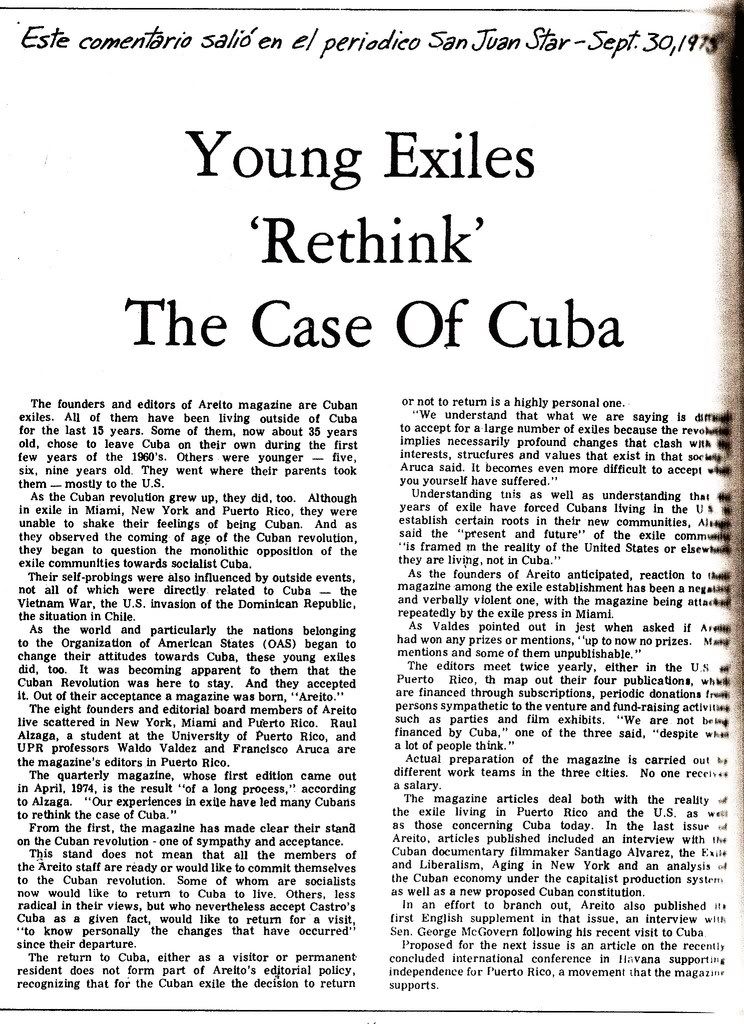
Mr. De la Cova engages in hypocrisy so often that anything he says is meaningless. In my case, while he insinuated that I was a spy, Mr. De la Cova himself has already engaged in espionage himself. Back in 1976, after his arrest, it was revealed that Mr. De la Cova assumed a left-wing persona in order to infiltrate himself into certain groups. His mission was to infiltrate Areito, a magazine that supported the normalization of US-Cuba relations.

A Herald article by Edna Buchanan showed that he assumed the figure of a pro-Palestine militant. At the time, the Cuban government was supporting the pro-Palestinian movement. The Herald provided a photo of Mr. De la Cova in disguise. In a Miami News article, it was revealed that Mr. De la Cova had admitted to an FBI agent (Joseph S. Dawson) that he was trying to infiltrate Areito.

"The [FBI] memo related how De la Cova explained that some students at Florida Atlantic University favored the Castro regime. To penetrate the magazine hierarchy and learn more, De la Cova told Dawson, he had become friendly with some of Areito's leaders."*

So, there's nothing honest about what Mr. De la Cova says. He attempted to defame me by publishing my private e-mail responses to him, and manipulating my words, but its useless. Mr. De la Cova hardly has any credibility.

To make my point, below is part of my e-mail response to Mr. De la Cova that he conveniently left out. It basically summarizes my deep respect for a community that provided love and friendship in difficult times, and whose image I hold up when I envision Miami, unlike the image of hard-liners who support violence, force and intolerance.

[From 8/24/07]

"That's why I will never forget those who opened their arms to my family when we first arrived here in Miami. It's those Cuban families that we shared our lives with that still have impact in our lives today.

"And, that's why I have a fascination with the Cuban community. I have faith that they wish for peace between the US and their homeland, and that they want it peacefully, not by force or violence. That's why I criticize hard-liners that want the opposite. Those who support violence should be the ones who should be most criticized. They are demanding that people make big sacrifices, and that should be strongly examined and critiqued.

"That's the purpose of Mambi Watch. And, since I have been writing about the Miami hard-liners, I've noticed that some argue for irrational objectives for a 'free Cuba' and also outright reject various alternatives for peaceful solutions.

"That's unacceptable, and that will be the work of Mambi Watch to point out."

Thursday, September 20, 2007

You're Wrong Again Mr. De la Cova (Part 2)

Mr. De la Cova's webpage on Thomas Nast is very strange. It's actually part of a larger section titled Nativism and Bigotry on Mr. De la Cova's Latin American Studies website. On this main page, you are presented with six images (three of those images are cartoons) and seven links. The seven links are important to look at.

At the top is the link to Mr. De la Cova's Thomas Nast page. THREE of the links are devoted to white supremacists. One link is outdated, and another takes you to a 1997 International Migration Review article about immigration and Nativism in the US. But, the last link is strangest. It takes you to a 2005 book review about William M. Tweed and his infamous Tweed Ring. It's an obvious connection to Thomas Nast, who's cartoons famously attacked the corruption of Tweed and his Ring. Reading the article, it becomes clear that Mr. De la Cova is using it to point out Nast's "virulently anti-Catholic" attitude and other criticisms of Nast's work against the Tweed Ring.

But, Mr. De la Cova leaves out a lot of history, which is strange coming from a Professor of History.

There's no doubt in anyone's mind that white supremacists are guilty of Nativism and Bigotry. But, as I had pointed out already, Nast was not a total Nativist because he supported the rights of Chinese immigrants, and he himself was an immigrant. Also, everyone at the time (the 19th Century) was guilty of bigotry, even the immigrants. To single out Nast as a bigot leaves out a huge piece of American history.

Nativism, defined as a policy "favoring the interests of established inhabitants over those of immigrants," has a long, long history in the US, leaving Mr. De la Cova's webpage about the subject small and inadequate. In my opinion, its inexcusable since he is a history professor. During the 1800's, Nativism was everywhere, rooted in politics, economics, and race.

Nast's anti-Irish bigotry was was rooted more into politics. He was a staunch Republican favoring a Protestant American society, but mostly a post-war "Great Republic." At the time, Catholics and Protestants were mostly divided by political lines and Nast was a strong opponent of Democrats. To him, the "Democratic party... was bitterly anti-black and, at best, lukewarm on fighting the Confederacy." These were considered Nast's "defining issues."

The conflicts between Catholics and Protestants were brutal and went back to the 1830's. One big dispute concerned religious studies in school, beginning in the 40's and resurfacing in the 70's. Nast is famous for one of his cartoons tackling the subject. Mr. De la Cova obviously labels it anti-Catholic, but he neglects the important political background. Furthermore, Nast was not the only cartoonist to notice the suspicious connections between the Catholic Church and the wholly corrupt Tweed Ring.

Nast's insulting caricatures of Irish immigrants were also rooted in the racism they exhibited towards Blacks and Chinese. But, this Irish bigotry was complex. According to Social Scientist Stanford Lyman, "[u]nlike black slaves and many free Negroes, the Irish had the right to vote, to join political parties, to seek niches of influence, power, and control in urban politics each providing a competitive advantage in the struggle to get ahead in America."

But, that need for competitive advantage got really bad in 1863 when Irish immigrants, fueled by racism and mass hysteria, took part in one of America's worst riots against African-Americans. The Irish immigrants had succumb to the racist lure of what Lyman calls "the social, moral, and civic status of white men"; the culmination of earlier events such as shouting out "Down with the Nagurs!" The Irish assault on Blacks and Chinese continued for years. But, Mr. De la Cova does not mention that on his Nativism and Bigotry webpage.

History professor Morton Keller explains Nast's anti-Irish and anti-Catholic attitude:

"Mid-nineteenth century liberals—and Nast certainly was one of them—regarded the Catholic church as the fount of anti-modernism and fanaticism. This attitude was reinforced by the commitment of many Irish-Americans to the Democratic party, hostility to abolition, and Negrophobia. The intertwining of his hostility to the Church, the Irish, and the Tweed Ring suggest that for him this was another chapter in the ongoing struggle to preserve the American Union, and Lincoln’s new birth of freedom, from its enemies. In this sense the Confederates, the anti-Reconstruction, pro-Johnson Democrats, and the Tweed Ring and the Catholic church were parts of a collective whole. It stirred in Nast the peak of his distinctive mix of artistic inventiveness and political passion."

And it was that passion that made Thomas Nast one of the greatest political cartoonist of our times. Some say he was one of the last great cartoonist who used "a tradition of ruthless, two-fisted attack." No doubt he was vicious, but Nast carried on the tradition of Charles Philipon, considered the Father of Political Caricature, who was repeatedly sent to jail for his political cartoons.

These were truly "[a] breed of troublemakers by profession" as Art Spiegelman once put it. And, that's the job of caricature or cartoonists. We should expect it, not condemn it.

In the end, they're just cartoons Mr. De la Cova. But you need to brush up on your history.

You're Wrong Again Mr. De la Cova (Part 1)


While doing research for the Pat Oliphant cartoon story, I also ran into important information about famed cartoonist Thomas Nast. In one condemning letter against the controversial Oliphant cartoon, our favorite Ph.D., Antonio Rafael De la Cova, compared the cartoon to "the racist, anti-immigrant spirit" exhibited by the 19th Century cartoonist Thomas Nast.

But, history shows that Nast wasn't racist, or anti-immigrant. But, in fact, his work revealed a man who stood up for Chinese immigrants, supported abolition, and respected the rights of other minorities, despite the powerful calls of American Nativism at the time (check cartoon above by Nast). Let's review.

In his email to the Washington Post (posted on Babalu blog of course), Mr. De la Cova provides a link to his website that takes the reader to a page called "Nativism and Bigotry - Thomas Nast." This page provides four Nast cartoons that clearly reveal an anti-Catholic and anti-Irish attitude by Nast. This is accurate. But, is it racist and anti-immigrant? Let's look closer.

In a 2002 symposium held on the centennial mark of Thomas Nast's death, Morton Keller, Spector Professor of History (Emeritus) at Brandeis University, presented a summary of Nast's life. He said: "[Nast] reacted with passion against white Southern violence against the Freedmen, Indians denied the vote, and Chinese immigrants facing exclusion." Keller's comments are supported by four Nast cartoons: one is provided at the top, and another ironically happens to be on Mr. De la Cova's Thomas Nast webpage. The cartoon shows Columbia (symbolizing the US) telling an angry Irish mob: "Hands off, gentlemen! America needs fair play for all Men."

This certainly doesn't seem racist. I wonder why Mr. De la Cova would think so?

Furthermore, this same cartoon contradicts Mr. De la Cova's description of Nast as anti-immigrant. The Nast cartoon (from 1871) shows sympathy for Chinese immigrant laborers, who at the time were being targeted by exclusionary forces (which included Irish immigrants) against Black and Chinese. By 1882, the US stopped all Chinese immigration with the Chinese Exclusion Act, which subsequently caused harmful effects on the ethnic population, and provided a grim legal precedent for Blacks later.

According to Keller:

"Nast came of political age not in the prewar antislavery crusade, but in the crucible of the [Civil] War. Saving the Union, freeing the slaves, supporting Lincoln’s Republicans against a Democratic party that was bitterly anti-black and, at best, lukewarm on fighting the Confederacy: these were his defining issues. Emancipation and the compelling vision of a postwar Great Republic, in which all races and ethnic groups would share in an equal American citizenship, had a strong, self-evident appeal for him."

Where's the "racist, anti-immigrant spirit" that Mr. De la Cova speaks of?

To be fair, let's also examine the anti-Catholic and anti-Irish cartoons by Nast.

[Part 2]

Monday, September 17, 2007

Troublemakers (Part 1)

Late last month, there was outrage at cartoonist Pat Oliphant and his provocative depiction of Cuban-Americans.

The Cuban American National Foundation called it "incredibly bigoted and exceedingly inaccurate." Blogger Marc Masferrer from Uncommon Sense called it "filth" and believed it showed that "it's OK to hate Cubans." Jose Reyes, writing for the Cubanology website called it "communist propaganda." Blogger Charlie Bravo at the Kill Castro blog called Oliphant a "racist, anti-Semitic, anti-Cuban, anti-Arab, anti-Catholic bigot." Professor Antonio de la Cova called the cartoon "inconsiderate" and thought it revealed "how Mr. Oliphant does not need to hide behind a white hood to express his racist views."

But, in my opinion, the most extreme reply comes from everyone's favorite (and hysterical) columnist Humberto Fontova. His reply is titled "Hate Speech at the Washington Post" and believes that Oliphant has depicted Cuban-Americans as "these vermin [that] should be shoved off en masse to Stalinist prison camps by a smiling Uncle Sam."

It's a cartoon ladies and gentleman. And its Pat Oliphant.

Just last year, an important debate over the impact of cartoons and caricatures took place when the Muhammad Cartoon controversy occurred. One of the debates, of course, was about the impact of offensive imagery in cartoons. One of my favorite cartoonists, Art Spiegelman, confronted the whole controversy in a June issue of Harper's Magazine (which at the time was among the first to bravely confront the issue) and pointed out some harsh truths about cartoons and caricatures:

"Caricature is by definition a charged or loaded image: its wit lies in the visual concision of using a few deft strokes to make its point. The compression of ideas into memorable icons gives cartoons their ability to burrow deep into the brain..."

Spiegelman clearly points out the fact that cartoons (especially caricature) belong to a limited language. Every political cartoonist, like Oliphant, has to work with "memorable icons", cliché images, even stereotypes to make a point. Stereotypes that are already "burrowed" in the brain. That's the inevitable and dirty work of the cartoonist. They are "[a] breed of troublemakers by profession," as Spiegelman honestly puts it.

But, that doesn't mean we should excuse cartoonists and their work all the time. Spiegelman and Harper's Magazine confronted the Mohammad Cartoon controversy by publishing the offensive cartoons as "a matter of demystifying the cartoons and maybe even robbing them of some of their venom" because "open discourse ultimately serves understanding," and this act allows everyone to ultimately confront and eliminate social stereotypes.

In the end, it's IGNORANCE that we struggle with. There's no question that Oliphant exploited his personal biases of Cuban-Americans and revealed his bigotry and ignorance in his cartoon. But, it was Oliphant the Cartoonist: the one that is REQUIRED to burrow into grotesque imitations and personal representations. It wasn't Pat Oliphant the Man. And, if he made an error, then point it out in the work. Don't condemn the man.

I'm sure we have all made errors of judgment at one time or another, especially based on our own biases. Stereotypes, and ethnic bigotry are still abundant today as they were many years ago. But, if a person makes such an offense, then we correct or enlighten them in order to raise their consciousness on particular issues. We don't excoriate them.

What if the tables were turned? What if a Cuban-American made a bigoted statement in the media? Should the offended ethnic group immediately condemn the person? Or, simply confront the offense with facts that dispel such common stereotypes?

This past Saturday, Carlos Perez on Radio Mambi made such a bigoted remark against African-Americans. I wonder how the African-American community should respond.

[Part 2]

Saturday, September 1, 2007

A Very Misinformed De la Cova

I just read the latest fulminations at Babalu blog, and noticed that occasional commenter Antonio De la Cova (Indiana University assistant professor) posted a very misinformed comment.

In a controversial post concerning a recent Pat Oliphant cartoon, which I will try to address soon (especially Henry Gomez's apparent racism), Antonio De la Cova (who has before identified himself as commenter "delacova") adds a comment referring to Senator Robert Byrd.

Mr. De la Cova writes:

"Senator Robert Byrd, Democrat from West Virginia, joined the Ku Klux Klan in 1942, and was the Exalted Cyclops leader of his local chapter. While speaking on race relations before the U.S. Senate on March 4, 2001, Byrd was heard on C-Span saying: 'There are white niggers. I've seen a lot of white niggers in my time.' He didn't specify if he saw them in the KKK."

I don't know about the "Exalted Cyclops" part (Byrd has already publicly regretted his membership with the KKK), but Mr. De la Cova makes THREE factual errors in ONE sentence. How odd coming from a Ph.D. in history. His only correct statement seems to be the quote by Senator Robert Byrd.

1) Senator Byrd DID NOT speak about race relations "before the U.S Senate." Byrd spoke about race relations on Fox News Sunday, interviewed by Tony Snow.

2) Senator Byrd DID NOT speak about race relations on March 4, 2001. The nationally broadcast interview was taped on Friday, March 2, 2001.

3) Senator Byrd WAS NOT "heard on C-Span." He was heard by a national audience on the Fox News Channel. The interview can be viewed on YouTube, at your leisure.

This is very surprising (and disappointing) coming from a Ph.D.. I wonder what else Mr. De la Cova has misinformed readers about at Babalu blog? (Not that they aren't already misinformed about a lot of other things.)

Tuesday, August 14, 2007

Public Bashings in Miami

Radio Mambi today didn't fail to harshly criticize José Pardo Llada for his recent appearance on Mano Limpia yesterday. Mano Limpia is a local political Spanish TV program (which spends plenty of time on Cuban issues), hosted by Oscar Haza (a man who last month called OAS secretary general José Miguel Insulza a "coward" for not supporting an "intervention" policy in Venezuela).

Jose Pardo Llada is a Cuban exile who left the island in 1961 (bashed by Fidel Castro at the time), became a Colombian politician and returned to Cuba in 2004, at the age of 80. Traveling as a tourist, and seeking medical attention for his increasingly deteriorating vision, he described his trip in 2004 as being very emotional. It seems that yesterday on Mano Limpia (I did not see the show) Pardo Llada spoke positively of Raul Castro as a reformist, and this kind of talk is not tolerated by hard-liners in Miami. Just ask Brian Latell. Pardo Llada has been called a "disgrace" to the Cuban exile community.

Antonio Rafael De la Cova also appeared today for a full hour on WQBA's 4pm radio program called "Contra Punto" (WQBA, like Radio Mambi, is also owned by Univision). De la Cova was given air time to criticize a new book titled "The Americano" by author Aran Shetterly. He made excellent points about factual errors in the book, but couldn't help himself from AGAIN accusing Marfeli Perez-Stable of possibly being a Cuban agent, an accusation he also levied against other professors at Florida International University. Neither Shetterly or any of the accused were present to confront De la Cova's accusations. How brave.

Tuesday, August 7, 2007

What's Eating Antonio Rafael De La Cova? (Part 2)

I feel that Antonio Rafael De la Cova, as a Ph.D., should concern himself more with academic pursuits, not responding to some obscure AM radio host. The many years of academic research and study that De la Cova has attained should serve further inquiry into important issues, and should be used at such high educational capacities. I believe the public, who funds our academic institutions, deserves this from a Ph.D. But, it seems that De la Cova has a hard time understanding this value.

Recently, De la Cova continued his unrelenting attack on Marifeli Perez-Stable, another academic, whom De la Cova accuses of possibly being a Cuban spy. De la Cova's accusations are based on ONE allegation from 1983, and no hard evidence. A Ph.D. should know better. But, recently De la Cova found another piece of the puzzle for his attacks: clothes owned by Perez-Stable. This kind of investigation does not represent someone with years of academic work, and is quite embarassing. Let's examine what "El Duende" accuses Del la Cova of.

The personal attacks by "El Duende" are based on De la Cova's arrest by the FBI in 1976. He was convicted and sentenced to 65 years in prison for attempting to bomb an establishment in Little Havana. De la Cova was released and paroled after serving five years.*

These events have nothing to do with De la Cova's many years of academic work and the contents of his recent book. Those who wish to portray De la Cova in this manner seek to obviate readers from the relevant and important facts found in De la Cova's recent book, The Moncada Attack, now being praised for its scholarship.

But, it's also relevant to know who "El Duende" is and understand why he would level these attacks on De la Cova.

"El Duende" is none other than Max Lesnik. During the seventies (and into the eighties), Max Lesnik's Miami office became the target of a bombing campaign because he published a magazine called Replica. The violence that became rampant in Miami at the time is the basis of a recent documentary titled "The Man of Two Havanas." The movie was directed by Vivien Lesnik Weisman, daughter of Max Lesnik, who in a recent interview recalled those days as living "in a constant state of siege, like a war zone." The seventies in Miami saw the murder of influential Cubans like José Elias de la Torriente, Rolando Masferrer Rojas, Ramon Donestevez Dominguez, and Juan José Peruyero. Emilio Milian, a Cuban radio host, lost both his legs in a car bomb in 1976, and Lesnik's offices were repeatedly attacked.

These are the memories that come back when Lesnik hears the name of Antonio Rafael De la Cova. When De la Cova was arrested in 1976, it was a year that saw 19 bombings in Miami, the second highest after the year before with 37 bombings.

These are years that Lesnik cannot forget, but that De la Cova wishes to put behind him. And, unfortunately, may be negatively affecting his academic pursuits.

The release of The Moncada Attack should not suffer this personal pain. Instead, this sad history should be appropriately discussed at the future release of The Man of Two Havanas, a movie that deserves to be embraced by Miami, even if only a fraction as De la Cova's book was. Hopefully, this city will be brave enough to do so.

[*] Miami Herald, August 4, 1982, "Exile in Bomb Case Free 59 Years Early" by Herald Staff.

[Part 1]

Saturday, August 4, 2007

What's Eating Antonio Rafael De La Cova? (Part 1)

With the release of his newest book, Antonio De la Cova has been embraced fully by most in Miami. He has appeared repeatedly on Radio Mambi to talk about his book (and also for an hour on WQBA for a popular talk show), appeared repeatedly on local Spanish TV stations (with Oscar Haza on Mano Limpia, twice with Luis Conte Agüero on Telemiami), he's had numerous book presentations (one at UM's prestigious Casa Bacardi, one at the local Books and Books which was taped by C-Span2, and one today near Little Havana, not to mention others, which makes five presentations altogether), and articles in the Miami Herald and Diario Las Americas. Of course, let's not forget the Babalu Blog. And, its only been about one month in release.

The publicity this book has received in Miami is an author's dream. So, yesterday morning De la Cova comes on Radio Mambi's roundtable program "En Caliente" (for just 15 minutes) and mentions that the book has been received well and that sales are great, and mentions today's book signing (which took place at Sentir Cubano). But, instead of talking about how incredibly hospitable Miami has been, De la Cova all of a sudden mentions "El Duende."

De la Cova says that "El Duende" has been waging personal attacks on him since the publication of his newest book. De la Cova's book, The Moncada Attack: The Birth of the Cuban Revolution, is being described as THE authoritative book on the attack of the Moncada Barracks, a "tour de force" and "ground breaking." This is hopefully the case since De la Cova spent 30 years (!) doing research and interviews for the book. De la Cova is without question a very good historian. His excellent website, Latin American Studies, provides a vast archive of news articles, photos, and reports (of which I have found very useful myself). The numerous interviews which have contributed to his newest book are accessible to everyone on his website, in PDF or MP3 format.

So, De la Cova, instead of basking in the strong local support of his new book, talks about how he's being vilified by "El Duende." I'm thinking: who cares about "El Duende?" For those who don't know, "El Duende" (The Goblin/Ghost) is a radio personality on WOCN 1450 AM, which appears for only TEN MINUTES daily, on a radio station that doesn't even register an Arbitron rating, and is mostly dominated by Haitian programming.

Why does "El Duende" bother De la Cova?

[Hint]

[Part 2]