
Thursday, April 7, 2011
Hialeah Leaders Support Posada
Above shows Hialeah Mayor Julio Robaina and Hialeah Council President Carlos Hernandez expressing their affection for Luis Posada Carriles, a man accused of being a terrorist and a self-admitted unrepentant militant. In South Florida, support for Posada means you either justify his violent tactics in a global war against communism/evil/hate (which the Cuban government represents), or you, as an anti-communist, feel profound respect for someone who has sacrificed his/her life for anti-communism (in this case freedom for Cuba).
But, these are false choices. The violence or cause that Luis Posada Carriles represents is the most extreme form among other methods. Showing public support for Posada, especially as a community leader, serves to advocate these extreme forms of politics while ignoring more moderate ones.
While Robaina and Hernandez have the right to support whatever cause or agent they want in that cause, both Hialeah leaders should be aware that many other Cuban-Americans are not militants, or anti-communists.
As leaders of that community, will they listen to those voices?
-----
- Hialeah Mayor Robaina is currently running for Mayor of Miami-Dade County, while Council Pres. Hernandez is expected to become the interim Hialeah mayor and potential candidate for the seat.
- Recorded from radio program "Esquina de Pepe" hosted by Jose 'Pepe' Yedra on WWFE 670 AM, February 18, 2011. Jose 'Pepe' Yedra is broadcasting live from the Big Five club in West Miami where a fund-raising event is taking place supporting Luis Posada Carriles.

Thursday, March 31, 2011
Carter Press Conference in Havana
Here's the full press conference Jimmy Carter held on Wednesday before leaving Cuba, it also includes Carter's 20-minute interview with Cuban television . It's courtesy of TVCubana.tv who provides a large collection of television programs from Cuba. The press conference is translated into Spanish, but you can hear a little of Carter's English comments.
[In English, edited video of some comments from Carter at the press conference.]
I will write later about Carter's comments at this press conference, and how the local media presented his 3-day visit.
Tuesday, March 29, 2011
Carter in Cuba: Day One
 It's been interesting to read the optimistic speculation about Jimmy Carter's visit to Cuba. On the first day, many reports indicated the possibility of Carter's intervention in the case of Alan P. Gross, the jailed USAID contractor, and others saw Carter as a promising interlocutor between Washington and Havana. Meanwhile in Miami, the hard-liners went on the offensive to attack Carter and paint a negative image of the visit.
ARRIVING IN HAVANA
On Monday, Jimmy Carter again arrived in Havana at the invitation of the Cuban government. Back in May 2002 Carter first arrived at the invitation of Fidel Castro, this year by his brother Raul. Carter landed at Jose Marti International Airport with his wife Rosalynn, his former National Security Advisor for Latin American Affairs, Robert Pastor, and directors of the Carter Center. They were greeted by Cuba's Foreign Minister Bruno Rodriguez, including Jonathan Farrar, chief of the U.S. Interests Section in Havana, among others.
Jimmy Carter and his guests soon made their way to the Patronato Jewish center and Temple Beth Shalom where they were greeted by Adela Dworin, president of the temple, and other members of the Jewish community (video of tour). (Dworin later told reporters that they did not discuss the Gross case or any politics at all.) Later, Carter and his guests met with Cardinal Jaime Ortega of the Catholic Archdiocese in Havana. (Reports say they met behind closed doors for about an hour where Carter expressed his satisfaction with Ortega's role in the release of Cuban political prisoners.)
Several early reports seemed to indicate that Carter arrived with the intent to return to the U.S. with Alan P. Gross, but later in the day reports (such as Jeff Franks') revealed that Cuban officials would not allow it. Nevertheless, CBS News (Portia Siegelbaum) speculated that Carter was working in the background to gain access to Gross, and CNN (Shasta Darlington) confirmed that Carter met with Secretary Hillary Clinton before his trip perhaps sharing her concerns over the case.
IN THE MIDDLE
There were many articles that expressed optimism about the Carter visit to Cuba. The Miami Herald published an article by Matthew Brady from Freedom House suggesting that "Carter’s visit could kick-start U.S.-Cuba relations through a relatively moderate interlocutor." Brady argues well that the time is right.
Other commentators, like Cuban professor Esteban Morales and Lilia Lopez from the Havana Note blog, see Jimmy Carter as a someone influential enough to provide a "realistic" (Morales) assessment of Cuba with "fresh eyes" (Lopez) directly to President Barack Obama.
It should be noted too that Jimmy Carter is traveling with Robert Pastor, another optimist who is confident that the Obama administration could improve U.S.-Cuba relations with an envoy between Washington and Havana.
ATTACKING CARTER
Meanwhile in Miami, some hard-liners have taken an ambivalent stand, and others are just being offensive. It seems most militants/hard-liners oppose the trip because it "legitimizes" the Cuban government they see as totally immoral or dangerous. But, seeing that the media is mostly optimistic about the visit, the strategy seems to be to attack Carter's character, or to misrepresent the intent of the visit.
On Monday, Radio Mambi's Ninoska Perez-Castellon tried her tired tactic of presenting the subject (Carter) as a fool. She began reading from Jimmy Carter's 2002 Cuba Trip Report, but it soon became apparent that she wasn't prepared to thoroughly challenged the well-detailed and highly-informative report. Perez-Castellon had obviously not read the report before and ended up skipping several paragraphs of important information (including the paragraph that mentioned the Varela Project) and telling listeners that Carter was just repeating Cuban propaganda and lies.
(The attacks continued today too. Armando Perez-Roura's daily radio editorial described Carter today as an "ultra-leftist-pacifist" and Rep. Mario Diaz-Balart called in to Perez-Castellon's radio show and called Carter an "extremist" and "anti-semite.")
In the evening, the Spanish-language political talk show Maria Elvira Live (on MegaTV) invited CANF President Jose "Pepe" Hernandez and ICCAS analyst Jose Azel to talk about the Carter visit (video). Both didn't say if they supported or opposed the visit, but instead focused on speculating about Jimmy Carter's possible intentions in Cuba. Of course, they ignored Carter's stated reasons for going to Cuba because both believe that improving relations is virtually impossible with the current Cuban government. Hernandez argued that Cuba was using Carter to improve its international image, and Azel agreed adding that the Cuban government had nothing to offer the U.S. in a negotiation anyway (and therefore there's no reason to improve relations).
(It should be noted that CANF took a stronger position against Carter's 2002 Cuba visit. CANF, through Joe Garcia, first opposed the Carter visit saying that Carter should only go to demand the removal of Fidel Castro: "However, if his purpose is to better U.S.-Cuban relations with the 43-year-old dictatorship, his time would be better spent elsewhere.")
In the evening news, Telemund051 also attempted to misrepresent Carter's visit (video). Telemundo put their best reporter on the job: Fausto Malave. In typical fashion, Malave mocks the importance and the reason for Carter's visit, barely mentioning Carter's stated purpose. And, instead, attempts to portray the visit as showing little concern for internal political repression and the case of Alan P. Gross. Of course, Malave interviews one person, Janisset Rivero, of the hard-line Directorio Democratico Cubano who erroneously equates the voice of Cuban dissidents with the voice of the entire Cuban people.
Univision23 also does a poor job reporting on the visit. In this report (video), Carter's stated purpose is never mentioned. Instead, the report focuses on the Gross case, and includes Alfredo Duran and James Cason making comments about the Gross case. Fortunately, the report includes comments from Cuban dissident Oswaldo Paya saying: "Jimmy Carter is a person that inspires us with confidence... and someone you can expect good from."
It's interesting to see how hard-line commentators in Miami have ignored Carter's personal views about U.S.-Cuba relations. (His views actually coincide with the larger intellectual community and the majority of Americans.) He made them very clear before he first visited Cuba in 2002. Instead, most Spanish-language pundits have tried to portray Carter as possibly having mysterious goals, or being a naive fool while in Cuba. Only in Miami.
[Below, Jimmy Carter in March 2002]
"I think the best way to bring about democratic changes in Cuba is obviously to have maximum commerce and trade and visitation by Americans and others who know freedom, and to let the Cuban people know the advantages of freedom. That's the best way to bring about change. And not to punish the Cuban people themselves by imposing an embargo on them, which makes Castro seem to be a hero, because he's defending his own people against the abusive Americans."
[Reps. Lincoln Diaz-Balart and Ileana Ros-Lehtinen tried to block Carter's 2002 Cuba visit by writing to the President: "We write to request that you deny permission for Mr. Carter to visit the Cuban dictator. While U.S. law authorizes the granting of licenses by the Treasury Department to U.S. officials and members of Congress to visit Cuba on official business for the U.S. government, it does not do so for former presidents seeking to appease anti-American dictators.'']
Wednesday, January 19, 2011
The Hand of Fidel
Last week, the trial of Luis Posada Carriles began and I was not surprised to read about how Posada's lawyers wanted to turn the trial around against the Cuban government. I found it typical because one thing I've noticed from my focus on militants and hard-liners in Miami is the constant blaming of the Cuban government for involvement in almost all things that go wrong. It's something that they themselves joke about, but also something that seriously borders on paranoia. In the world of militancy and the hard-line, one is naturally in constant vigilance against the enemy's possible interference in all matters. In the case of Miami, the hand of Fidel Castro and the Cuban government is constantly plotting against Cuban exiles. And, the Posada trial is yet another example of "The Hand of Fidel."
Last week, Arturo Hernandez (above), one of Posada's lawyers, demanded he be allowed to argue in court about "the Cuban government's motive to fabricate" evidence against Posada. (Some evidence collected inside Cuba will be presented in court.) Hernandez argued that this motive originates from the fact that "[i]n a long life of 83 years, [Posada] has made some very powerful enemies. None more powerful than Fidel Castro and his regime." The demand was soon dismissed by the judge as irrelevant. And, prosecutors agreed saying: "This is not the History Channel . . . The regime in Cuba is not the defendant in this case... This is not for The Miami Herald.'' (Ouch.)
[Reality is the FBI alone has gathered enough evidence to criminally charge Posada. Evidence collected from Cuba represents cooperation from two countries that should have better bi-lateral relations.]
No doubt Posada's defense was upset by the decision, but so was Alberto de la Cruz at the Babalu blog. De la Cruz called the trial a "kangaroo court trial" where the judge "has in effect banned the truth from the trial" and the prosecution has "partner[ed] up with a brutal and murderous totalitarian regime." And, no one would have noticed this gross and outrageous blunder of a post from the boys at Babalu if the Miami Herald had not published it this past Sunday.
It seems that the Miami Herald did eventually live up to the expectations of the prosecution at the Posada trial. And there's more, because the Herald managed to squeeze the Babalu commentary (which had the highest word count) in between two other comments by distinguished scholars (Julia Sweig and Peter Kornbluh) and a renowned journalist (Stephen Kinzer). Which means that, despite all the pathetic criticism the Herald gets from Babalu, the Herald has no problems disguising that obscene blog blundering as serious commentary.
That's Miami for you. Some still see Luis Posada Carriles as a hero that fought against modern-day evil, and thus worthy of some kind of defense. But, Posada's violent life and corporal sacrifice also represent something greater: self-confirming evidence proving the existence of the "Hand of Fidel," which is a threat to Cuban exiles and can only be fought with equal intensity.
- Video above of Arturo Hernandez (from local program "A Mano Limpia"), in his own words (@3:35):
"The important thing is that there can be no truthful testimony while those individuals [in Cuba] are in the hands of a dictatorship like that of Fidel Castro and Raul Castro. In other words, its not a question of whether philosophically thinking a person who cooperates is gonna tell the truth or not. No. There is no truth there [in Cuba]. The only thing that exists there is the will of the dictator."
[Related articles]
- Cuban Exile on Trial by Julia Sweig and Peter Kornbluh
- Trial of the Terrorist Who Almost Killed Me by Stephen Kinzer
Friday, January 14, 2011
In Defense of the Cuban Five [Updated Links]
 It was the little billboard that couldn't. It survived only a day until enough people threatened to boycott the owners arguing that it was an offense to the community. Suddenly it was gone. I myself was surprised that this billboard was actually up in Miami, knowing well that this city, when it comes to news about Cuba, lives in an almost impenetrable bubble. You can't deny it. The very mention of the Cuban Five in Miami evokes comparisons to the worst criminals, like Hitler or Al-Qaeda. The result of course is a city that dares not confront such taboo subjects, and its citizens, without much choice, acquiesce to a propaganda message repeated in the local media.
But, Mambi Watch believes people have the right to choose their political causes, and be given the right to defend their causes in public and in the media. Unfortunately, when it comes to the Cuban Five, this right is hardly observed.
THE BILLBOARD OF DISCORD
The story of the billboard, dubbed the "Billboard of Discord" by America TeVe show "A Mano Limpia," is simple to summarize: A local Miami group called Alianza Martiana (Marti Alliance) rented space on a billboard to promote the cause of the Cuban Five. They paid a month's rent to Clear Channel Outdoors and the company placed the ad on a billboard near the Alianza Martiana offices on Tuesday. By Wednesday afternoon it was gone because members of Vigilia Mambisa threatened to boycott the property owners where the billboard is located. The property owners, fearing a boycott from several other Cuban exile organizations called Clear Channel Outdoors and asked for the ad's removal. According to reports, the removal was negotiated just a few hours after the complaint. An official from Clear Channel responded publicly that "it was determined the material does not fit with our norms [of processing], and has been removed." The property owners fully supported the decision.
But, the billboard incident is just the tip of the iceberg. A review of how this story was reported in the media reveals how difficult it is in general to promote the cause of the Cuban Five, while the cause AGAINST the Cuban Five is constantly promoted.
Locally, none of the English-language news stations gave the billboard story any attention, which is typical. Local news in English concerning Cuba is far less frequent than in Spanish media, as if they avoid it. Univision23 and AmericaTeVe, on the other hand, kept audiences well updated on the "Billboard of Discord." But, neither one presented the cause of the Cuba Five, meaning they didn't even mention the main reasons why their supporters believe they should be free. In other words, there seems to be a deliberate attempt to silence the cause of the Cuban Five. But, in every report there was time given to speakers opposed to the Cuba Five, be it someone calling them assassins or convicted criminals. Not very balanced.
ENTER MAX LESNIK
Speaking on behalf of Alianza Martiana was Max Lesnik who was given time on both Univision23 and AmericaTeVe to explain why his organization placed the Cuban Five ad (and to respond to its removal), but not to elaborate on the cause to free the Cuba Five. On Wednesday, Lesnik appeared on AmericaTeVe's 8pm talk program "A Mano Limpia" to speak at length about the billboard incident. The program began with an interview with Miguel Saavedra, leader of Vigilia Mambisa, to explain how he negotiated the removal of the Cuban Five ad. Lesnik then appeared on the show alongside an opponent of the Cuban Five, but the discussion focused on the ad's offense to the community (because the Cuban Five are undoubtedly assassins), and soon framed as Miami-vs-Cuba (asking Lesnik to help place a billboard in Cuba favoring a cause by Cuban exiles). The details over the cause supporting the Cuban Five were ignored.
Max Lesnik then appeared Thursday on the radio on WQBA (1140AM) with Bernadette Pardo. In this interview, again Lesnick had to explain the reasons behind the ad, but within the first few minutes the interview took a predictable turn: the Cuban Five were compared to Osama bin Laden. Obviously, the discussion is framed as an issue of respect towards the community, and not about the cause of the Cuban Five. The details of the case were never discussed.
OTHER EXAMPLES
So, do the Cuban Five ever get a break? Not in Miami. Last September, several American actors and artists sent a letter to President Obama requesting a review of the case of the Cuban Five. Soon, the letter was also signed by non-American artists and actors, such as Colombian singer Juanes. The local Spanish media jumped at the chance to attack Juanes.
The letter campaign was ill-described as a "political campaign of the Cuban government" by AmericaTeVe reporter Juan Manuel Cao. The news reporting was an obvious attempt to cast doubt on Juanes' honest intentions concerning his Peace concert in Cuba the previous year, while reporter Gina Romero wonders why Juanes hasn't signed a letter in favor of Cuban political prisoners. (Not surprisingly Capitol Hill Cubans had the same concern.)
The AmericaTeVe program "A Mano Limpia" followed the same attack on Juanes with a full program, including Gina Romero and other opponents of the Cuban Five. And, never a mention of the details over the cause of the Cuban Five.
Finally, when Amnesty International (AI) came out in support of the Cuban Five with a letter to U.S. Attorney General Eric Holder, the same thing happened. Aside from the usual silence from the local media, America TeVe program "A Mano Limpia" came out ready to challenge the AI letter. Host Oscar Haza gathered three local attorneys to argue against the Cuban Five and the AI letter which Haza described as part of a "fierce international campaign" by the Cuban government.
FREE THE CUBAN FIVE
If any honest person takes the time to review the case of the Cuban Five, just like Amnesty International did, they may reach the conclusion that this MIGHT be a case of injustice. Or perhaps not. But, they should be given that chance to decide for themselves.
The cause of the Cuban Five has not been given fair treatment in Miami (or no treatment at all), and therefore people have not been given the opportunity to form an opinion over the case. In addition, some in Miami feel that even discussing the subject of the Cuban Five is an attack against the community. This is nothing but paranoia.
The case of the Cuban Five is a legitimate political cause that has been supported by many people internationally, and deserves to be defended. Even if you do not totally agree with it (like myself because I oppose espionage on principle), it does have the right to be heard. Especially in the media which is responsible for giving everyone with a cause a voice.
Media Sources Reviewed:
- Univision23 news reports
- America Teve news report 1 and 2
- Radio Mambi news report
- El Nuevo Herald report
- Cafe Fuerte report
Additional Resources supporting the Cuban Five:
- Amnesty International's "The Case of the Cuban Five" (October 2010)
- National Committee to Free the Cuban Five
- International Committee for the Freedom of the Cuban Five
- Sting of the Wasp: The Cuban Five Connection
Tuesday, January 11, 2011
"The Price of Blood"
The video above features a speech by Luis Conte Aguero, President of the Cuban Orthodox People's Party in Miami, visiting members of the Junta Patriotica Cubana (JPC) in Pomona, California on October 9, 2010.
Luis Conte Aguero, is an eloquent speaker, a local television show host and a militant. Even though he is asking the JPC to support the non-violent civil disobedience of Cuban dissidents, he can't help but also emphasize the important of "the price of blood."
[Excerpt beginning at 8:35]
"Pacifism... Pacifist enemy, very well. Whoever wants that practice, its convenient... But, complimentary to it we cannot renounce the strategy of war... Today, no one says war, as if war was unnecessary. War is an instrument of history. And, it can be constructive. And, no one can accuse me of being cruel, or much less satanic. No. But, one has to pay the price of blood. [Pay with] the blood of the enemy and one's own if you want to truly cultivate the tree of liberty so that it grows and blossoms."
[Rep. David Rivera and Florida State Rep. Erik Fresen are both members of the Cuban Orthodox People's Party.]
Why Support Posada?
 So, maybe some of you might be baffled why Luis Posada Carriles, a person with such a violent history, gets so much support around Miami. Every supporter may have their own personal reason, but the general explanation seems to be that Posada is a symbolic hero of "la causa" (the collective exile mission to defeat the Castro government by any means). But, support for Posada should not be confused with support for violence (despite some Cuban exile leaders who continue to believe in the effective use of violence). Rather, aside from the militant politics he promotes, Posada also represents a politics of force without democracy: this is the hard-line.
I recently posted some reasons why the hard-line is a non-democratic idea, and it is this contempt for the public that it shares with militancy. Those who feel that violence is an effective use of force generally have no regard for public opinion. I'll present some examples. The photo above shows a gathering of Cuban exile groups at the Presidio Politico Historico Cubano, a center in Little Havana that documents past and current abuse of political prisoners inside Cuba. This gathering took place on October 2006 [PDF, Page 14] to protest the detention of Luis Posada Carriles while he awaited criminal immigration charges.
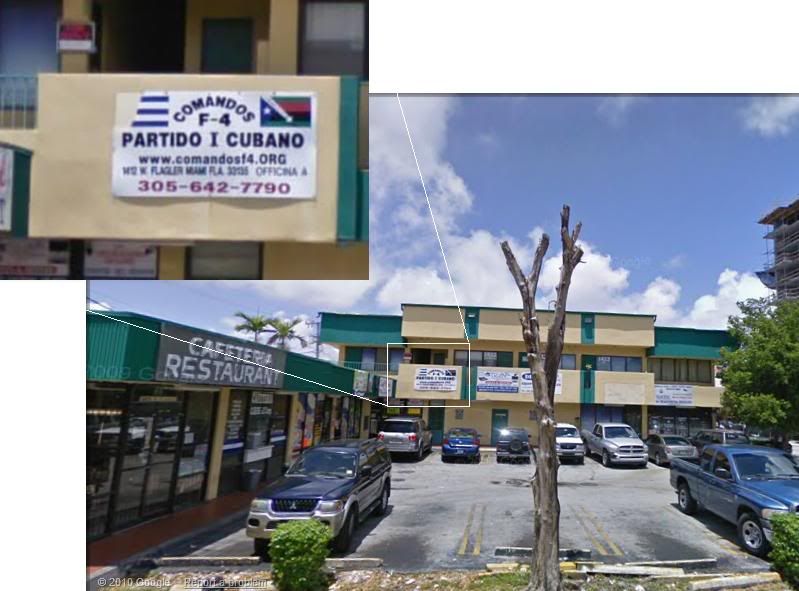
In the photo is Rodolfo Frometa (center, black beard), leader of the recently defunct group F4 Commandos (the website is down and the office has been put for rent). Frometa made it very clear to listeners of Radio Mambi that violence was necessary to bring change to Cuba. Frometa, of course, rarely appeared before any other media outlets in Miami because of the anticipated public rejection. Frometa, without the F4 Commandos, was last seen publicly among the marchers at last year's march supporting the (non-violent) Ladies in White in Little Havana.
Also, in the photo is Miguel Saavedra (center, red tie), leader of Vigilia Mambisa. Back in 2007, Saavedra and other members of Vigilia Mambisa physically attacked a small group of protesters in Little Havana after the small group held up a sign calling Luis Posada Carriles a terrorist. Saavedra is also a member of the militant group Unidad Cubana, and in 2009 was found to be an unpopular figure after a poll found a majority of Cubans (74%) in Miami opposed his protests.
Ernesto Diaz Rodriguez (center, blue shirt), secretary general of Alpha 66, also appears in the photo. Diaz was arrested in 1968 inside Cuba while attempting to "set up a base" and "infiltrate guerrillas." Diaz was released in 1991 after serving 22 years of a 40-year sentence. Alpha 66 long ago gave up its violent campaign, but now advocates the use of "sabotage" inside Cuba by dissidents. (I once heard him suggest on Radio Mambi the burning of Cuban government vehicles.)
Enrique Encinosa (front, dark glasses), also a strong defender of Posada's and news editor at Radio Mambi, was featured in a documentary defending the bombing campaign of Cuban hotels. Encinosa says: "I personally think its an acceptable method. Its a way of damaging the tourist economy. The message that one tries to get across is that Cuba is not a healthy place for tourists. So, if Cuba is not a healthy place for tourist because there's a few windows being blown out of hotels, that's fine."
The individuals and groups above represent a political idea which includes a strong disdain for the public. They don't care if you detest their use of force because for many years they have ignored the public and done as they pleased. Not just because of "la causa," but also because the public (or their representatives) never really tried to stop them. And, neither were any alternatives considered.
Subscribe to:
Posts (Atom)