Judge Jeri B. Cohen has decided that Rafael Izquierdo is a "non-offending" parent. The term seems to be most used in cases where child-abuse has been alleged, but where the parent is found innocent of such charges. According to a 2006 article [PDF] in the Michigan Bar Journal, non-offending parents in the US currently face difficult custody battles in our court system.
Judge Cohen has also determined that Izquierdo can regain custody of the child once a home study is completed, and provided that no court objects. But, there will be an objection.
Izquierdo's lawyer, Ira Kurban, told reporters today:
"We are grateful that justice has finally been done. We have said all along that the state of Florida never had a case against Rafael Izquierdo. This was always about the politics of the state of Florida versus Cuba and we are delighted that the judge has seen through all that and has made a just and fair decision.
"We believe that the decision requires that this child be returned to her father immediately. He's a non-offending father. The judge found that today. He is a fit father. The facts found that in this case and he deserves to have his child back. And we call upon the Cubas Family to give it up, to stop keeping a child that is not theirs. They are not family. They are not related to this child. And the appropriate action is to turn this child over to her natural father."
A Miami Herald poll shows that (as of 4pm), from 348 votes, 56% of readers think the child in dispute should return to Cuba with her father, and 44% percent believe the child should remain with the Cubas Family.

Showing posts with label Cuban Child Custody. Show all posts
Showing posts with label Cuban Child Custody. Show all posts
Thursday, September 27, 2007

Thursday, September 13, 2007
Change of Heart
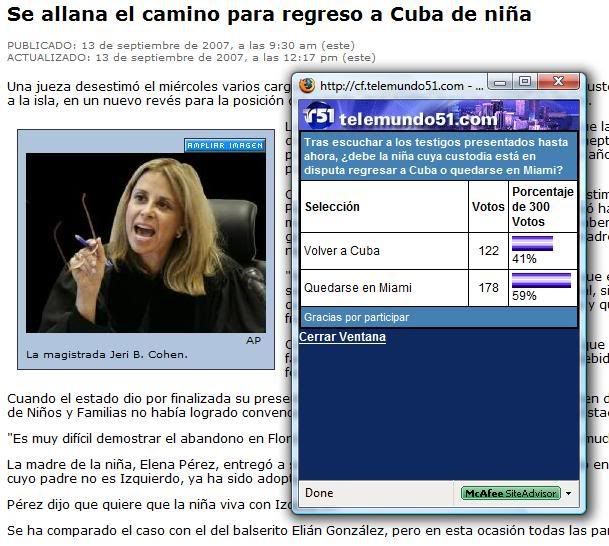
 Late last month I posted about the Cuban child custody case and its similarities with the Elian Gonzalez case. I also linked poll results from Telemundo51 viewers. At that time, about 56% of viewers were in favor of returning the child in question back to Cuba with her father.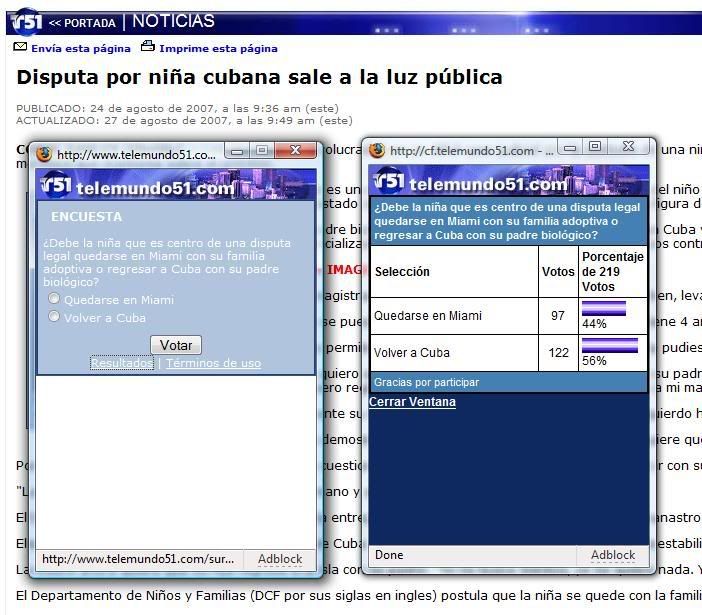
But, in a new Telemundo51 poll, viewers now think that the child should STAY here in Miami with her adoptive custodians. From 300 votes, 59% believe the girl should stay in Miami. This change of heart may be the result of the increased coverage this case is getting, revelations of lies and false evidence, and increased criticism of the lawyers involved.
Thursday, September 6, 2007
On Separation
The tales of young siblings being separated by the state are tragic. I myself have an older brother, and cannot imagine a world without him. That's why many, like Alan Mishael, argue that siblings have rights to be together (a "fundamental right to family integrity"), and shouldn't be easily separated. And I agree totally. But, the issue is complicated.
When Carol Marbin Miller reported about Alan Mishael and his fight to keep the siblings together, she also reported about DCF's past record in keeping siblings together through adoption. It wasn't a rosy picture.
"A 2001 audit found that, statewide, siblings in state care who were eligible for adoption were in the same home 67 percent of the time; in Miami-Dade the success rate was 43 percent... And a soon-to-be released report from the University of Chicago found that siblings in foster care often do not live together in the same home, and visitation among brothers and sisters 'is occurring infrequently' in Miami-Dade and Monroe, and 'not occurring regularly' in Broward. The report says brothers and sisters don't get opportunities to talk on the phone or communicate in other ways."
Articles describing the problem of separation cite various obstacles: lists of potential families that only want one child, families that don't have the resources to take in more than one child, or a sibling with special needs. No doubt, there are many other obstacles, but according to Lillian Johnson, welfare department director of 10 years, it's mainly due to the list of potential families.
"[T]he likelihood of finding a family that will take more than two children is so limited... Sometimes all [welfare departments] have are families that only want one child."
Additionally, according to a great 2000 Salon article by Nell Burnstein, "[t]he [national] number of children in foster care has ballooned to more than 500,000 while the number of foster home beds has shrunk. And new federal legislation -- the Adoption and Safe Families Act of 1997 (ASFA) -- has created pressure (and financial incentives) to get children into permanent homes as quickly as possible."
According to a 2005 Miami-Dade County report [PDF], the number of children in foster care has decreased from 5,911 in 2003 to 4,822 in 2005. Yet, a Miami Herald article last month (by Carol Marbin Miller) revealed that foster care is currently suffering from "serious flaws."
Through this tragedy of foster care, all measures should be taken to keep siblings together when they loose their parents, BEFORE one of them gets adopted (looking at you Joe Cubas). The benefits of keeping those bonds can have long-term positive impacts. Thus, there are means to preserving those bonds if they are eventually broken.
Maintaining the bonds of separated siblings can be done by simply arranging regular phone calls, letters or e-mail exchanges, or regular personal visits. Brian Samuels, former director of the Illinois Department of Children and Family Services believes that "[i]n most cases, maintaining sibling contact is essential to the growth and development of these children."
When Carol Marbin Miller reported about Alan Mishael and his fight to keep the siblings together, she also reported about DCF's past record in keeping siblings together through adoption. It wasn't a rosy picture.
"A 2001 audit found that, statewide, siblings in state care who were eligible for adoption were in the same home 67 percent of the time; in Miami-Dade the success rate was 43 percent... And a soon-to-be released report from the University of Chicago found that siblings in foster care often do not live together in the same home, and visitation among brothers and sisters 'is occurring infrequently' in Miami-Dade and Monroe, and 'not occurring regularly' in Broward. The report says brothers and sisters don't get opportunities to talk on the phone or communicate in other ways."
Articles describing the problem of separation cite various obstacles: lists of potential families that only want one child, families that don't have the resources to take in more than one child, or a sibling with special needs. No doubt, there are many other obstacles, but according to Lillian Johnson, welfare department director of 10 years, it's mainly due to the list of potential families.
"[T]he likelihood of finding a family that will take more than two children is so limited... Sometimes all [welfare departments] have are families that only want one child."
Additionally, according to a great 2000 Salon article by Nell Burnstein, "[t]he [national] number of children in foster care has ballooned to more than 500,000 while the number of foster home beds has shrunk. And new federal legislation -- the Adoption and Safe Families Act of 1997 (ASFA) -- has created pressure (and financial incentives) to get children into permanent homes as quickly as possible."
According to a 2005 Miami-Dade County report [PDF], the number of children in foster care has decreased from 5,911 in 2003 to 4,822 in 2005. Yet, a Miami Herald article last month (by Carol Marbin Miller) revealed that foster care is currently suffering from "serious flaws."
Through this tragedy of foster care, all measures should be taken to keep siblings together when they loose their parents, BEFORE one of them gets adopted (looking at you Joe Cubas). The benefits of keeping those bonds can have long-term positive impacts. Thus, there are means to preserving those bonds if they are eventually broken.
Maintaining the bonds of separated siblings can be done by simply arranging regular phone calls, letters or e-mail exchanges, or regular personal visits. Brian Samuels, former director of the Illinois Department of Children and Family Services believes that "[i]n most cases, maintaining sibling contact is essential to the growth and development of these children."
Wednesday, September 5, 2007
About Fathers [and Siblings] (Part 3)
 I've mentioned before about one of the controversial arguments that have been presented in the Cuban child custody case, but recently another has been posed.
Last Wednesday (August 29), Joe Cubas [in picture], current custodian of the 4-year old Cuban girl in dispute, appeared on the Jim DeFede radio show to present his side of the story. He mentioned his early efforts in trying to contact the legal father of the girl in Cuba, and how he respected the father's right as a parent. BUT, he also mentioned his respect for the rights of the girl's 13-year old half-brother [MP3]:
"First of all, I've said that I believe these children deserve to be together. And the reason I say that is because the same rights that Mr. Izquierdo has as a father are the same rights that her brother has as a brother."
"This is not only a sibling, this is also a parentified sibling. This has been the one person that has been constant in this child's life... who from the moment of her birth has acted not only as her older brother, but to a certain degree as her father."
The issues that Cubas raises about parentified siblings and the separation of siblings are very important (and have been discussed thoroughly), but I have never heard of the rights of parentified siblings being viewed as "the same" as a legal parent's until recently.
The phenomenon of parentification, where a child assumes a parental role when a legal parent (for various reasons) cannot, does seem to apply to the Cuban child custody case: the 13-year old brother very likely had to assume a larger role in the single-parent family after they arrived in the US, and may have thus achieved a very profound bond with her younger 4-year old sister, especially after the mental breakdown of the mother and the subsequent intervention by the state. But, how these facts lead to a legal claim to the younger sister, on par with the legal rights of the father, is beyond me. Though, attorney Alan Mishael does try to explain.
Alan Mishael, part of the legal team representing the Joe Cubas Family and the 13-year old half-brother, last month told the Miami Herald that ''[c]hildren have a constitutional right to remain with their siblings, unless the state presents a compelling reason for splitting them up." Mishael is referring to the 14th Amendment that specifically forbids laws denying "life, liberty or property" without due process. It's the same amendment that protects a parent's right to their children, unless they are determined to be unfit. But, I think Mishael is really stretching it thin because this particular argument for sibling rights has been defeated in the past, and very likely does not apply in this case.
Mishael's concern is understandable. He's on the board of directors of Florida's Children First, an organization that does very noble work representing childrens' concerns in the care of the state. His professional history is admirable and deserving of many other awards, but does he really want to go on a "collision course" with the rights of the father and brother? Whose interest does this really serve?
In the literature (and articles) concerning the separation of siblings (or parentified siblings), many strongly argue that actions should be taken very early to keep siblings together (during and after state care), especially if the bonds are strong. In the Cuban custody case, while the siblings do not have the same father, their separation could have been prevented if the state had denied any adoption until the parents of BOTH children had given up parental custody. But, instead (as if in a hurry), DCF carelessly gave custody rights to the Cubas Family knowing well that there was a father in Cuba.
It's a bit too convenient for Joe Cubas or DCF to now say that they want the siblings together, when it was they that caused the initial separation of the two. Arguments about the rights of siblings (or parentified siblings) should've been made when the children were still in state care, before the half-brother was adopted by Joe Cubas. According to Ira Kurzban, lawyer for the legal father (Rafael Izquierdo), "the [half-brother] no longer has the same legal rights, under Florida law, as other siblings. State law... terminates the bonds between siblings when one or more of them are adopted." There are similar laws in other states when siblings are separated through adoption.
Those who are making this case more complicated, are stretching the legal limits.
Tuesday, September 4, 2007
About Fathers (Part 2)
 Gordon E. Finley astutely points out one factor that may be influencing motivations in the Cuban child custody case. A recent and unrelated case involving the Florida Department of Children and Families (DCF) may provide some insight into another factor.
Late last month, a mother and father finally got a court victory after their children, ages 2 and 5, were wrongly taken away by DCF last year. According Jon Burstein of the Sun-Sentinel, a Broward county judge found "state [DCF] was negligent in failing to properly investigate two children's medical histories before accusing their mother of intentionally making them sick", despite the fact that "[t]he children had detailed medical records from California, where the family had lived, and the family's doctors gave sworn statements rejecting the abuse allegations."
The DCF abuse allegations in court (based on the theory of Munchausen syndrome by proxy) dragged on for 6 months! The children ended up in shelter care for at least 77 days where they were not allowed to see their parents. Now, with a victory over DCF, the parents, Donald and Sara Evans, plan to sue three DCF officials in federal court for taking away their children. According to one of the Evans' lawyers, "[t]he family now lives in a constant state of paranoia, fearing they could be separated at any time."
The motivations by DCF in the Evans case are puzzling. One advocate (Lary Holland) believes that DCF (like other state departments of human services) are motivated by federal grants to separate families. This argument follows that "a relationship exists between the federal funding of state welfare programs and the determinations made by state family court judges presiding over child-custody and domestic relations matters." Specifically, federal grants under Title IV of the Social Security Act operates as the "external economic factors that... drive judicial discretion and influence professional judgment in domestic relations matters" in state cases. Holland's personal experience, being declared an "absent parent" by the state of Michigan, has made him lose full custody of his two children. He is now an advocate for equal custody rights for parents, part of a growing movement in the United States for separated families.
If DCF is found to be negligent in the Cuban child custody case, aside from the trauma already produced by the case, there may very well be lawsuits ahead, with additional personal impacts on BOTH families in the dispute. This reality must be weighed by DCF (and most likely it is) before it continues to drag the case any further with its controversial arguments. Still, the Evans Family case presents a foreboding scenario.
[Photo by Lary Holland]
About Fathers (Part 1)
 Yesterday, the Miami Herald published letters regarding the controversial Cuban child custody case. Its a mixed bag of opinions from the Herald's readership, but I noticed one letter that provided some interesting insight.
The letter comes from Gordon E. Finley. Some readers might recognize the name because Gordon E. Finley is also the name of a respected psychologist who has worked extensively on the subject of relationships between father and child, and has a Ph.D. from Harvard and now teaches at FIU.
It is very likely that the letter published yesterday comes from Dr. Finley, and he raised an interesting point: "The reality is that were the gender of the two parents in this international custody dispute reversed, the Cuban mother would have been on a plane to Havana with her daughter within hours of the girl's circumstances coming to light."
He may be a little too confident in his remark, but I believe that our stereotypes of gender has been a crucial factor in this case, as was in the Elian Gonzalez case. Dr. Finley's beliefs come from his extensive research in divorce cases, where he notes that the court system "awards either sole custody or primary residential parental responsibility to the mother around 85 percent to 90 percent of the time." Finley also points out that a father's loss of child custody can have severe effects on the father's life, such as "substantially higher [compared to divorced mothers who lose custody] rates of: suicide, depression, alcohol abuse, drug abuse, poor health, work problems, relationship problems, and social isolation." These facts may point out our social bias towards always supporting the "nurturing mother" in custody cases.
Finley, without question, is a strong advocate for equal gender/parental rights, and rightly points out gender bias on other issues, but he's most concerned about what he calls "the silent epidemic of the demise of fathers from the lives of our children." According to Finley's own research based on children of divorce, interviews showed that these individuals (looking back) felt they had lost "intangible assets" after divorce, such as "the 'being there' assets of affection, emotional connection, and companionship with their fathers."
While I disagree with Finley's general assumptions about what lies behind our gender stereotypes, I think his findings are important points to consider in the Cuban child custody case. The weak allegations being made against the Cuban father, Rafael Izquierdo, by the Florida Department of Children and Families may be based on these negative biases that society generally has on fathers in custody disputes. There is still no evidence indicating that Izquierdo is an unfit father.
This fact may explain why DCF and lawyers for Joe Cubas have so far provided radical arguments in court to deny Izquierdo custody of his 4-year old daughter.
Monday, August 27, 2007
Elian Redux
 It's disappointing to see this case, of the four-year old girl, going down the same troubled path of the 1999-2000 Elian Gonzalez case.
This evening (Aug. 27), the Spanish TV program Polos Opuestos had on two attorneys discussing this new case. One of the guest was Isabel Bombino, and the other was Jose Garcia-Pedrosa. You might remember Garcia-Pedrosa because he was one of the many attorneys that fought for Elian Gonzalez to stay in the US in 2000, contrary to the biological father's wishes and federal rulings.
Now, it seems (but I'm not certain) that Garcia-Pedrosa works for the legal team trying to keep this four-year old girl in the US, again contrary to the wishes of the biological father and legal standards.
On Polos Opuestos, Garcia Pedrosa repeated one of the same failed arguments used in 2000 to keep Elian Gonzalez away from his father: that the child's separation from his current place of custody would be severely traumatic to bear and constituted abuse.
According to AP's Laura Wides-Munoz, the presiding Judge, Jeri Cohen, today was shocked at such an argument saying: "What you're trying to do is say that if a father wants to remove his child from placement....that if a father does that or a mother, that constitutes prospective abuse?... I have never seen anything like this in all of my years of doing dependency [hearings]."
The other guest, Isabel Bombino, also thought the argument was weak, but instead believed that arguing the father had abandoned his child had a better chance. According to this argument, the biological father should have known that the mother, who lost child custody in the US, was unfit to care for her daughter and thus "failed to protect" the child when he allowed her to leave for the US. Wides-Munoz reports that this argument allowed the case to move forward for tomorrow, but "[Judge Cohen] warned state officials, however, that their evidence seems flimsy." According to video by CBS4 news, before she heard the abandonment argument, Judge Cohen tells state officials: "I'm ready to dismiss it, convince me not to."
Some details about this argument are in the Wides-Munoz article, and there are similarities with the Elian Gonzalez case too. In 2000, Elian's father was also accused of being unfit, and abandoning his child when he earlier separated with Elian's biological mother.
Columnist Michelle Malkin, in 2000, pointed out how Garcia-Pedrosa was insinuating that Elian's father was abusive by suggesting the need for "psychological experts to do what we do anytime a child in this country makes allegations of sexual molestation, child abuse or any kind of misconduct by an adult." Malkin called it a "defamatory charge," and describe the tactic as the "dirtiest card."
According to Jeffrey M. Leving, child custody expert, "[t]his is a very simple case in juvenile court... If the father's attorney cooperates and continues with the visitation between the dad and the child, the father will end up getting custody." Leving suggests keeping the case at a "low profile" and "under the radar."
It's important to note that the Elian Gonzalez case was also a simple immigration case that blew up into a custody case, which it wasn't. Allowing attorneys to present failed arguments on television, like Polos Opuestos allowed, will certainly create another public circus to surround this case, and obviate from its simple legal procedure.
According to a poll conducted this evening by Telelmundo51 (whose results were revealed in the 11pm news), 44% of voters thought the four-year old girl should stay in Miami, while 56% thought she should return to Cuba with her father. More than 200 voters participated. Here's a screen shot by 11:30pm.
The only obstacle in this case seems to be the fact that old and failed arguments have been resurrected from 2000. Garcia-Pedrosa, on Polos Opuestos, again attempted to make this a political issue, where the Cuban government has ultimate custody of Cuban children. A similar argument from January 2000, saying: "that the irony of this situation is that the custody of the father has been taken over by the Cuban government... So the nature of the consent or the nature of the wishes of the father is very much an issue until what is in Cuba a highly ideological totalitarian rigid state."
Hopefully, Garcia-Pedrosa has abandoned his 2000 position when he said: "The boy will not be surrendered, period... They either have to take him by force, which would be scandalous, or they have to go to federal court, which is what they should do."
A child's options should not include such faulty, limited and drastic alternatives.
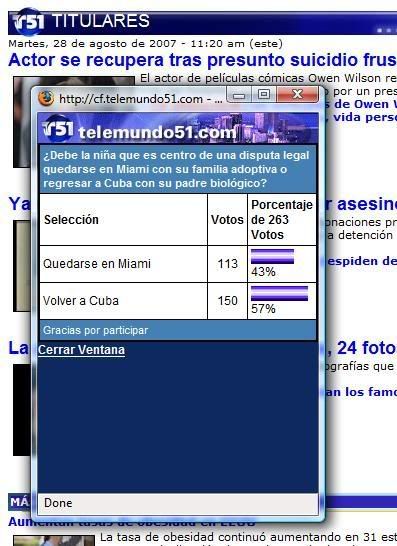
[Update - Aug. 28: Latest Telemundo51 poll results show increased support for the girl to go back to Cuba with her father, 57%.]
Subscribe to:
Posts (Atom)