Saturday, February 27, 2010

Perspectives


Above is a video that captures five interesting perspectives of Cuban-Americans in South Florida, and their reasons for not returning to Cuba. The video is directed by Jono Fisher, a professional photographer and video producer with family in South Florida, and recently intrigued with the idea of Cuban culture and the diaspora.

The video seems to be the beginning of a very promising project.

Wednesday, February 24, 2010

Second or Twelfth? [Updated]

A recent news release from the Cuba Archive, an online database that "records" human rights violation cases in Cuba, states that they have "documented eleven other cases of death by hunger strike in protest of prison conditions under the Castro regime."

The statement is at odds with several other news reports indicating that the death of Orlando Zapata Tamayo was only the second death of a political prisoner in Cuba due to a hunger strike. The first recognized as the death of Pedro Luis Boitel, dissident who died in Castillo del Principe prison in 1972. Even Elizardo Sanchez, dissident inside Cuba who keeps records of all political prisoners, says that Zapata Tamayo is only the second death of this type.

So I reviewed some of the files from the Cuba Archive. And I found poor or conflicting data.

- Miguel Lopez Santos' cause of death is recorded as "hunger strike" in the Cuba Archive database. The date of death is recorded as April 2001. The only source comes from a June 2001 article by the Center for a Free Cuba. Miguel Lopez Santos is also the name of a Cuban dissident that went on a hunger strike in April 2001 [source: U.S. 2001 report], but he didn't die. He was soon released from prison, but arrested again in May 2001 for "social dangerousness" [source: Directorio Democratico Cubano, PDF]. The name Miguel Lopez Santos continues to appear in recent reports as an active dissident inside Cuba.

- Nicolas Gonzalez Regueiro's cause of death is also recorded as "hunger strike" by the Cuba Archive database. The date of death was September 16, 1992. There are more sources in this case, but they conflict. One important conflict of data comes from the Inter-American Commission on Human Rights which reported that Gonzalez Regueiro "died by hanging on September 16, 1992" [source: IACHR, 1992-93 report].

- And, the case of Santiago de Jesus Roche Valle, recorded as death due to "hunger strike" in 1985, also contains several conflicting sources in the Cuba Archive database.

The Cuba Archive should have warned everyone in their news release about the credibility of their "records." Only until you get to read the "Terms of Use" on their website does one begin to understand how reliable the Cuba Archive really is:

"Cuba Archive provides access to the information as a service to the users and does not take responsibility for such content. It cannot guarantee that any or all details contained in any case record or any of its other reports are true, accurate, or reliable... It is expected that users use caution and common sense and exercise proper judgment when using the material reported by Cuba Archive. Users acknowledge that any reliance on material posted via this website will be at their own risk."

Readers should always be cautious with reports about Cuban dissidents and prisoners. Confirmation of these sources neutralizes attempts to exaggerate and play politics with the victim.

[Update: Ninoska Perez-Castellon, radio host on Radio Mambi, today corrected the Cuba Archive list and said that Miguel Lopez Santos is still alive. The Cuba Archive has now erased that case file. Somebody is reading Mambi Watch.]

Tuesday, February 23, 2010

Orlando Zapata Tamayo (1967-2010)

Today's Detour

There's a wonderful post by Tracy Eaton from Along the Malecon. It expands on a recent article by Juan O. Tamayo for El Nuevo Herald which reviews two books on the difficulties reporting inside Cuba. The Tamayo article is the typical negative story about Cuba, and not surprisingly recently used by Radio Mambi as part of their propaganda.

But, Eaton's post provides an important dimension which Juan O. Tomayo neglected to report:

"I've heard some say that if they had the chance to run a news bureau in Cuba, they'd write about nothing but human rights abuses and prison conditions until the Cuban government kicked them out. Then they'd make a heroic exit...

"But I wanted to write about Cuba over the long haul. I wanted to maintain relationships with Cubans of all political persuasions, from government officials and press spokesmen to activists who don't agree with the government. I also wanted to stay in touch with those who have had enough of the Castro brothers, including U.S. officials, diplomats and some Cuban-American activists...

"Cuba is a complicated place. I know that we journalists only cover a tiny fraction of what goes on. We skim the surface. We write about the people who have the most extreme views, but fail to talk to those in the middle. We write about blacks and whites, not the subtle tones of gray."

Full post here.

Thursday, February 18, 2010

Dia del Exilio Cubano [Updated]

This morning Miami-Dade County Commissioner Rebeca Sosa will propose before the board a resolution [PDF] designating February 24th as "International Cuban Exile Day."

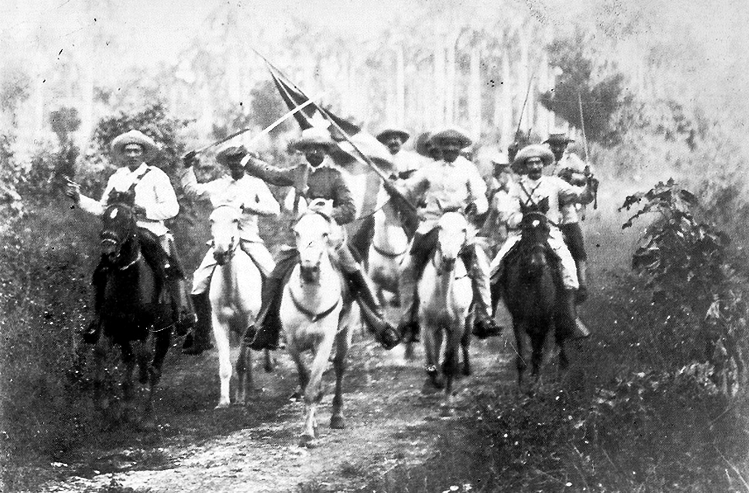
The idea for "Dia del Exilio Cubano" (which I translate as "Cuban exile community day") was conceived by the militant organization La Junta Patriotica Cubana (Cuban Patriotic Council) last month. The significance of February 24th is based on the day that the Cuban War of Independence (1895-98) began, which included Jose Marti as one of its leaders.

Coincidentally, a radio marathon begins today to collect funds for Luis Posada Carriles' trial beginning in El Paso, Texas next month. (According to Radio Mambi, the fund-raising was organized by Amadeo Lopez Castro, President of Intercontinental Bank in Miami.) Radio Mambi (WAQI 710 AM) and La Poderosa (WWFE 670AM) are providing listeners with a phone number to call (number is posted on the Univision/Radio Mambi website [screenshot]), and locations where listeners can go to leave checks and money orders. Locations include the Versailles Restaurant in Little Havana, the WWFE radio station, and Nuevos Horizontes, the Hialeah lodge of the Federation of Cuban Exile Masons.

This morning on Radio Mambi, Armando Perez-Roura talked about how Luis Posada Carriles is symbolic of the Cuban exile: his character of sacrifice to wage a cosmic battle against communism, only to be betrayed in the end by the rest of the world.

But, aside from praising the exploits of Posada, Perez-Roura also admires the life of being in perpetual conflict. He felt compelled this morning to quote Jose Marti saying:

"A sad thing it is to not have friends, but even sadder must it be not having any enemies; that a man should have no enemies is a sign that he has no talent to outshine others, nor character that inspires, nor valor that is feared, nor honor to be rumored, nor goods to be coveted, nor anything to be envied."

Meaning that if you have critics, then maybe you are doing something right. But, this also sounds like self-deception or making false attributions over one's own character.

[Update: The Miami-Dade Board of County Commissioners voted unanimously approving "Dia del Exilio Cubano" for February 24th, according to a report from Radio Mambi.]

[Photo of Cuban Mambises that fought the Spanish during the Cuban Wars of Independence]

[Along the Malecon has regular updates on the trial of Luis Posada Carriles]

Friday, February 12, 2010

Portuondo Show Cancelled [Updated]

The scheduled concert by Cuban singer Omara Portuondo for next month in Miami Beach has been cancelled.

The renowned Cuban singer, who won a Grammy Latin Award last November, was scheduled to perform at the Fillmore/Jackie Gleason Theater in Miami Beach on March 2nd. Yesterday, the blog Villa Granadillo announced (and celebrated) that they had received word from the City of Miami Beach that the show was canceled. The ticket website LiveNation also indicates that the show has been canceled.

There are no other details yet on the reasons for the cancellation. Portuondo has three other shows scheduled for this month in Washington D.C., Boston and New York.

Portuondo received harsh criticism last December when she performed at the closing ceremony of the ALBA Summit in Havana, Cuba.

[Update: Erik Maza from the Miami New Times blog confirms that the show was canceled due to slow ticket sales. The article includes the absurd reactions by some Cuban exile militants.]

[Video of Omara Portuondo being interrogated over her ALBA performance by local Spanish-language news AmeraTeVe as she arrives in Miami.]

[Photo by Reuters: Portuondo receives a Latin Grammy last November for Best Contemporary Tropical Album.]

Thursday, February 11, 2010

Irrational

So why did Rep. Lincoln Diaz-Balart decide to finally end his political career in Florida's 21st Congressional District? I have yet to hear a rational answer.

This evening Rep. Ileana Ros-Lehtinen was very busy, appearing on Radio Mambi's "Mesa Redonda" for two hours, and then appearing for an interview with Maria Elvira Salazar which aired at 8pm. Later, by 9pm, she reappeared on Radio Mambi with Marta Flores. She spoke about Rep. Diaz-Balart's announcement today, but failed to give a clear answer as to why Lincoln was leaving. Instead, her goal seemed to be to reassure everyone that support for U.S. policy towards Cuba was still secure in Congress.

Also on tonight's broadcast with Maria Elvira Salazar was Rep. Mario Diaz-Balart (who will now run for Lincoln's seat), and Ana Carbonell, Lincoln's long-time Chief of Staff. Despite the host's attempts to probe for an answer, none gave in. All just repeated what Lincoln had announced earlier today: Lincoln decided that he would better serve the mission (or "la lucha") for a free Cuba as a private citizen. This explanation seems straightforward, but raises many questions.

It seems to imply that Rep. Lincoln Diaz-Balart felt he could no longer achieve anything more towards a free Cuba in Congress. (Could anymore be done after Helms-Burton?) It also implies then that Lincoln's ultimate goal in Congress was to influence U.S.-Cuba policy, while serving the other interests of his constituents was secondary, or not worth representing anymore.

Also, Lincoln could've stayed in Congress to achieve important positions like Rep. Ileana Ros-Lehtinen who has been serving in Congress for over 20 years and now expected to become chairman of the House Committee on Foreign Affairs. Lincoln was certainly in a safe Republican district, so why decide to leave it when he could have achieved more in Congress?

I think he did it for his brother Mario.

Rep. Mario Diaz-Balart is not in a safe Congressional district (FL-25). Since his first race in 2002, Mario's winning percentages have progressively decreased: 65% in 2002, 58% in 2006, and 53% in 2008 [source]. It was a dangerous trend. So, I figure that Lincoln sacrificed himself for his brother Mario, since the 21st district is much safer.

But, this is not a rational answer. It risks too much because Rep. Mario Diaz-Balart could still lose the district. An online poll by Telemundo51 today indicates that Mario is not favored as a replacement for Lincoln, 68% voting for "another candidate."

And, is Lincoln in a better position as a lobbyist, possibly working with the U.S. Cuba Democracy PAC? Lincoln is a firebrand, not really someone to work behind the scenes I think.

So far it all seems irrational. But, time will tell.

[Rep. Lincoln Diaz-Balart says he will continue working on a project called "The White Rose." It is a project started 50 years ago by his father, and outlines a comprehensive transition process for a free Cuba. It can be viewed here in Spanish.]